
Every week, I get calls from homeowners asking some version of the same question: ‘My driveway is looking rough, is it time to replace it, or can we save it?’ After more than 20 years installing and repairing concrete driveways across New York, I’ve seen driveways that were crumbling at 12 years and driveways still holding strong at 40. The difference almost always comes down to the same handful of factors.
So how long does a concrete driveway last? The honest answer: anywhere from 25 to 50 years, sometimes longer. But that range tells you very little unless you understand what pushes a driveway toward the short end or the long end of that spectrum.
In this guide, I’m going to walk you through what really determines concrete driveway lifespan, what warning signs to watch for, how to get the most years out of what you’ve got, and how to know when it’s time to stop patching and start fresh.
How Long Does a Concrete Driveway Last?
A well-built residential concrete driveway, properly maintained, should last 30 to 40 years. That’s the realistic sweet spot for most New York homeowners. Under ideal conditions, with a quality installation, minimal freeze-thaw stress, and routine sealing, 50 years is achievable. Under poor conditions, you might be looking at a replacement in 15 to 20 years.
The biggest variable isn’t the concrete itself. It’s everything surrounding the concrete: how it was poured, what it was poured on, how much punishment it takes from weather and vehicles, and whether the homeowner bothered to maintain it.
| Driveway Condition | Expected Lifespan |
| Professionally installed, well-maintained, and sealed regularly | 35–50 years |
| Professionally installed, minimal maintenance | 25–35 years |
| DIY or poor-quality installation, some maintenance | 15–25 years |
| Poor installation, no maintenance, heavy traffic | 10–15 years |
| Already showing major cracks, spalling, or drainage issues | 5–10 years (if not addressed) |
I’ve replaced driveways at the 15-year mark that were in worse shape than driveways I’ve inspected at 35 years old. Age is just a number; condition is what matters.
What Affects the Lifespan of a Concrete Driveway?
Six main things determine how long your driveway will last. Some you can control going forward. Some you’re already locked into.
1. Installation Quality

This is the single biggest factor, and it’s one most homeowners never think about until problems show up years later. Concrete driveway durability starts with the mix design, the subbase preparation, and the finishing work.
A subbase that wasn’t compacted properly will shift. Concrete that was poured too thin (less than 4 inches for residential) will crack under load. If water isn’t cured out correctly, the surface will scale prematurely. I’ve repaired driveways that were done cheaply by whoever gave the lowest bid, and in almost every case, the problems were baked in from day one.
2. Climate and Weather

New York is hard on concrete. We get cold winters, spring thaws, summer heat, and enough rain to cause serious drainage headaches. Each freeze-thaw cycle, when water gets into cracks or the subbase, freezes, expands, and thaws, is a small attack on your driveway’s structure. Do that enough times over enough years, and you’ll see cracking and heaving.
The freeze-thaw issue is why we’re big on sealing driveways here. A properly sealed driveway keeps water from penetrating the surface, which dramatically slows down freeze-thaw damage.
3. Soil Conditions
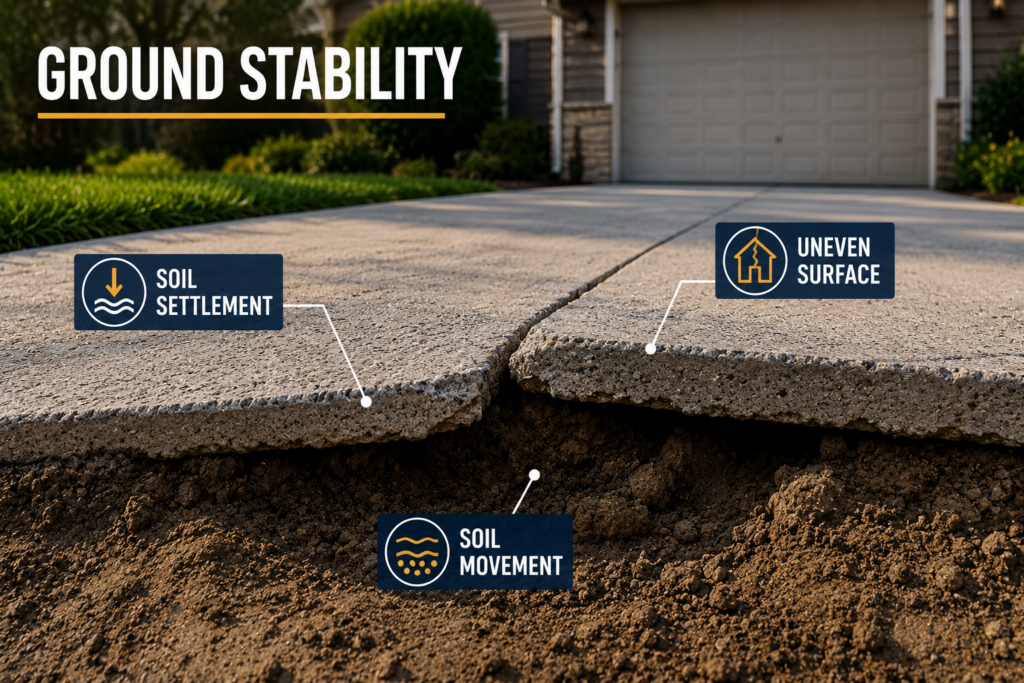
Clay-heavy soil shifts more than sandy or gravelly soil. Expansive soils push up from below, especially during wet seasons. I’ve replaced sections of driveways in parts of Long Island and Westchester where the soil movement was severe enough to crack concrete that was only 8 years old. If your house sits on problematic soil, you need a contractor who accounts for that upfront with proper drainage and subbase preparation.
4. Vehicle Traffic
A standard residential concrete driveway is built for passenger vehicles. If you’re regularly parking delivery trucks, RVs, or heavy equipment on a residential pour, you’re exceeding what it was designed to handle. I’ve seen driveways crack in specific spots that always had the same dump truck parked on them during a renovation project. Weight distribution matters.
5. Maintenance Habits
The homeowners with the longest-lasting driveways are the ones who seal on schedule, fill small cracks before they become big ones, and keep an eye on drainage. It sounds simple because it is simple. Neglect leads to deterioration. Maintenance leads to longevity.
Signs Your Concrete Driveway Is Aging
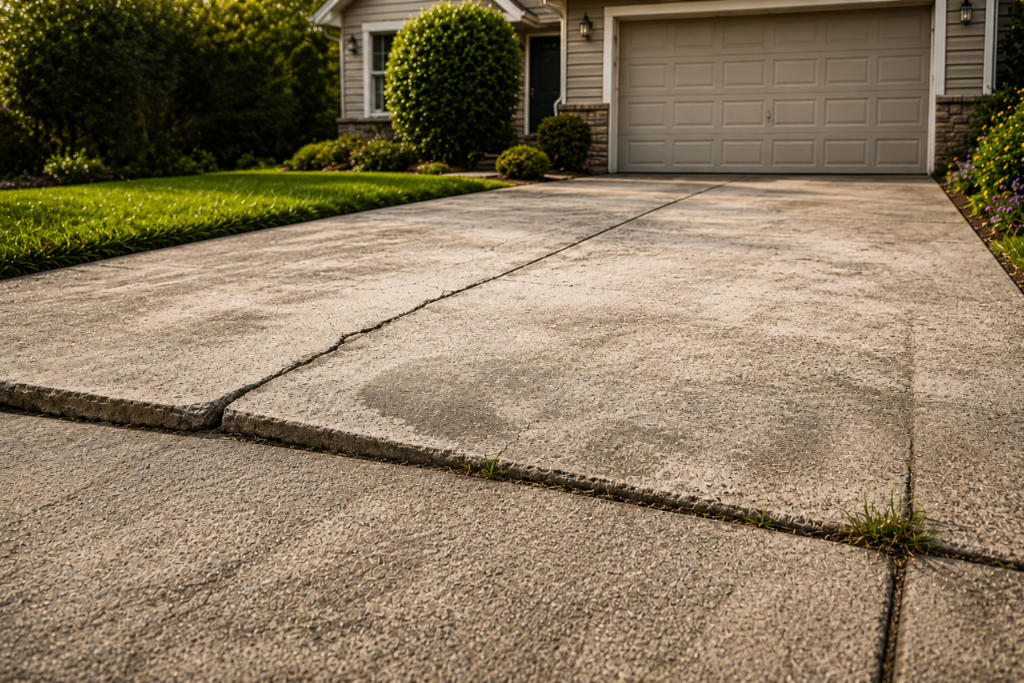
Most homeowners don’t notice driveway problems until they’re fairly serious. Here’s what to look for when you walk out to your car:
Surface Cracks
Hairline cracks are common and not necessarily alarming. They develop as concrete cures and settle. But cracks wider than a quarter inch, cracks that run in multiple directions, or cracks that have started to shift vertically (where one side is higher than the other) are signs of deeper structural movement. Left alone, they become channels for water, and then freeze-thaw damage accelerates rapidly.
Scaling
Scaling looks like the surface of the concrete is flaking or peeling away in thin layers. You’ll notice it first where you applied rock salt or calcium chloride de-icers. It can also happen when concrete is poured in cold weather without proper curing protection. Once scaling starts, it rarely stops on its own.
Spalling
Spalling is more severe than scaling; you’re seeing chunks of concrete breaking off rather than surface flaking. This usually means water has gotten deep into the slab, frozen, expanded, and broken pieces have become loose from the inside. Significant spalling typically means the driveway is approaching the end of its serviceable life.
Drainage Problems
If water is pooling on your driveway after rain instead of running off the edges, something has changed: either the concrete has settled unevenly, or it was graded incorrectly from the start. Standing water accelerates surface deterioration and eventually undermines the subbase.
Uneven or Sunken Sections
If part of your driveway has started to sink or tilt, the subbase beneath it has shifted or eroded. This is a trip hazard, and it’s not something a surface patch fixes. It usually requires either mudjacking (pumping grout underneath to lift the slab) or slab replacement.
Step-by-Step Guide to Extending the Life of Your Concrete Driveway
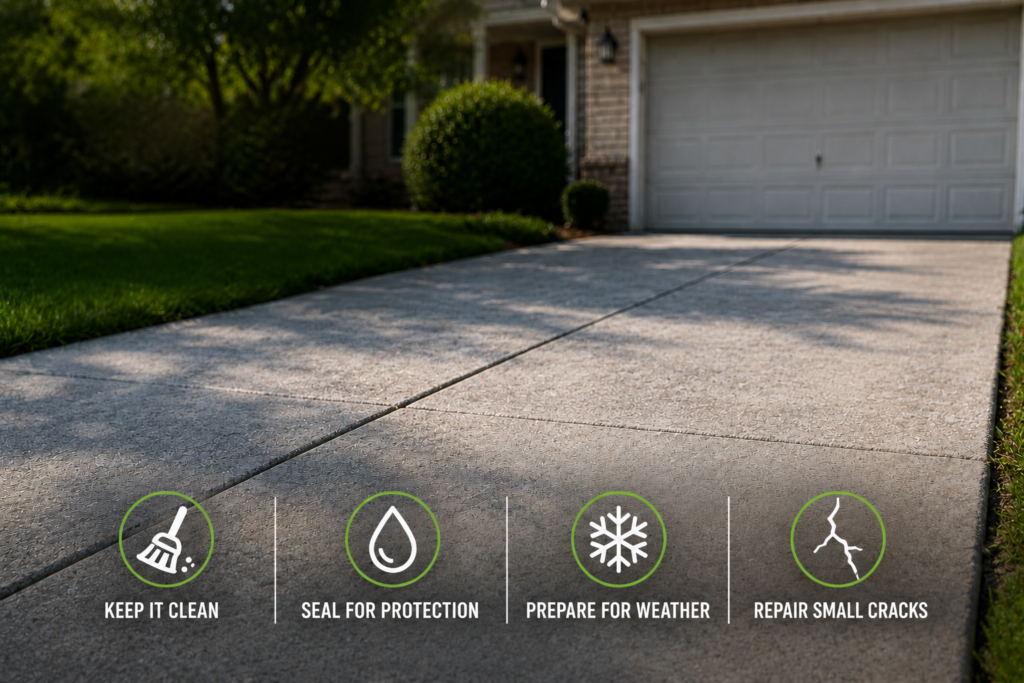
The good news: most of what kills driveways prematurely is preventable. Here’s what I tell every homeowner who wants to get maximum life out of their investment.
Step 1: Clean Regularly
Rinse your driveway down a few times a year. Remove oil stains promptly; motor oil degrades concrete if left to sit. A pressure washer works well for deep cleaning, but don’t use so much pressure that you’re etching the surface. Twice a year is sufficient for most properties.
Step 2: Seal When Needed
Plan on sealing your concrete driveway every 2 to 5 years. New driveways should be sealed about 30 days after installation. The right sealer creates a protective barrier against water infiltration, UV damage, and freeze-thaw cycles. Don’t over-seal; applying too many coats too frequently traps moisture and can actually cause problems. When the surface starts to look dull and porous, it’s time.
Step 3: Repair Small Cracks Early
A hairline crack is a quick, inexpensive fix. That same crack left for two winters is a structural problem. Use a quality polyurethane or epoxy crack filler for cracks up to half an inch wide. Anything wider than that, or cracks with vertical displacement, should be looked at by a professional before you decide how to address them.
Step 4: Improve Drainage
Make sure water drains away from your driveway, not under it. If you have downspouts directing roof water onto the driveway surface, reroute them. If the grade around your driveway is causing water to pool, a simple swale or drain can make a significant difference in long-term performance.
Step 5: Avoid Excessive Weight Loads
Remind your contractors and delivery drivers not to park heavy vehicles on residential concrete. If you know a big delivery is coming, put down temporary plywood to distribute the load. It’s a small inconvenience that can prevent a costly repair.
Step 6: Schedule Periodic Inspections
Have a concrete contractor take a look at your driveway every 5 to 7 years, or any time you notice something new, a new crack, a sunken section, or water pooling in a place it didn’t before. Catching problems early is almost always cheaper than dealing with them after they’ve progressed.
Expert Insight
“In my experience, the thing that separates a 20-year driveway from a 40-year driveway almost always comes back to the subbase. If it wasn’t compacted correctly, if the drainage wasn’t accounted for, if someone tried to save money on gravel depth, you’re going to pay for it eventually. The concrete on top is only as stable as what’s underneath it.”
Mike R., Licensed Concrete Contractor, New York (20+ years of experience)
When Should You Repair vs Replace a Concrete Driveway?
This is the question homeowners wrestle with most. Here’s how I think about it when I’m doing a driveway assessment:
| Condition | Repair Recommended | Replacement Recommended |
| Hairline or narrow cracks (under 1/4 inch) | Yes fill promptly | No |
| Surface scaling on less than 25% of the driveway | Yes, resurfacing may work | No |
| One or two sunken sections with good surrounding concrete | Yes, mudjacking or section replacement | No |
| Cracks wider than 1/2 inch across large areas | Partial repair only | Yes, if widespread |
| Significant spalling throughout | No surface patching won’t hold | Yes |
| Multiple areas of vertical displacement | No | Yes |
| Driveway under 20 years old with isolated damage | Yes | No |
| Driveway over 30 years old with widespread issues | Consider costs carefully | Usually yes |
| Drainage issues undermining the subbase | Drainage fix + section repair | If damage is extensive |
| Alligator cracking across the surface | No structural failure | Yes |
One rule of thumb I use: if repairs would cost more than 50% of the replacement cost, and the driveway is more than 20 years old, replacement usually makes more financial sense over the long run. Patching a driveway that’s structurally failing just delays an inevitable expense while spending money on repairs that won’t hold.
How Much Does a Driveway Replacement Cost in New York?
Concrete driveway replacement in New York typically runs between $8 and $18 per square foot installed, depending on several factors. For a standard two-car driveway (roughly 400 to 600 square feet), you’re generally looking at $4,000 to $10,000 for a straightforward replacement.
What affects that range:
• Size and shape: Simple rectangular driveways cost less per square foot than complex layouts with curves or multiple sections
• Removal and disposal of existing concrete. Demolition and hauling add $1 to $3 per square foot
• Subbase work If the existing base needs to be excavated and rebuilt, that’s an additional cost
• Thickness Standard residential is 4 inches; upgrading to 5 or 6 inches for heavy vehicles adds cost but adds life
• Finishing options: Broom finish is standard; exposed aggregate, stamped concrete, or decorative borders increase cost
• Drainage improvements: Adding drain channels or regrading during replacement is cost-effective when bundled together
• Permitting: New York City and many surrounding jurisdictions require permits for driveway work; factor this into your budget
One piece of advice: don’t get quotes from only one contractor. Prices in New York vary significantly. And be wary of quotes that seem dramatically lower than others; ask specifically about concrete thickness, subbase depth, and what’s included in removal.
Frequently Asked Questions
How long does a concrete driveway last?
A properly installed and maintained concrete driveway typically lasts 30 to 40 years. With excellent installation quality and consistent maintenance, 50 years is possible. Poor installation or neglected maintenance can shorten that to 15 to 20 years.
Can a concrete driveway last 50 years?
Yes, but it requires several things to align: quality installation with proper subbase preparation, regular sealing every 2 to 5 years, prompt crack repair, good drainage management, and avoidance of harsh de-icing chemicals. I’ve inspected driveways in New York approaching or exceeding 50 years that were still functional. They’re not common, but they exist.
How often should a driveway be sealed?
Every 2 to 5 years for concrete, depending on exposure and condition. New concrete should be sealed about 30 days after installation. Don’t seal too frequently; over-sealing traps moisture and can cause its own problems. When the surface looks dull and water no longer beads on it, it’s time to reseal.
What causes driveways to crack?
The most common causes are freeze-thaw cycles (water infiltrating and expanding as it freezes), subbase settlement or erosion, excessive vehicle weight, tree root intrusion, and thermal expansion and contraction over time. Driveway cracks that are isolated and narrow are normal. Widespread or displaced cracking indicates structural problems.
Is it better to repair or replace an old driveway?
It depends on the extent and type of damage, and the driveway’s age. Surface cracks, minor scaling, and isolated sunken sections can often be repaired cost-effectively. Widespread spalling, alligator cracking, or significant subbase failure usually means replacement makes more sense. A good rule: if repair costs exceed 50% of replacement cost and the driveway is over 20 years old, start planning for replacement.
In Summary
Concrete driveway lifespan comes down to three things: how well it was built, how New York’s weather treats it, and how consistently you maintain it. A driveway that was installed correctly and gets even basic attention, periodic sealing, crack repairs, and drainage management will outlast one that was installed carelessly or ignored for years, no matter how similar they look today.
If your driveway is showing signs of aging, the first step is an honest assessment. Small problems are almost always cheaper to fix early than to let compound. And if you’re at the point where replacement makes more sense than repair, choosing a quality installation now is an investment that will pay off over the next 30 to 40 years.
Don’t wait until a small crack becomes a big problem. The best time to take care of your driveway is before it needs serious work.
Get a Free Driveway Inspection
Not sure where your driveway stands? We offer free on-site driveway inspections throughout New York. One of our experienced concrete contractors will take a look, give you an honest assessment of what you’re dealing with, and walk you through your options, whether that’s a simple seal and crack repair or a full driveway replacement estimate.
Call us today or fill out our contact form to schedule your inspection. No pressure, no sales pitch, just a straight answer from someone who’s been doing this for over 20 years.