Take a walk down almost any block in the outer boroughs, or drive through a suburban neighborhood on Long Island or up in Westchester, and you’ll see it: driveways with a grayish, blotchy look, patios with hairline cracks running through them, sidewalks that have gone rough and pitted after years of shoveling and salt. In most cases, none of that concrete is actually falling apart. It’s just tired.
That’s usually when the question comes up. Does this need to be torn out and replaced, or is there a way to fix the surface without the mess and expense of demolition? Often, the answer is concrete resurfacing.
This guide walks through what resurfacing actually is, how it holds up against New York winters, when it makes sense, and when it doesn’t.
What Is Concrete Resurfacing?
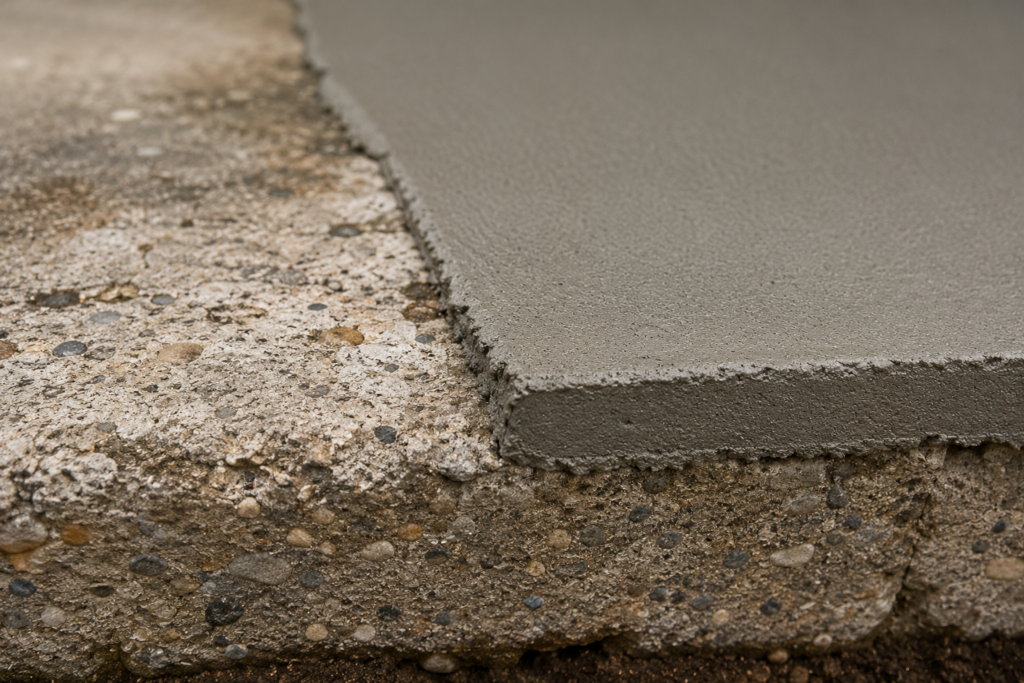
Concrete resurfacing is the process of applying a new, thin layer of cement-based material over an existing concrete slab that’s still structurally sound but showing wear on the surface. Instead of breaking out the old slab and pouring a brand-new one, the contractor cleans and repairs what’s already there, then bonds a fresh overlay on top of it.
It’s not paint. A painted or stained surface sits on top of the concrete without bonding into it structurally, and it wears off quickly under foot traffic, car tires, and New York weather. A resurfacing overlay, on the other hand, is designed to chemically and mechanically bond with the original slab, so it behaves more like a new wear layer than a coating.
Think of it as similar to refinishing a hardwood floor instead of ripping it up and installing new boards. The structure underneath is fine. It’s the surface that needs attention.
When Does Concrete Resurfacing Make Sense?
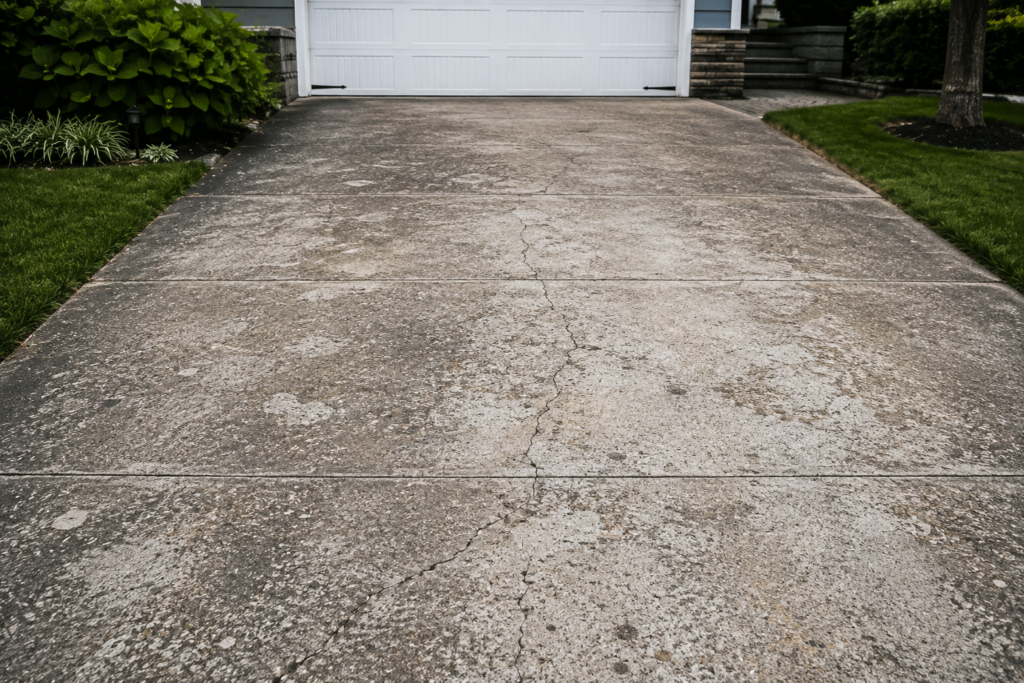
Resurfacing is a good fit when the problems are cosmetic or surface-level rather than structural. That covers a lot of situations we run into regularly:
- Faded, blotchy, or discolored concrete from years of sun, salt, and freeze-thaw cycles
- Light surface scaling, where the top layer starts flaking off after repeated winters
- Minor cracking that doesn’t run deep or indicate movement
- Rough, pitted texture from years of foot and vehicle traffic
- A patio or walkway that looks dated but hasn’t shifted or settled
- A commercial entryway or courtyard that needs to look presentable again without shutting the property down for a full tear-out
We often see driveways where the concrete is still structurally sound, but years of New York winters have left the surface looking rough and inconsistent. That’s the classic resurfacing candidate.
Resurfacing is not the right call for concrete with real structural problems. If a slab has significant settlement, large gaps where sections have separated, deep cracks that go all the way through, or is heaving unevenly because of what’s happening underneath it, an overlay isn’t going to fix that. It might hide it for a little while, but the same problems will telegraph back through the new surface, usually faster than anyone would like. In those cases, the honest recommendation is repair of the base issue first, or full replacement.
A good rule of thumb: if the damage is on top of the concrete, resurfacing is worth considering. If the damage is coming from underneath the concrete, it needs to be addressed before any resurfacing happens.
How Does Concrete Resurfacing Work?
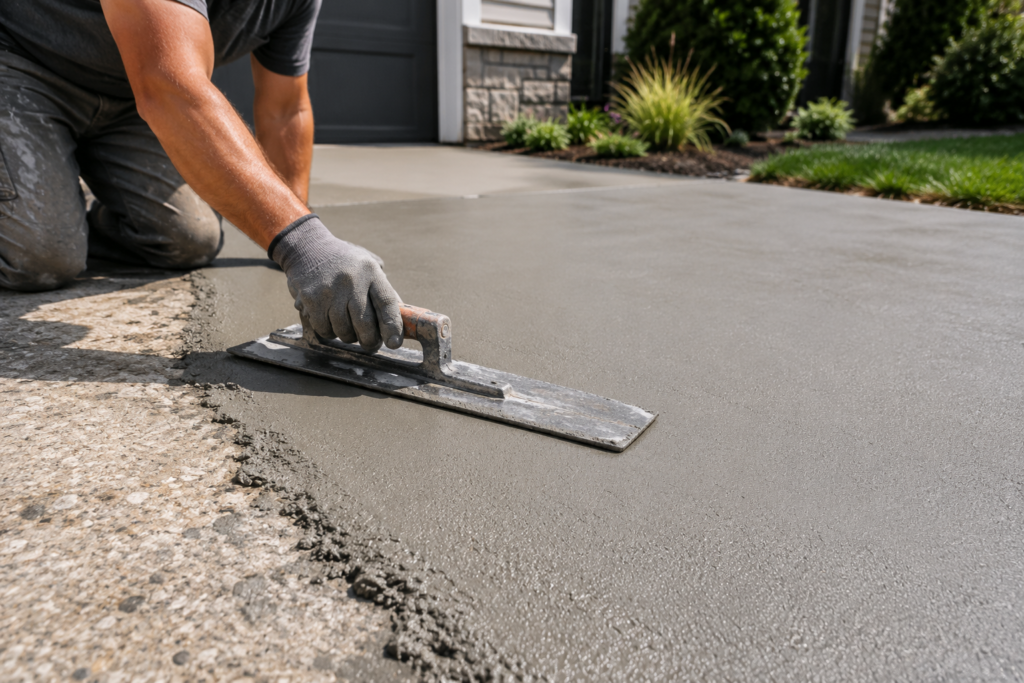
The process is fairly straightforward, but the prep work is where a job succeeds or fails.
- Inspection. A contractor evaluates the slab for structural issues, checking for settlement, deep cracking, or drainage problems that need to be dealt with before resurfacing is even an option.
- Cleaning and preparation. The surface gets pressure washed, and in most cases mechanically profiled or ground down, to remove grease, sealers, and loose material and to open the surface so the new layer can actually bond.
- Crack and damage repair. Cracks and low spots get patched and leveled. This step matters more than people expect. Skipping it or rushing it is one of the most common reasons an overlay fails early.
- Mixing the resurfacing material. The overlay is a polymer-modified cement product mixed to the right consistency for the application method being used.
- Application. The material is applied evenly across the slab, sometimes by squeegee or trowel, sometimes sprayed, depending on the finish.
- Finishing and texture. Broom finishes, stamped patterns, or decorative textures can be added at this stage, depending on what the property owner wants.
- Curing. The new surface needs time to cure properly before it’s sealed and put back into use.
Surface prep is the part that determines whether the job lasts. An overlay applied over a poorly cleaned or improperly profiled slab may look fine on day one and start peeling or delaminating within a season or two, which is a frustrating and avoidable outcome.
Concrete Resurfacing vs. Concrete Replacement
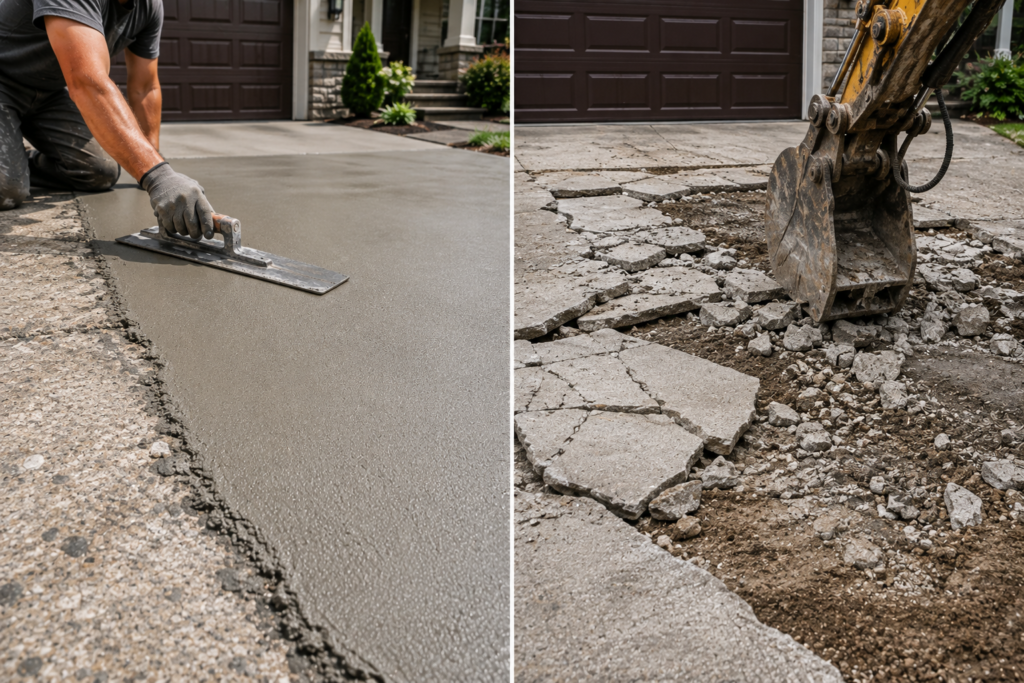
| Factor | Resurfacing | Replacement |
| Existing slab | Retained | Removed |
| Best for | Surface-level wear, discoloration, minor cracking | Major structural damage, significant settlement, extensive deep cracking |
| Demolition | Minimal or none | Required |
| Project disruption | Generally lower, faster turnaround | Generally higher, longer timeline |
| Appearance options | Broom, stamped, decorative finishes available | Broom, stamped, decorative finishes available |
| Cost considerations | Typically less expensive since demolition and disposal are avoided | Higher upfront cost due to demolition, disposal, and a full new pour |
Neither option is universally better. Resurfacing extends the life of a slab that still has structural integrity. Replacement resets the clock entirely, which is sometimes exactly what a property needs, especially if the base underneath the concrete was never properly prepared in the first place.
How New York Weather Affects Concrete
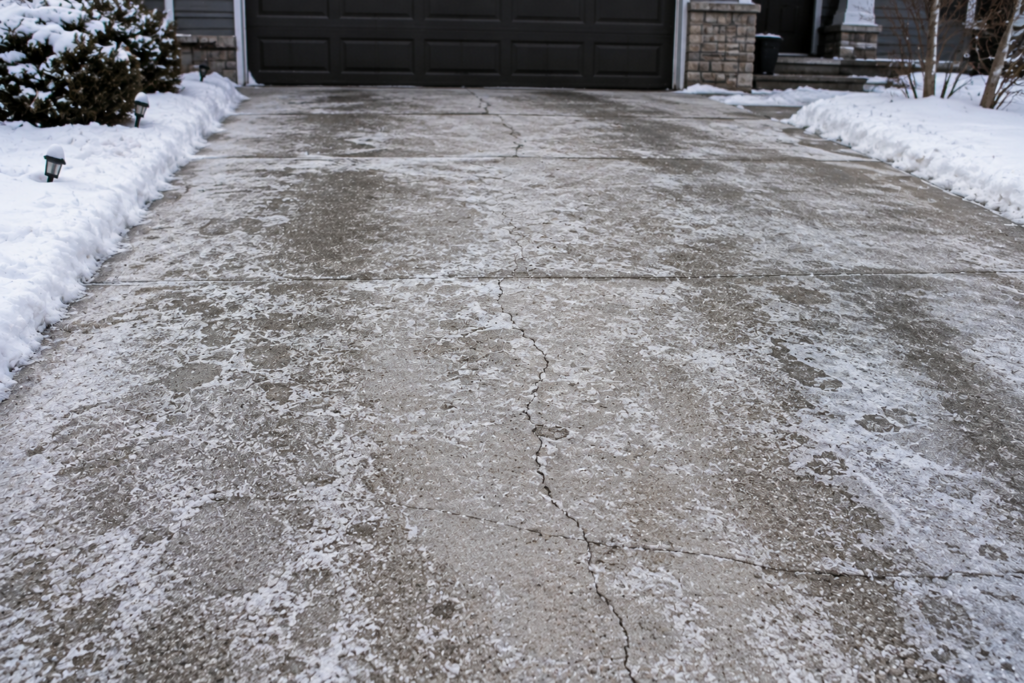
New York concrete has a hard job. Freeze-thaw cycles are probably the biggest factor. Water gets into small cracks and pores in the concrete, freezes, expands, and gradually widens those openings. Repeat that dozens of times over a winter, year after year, and it takes a visible toll on the surface.
Deicing salts add to the problem. They lower the freezing point of water sitting on the concrete, which sounds helpful, but the repeated freeze-thaw cycling that results, combined with the chemical effect of the salt itself, accelerates surface scaling and pitting. That’s a big part of why so much residential and municipal concrete around the state looks rough and flaky even when the slab underneath is fine.
Snow removal equipment, drainage that pools water against the slab instead of away from it, and simple age all play a role too.
None of this means resurfacing won’t hold up here. It means the condition of the original slab needs a real evaluation before resurfacing goes forward, and it means using a resurfacing material and sealer suited to freeze-thaw exposure rather than a generic product. A slab with poor drainage or existing moisture intrusion is a poor candidate until that underlying issue is addressed.
Where Can Concrete Be Resurfaced?
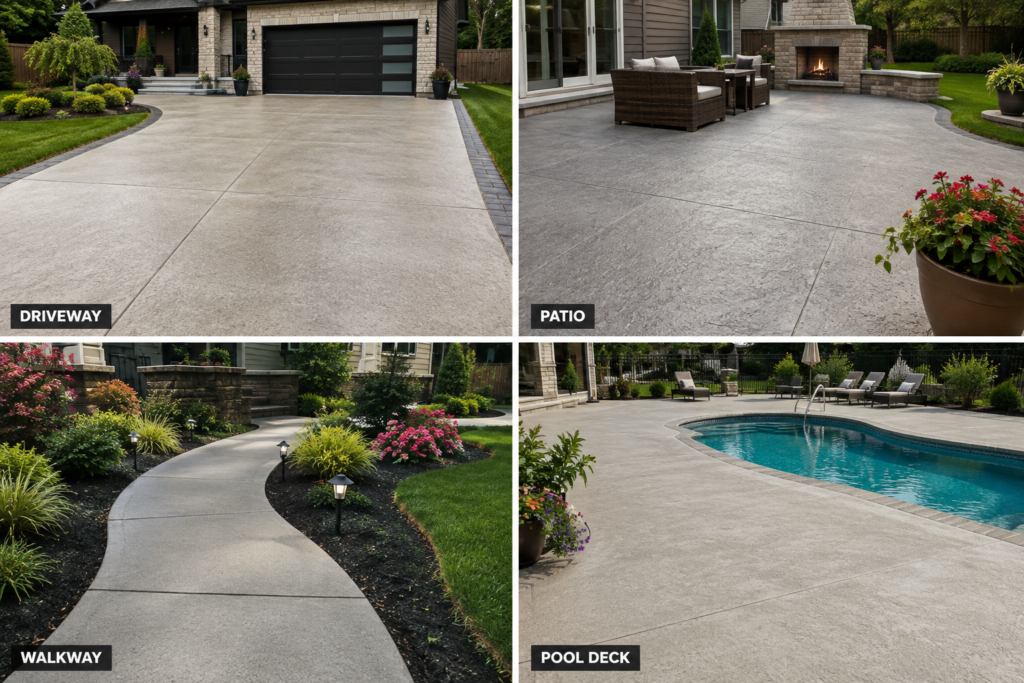
Most flatwork concrete is a reasonable candidate, assuming the structural condition checks out:
- Driveways
- Patios
- Walkways
- Pool decks
- Garage floors
- Commercial sidewalks
- Courtyards and entryways
That said, not every surface is automatically suitable. Steps, ramps, and areas with heavy structural cracking or active water infiltration often need repair or replacement work first, and in some cases, resurfacing isn’t the right fit for those areas at all. A contractor should be able to tell you which parts of a property are good candidates and which aren’t, rather than assuming everything qualifies.
How Long Does Resurfaced Concrete Last?
There’s a wide range in how long resurfaced concrete holds up, and honestly, anyone who gives you one precise number without asking about your slab first is oversimplifying it.
Industry sources generally put the lifespan of a properly installed overlay somewhere in the range of 8 to 15 years, with well-maintained, high-quality installations sometimes reaching 20 years. Where a given project lands in that range depends on a handful of things:
- Condition of the existing slab. A stable, well-prepared base gives the overlay a much better chance of lasting.
- Surface preparation. Thorough cleaning and profiling before application matter as much as the material itself.
- Installation quality. An experienced installer applying the right thickness and technique makes a real difference.
- Drainage. Water that’s allowed to pool or sit against the surface shortens the lifespan considerably.
- Weather exposure. In New York, that means freeze-thaw cycling and road salt in particular.
- Traffic and load. A driveway that sees daily vehicle use wears differently than a lightly used patio.
- Maintenance. Periodic sealing and prompt attention to small cracks go a long way.
Treat any lifespan estimate as a range tied to your specific conditions, not a guarantee.
What Does Concrete Resurfacing Cost in New York?
We’re not going to hand you a fixed New York price here, because honestly, anyone who quotes you a number before seeing the slab is guessing. What we can walk through are the factors that actually drive the cost up or down:
- Square footage. Larger areas cost more in total but often come with a lower price per square foot.
- Existing condition. A slab that needs crack repair, leveling, or extensive grinding before resurfacing costs more than one that’s in decent shape.
- Surface preparation required. Heavier profiling and cleanup adds labor time.
- Finish selected. A basic broom or trowel finish costs less than stamped or decorative overlays with multiple colors.
- Accessibility. Tight urban lots, stairs, or limited equipment access can add to labor costs.
- Project complexity. Multiple surfaces, drainage corrections, or custom detailing all add time.
National industry data from multiple cost-estimating sources puts basic concrete resurfacing somewhere in the general range of $3 to $10 per square foot, with decorative or stamped overlays running higher, often into the teens per square foot. Those figures aren’t New York-specific pricing, and actual costs here will vary by borough, contractor, and project scope. The only way to get a real number is a site evaluation. Treat any number you see online as a starting point for a conversation, not a quote.
Common Concrete Resurfacing Mistakes
A lot of resurfacing problems trace back to a handful of avoidable mistakes:
Resurfacing concrete that’s structurally compromised. An overlay isn’t a fix for settlement or deep structural cracking. It just delays the visible symptoms while the underlying problem continues.
Poor surface preparation. Skipping proper cleaning or grinding leads to weak bonding, which shows up as peeling or delamination, sometimes within months.
Ignoring drainage. Water pooling against or under a resurfaced slab accelerates freeze-thaw damage and undermines the bond over time.
Covering cracks without evaluating their cause. A crack that’s still moving will usually telegraph back through a new overlay. Patching over it without understanding why it formed just postpones the problem.
Applying material in unsuitable conditions. Resurfacing products have temperature and humidity requirements. Applying them too cold, too hot, or right before rain can compromise the whole job.
Neglecting maintenance afterward. Even a well-installed overlay needs periodic sealing and prompt attention to small damage. Skipping that shortens its lifespan.
How to Maintain Resurfaced Concrete
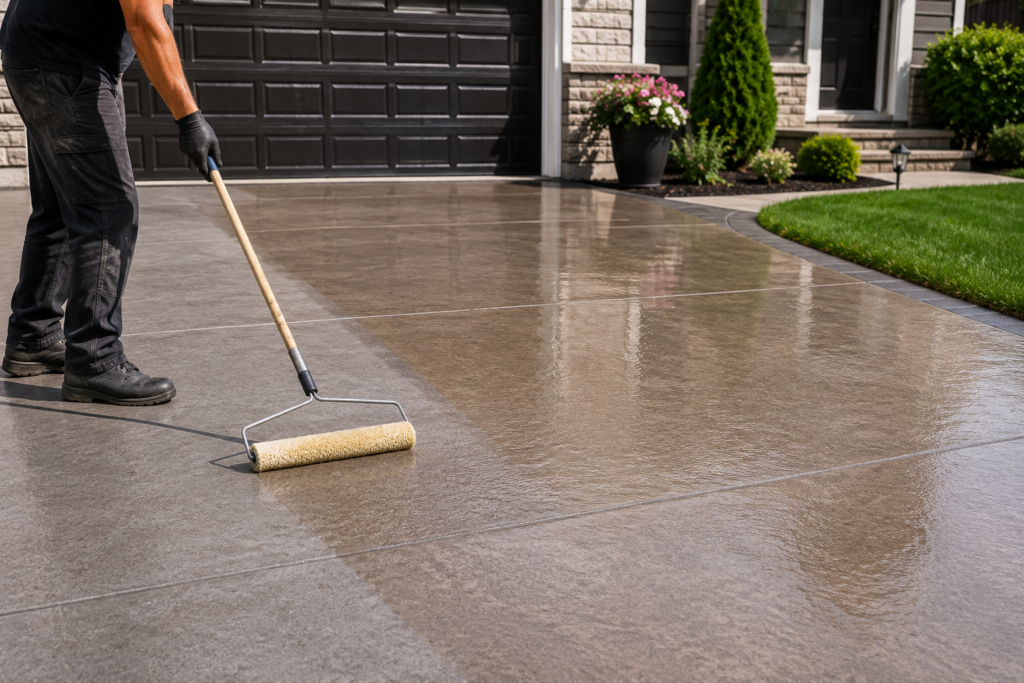
Maintenance for resurfaced concrete isn’t complicated, but it does matter.
Keep the surface reasonably clean with regular sweeping and occasional gentle washing, avoiding harsh chemical cleaners that can degrade the sealer. Make sure water drains away from the slab rather than sitting on it. In winter, use a plastic shovel where possible rather than a metal one, and go easy on deicing salts, since they contribute to the same scaling that affected the original concrete. Reseal on a periodic basis, generally every few years, though the right interval depends on traffic and exposure. And if you notice a small crack or chip developing, get it looked at early rather than waiting. Small repairs are far cheaper and easier than the ones that come from ignoring a problem for a few winters.
Is Concrete Resurfacing Worth It?
For a lot of New York properties, yes. If the slab is structurally sound and the problems are cosmetic or surface-level, resurfacing generally costs less than full replacement, takes less time, and avoids the disruption of demolition. It’s a practical way to extend the useful life of concrete that still has good years left in it.
It’s not the right move for every situation. If the underlying slab has real structural problems, resurfacing over them is a short-term fix that tends to disappoint. In those cases, replacement usually delivers better long-term value even though it costs more upfront.
The honest answer is that it depends on the condition of what you’ve already got. That’s not a dodge. It’s genuinely the deciding factor, and it’s worth having someone look at the actual slab before assuming either way.
Comparison Table
| Factor | Resurfacing | Replacement |
| Existing slab | Retained | Removed |
| Best for | Surface-level wear, discoloration, minor cracking | Major structural damage, significant settlement, extensive deep cracking |
| Demolition | Minimal or none | Required |
| Project disruption | Generally lower, faster turnaround | Generally higher, longer timeline |
| Appearance options | Broom, stamped, decorative finishes available | Broom, stamped, decorative finishes available |
| Cost considerations | Typically less expensive since demolition and disposal are avoided | Higher upfront cost due to demolition, disposal, and a full new pour |
FAQ Section
What is concrete resurfacing?
Concrete resurfacing is applying a new, thin bonded layer of cement-based material over existing concrete that’s structurally sound but worn on the surface, rather than demolishing and repouring the slab.
Is concrete resurfacing worth it?
It’s usually worth it when the existing slab is structurally sound, and the issues are cosmetic, like discoloration, minor cracking, or surface wear. It’s less worth it when there’s significant structural damage underneath.
How long does concrete resurfacing last?
Most properly installed overlays last somewhere between 8 and 15 years, and sometimes longer with good installation, proper drainage, and regular maintenance. Slab condition and weather exposure both affect where a given project falls in that range.
Can an old concrete driveway be resurfaced?
Often, yes, as long as the slab hasn’t settled, shifted, or developed deep structural cracking. A contractor needs to evaluate the base condition before recommending resurfacing.
Can cracked concrete be resurfaced?
Minor, stable cracks can typically be repaired and resurfaced over. Active or deep structural cracks will be evaluated and addressed first, since resurfacing alone won’t stop them from reappearing.
Is it cheaper to resurface or replace concrete?
Resurfacing is generally less expensive than full replacement because it avoids demolition, disposal, and a full new concrete pour. The exact cost gap depends on the size and condition of the project.
How thick is concrete resurfacing?
Overlay thickness varies by product and finish, typically ranging from about an eighth of an inch for basic overlays up to closer to an inch for some decorative or heavy-use applications.
Does resurfacing work in New York’s climate?
Yes, when the existing slab is a good candidate, and the resurfacing material and sealer are suited to freeze-thaw exposure and road salt. Drainage and surface prep matter more here than in milder climates.
Not Sure If Your Concrete Can Be Resurfaced?
If you’re unsure whether your driveway, patio, or walkway needs resurfacing, repair, or full replacement, an in-person evaluation is the best place to start. Cracking, settlement, drainage, surface deterioration, and the stability of the existing slab all play a role in determining the right approach.
Let Kings Pavers & Concrete evaluate your existing concrete and help you understand your options. Call 516-905-4800 today to schedule an on-site assessment in New York.