You probably didn’t think much about that hairline crack near your stoop back in October. It was thin, barely wide enough to catch a heel, the kind of thing you step over without noticing. Then March rolled around, the snow melted, and suddenly that same crack has a lip to it. One side sits a little higher than the other. Water pools next to it every time it rains.
If that sounds familiar, you’re not imagining things. New York sidewalks take a beating every year, and the damage tends to show up gradually, then all at once.
Why Are There Cracks in Sidewalks?
Sidewalk cracks usually aren’t caused by one single thing. They’re the result of several forces working on the same slab of concrete over time: moisture getting into small gaps, the ground underneath shifting, roots pushing up from below, the concrete itself aging, and in some cases, a base that wasn’t prepared properly when the sidewalk was poured. Add in a New York winter, and a small imperfection can turn into a real problem faster than most property owners expect.
Concrete is strong under compression but much weaker when it’s pulled or flexed, which is exactly what happens when the ground beneath it moves unevenly. Once a crack forms, it becomes an entry point for water, and that’s usually where things start to accelerate.
Common Causes of Sidewalk Cracks in New York
Freeze-thaw cycles
Water gets into a crack, freezes, expands, and widens the opening. This happens repeatedly over a winter, sometimes dozens of times depending on the weather pattern.
Tree roots
Mature street trees, especially the older plantings common in many New York neighborhoods, have root systems that don’t stop growing just because there’s concrete overhead. Roots push up from underneath, and a slab that was flat can end up tilted or lifted along one edge.
Soil settlement and movement
The soil under a sidewalk isn’t static. It compacts, shifts, and sometimes washes out from underneath the slab, particularly near older utility work or where drainage has been a long-term issue. When the base loses support, the concrete above it has nothing to rest on evenly.
Aging concrete
Concrete has a service life. Older sidewalks, especially ones installed decades ago with different materials and standards, are simply more prone to cracking than a slab poured in the last several years.
Poor drainage
Water that has nowhere to go tends to find its way under the sidewalk instead. Over time, that erodes the base and contributes to uneven settling.
Heavy pedestrian and vehicle use
Sidewalks near commercial corridors, transit stops, or driveways see far more load and vibration than a quiet residential block. That extra stress adds up.
Improper installation
Not every sidewalk was poured the same way. A base that wasn’t compacted correctly, or concrete that wasn’t cured properly, tends to crack sooner and more unpredictably than a well-installed slab.
How New York Winters Affect Concrete Sidewalks
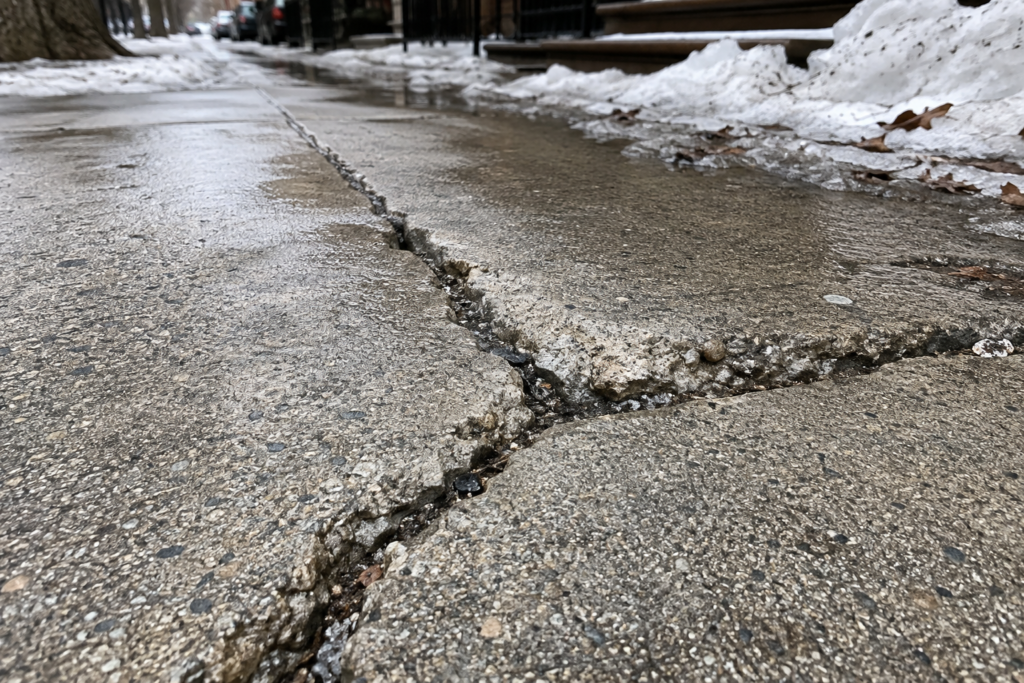
This is the one most property owners underestimate. A crack that looks purely cosmetic in October can look completely different by February.
Here’s the basic mechanism: water gets into any small opening in the concrete, whether that’s a hairline crack or a joint. When temperatures drop, that water freezes and expands, which pushes the crack wider. When it thaws, the water drains a little deeper into the gap. Then it freezes again. Repeat that cycle a few dozen times over a New York winter, and a crack that started as a cosmetic issue can turn into something with real depth and width.
This is also why so many sidewalk complaints and repair calls pick up in early spring. The damage was building all winter. It just becomes visible once the snow is gone.
Tree Roots and Sidewalk Damage
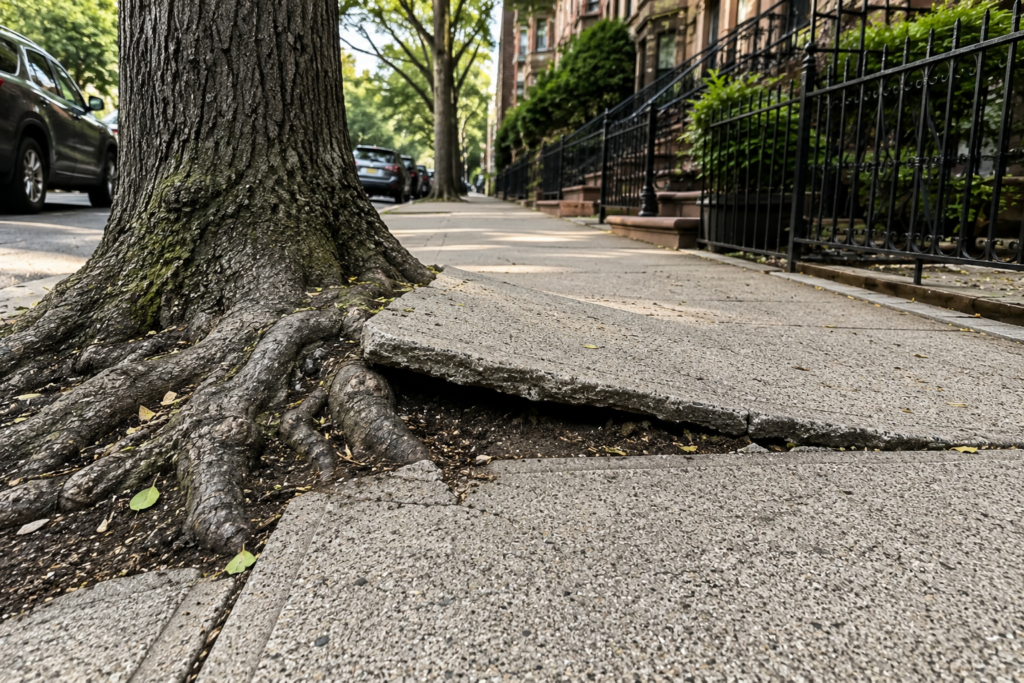
Street trees are one of the most common causes of lifted or cracked sidewalk slabs in New York, particularly on blocks with mature trees planted decades ago. As a tree matures, its root system spreads outward, often much farther than people expect, and roots close to the surface can push directly against the underside of a concrete slab.
This doesn’t mean the tree needs to come out. In many cases, the tree can stay, and the sidewalk section can be repaired or reset around it. Because trees along New York sidewalks are frequently subject to specific rules, particularly when they’re city-owned, any work near tree roots may require some coordination with the relevant department before repairs move forward. It’s worth checking current requirements before starting work, since root-related sidewalk repairs are handled differently than a standard crack repair.
Drainage and Water Problems
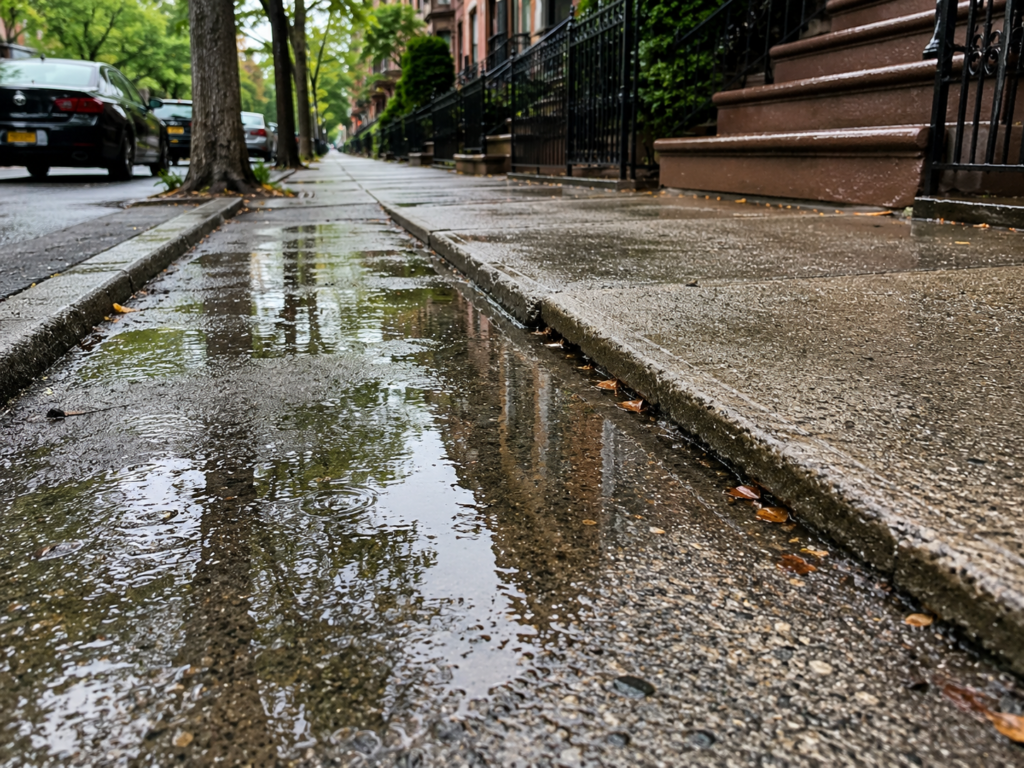
Water is one of the most consistent culprits behind sidewalk deterioration. When drainage around a property isn’t working the way it should, water can run toward the sidewalk instead of away from it, pool at low points, and eventually find its way underneath the slab.
Once water sits under a section of concrete regularly, it starts to erode the base material. That leads to voids, which leads to settling, which leads to cracking or an uneven slab. It’s a slow process, but it’s a steady one, and it’s often made worse by gutters, downspouts, or grading that push water toward the sidewalk rather than away from the building.
Does Every Sidewalk Crack Need Repair?
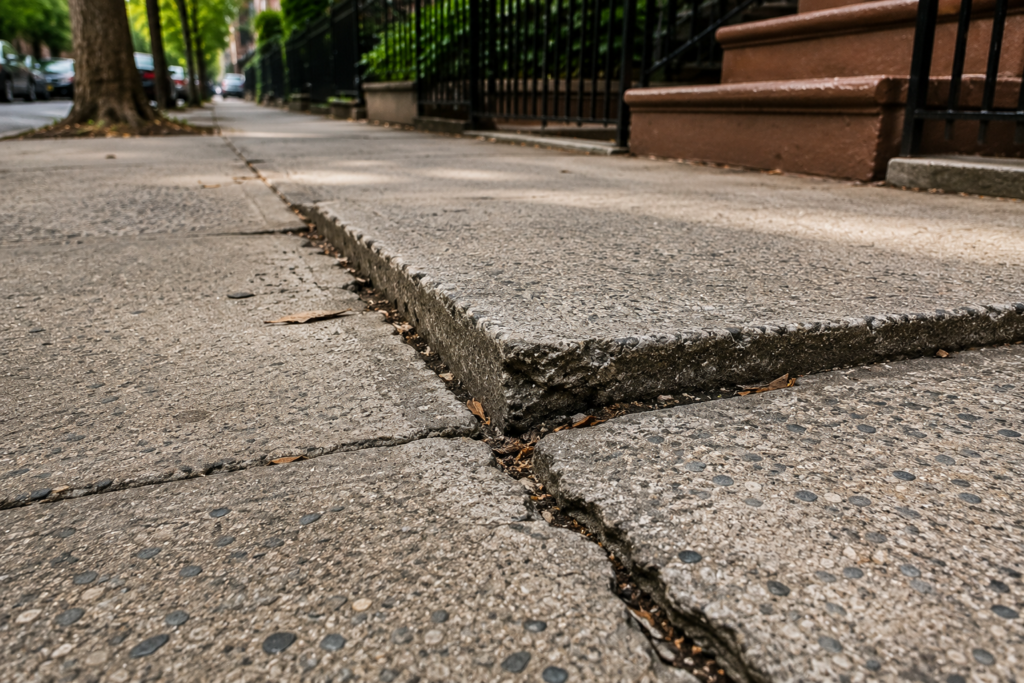
Not necessarily. Sidewalk damage exists on a spectrum, and the right response depends on where a specific crack falls on it.
- Small hairline cracks with no vertical offset are often cosmetic and mainly worth monitoring.
- Growing cracks that are visibly wider than they were a season ago suggest active movement underneath.
- Uneven slabs, where one section sits higher than its neighbor, are more likely to be a tripping hazard.
- Vertical displacement of a half inch or more is generally treated as a real safety issue.
- Crumbling or deteriorated concrete usually points to a base or drainage problem rather than a surface-level issue.
- Areas where water repeatedly collects are worth watching even if the crack itself looks minor, since standing water accelerates everything else on this list.
None of this can be diagnosed accurately from a description alone. If a crack is growing, if a slab has shifted, or if water is consistently pooling in the same spot, that’s usually the point where a professional inspection makes more sense than guessing.
Signs a Sidewalk Problem Is Getting Worse
A few practical things worth watching for over time:
- The crack is visibly wider than it was last season
- One side of the slab is noticeably higher than the other
- Water sits in or near the crack after rain instead of draining away
- Pieces of concrete are crumbling or breaking off at the edges
- The crack is spreading toward a joint or another section of the sidewalk
- You’ve noticed the same spot needing patchwork more than once
None of these alone means a full replacement is necessary, but seeing more than one of them together is a reasonable signal to get it looked at.
Step-by-Step: What to Do When You Notice a Sidewalk Crack
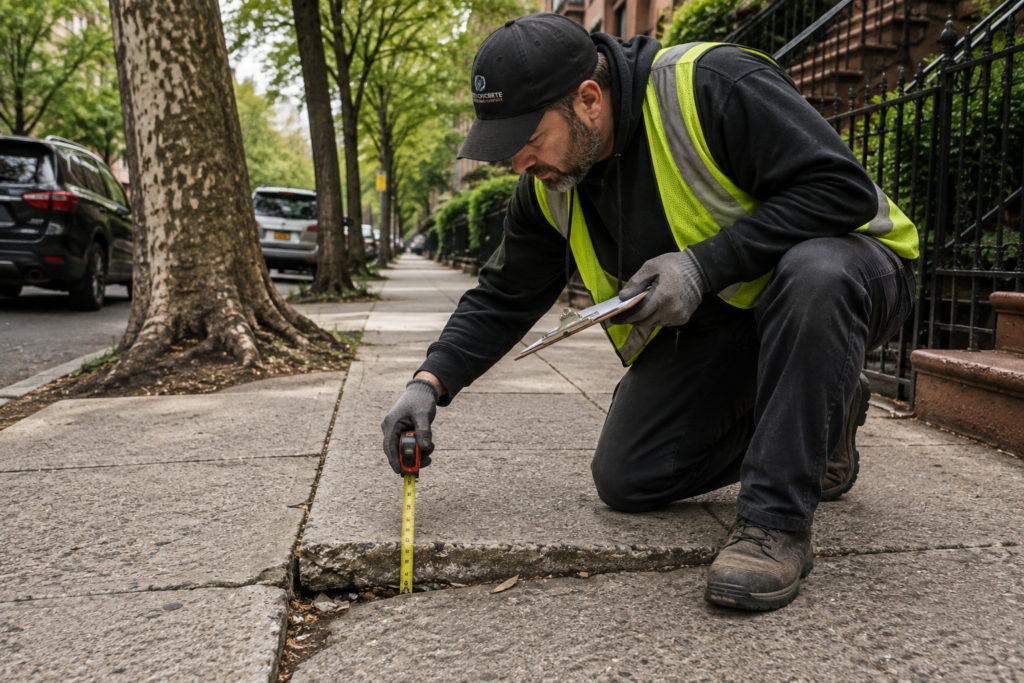
- Look at the size and location of the crack. Note whether it’s near a joint, a tree, a driveway apron, or an isolated section of slab.
- Check whether neighboring slabs are level. Run your foot or a straightedge across the joint to feel for any lip or offset.
- Look for nearby roots or drainage problems. A street tree close by or a downspout draining onto the sidewalk are both common contributors.
- Observe what happens after rain. Standing water is one of the clearest signs that something underneath needs attention.
- Take photos so changes can be compared over time. A dated photo makes it much easier to tell whether a crack is actually getting worse or just looks different in changing light.
- Address minor maintenance problems where appropriate. Clearing debris, keeping the area free of standing water, and not ignoring small cracks can slow things down.
- Get professional advice when the slab is shifting, deteriorating, or creating a potential hazard. At that point, monitoring on your own isn’t enough.
How to Reduce Future Sidewalk Cracking
There’s no way to make concrete completely crack-proof, especially with New York’s freeze-thaw winters, but there are things that meaningfully reduce how fast damage develops:
- Managing drainage so water is directed away from the sidewalk rather than toward it
- Sealing or addressing small cracks before they become a repeated entry point for water
- Monitoring areas near mature trees for early signs of root movement
- Using proper base preparation and compaction during any replacement work
- Following appropriate concrete mix and curing practices during installation
- Keeping the surrounding area reasonably maintained, including clearing debris and standing water
- Doing a seasonal walk-through, especially after winter, to catch changes early
None of these guarantee a sidewalk stays crack-free forever. What they do is slow the rate of deterioration and catch problems while they’re still manageable.
Repair vs Replacement
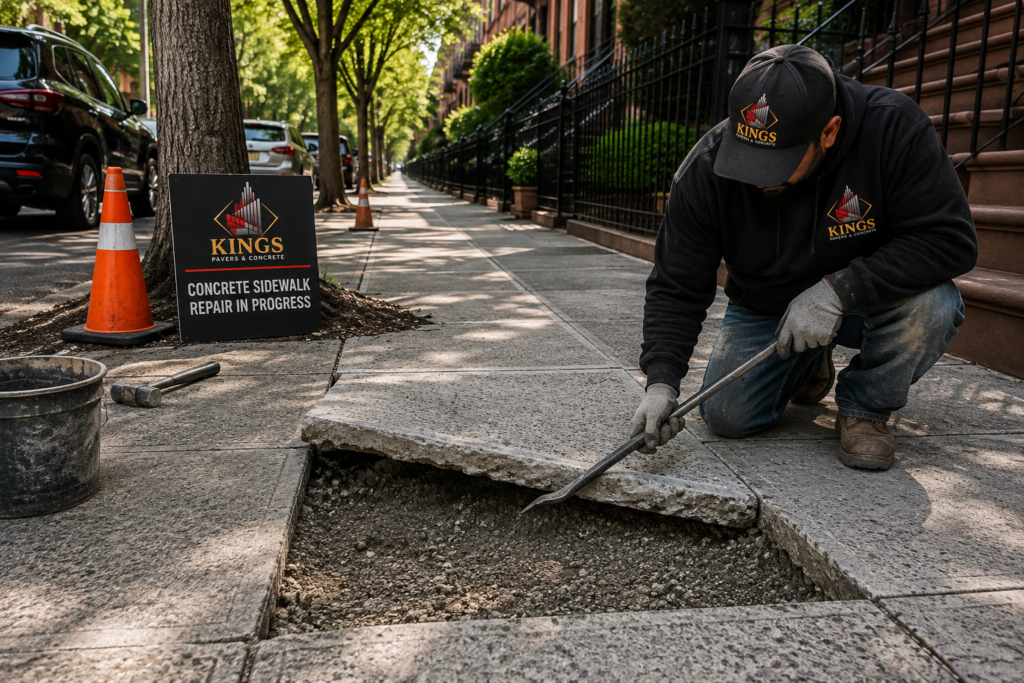
Whether a section should be repaired or replaced depends on the extent and cause of the damage, not just how the crack looks on the surface.
Repair tends to make sense for isolated cracks, minor surface damage, or a single slab with a manageable offset, especially when the base underneath is still sound. Replacement becomes the more reasonable option when there’s widespread cracking across multiple slabs, significant vertical displacement, a compromised base, or damage that keeps recurring in the same spot despite previous repairs.
There isn’t a universal answer here. A sidewalk with one bad slab next to several good ones is a different situation than a sidewalk where the whole run has aged out at once, and the right call usually comes down to what’s actually happening underneath the surface, not just what’s visible from the top.
Cause of Cracking Table
| Cause of Cracking | What You May Notice | Why It Happens | Possible Next Step |
| Freeze-thaw cycles | Crack widens noticeably after winter | Water enters the crack, freezes, expands, and repeats over the season | Monitor after winter; seal or repair before next season |
| Tree roots | One edge of a slab lifts or tilts | Roots grow beneath the slab and push it upward | Inspection near the tree before repair work begins |
| Poor drainage | Water pools near or in the crack | Water erodes the base material underneath the slab | Address grading or drainage source, then assess the slab |
| Soil settlement | Slab sinks or tilts unevenly | Ground beneath the concrete compacts or shifts unevenly | Professional assessment of the base |
| Aging concrete | Multiple cracks across an older sidewalk | Concrete naturally weakens and becomes brittle with age | Evaluate for repair vs. full replacement |
| Heavy use | Cracking near driveways or busy entry points | Repeated load and vibration stress the slab over time | Monitor; reinforce or replace high-traffic sections |
Monitor vs Professional Assessment Table
| Minor Issue | Monitor/Repair | Professional Assessment May Be Needed |
| Thin hairline crack, no offset | Monitor seasonally, seal if needed | — |
| Small surface crack near a joint | Simple patch repair | — |
| Crack growing wider each season | — | Yes, active movement likely |
| Slab offset of half inch or more | — | Yes, potential trip hazard |
| Water consistently pooling in the same spot | — | Yes, may indicate base or drainage failure |
| Crumbling concrete at the edges | — | Yes, may indicate deeper deterioration |
A Realistic Example (Hypothetical)
Picture an older residential sidewalk on a tree-lined block, sitting next to a mature street tree that’s probably been there longer than the house. For years, the sidewalk looked fine. Then, over a couple of seasons, one slab near the tree starts to lift slightly on one edge. It’s subtle at first, just enough that you’d notice it if you were looking for it.
By the following spring, water has started collecting along that lifted edge after every rain, since the tilt now sends runoff toward the low side instead of away from it. The crack that was barely visible two years earlier now has a clear offset.
In a case like this, the visible problem, the tilted slab, isn’t really the whole story. The root growth underneath is what caused the movement, and the drainage issue that followed is a direct result of that shift. Fixing the surface without understanding what’s happening below it usually just means dealing with the same problem again in a year or two.
A Practical Insight
One thing that tends to surprise property owners is how much a crack’s history matters more than its current size. A crack that’s stayed the same width for three years behaves very differently than one that’s grown noticeably in a single season, even if they look similar side by side today. Tracking changes over time, rather than judging a crack by a single snapshot, is usually what separates a minor maintenance item from a problem that needed attention months earlier.
FAQ Section
Why are there cracks in sidewalks?
Sidewalk cracks typically develop from a mix of causes working together: freeze-thaw cycles, moisture getting into small openings, soil movement beneath the slab, tree root growth, aging concrete, and sometimes installation quality. Rarely is there just one single cause.
Are cracks in concrete sidewalks normal?
Small hairline cracks with no offset are common, especially on older sidewalks, and aren’t automatically a sign of a serious problem. Cracks that are growing, uneven, or collecting water are worth keeping an eye on more closely.
Why do sidewalk cracks get worse during winter?
Water enters existing cracks, freezes, and expands, which widens the opening. This freeze-thaw cycle can repeat many times over a New York winter, which is why cracks often look noticeably worse by early spring.
Can tree roots crack or lift a sidewalk?
Yes. As roots from a mature tree grow, they can push against the underside of a concrete slab and lift or tilt it. Repairs near tree roots may involve some coordination depending on who owns the tree, so it’s worth checking current requirements before starting work.
Can a cracked sidewalk be repaired?
In many cases, yes. Isolated cracks or a single affected slab can often be repaired without replacing the whole sidewalk, as long as the base underneath is still in reasonably good condition.
When should a sidewalk be replaced instead of repaired?
Replacement tends to make more sense when there’s widespread cracking across several slabs, significant vertical displacement, a failing base, or damage that keeps coming back in the same spot after previous repairs.
How can you prevent sidewalk cracks from getting worse?
Managing drainage, addressing small cracks before water repeatedly gets into them, keeping an eye on areas near mature trees, and doing a seasonal check after winter are all realistic ways to slow down further damage, even though no sidewalk can be made completely crack-proof.
Need Help With a Cracked Sidewalk in New York?
If the crack outside your property is getting wider, one slab is sitting higher than the next, or water keeps pooling in the same area, it may be time for a professional assessment. Not every crack requires immediate repair, but identifying the cause early can help prevent further deterioration.
Kings Pavers & Concrete provides professional sidewalk repair and concrete services throughout New York. Contact our team to have your sidewalk inspected and discuss the right repair option for your property.