
If you’ve ever looked down at the sidewalk in front of your building and noticed a series of straight lines running across it every few feet, you may have wondered whether the concrete is falling apart. It usually isn’t. In most cases, what you’re looking at is a control joint, a groove that was cut or formed into the concrete on purpose. So to answer the question directly: why do sidewalks have built-in cracks? They don’t, technically. What looks like a crack is almost always a planned joint, placed there specifically so the concrete has somewhere to move without breaking apart on its own terms.
That distinction matters more than it sounds like it should. Concrete is rigid, but it’s not static. It expands when it warms up, contracts when it cools, shrinks slightly as it cures, and shifts a little depending on what’s happening in the soil underneath it. If a contractor pours a long, unbroken slab of concrete with nowhere for that movement to go, the concrete will crack somewhere, and it won’t ask your permission about where. Joints give it a place to do that in a straight, controlled line instead of a jagged one running through the middle of a panel.
Are the Lines in Sidewalks Actual Cracks?
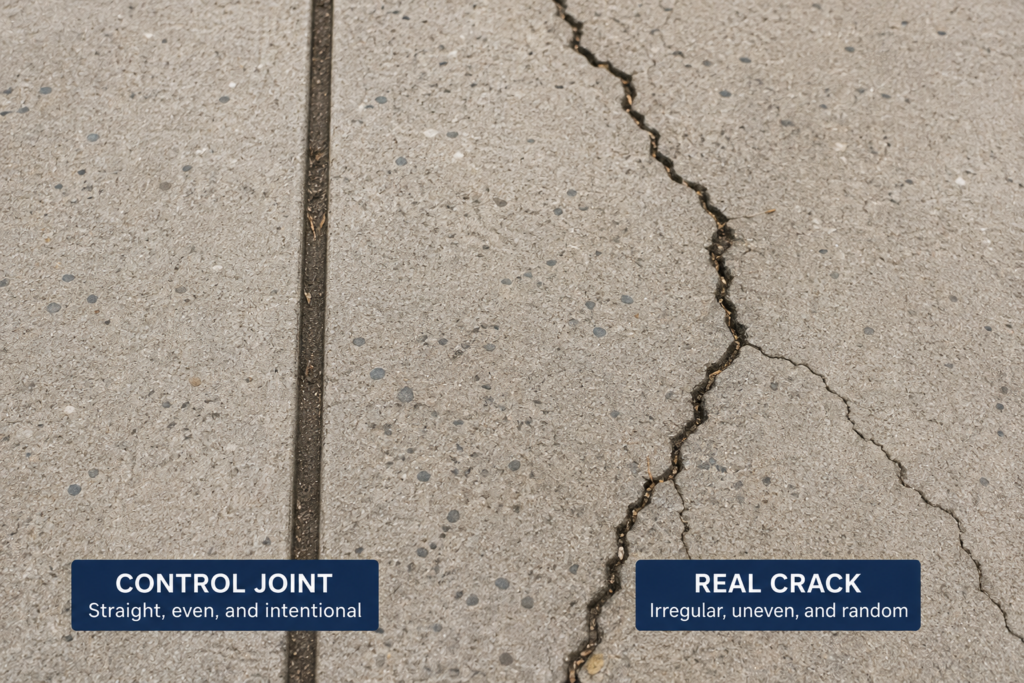
No, not usually. The straight, evenly spaced lines you see across most sidewalk panels are control joints, tooled or saw-cut into the concrete during installation. They’re there by design, not by accident.
A real crack, on the other hand, tends to look different. It’s often irregular, doesn’t line up with the joint pattern, and may run diagonally through a slab rather than straight across it. Once you know what to look for, the difference becomes fairly easy to spot on your own.
What Control Joints Actually Do
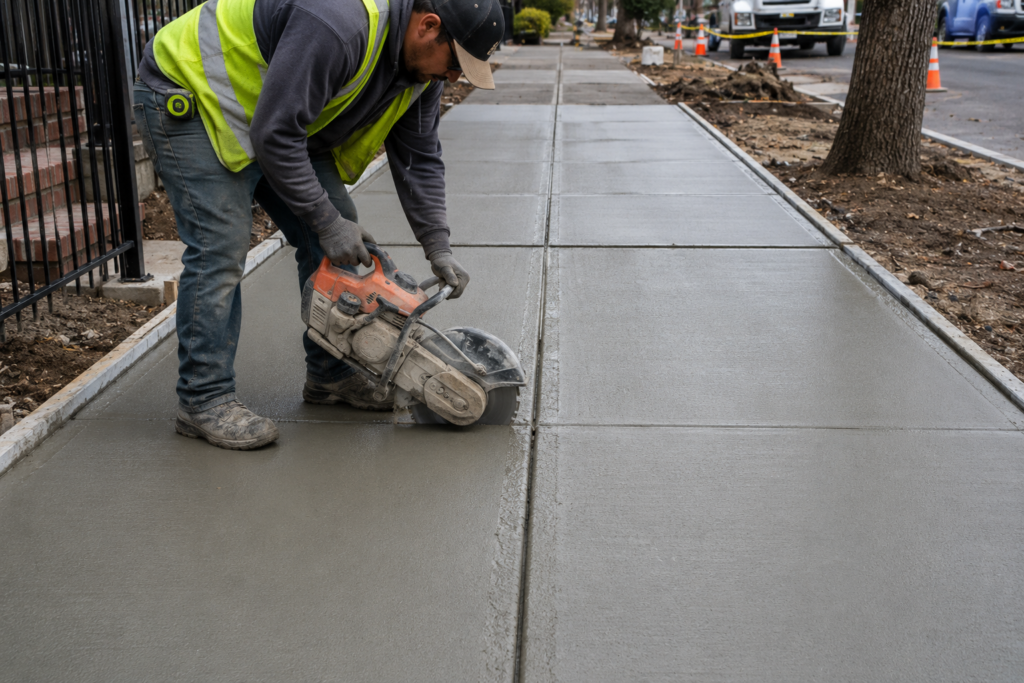
Concrete shrinks as it cures. This isn’t a defect; it’s just how the material sets. As the water in the mix evaporates and the concrete hardens, it pulls inward slightly. Over a large, continuous surface like a sidewalk, that shrinkage has to go somewhere.
Control joints give it a predetermined weak point. By cutting or forming a groove partway through the slab, the concrete is more likely to crack along that thinner line rather than at some random spot across the surface. It’s a similar idea to scoring a piece of glass before you snap it: you’re not preventing the break; you’re deciding where it happens.
Contractors typically space these joints based on the thickness of the slab. A common rule of thumb is spacing the joints at roughly two to three times the slab’s thickness in feet, though the exact spacing depends on the project, the concrete mix, and site conditions.
Why Concrete Cracks in the First Place
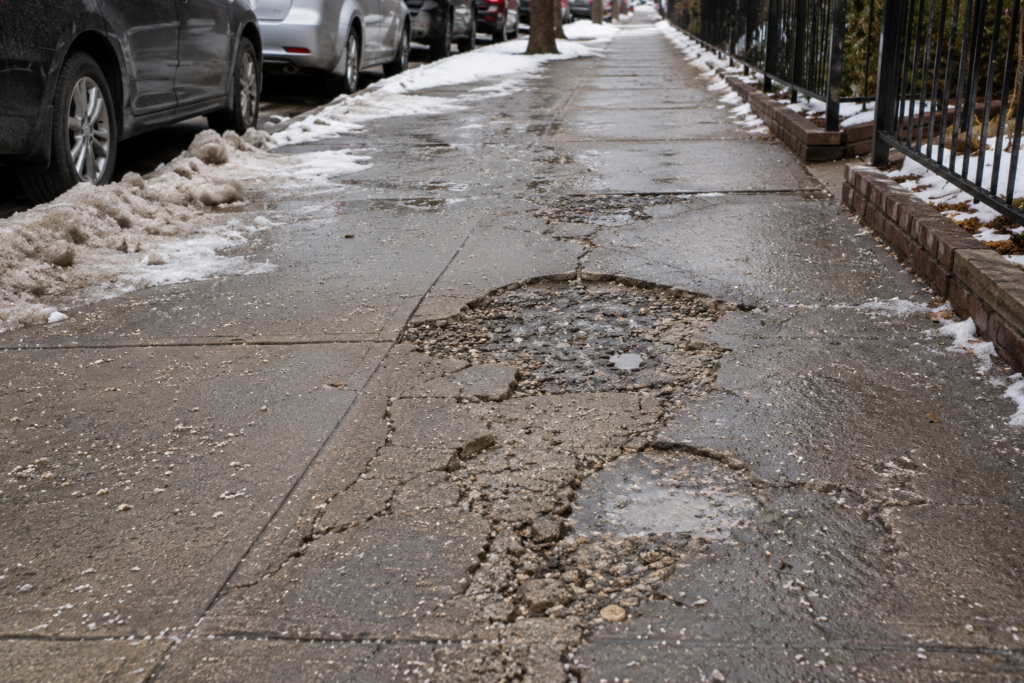
Even with well-placed joints, concrete can still develop hairline cracks. That’s not a sign of poor workmanship by itself; it’s a reflection of how the material behaves.
Shrinkage during curing. As mentioned above, concrete loses moisture as it hardens, and that process causes it to contract slightly. Some minor shrinkage cracking is considered normal, especially in the first year after a pour.
Temperature swings. Concrete expands when it heats up and contracts when it cools. In a city with hot summers and cold winters, sidewalks go through a wide temperature range every year. Without joints or with joints spaced too far apart, that constant expansion and contraction puts stress on the slab.
Freeze-thaw cycles. This is a big one for New York specifically. Water that seeps into small cracks or the porous surface of concrete can freeze in winter. When it freezes, it expands, and that expansion pushes outward on the surrounding concrete. Repeated freezing and thawing over a winter, or over several winters, gradually widens small cracks and can flake or spall the surface. Deicing salts can make this worse, since they affect how and when water on the surface freezes and refreezes.
Soil movement and settlement. Sidewalks sit on a base of compacted soil or gravel. If that base wasn’t compacted evenly, or if the soil underneath shifts over time, which happens with New York’s clay-heavy soils in some neighborhoods, the slab above it can settle unevenly. This is a common cause of the more serious cracks and of slabs that no longer sit flush with each other.
Tree roots. Street trees are part of what makes a lot of New York blocks pleasant to walk down, but their root systems don’t always stay put. Roots growing under a sidewalk panel can lift it from below, which shows up as either a raised slab edge or a crack radiating out from the pressure point.
Water and drainage problems. Water that consistently pools next to or under a slab softens the base material over time. A slab sitting on a saturated, uneven base is more likely to shift, crack, or settle than one on a well-drained base.
When Joints Are Missing or Poorly Spaced
Not every crack you see is the fault of the concrete itself. Sometimes it comes down to how the joints were laid out in the first place. If joints are spaced too far apart, or skipped in sections where they should have been placed, the slab has fewer controlled release points for all that shrinkage and movement. The result is a random crack somewhere in the panel instead of a clean line along a joint.
This is one of the more avoidable causes of sidewalk cracking, and it usually traces back to the original installation rather than anything the property owner did.
How to Tell a Joint From a Real Problem
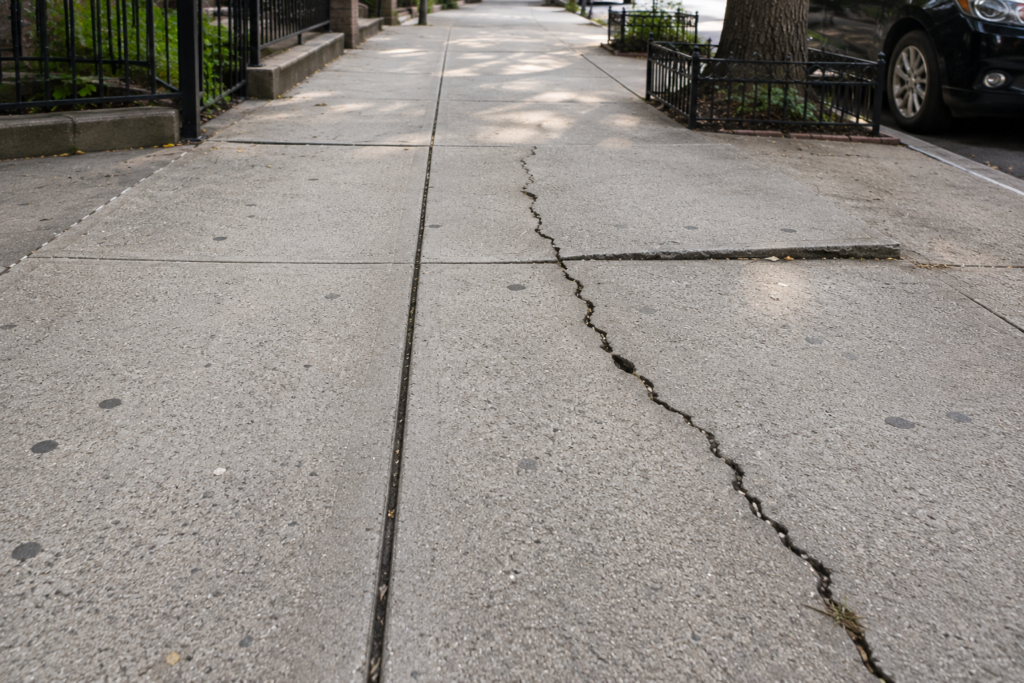
A straight groove that runs the same width across several slabs, spaced at regular intervals, and lines up from panel to panel is almost certainly an intentional control joint. That pattern is deliberate.
A crack that cuts diagonally through the middle of a slab, that doesn’t match the joint pattern, or that appears suddenly in one spot tells a different story. That’s more likely to be the slab responding to a real stress, settlement, a root, water damage, or a joint that failed to do its job.
There’s also a difference in what deserves your attention. A small hairline crack sitting flush with the rest of the slab is mostly cosmetic. A crack where one side sits noticeably higher than the other is a different situation entirely; that’s a trip hazard, and it’s worth having someone look at it sooner rather than later. Water that keeps collecting next to a slab, even if the slab looks fine today, is also worth paying attention to, because a small drainage issue left alone tends to turn into a bigger structural one.
Illustrative Scenario: A Sidewalk That Looks More Damaged Than It Is
Here’s a typical situation. A property owner in New York calls because their sidewalk looks like it’s “cracking everywhere”; they’ve counted what seems like a dozen cracks across the front of their building. On inspection, most of those lines turn out to be standard control joints: straight, evenly spaced, and consistent from panel to panel. Nothing unusual there.
But one panel near the curb has a diagonal crack running from corner to corner, and that panel sits about half an inch lower than the one next to it. That’s the one that matters. The pattern points to settlement, likely from soil movement or a drainage issue near that section, not from normal shrinkage. The rest of the sidewalk is fine as-is; that one panel is a candidate for leveling or replacement.
This kind of mixed picture mostly normal joints with one genuine problem area is common. It’s also why a quick visual sweep of the whole sidewalk, rather than fixating on the first crack you notice, gives a more accurate read on what’s actually going on.
How to Inspect a Sidewalk Crack Yourself
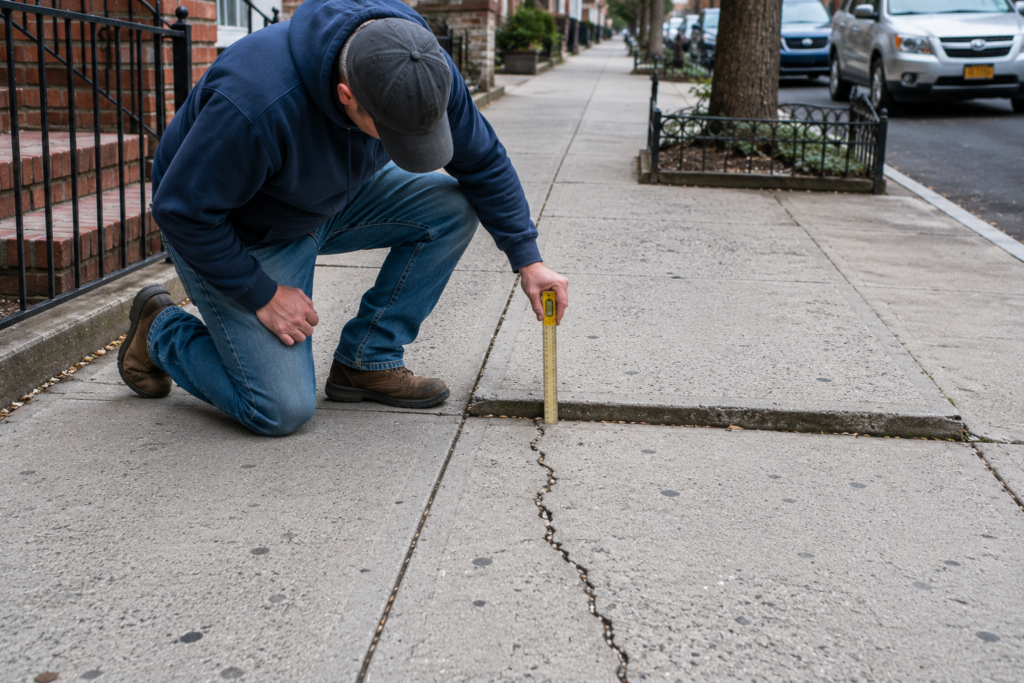
You don’t need special tools to get a reasonable first read on a crack. A few minutes of looking is usually enough to know whether it’s worth calling someone.
- Look at the shape and direction. Straight and evenly spaced usually means a joint. Diagonal, irregular, or branching usually means a crack.
- Check whether it lines up with a joint pattern. Walk a few panels in either direction. If the same line repeats at regular intervals, it’s a control joint.
- Feel for vertical movement between slabs. Run your foot or hand across the joint or crack. If one side sits higher than the other, note how much; even a small lip can be a trip hazard.
- Check nearby drainage. Look for water pooling next to the slab after rain, or staining that suggests standing water is a repeat issue.
- Look for tree roots or soil disturbance. A nearby tree with visible surface roots, or a slab that seems to be tilting away from flat, points to root or soil movement underneath.
- Watch it over time. Take a photo now. If the crack is wider or the height difference has grown in a few months, that’s a sign of ongoing movement rather than a one-time settling event.
- Call in a professional evaluation when there’s displacement, recurring movement, or a safety concern. Cosmetic hairline cracks rarely need urgent attention. Height differences, widening cracks, or standing water issues are worth a proper look.
Quick Reference Table
| What You See | Likely Meaning | Usually a Concern? |
| Straight, evenly spaced groove | Control joint | Usually no |
| Thin random crack | Shrinkage or minor movement | Depends |
| Wide crack | Greater movement or damage | Needs attention |
| Uneven slab edges | Settlement or root movement | Potential safety concern |
Repair or Replace?
A slab with hairline cracks and no height difference between panels is often fine to leave alone, or can be patched if the cracking is cosmetic and someone wants a cleaner look. Sealing small cracks can also help keep water out before winter, which limits freeze-thaw damage down the line.
Slabs with real settlement, a consistent trip hazard, or cracking that’s clearly worsening are a different case. Sometimes leveling the existing slab solves the problem, especially when the concrete itself is still sound, but the base underneath has shifted. When the concrete is badly deteriorated, spalled, or broken into pieces, replacement is usually the more practical route.
The Basic Principle Behind Control Joints
The underlying idea is straightforward: concrete is going to crack somewhere as it shrinks and moves, so a joint gives it a planned place to do that instead of leaving it to chance. It’s a standard, well-established practice in concrete construction, not a shortcut or a sign of cutting corners. A sidewalk without any joints at all would almost certainly crack randomly within its first year.
Frequently Asked Questions
Why do sidewalks have built-in cracks?
They don’t, exactly. What looks like a built-in crack is usually a control joint, cut or formed into the concrete on purpose so shrinkage and movement happen along a straight, planned line instead of randomly across the slab.
Are the lines in sidewalks actual cracks?
No. Most of the straight, evenly spaced lines are control joints, not damage. Real cracks are usually irregular and don’t follow that repeating pattern.
Why are there lines between concrete sidewalk sections?
Those lines, called control joints or sometimes expansion joints depending on their purpose, allow the concrete to expand, contract, and shrink without cracking unpredictably.
What is the purpose of control joints in concrete?
They create a weaker, planned point in the slab so that natural shrinkage and movement produce a straight crack along the joint rather than a random crack somewhere else in the panel.
Can concrete still crack even with control joints?
Yes. Joints reduce random cracking, but they don’t eliminate all cracking. Temperature swings, freeze-thaw cycles, soil movement, and tree roots can still cause cracks, especially if joints are spaced too far apart.
When should a sidewalk crack be repaired?
Small hairline cracks with no height difference are often cosmetic and not urgent. Cracks with a noticeable lip between slabs, ones that are widening over time, or ones near standing water are worth having evaluated.
Why do sidewalks become uneven?
Usually from soil settlement, tree root growth underneath the slab, or a poorly compacted base at the time of installation. Freeze-thaw cycles can also gradually worsen an existing unevenness.
Need Help With Your New York Sidewalk?
If you’ve spotted a crack or uneven slab in front of your property and you’re not sure whether it’s just a control joint doing its job or something that needs attention, Kings Pavers & Concrete can take a look. A short inspection can help determine the cause and whether sidewalk repair, leveling, or replacement makes the most sense for your property.
Contact Kings Pavers & Concrete today to request a free estimate.