
Sooner or later, most people planning a new driveway, patio, or walkway land on the same question: what are interlocking pavers, and are they really different from the concrete slab already in front of the house?
They are different, and the difference matters more in New York than in a lot of other places. Our winters put paved surfaces through repeated freezing, thawing, snow removal, and deicing. Some materials handle that movement better than others, and even the best material fails when the ground under it is poorly prepared.
This guide explains how interlocking pavers work, where they fit, where they don’t, and what to weigh before you spend money on them.
What Are Interlocking Pavers?
Interlocking pavers are individual units, usually made of concrete but sometimes clay or natural stone, that are laid in a pattern on a compacted base. Sand fills the narrow gaps between them. Once the joints are filled and the surface is compacted, the pavers grip each other and behave like a single flexible surface.
That last part is where the name comes from. Each unit is held in place by its neighbors, by the joint material, and by the edge restraints around the perimeter. Interlocking concrete pavers are the most common choice for residential driveways and patios because they come in a wide range of shapes, colors, and thicknesses.
A finished paver surface is built from several layers, and each one has a job:
- Compacted base. Crushed stone, compacted in layers, carries the load and drains water away from the surface. This is the most important part of the job, and the part you never see once it is finished.
- Bedding layer. A thin, screeded layer of coarse sand or fine stone that gives the pavers a smooth, even place to sit.
- Pavers. The visible surface. Thickness varies, and a paver driveway generally calls for thicker units than a patio or walkway.
- Joint material. Sand (or a polymeric sand product) swept into the gaps. It locks the units together and lets them share loads.
- Edge restraints. Rigid borders, often plastic, concrete, or stone, that keep the outer pavers from spreading. Without them, the whole field can slowly creep outward.
How Do Interlocking Pavers Work?
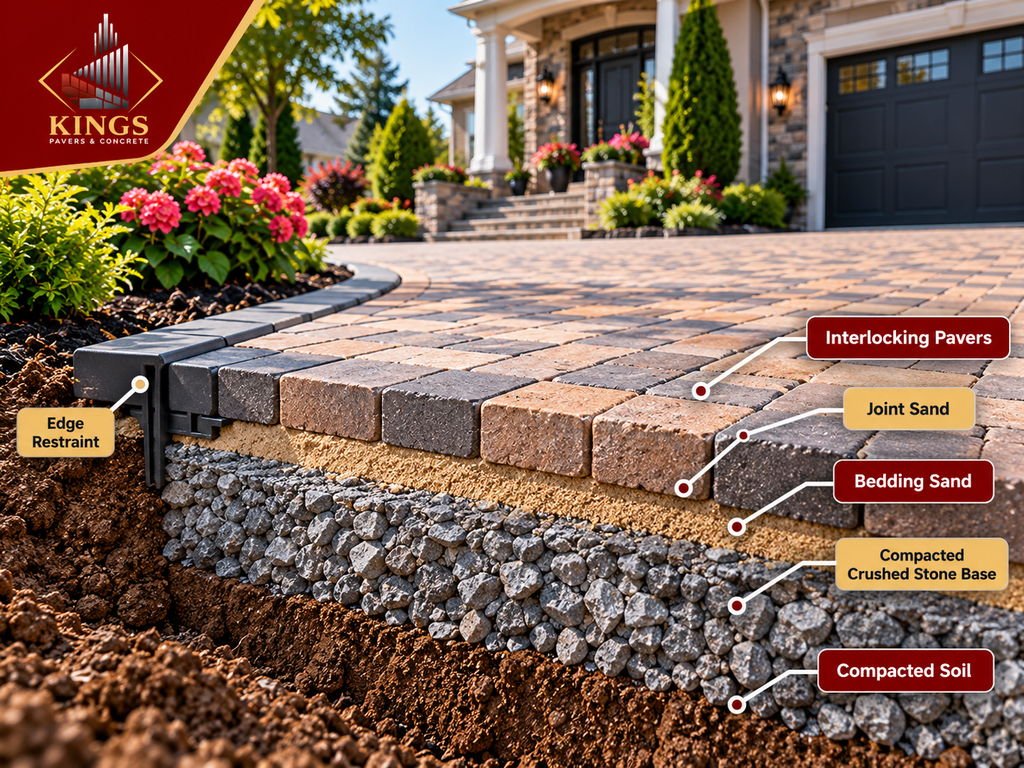
The easiest way to think about it is that you are building a system, not stacking blocks on dirt.
When a car drives over a paver, the load moves through the unit, into the joint sand, across to the neighboring pavers, and down into the bedding layer and base. The base spreads that weight over a larger area of soil. If any layer is weak, thin, or badly compacted, the load has nowhere good to go, and you eventually see a dip, a rut, or a wobbly edge.
This is why two driveways using the same pavers can look completely different after five winters. One was built on a properly excavated, compacted, well-drained base. The other was built on a few inches of stone over soft soil because the crew wanted to finish early. The pavers themselves were not the difference.
The system also explains why pavers can flex slightly with the ground without cracking the way a rigid slab can. The joints allow small movements. That flexibility has limits, though, and it depends on the base staying stable underneath.
Where Can Interlocking Pavers Be Used?
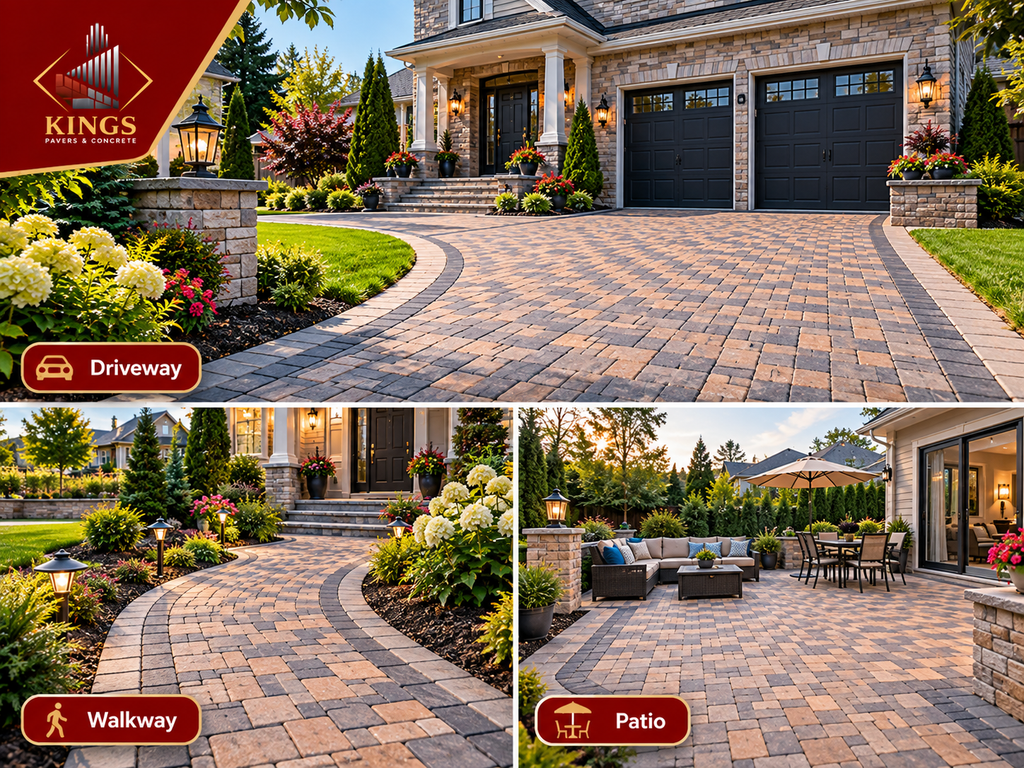
Pavers are used almost anywhere people walk, park, or gather. The right paver and base depth change depending on the job.
Driveways. Interlocking driveway pavers need a deeper base and a thicker unit than a patio, because they carry vehicle weight and turning forces. Areas where cars turn the wheel while stopped, such as near the garage, take the most stress.
Walkways and entrances. Walkway pavers are forgiving and good-looking, and a front entrance is often where owners first add a paver border or pattern. A cracked slab at the front door is a common reason people start this conversation.
Patios. Patio pavers handle furniture, grills, and foot traffic well, and the layout can curve around planting beds and steps without much fuss.
Pool surrounds. Pavers can work around pools, provided the surface has enough texture for wet feet and the grading moves water away from the pool and the house. Color matters here too, since dark pavers can get quite warm in direct summer sun.
Commercial areas. Building entrances, plazas, courtyards, and parking areas use pavers when the owner wants a finished look and the ability to open up one section for utility work and put it back. Heavy delivery trucks or frequent plowing call for a base designed for that load from the start.
Interlocking Pavers vs. Poured Concrete
Both are legitimate choices. Which one suits you depends on the site and what you want out of the surface.
| Feature | Interlocking Pavers | Poured Concrete |
| Appearance | Many colors, shapes, and patterns. Looks more custom. | Cleaner and simpler. Can be stamped or colored, but the look is more uniform. |
| Repairs | Individual units can often be lifted and reset or replaced. Color matching may be an issue over time. | Cracks and spalled areas are usually patched or sections are replaced. Patches often stay visible. |
| Cracking behavior | Joints allow slight movement, so you tend to see settling rather than cracks. | Rigid, so it can crack if the ground moves or control joints are poorly placed. |
| Maintenance | Joint sand needs topping up, and weeds can take hold if joints are neglected. | Less routine upkeep. Sealing and crack filling may be needed. |
| Installation | More labor and more steps. Usually a longer job. | Generally faster once forms are set, but it must cure before use. |
| Drainage | Water can pass through joints, but the base still has to drain. Grading remains essential. | Sheds water off the surface. Poor slope leads to pooling, and water can get underneath through cracks. |
| Winter performance | Can handle ground movement well when the base is right. Plowing and deicing need some care. | Performs well when properly installed, but surface scaling can happen, especially with poor mix or heavy deicing. |
| Long-term flexibility | Easy to add on, open up for utility work, and reset. | A change usually means cutting or replacing sections. |
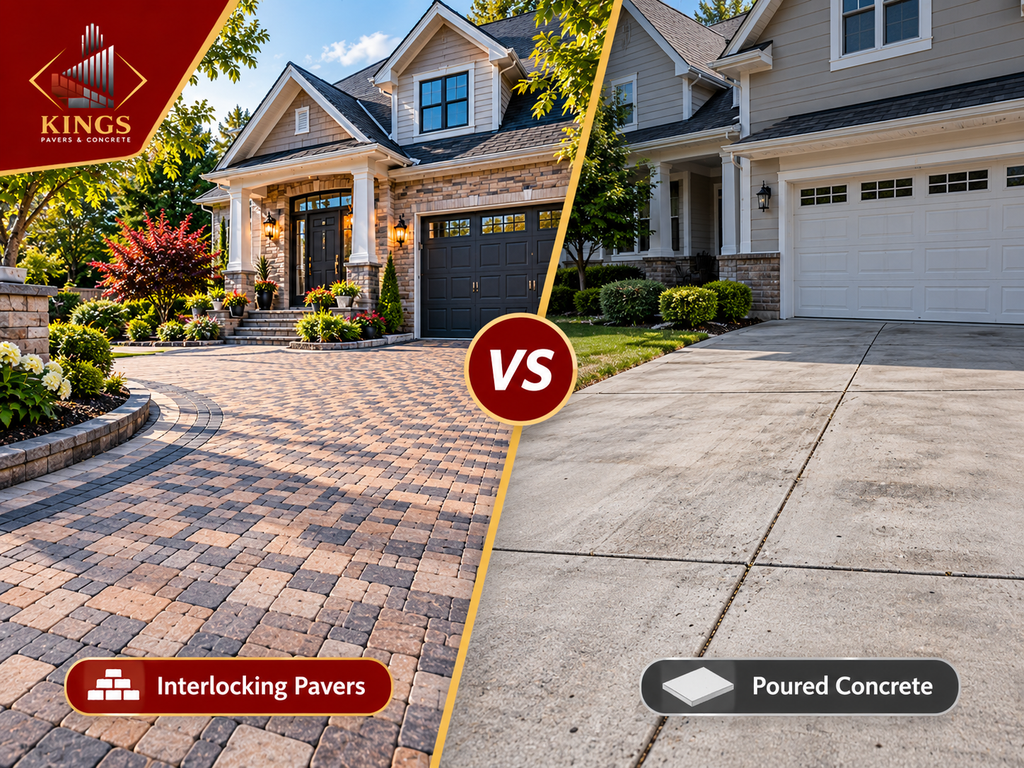
A well-built concrete driveway is a perfectly good driveway. If you want a simple, low-fuss surface and the budget is tight, it can be the better call. Pavers tend to make more sense when you value repairability and appearance, or when the site has conditions that make a rigid slab a repeat problem.
Benefits of Interlocking Pavers
You can fix a small problem without redoing the whole surface. If a section settles because a utility line was dug up, or a tree root pushes up one corner, a contractor can lift the pavers, correct the base, and set them back. That is a very different repair than breaking out a slab.
They tolerate some movement. The joints let the surface shift a little with seasonal ground movement instead of cracking. This does not make pavers immune to frost, but it changes how the surface responds.
Design flexibility is real. Borders, contrasting bands, herringbone or running-bond patterns, and curved edges are all options. Owners often use this to tie a driveway, walkway, and front steps together visually. That can help curb appeal without needing anything ornate.
They can be phased. A homeowner can pave a walkway now and extend to the driveway later, using the same product. That is harder with a poured slab.
Access for utility work. Commercial owners and homeowners with buried lines appreciate that pavers can be lifted and reinstalled rather than cut out.
What Are the Drawbacks?
Pavers are not the right material for everyone, and it helps to know why before you commit.
The upfront investment can be higher. Excavation, base material, labor, and the pavers themselves add up. In some cases, a paver project costs more than a basic poured slab of the same size, though this varies by site, product, and pattern.
Installation quality is everything. A poorly compacted base or shallow excavation leads to sunken areas, ruts, and pavers that shift under tires. Because the pavers hide the base, the problem may not show up for a year or two.
Joints need attention. Sand washes out over time, especially where water runs across the surface or a pressure washer has been used aggressively. Open joints let weeds seed themselves and can loosen the surface.
Edges can move. If restraints are missing, undersized, or poorly anchored, the outer pavers can spread, and gaps open up. Driveway edges next to lawns and planting beds are the usual place to look.
Drainage still matters. Pavers do not fix a drainage problem. If water is running toward the house or collecting under the surface, the base may soften, and the pavers will eventually show it.
Are Interlocking Pavers Good for New York Weather?
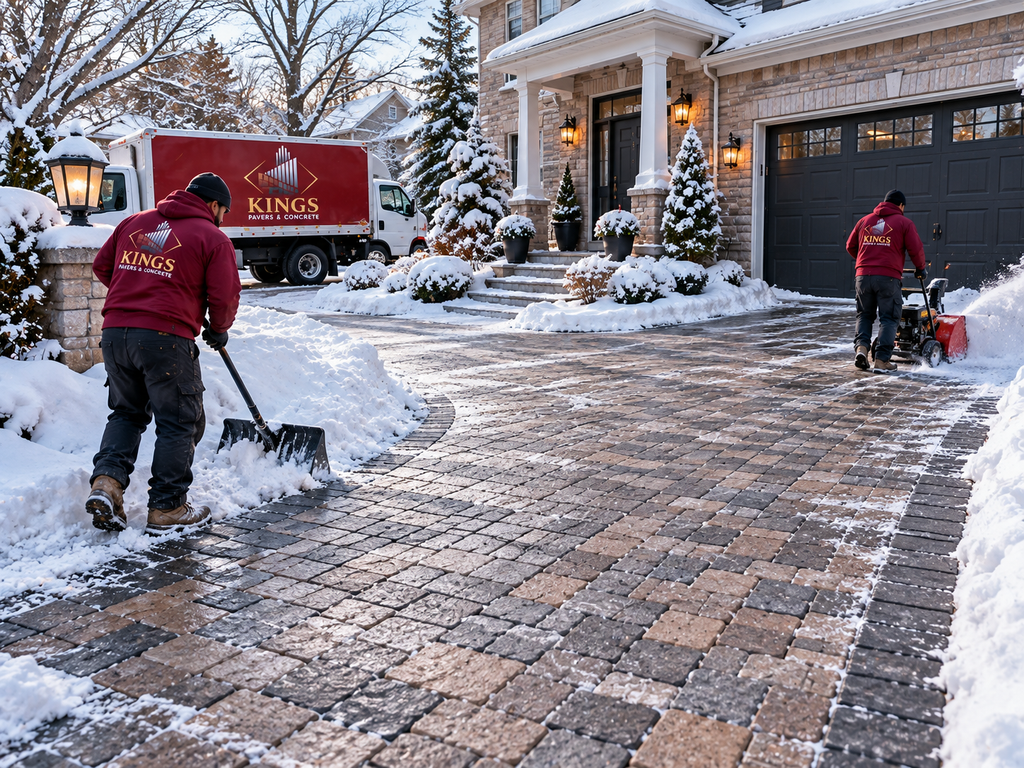
They can be, when they are built and maintained with the climate in mind.
The main stress in our area is the freeze-thaw cycle. Water gets into the base or soil, freezes and expands, then thaws and leaves voids behind. A base that drains well gives water somewhere to go, which reduces the damage. A base sitting on wet, poorly draining soil is more likely to move. That is why site evaluation and proper excavation depth count for so much here, especially on properties with clay soil, slopes, or a high water table.
Seasonal ground movement affects any paved surface. Pavers can tolerate small shifts better than a rigid slab, but they are not magic. If the ground moves a lot because of poor compaction or trapped water, you will see it.
Snow and ice add another layer of considerations:
- Snow removal. Metal plow blades and shovels can catch paver edges, particularly if the surface is slightly uneven. Plastic-edged shovels and a plow operator who knows to set the blade slightly above the surface help. Let anyone plowing your property know it is a paver surface.
- Deicing products. Rock salt and other deicers can be harder on some surfaces than others, and product quality varies. Check the paver manufacturer’s guidance, use deicers sparingly, and rinse residue from the surface when the weather allows. Sand can add traction without chemical exposure.
- Sealing and winter. Some owners choose to seal pavers, which can help protect against staining and deicer exposure. Whether it makes sense depends on the paver and the surface, and it is discussed below.
Above all, the paver itself is only part of the story. Base preparation, drainage, edge restraint, and maintenance matter just as much, and I would not trust any claim about exact lifespan that ignores those factors.
Expert Insight: What Experienced Installers Look At First
This section is general industry guidance, not a quote from any individual.
Before choosing a paver, an experienced installer usually looks at where water goes. A paved surface that sheds water toward the house, or into a low spot with nowhere to drain, will struggle regardless of material. Next comes the soil: soft or wet ground may need a deeper excavation and more base material. Then comes the traffic: a patio and a driveway that gets delivery trucks are not the same job. Only after those questions are answered does the paver style become the deciding factor. If a contractor spends more time showing you colors than asking about drainage, that is worth noticing.
Step-by-Step: How Interlocking Pavers Are Installed
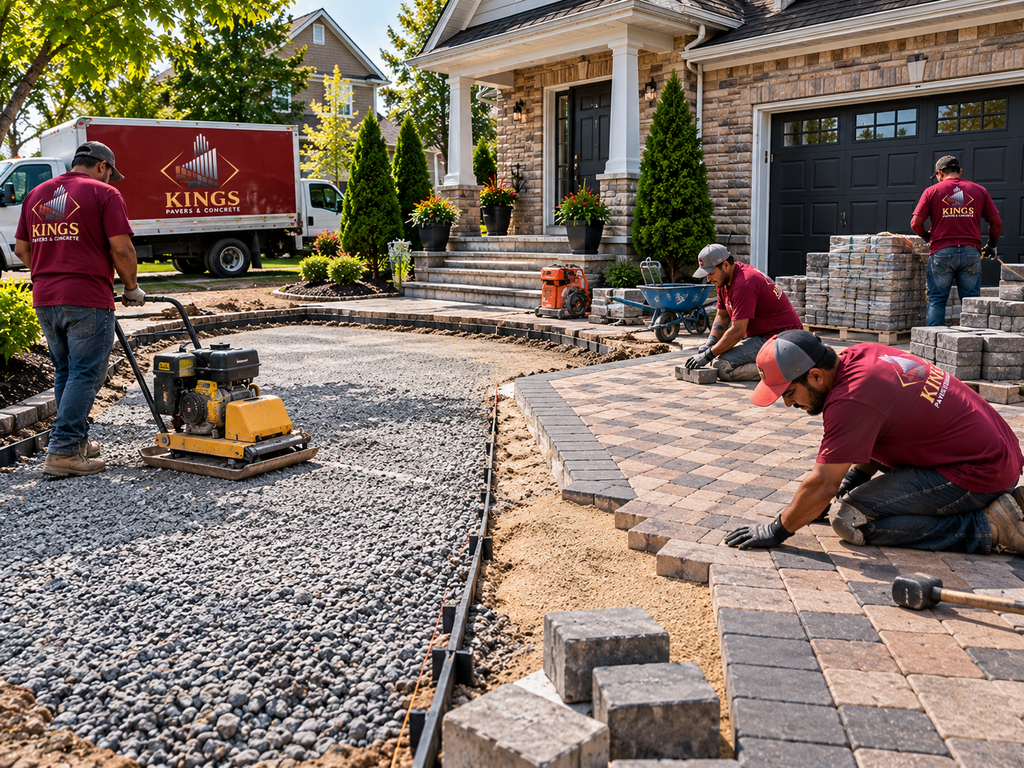
The details vary by site, but the sequence is fairly consistent.
Step 1: Evaluate the site and drainage. The crew looks at slope, soil, roof runoff, downspouts, and where water goes during heavy rain. Decisions about grading and drain pipes usually happen here.
Step 2: Excavate the area. Existing material is removed to the depth needed for the base, bedding, and paver thickness. Driveways go deeper than patios.
Step 3: Prepare and compact the base. Crushed stone is added in layers and compacted with a plate compactor. Soft spots in the soil get corrected at this stage. This is the step where shortcuts cause the most trouble later. A thin or lightly compacted base can look fine on installation day and start to sink within a season or two.
Step 4: Add and level the bedding layer. A thin layer of bedding material is screeded to the correct slope. It is not meant to be structural, so it should not be used to make up for a poor base.
Step 5: Lay the pavers in the selected pattern. Units are placed by hand, checked for line and pattern, and cut where they meet curves, edges, and obstacles.
Step 6: Install edge restraints. Restraints are set along the perimeter and secured so the field cannot spread.
Step 7: Add joint material. Joint sand is swept across the surface and into the gaps until they are full.
Step 8: Compact and finish the surface. The pavers are compacted with a plate compactor (usually with a protective pad), settling them into the bedding and locking the pattern. More joint sand is swept in, and excess is removed.
What Can Go Wrong With Interlocking Pavers?
Most problems fall into two groups: installation issues and routine maintenance. Telling them apart saves money.
| Problem | What It Usually Means |
| Sunken or rutted areas | Often a base issue (thin, poorly compacted, or wet). Not a routine maintenance problem. |
| Uneven or wobbly pavers | Can be bedding or base problems, or movement from tree roots or utility work. |
| Loose or spreading edges | Usually missing, undersized, or poorly anchored edge restraints. |
| Joint sand loss | Often normal over time, but heavy loss in one area can point to water flow or aggressive cleaning. |
| Weeds in joints | Usually routine maintenance. Open joints and debris let seeds take hold. |
| Standing water | Points to grading, base drainage, or downspout issues. Should be investigated. |
| Poor grading | An installation or design issue. Usually shows up as pooling near the house or garage. |
A few weeds after a rainy summer? That is maintenance. A dip that grows every winter, or water that never leaves one section, needs someone to look underneath the surface.
How to Maintain Interlocking Pavers
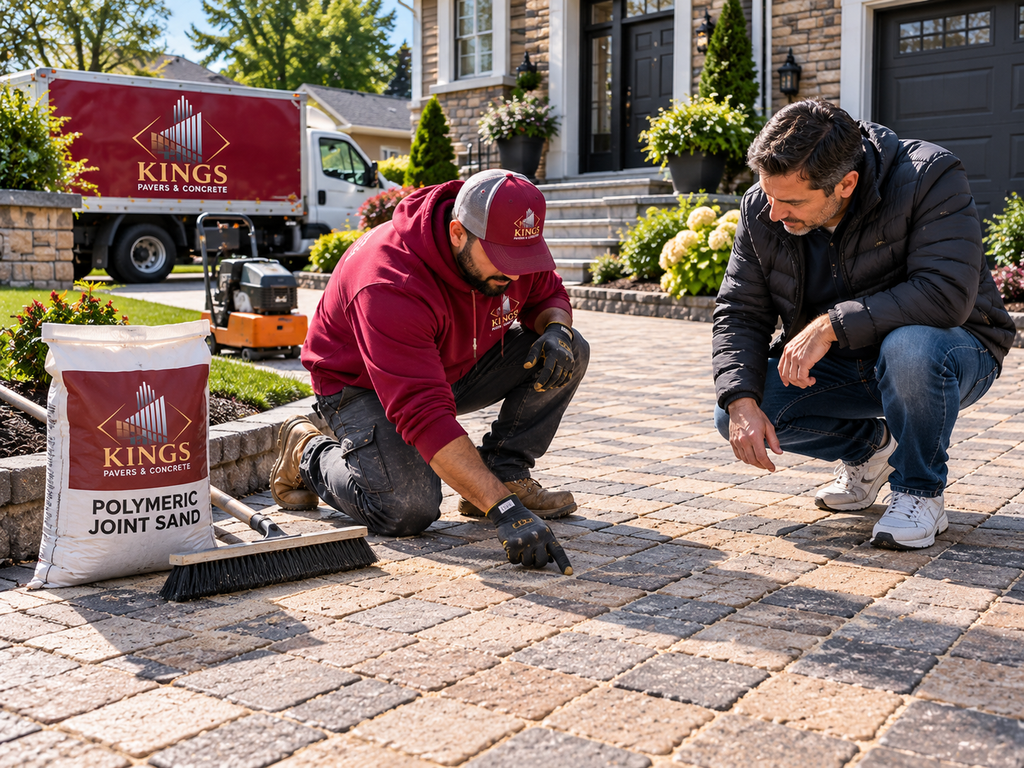
Paver maintenance is not complicated, but it is not zero either.
- Routine cleaning. Sweep debris off regularly, and rinse with a hose. Leaves and organic material left on the surface feed weeds and stain the pavers.
- Check the joints. If sand is thin or missing, sweep in more. Full joints keep the pavers locked and discourage weeds.
- Remove weeds when they appear. Pulling small weeds early is far easier than dealing with established ones. Address the cause by refilling joints.
- Watch for drainage problems. Look after heavy rain. Water pooling in one spot, or running along the edge of the surface, suggests grading or drainage needs attention.
- Deal with stains promptly. Oil, rust, and organic stains respond best when treated quickly. Test any cleaner on a small hidden area first.
- Inspect for settled or loose sections. Catch a small dip early and it is usually a small repair. Left alone, it can grow.
- Seal only where it makes sense. Sealing can enhance color, help resist stains, and stabilize joint sand, but it is not mandatory on every project. Some sealers change the surface texture or need reapplication, so discuss it with your installer based on the product and location.
- Be careful with pressure washing. High pressure can blast out joint sand. If you use one, keep it moderate and refill the joints afterward.
| Season | What to Do |
| Spring | Inspect for winter movement, sweep and rinse off salt and sand, refill joints, and check edges. |
| Summer | Pull weeds, address stains, and watch drainage during heavy storms. |
| Fall | Clear leaves, check joints, and confirm downspouts and drains are clear before freezing weather. |
| Winter | Use plastic-edged shovels, apply deicers sparingly, and let plow operators know it is a paver surface. |
Realistic Scenario: A Cracked Driveway in Westchester County
This is an illustrative example, not an actual customer project.
Picture a homeowner in Westchester County with a driveway that is more than twenty years old. It has cracks running across it near the garage, a low spot where water sits after rain, and a corner that has lifted where a tree root has grown underneath. They have patched the cracks twice, and the patches are already opening up.
They are deciding between replacing the slab with new poured concrete or switching to interlocking driveway pavers.
A contractor walking the property would want to know why the old slab failed before recommending anything. If the base was thin and water was collecting underneath, a new slab poured over the same conditions could crack again. Pavers over the same conditions could sink. So the first job, for either material, is excavating, correcting the base, and fixing the drainage. The tree root might need to be dealt with too.
Once those are addressed, the choice becomes about priorities. Pavers would offer easier repair if a utility line needs access or a section settles. Concrete might come in at a lower price and offer a simpler surface with less routine upkeep. If the homeowner cares about appearance and long-term repairability, pavers may be the better fit. If budget is the main concern and drainage is fixed, a well-built concrete driveway may make more sense.
Neither material is the automatic answer. The base and drainage decide how either one performs.
Are Interlocking Pavers Worth It in New York?
Sometimes, and the reasons matter.
Pavers tend to make sense when:
- You want flexibility in color, pattern, and layout.
- The site has conditions where a rigid slab has cracked before, and you are prepared to correct the base and drainage properly.
- You value being able to repair or access one section without replacing the whole surface.
- You are comfortable with periodic joint maintenance.
- The budget allows for proper excavation and base preparation, rather than cutting corners.
Another material may be a better fit when:
- Upfront cost is the main constraint and a simple slab meets your needs.
- You want the lowest possible maintenance and are not interested in joint upkeep.
- The site has unresolved drainage problems and there is no plan to fix them.
- You are hoping pavers will hide problems underneath. They will not.
Installation quality is the one factor that applies in every case. A well-installed surface in almost any material will outperform a badly installed surface in a “better” one.
5. FAQs
What are interlocking pavers?
What are interlocking pavers? They are individual units, most often concrete, installed on a compacted stone base and bedding layer, with sand-filled joints and edge restraints. Once compacted, the units lock together and work as one flexible surface.
How long do interlocking pavers last?
There is no single number. Lifespan depends on the paver, the base preparation, drainage, traffic, and how well the surface is maintained. A properly installed surface with good drainage and regular joint upkeep has the best chance of performing well over many years.
Are interlocking pavers good for driveways?
They can be, if the driveway is built with a deeper base, thicker pavers, and proper edge restraints for vehicle loads. Areas where cars turn or park regularly need particularly solid base preparation.
Can interlocking pavers crack?
Individual pavers can chip or crack under impact or unusual stress, but the surface as a whole does not crack like a slab. More often, problems show up as settling, shifting, or loose joints, which usually point to base or drainage issues.
Are interlocking pavers good for New York winters?
They can handle freeze-thaw conditions when installed over a well-compacted, well-drained base. Winter care matters too: use plastic-edged shovels, apply deicers sparingly, and tell plow operators the surface is pavers.
Do interlocking pavers require maintenance?
Yes, though it is manageable. Expect to sweep, refill joint sand as needed, pull weeds, watch drainage, and treat stains. Sealing is optional and depends on the situation.
Are interlocking pavers better than concrete?
Not always. Pavers offer design variety and easier repairs, while poured concrete can be simpler and less expensive up front. The better choice depends on your budget, site conditions, and maintenance expectations.
Thinking About a Paver Project?
If you’re considering interlocking pavers for your driveway, patio, or walkway, start with a professional look at the property. Kings Pavers & Concrete can assess the existing surface, drainage, and site conditions and help you understand which paving option makes sense for your property in New York.
Contact us to request an on-site assessment or free estimate for your paver project.