Most homeowners shopping for driveway pavers in New Hyde Park start with color and style. The pattern usually comes up later, almost as an afterthought. That is backwards. On a driveway, the way pavers are arranged affects how well the surface resists braking and turning tires, and it also decides how the finished drive looks from the street.
This guide compares the common layouts, explains which ones hold up under vehicle traffic, and shows how borders, colors, and accents can be combined into a design that suits your home. It also covers the winter and permit factors that shape design decisions, so you can walk into an estimate conversation with specific preferences instead of a vague wish for something nice.
Why Pattern Matters More on a Driveway Than a Patio
Pavers stay put because they interlock. Joint sand transfers load between neighboring units, and the layout locks the pavers against one another. A patio sees footsteps and furniture. A driveway sees braking, accelerating, and tires turning in place beside the garage. Those sideways forces push pavers along any joint line that runs straight for a long distance.
That is why the Interlocking Concrete Pavement Institute (ICPI) recommends a herringbone laying pattern for all vehicular applications. Other layouts are not off limits, but the main field of a driveway should be chosen for function first and looks second.
Pattern is only one part of a durable driveway. Thickness, base depth, drainage, and edge restraint matter just as much, and our guide to driveway pavers in New Hyde Park covers materials and construction. This article stays on layout and design.
The Main Driveway Paver Patterns Compared
The table summarizes general industry guidance. Confirm specifics with your installer and the paver manufacturer, since products differ.
| Pattern | Visual character | Driveway suitability |
| Herringbone (45 or 90 degrees) | Interlocking zigzag, traditional | Strongest choice, recommended by ICPI for vehicle use |
| Running bond | Staggered rows like a brick wall | Acceptable with correct orientation and lighter use |
| Basketweave | Pairs of pavers alternating direction | Better for patios, walkways, and accents |
| Stack bond | Pavers aligned in a grid | Not suited to vehicle areas |
| Multi-size or random sets | Varied, cobblestone look | Depends on the product and manufacturer guidance |
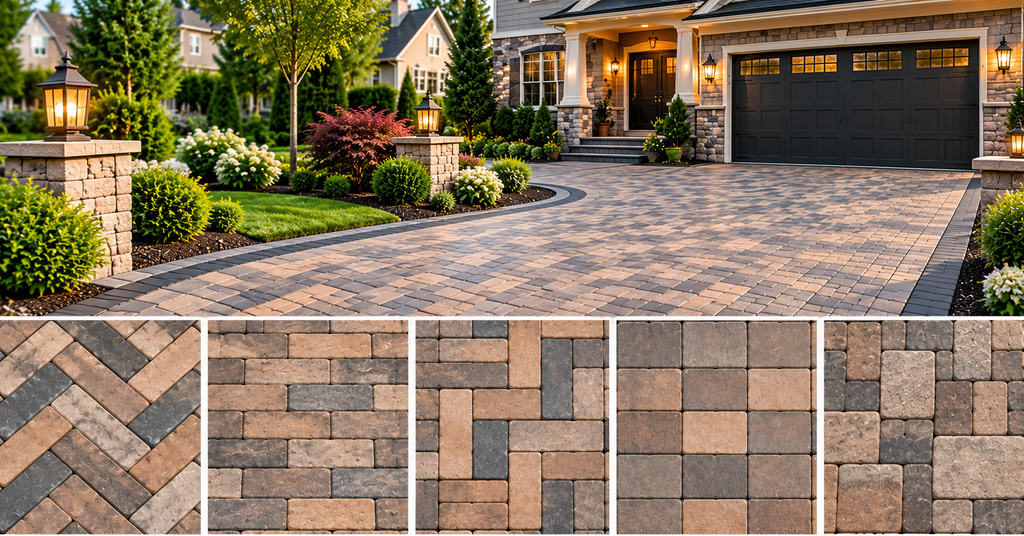
Herringbone: 45 or 90 Degrees
Herringbone sets rectangular pavers at right angles in a repeating V. Because the joints keep changing direction, none runs far in a straight line. According to an industry article on paver sizing, no joint in a herringbone layout runs longer than about one and a half pavers.
The 45-degree version runs the zigzag diagonally across the driveway, which many homeowners find more dynamic. It also creates angled cuts where the pattern meets straight edges, so it generally means more labor and more waste. The 90-degree version lines up with the driveway edges for a cleaner, more traditional look and typically fewer cuts. Both interlock well, so the choice comes down to appearance and budget.
Running Bond
Running bond lays pavers in staggered rows, like a brick wall. It reads quieter than herringbone and suits clean, modern homes and larger rectangular pavers. The drawback is that joint lines run continuously in one direction. On a driveway, they should run perpendicular to the direction of travel, so tires cross the joints instead of rolling along them. If you like this look, ask your installer how it will be oriented and whether the specific product is intended for vehicles.
Basketweave and Stack Bond
Basketweave alternates pairs of pavers horizontally and vertically for a classic woven look. Stack bond aligns every unit in a grid for a crisp, contemporary feel, but its joints run straight in both directions, which gives sideways forces an easy path. Both patterns are better suited to walkways, stoop landings, and patios. On a driveway, use them only as accents outside the main wheel paths, and only if your installer approves.
Multi-Size and Random Sets
Many manufacturers sell kits that combine several paver sizes into a cobblestone-style layout. Interlock varies with the shapes and the pattern, so follow the manufacturer’s driveway instructions. Keep in mind that interlock tends to decrease as units get larger, so oversized slabs are best kept out of the wheel tracks.
Borders, Bands, and Accents
The field pattern does the structural work. Borders and accents do most of the design work.
- Perimeter border: One or two rows framing the driveway, usually in a contrasting color or a different direction from the field. It also tidies the cuts where the field meets the edge.
- Apron band: A contrasting strip where the driveway meets the street or sidewalk, which marks the transition. Check permit rules first, since apron work often involves the municipality.
- Garage band: A stripe across the front of the garage that separates the parking area from the approach.
- Inset panels: A different color or layout set into the field, best placed away from the wheel paths.
Borders look cleanest when they follow the shape of the driveway, and curves require extra cutting or curved-edge products. A border is a design feature. It does not replace edge restraint, the separate component that keeps the whole field from spreading under turning tires. Kings Pavers lists driveway borders and edging among its services, and its interlocking driveway installation page covers the installation side.
Choosing Colors and Textures
Start with what will not change: the roof, brick or siding, trim, and front walkway. Gray and tan blends pair with most exteriors, warm tones suit red brick, and a charcoal border adds contrast without much effort. Two or three colors in total usually look more cohesive than five.
Judge samples outdoors, wet and dry, and ask to see a larger display or installed photos rather than a single paver. Order everything from one production run, and ask whether you can keep a few spares for future repairs.
Some concrete pavers develop a white haze called efflorescence during their first months. It is a surface deposit of natural salts and usually fades over time, but it is worth asking your supplier about before you buy. Texture is a style choice too. Tumbled edges give a softer, aged look, while smooth, square-edged units look more contemporary.
Matching the Design to Your Driveway
A wide two-car driveway can read as one large gray sheet, so a border or garage band helps break it up. A narrow driveway looks better with a simpler layout and a single border row, because heavy banding crowds the space. A curved driveway needs a pattern that adapts. Herringbone generally follows curves well, though the installer will need to cut pavers along the edge, so ask for a sketch showing how the pattern meets each curve.
Pattern will not fix drainage. The surface needs enough slope to carry water away from the house and garage regardless of layout, so settle that before the design details.
Winter and Permit Considerations in New Hyde Park
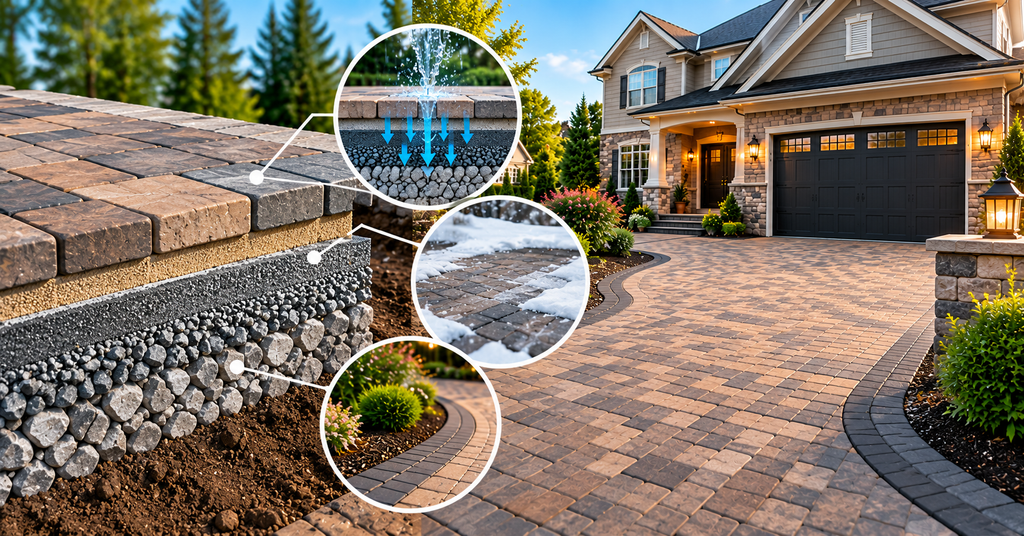
Long Island winters bring repeated freezing and thawing, and early trouble usually shows up where tires turn and along the edges. A well-interlocked pattern, tight joints, and solid edge restraint keep those areas stable. Joint sand tends to wash out over time, so plan to check it as part of regular upkeep.
Design changes can also raise permit questions. If your plan widens the driveway or alters the apron, curb, or sidewalk, the municipality may need to approve it. The Village of New Hyde Park publishes a Sidewalk, Curb, Apron and Driveway Permit Application, but New Hyde Park addresses can fall under different jurisdictions depending on where the property sits. Confirm the rules for your address before you finalize a layout, and ask your contractor who will handle the application.
How Design Choices Affect Cost
Per-square-foot numbers date quickly and rarely reflect a specific site, so it is more useful to know what moves the price. Diagonal layouts, extra border rows, several colors, curves, and custom accents all add cuts and labor and increase material waste. Specialty shapes can raise material costs as well.
Request an itemized estimate and a scaled layout drawing, then ask what changes if you simplify the border or switch from 45-degree to 90-degree herringbone. Seeing those options priced in writing is the easiest way to learn what each design element costs. For the installation side of the project, see Kings Pavers’ driveway paver installation page.
Design Mistakes to Avoid
- Choosing a pattern for looks alone, without confirming it is appropriate for vehicle traffic
- Laying running bond with joint lines parallel to the tires’ path
- Placing oversized slabs in the wheel tracks
- Using too many colors or border rows, which can look busy and add cost
- Approving a design without a sketch that shows curves, the apron, and the garage threshold
- Overlooking permit requirements when the design changes the apron or curb
Frequently Asked Questions
What is the best paver pattern for a driveway?
Herringbone, in either 45 or 90 degrees, is the standard choice. ICPI recommends it for all vehicular applications because its constantly changing joint directions resist the sideways forces of braking and turning. Running bond can work with the right orientation and lighter use.
Is 45-degree or 90-degree herringbone better?
Both interlock well. The 45-degree layout has a more dynamic look but creates more angled cuts, which usually means more labor and waste. The 90-degree layout lines up with the driveway edges and typically needs fewer cuts. Choose based on appearance and budget, then ask your installer to price both.
Can I use more than one pattern in the same driveway?
Yes, as long as the main wheel area uses a layout suited to vehicles. Many designs combine a herringbone field with a border in a contrasting color or direction. Confirm with your installer that any accent pattern is appropriate for its location.
Does the pattern change how much a paver driveway costs?
It can. Diagonal layouts, extra border rows, multiple colors, and curves add cuts, labor, and waste. Request an itemized estimate that shows the difference between design options so you can decide where added complexity is worth paying for.
Do I need a permit to change my driveway design in New Hyde Park?
It depends on the scope and your address. Work that affects the curb, apron, or sidewalk may need municipal approval, and the Village of New Hyde Park has its own permit application. Confirm requirements with the authority for your property before work begins.
Choosing Your Pattern
A strong paver driveway design starts with a layout built for traffic, usually herringbone, and then adds borders, colors, and accents that suit the house. Bring photos of driveways you like, your address, and any permit questions to the estimate conversation. Contact Kings Pavers & Concrete with your address and project details, and the team can confirm availability and talk through layout options for your driveway.