Concrete Resurfacing in NY: Can You Pour Over Existing Concrete?
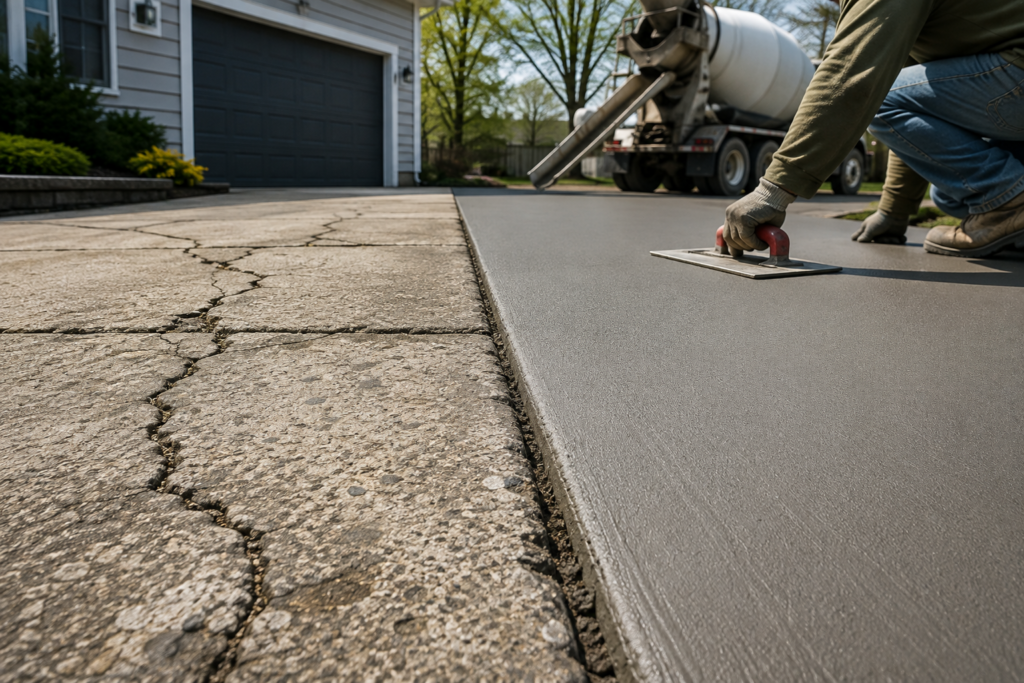
Yes, you can pour new concrete over existing concrete, but only if that old slab earns the privilege. A driveway with light surface wear and no real structural problems is often a good candidate. A driveway with a two-inch height difference across a crack, or one that’s been heaving every spring for years, usually isn’t. The concrete underneath doesn’t just sit there quietly once you cover it. Whatever problems it has tend to show up again, and sometimes faster than homeowners expect. If you’re standing on an old patio or driveway in New York right now, trying to decide whether it’s worth saving, here’s what actually goes into that decision. Can You Pour Concrete Over Existing Concrete? Technically, yes. Contractors do it all the time, and there’s nothing unusual about adding a new layer of concrete on top of an old slab. The real question isn’t whether it’s possible; it’s whether it’s the right call for your specific slab. Here’s the distinction that matters: pouring fresh concrete over an existing slab is different from what most people mean when they say “resurfacing” or “overlaying.” A true concrete overlay is a thin, specialized layer, often somewhere between a fraction of an inch and a couple of inches, designed specifically to bond to old concrete and give it a new wearing surface. Pouring a full-depth slab on top of an existing one is a heavier undertaking, and it comes with its own set of clearance and elevation issues around doors, garage openings, and drainage. Both approaches depend on one thing above everything else: the existing slab needs to be structurally sound. Not perfect. Not crack-free. Just sound enough that it isn’t actively moving, settling, or failing underneath whatever gets placed on top of it. Cosmetic damage: surface scaling, discoloration, shallow spalling, hairline cracks that have stopped moving – those are usually fine to build over. Structural problems are a different story, and covering them up rarely makes them go away. When Is Pouring Over Existing Concrete a Good Idea? A patio that’s held up fine for fifteen years but looks tired and pitted on the surface is a textbook case for resurfacing. So is a walkway with some staining and minor scuffing, or a basement floor that’s structurally solid but visually rough. Driveways are a little more situational. If the slab is level, drains properly, and the cracking is limited to hairline stuff that isn’t shifting, an overlay can extend its life and improve how it looks without the cost of tearing everything out. The trouble comes when a driveway has been patched repeatedly over the years, or when one section has settled lower than the rest. At that point, you’re not resurfacing a problem; you’re hiding it. Commercial properties see this question a lot too, especially older parking areas, loading zones, and walkways around retail buildings. If the base underneath is still stable and the slab isn’t tracking any drainage or settlement issues, resurfacing can be a reasonable way to refresh a worn surface without shutting down a lot of the property for demolition. The common thread across all of these situations is stability. Surface wear is something an overlay was built to solve. Movement is not. When Should You NOT Pour Concrete Over Existing Concrete? Some warning signs should stop the conversation before it starts. Major cracks the kind wider than a pencil line, or ones where you can feel a lip between one side and the other usually point to something happening below the surface, not on it. Uneven settlement is another one. If part of a slab has sunk relative to the rest, that’s a base problem, and a new layer of concrete on top isn’t going to correct the grade or stop it from continuing to settle. Heaving is its own category, and it’s common enough in this region that it deserves its own mention below. Drainage problems matter too if water already pools against a slab or runs toward a foundation instead of away from it, adding material on top can make the pitch worse, not better. An unstable base is probably the least visible of these issues and the most important. Concrete only performs as well as what’s underneath it. Voids, washed-out soil, or a base that was never compacted properly will eventually cause new concrete to crack in the same spots as the old, no matter how well the surface work was done. The practical point here is simple: a crack or movement problem in the old slab doesn’t stay contained. Left alone, it tends to reflect whatever gets placed on top, sometimes within a year or two, sometimes longer. Covering a problem isn’t the same as solving it. Concrete Resurfacing vs. Concrete Replacement Factor Resurfacing/Overlay Full Replacement Existing slab condition Structurally sound, cosmetic or surface-level wear Cracked, settled, heaving, or base is compromised Typical use Patios, walkways, some driveways, interior floors, commercial surfaces in stable condition Driveways with major cracking, slabs with drainage or settlement failure Preparation required Cleaning, crack treatment, bonding agent, surface profiling Demolition, disposal, base regrading and compaction Disruption Lower often a shorter project timeline Higher full excavation and rebuild Appearance options Stamping, staining, broom or trowel finishes, similar to new concrete Full design flexibility since it’s built from scratch Best suited for Slabs with wear, staining, or minor stable cracking Slabs with structural, drainage, or base problems Main limitation Can’t fix what’s happening underneath the slab Higher cost and more disruption to the property How Contractors Decide Whether Existing Concrete Can Be Resurfaced A contractor evaluating a slab isn’t just glancing at the surface. They’re reading it. Crack patterns tell a story. A single hairline crack that hasn’t widened in years reads very differently than a spiderweb pattern radiating from one corner, which often points to a base or drainage issue. Settlement gets checked by eye and sometimes with a level to see if one section is lower than the section next to it, and if so, by