What Is Concrete Spalling? Causes, Signs & How to Fix It in New York
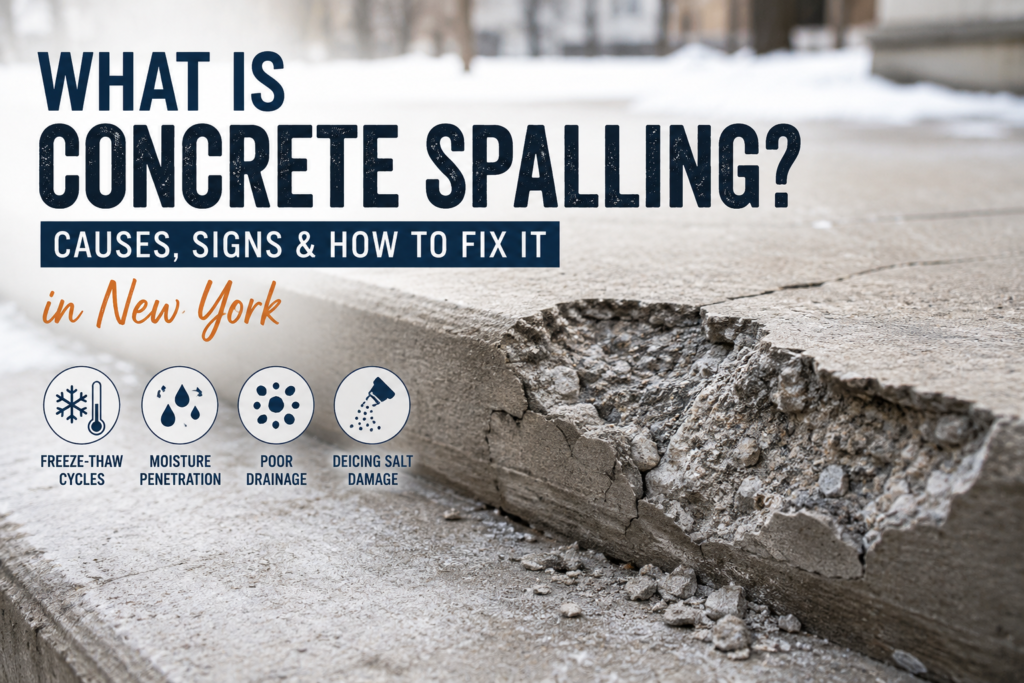
You walk out to the driveway in March, snow’s finally gone, and there it is: a patch near the garage where the top of the concrete has flaked away, leaving behind a rough, pitted surface that wasn’t there last fall. Maybe it’s the front steps. Maybe it’s a section of sidewalk where you can suddenly see the little stones that make up the concrete itself. Whatever the spot, the question is usually the same: what is this, and do I need to worry about it? In most cases, what you’re looking at is concrete spalling. It’s one of the most common things we get called out for in the spring, and it’s almost always tied back to how New York concrete gets treated over the winter. The short version: spalling is the surface of the concrete breaking away, usually in layers or chunks, because of moisture that got into the slab and then froze. The longer version, including when it’s minor and when it’s a bigger problem, is worth understanding before you decide what to do about it. What Is Concrete Spalling? Spalling is what happens when the top layer of a concrete surface flakes, peels, or chips away, exposing the material underneath. It can look like anything from light surface flaking that resembles peeling paint to larger chunks breaking loose and leaving craters behind. What’s actually happening is that moisture works its way into the concrete through hairline cracks, through the natural pores in the surface, or through poor finishing, and then something puts pressure on that moisture from the inside. Usually it’s freezing. Water expands when it turns to ice, and concrete isn’t flexible enough to handle that expansion without cracking or breaking at the surface. Over a few freeze-thaw cycles, that damage compounds. What starts as a rough patch can turn into a section of missing concrete. Some people call this spalling concrete, some call it flaking concrete, and some just say the surface is “peeling.” It’s the same issue described in a few different ways. And it’s worth being clear about something early on: a little bit of surface texture change isn’t automatically a crisis. Concrete ages. But spalling that keeps spreading, or that exposes anything underneath the surface, is a different story. What Does Spalling Concrete Look Like? This is usually the easiest way to figure out what you’re dealing with, because spalling has a pretty distinct look once you know what to check for. Light spalling often shows up as flaking or peeling thin layers of concrete lifting away, sometimes in patches only a few inches wide. Move further along the damage scale, and you start seeing pitting, small craters where pieces have popped out entirely. In more advanced cases, the surface feels rough or sandy underfoot; the aggregate, the gravel mixed into the concrete, becomes visible, and edges near joints or cracks start crumbling when you press on them. The most serious version is when you can see rebar or wire mesh poking through. That’s not cosmetic anymore, and it usually means water and possibly deicing salt have been getting to that steel for a while. What You See What It Could Indicate Recommended Next Step Light surface flaking, small patches Early-stage spalling, possibly a poor finishing layer Monitor and keep clean; note if it spreads Pitting or small craters Freeze-thaw damage progressing below the surface Have it inspected before next winter Visible aggregate (gravel showing) Loss of the top mortar layer Repair recommended to prevent further wear Rough, sandy texture over a wide area Widespread surface deterioration Professional assessment of repair vs. resurfacing Crumbling near joints or edges Water collecting and freezing at vulnerable points Check drainage and repair before it spreads Exposed rebar or wire mesh Reinforcement corrosion, more serious internal damage Get a professional evaluation soon What Causes Concrete Spalling? There’s rarely just one cause. Usually, it’s a combination of things working against the slab at the same time. Freeze-Thaw Cycles This is the big one in New York. Concrete is porous, not obviously, but at a small scale, water can get in. When temperatures drop, that trapped water freezes and expands, putting pressure on the surrounding concrete from the inside. When it thaws, the pressure releases, but the damage from the expansion is already done. Repeat that cycle over a winter with multiple thaws and refreezes, which is typical for us, and the surface starts to break down layer by layer. Deicing Salts Rock salt and other deicing products lower the freezing point of water sitting on the surface, which changes how and when that moisture freezes and refreezes. Over repeated seasons, this can accelerate surface deterioration, especially on concrete that wasn’t finished or sealed well to begin with. It’s not that using salt once will ruin a driveway; it’s the cumulative effect over years that tends to show up. Excess Moisture and Poor Drainage Any spot where water tends to pool a low point in a driveway, an area near a downspout, or a section without proper slope is going to spall before the rest of the slab. Standing water means more saturation, and more saturation means more material available to freeze and expand. Installation or Finishing Problems Some spalling traces back to how the concrete was placed years earlier. Adding too much water to the mix, finishing the surface too early or too late, or troweling in a way that seals a weak, water-rich layer at the top can all leave a surface that’s more vulnerable than it should be. This isn’t always obvious until years later, when that top layer starts to go. Corroding Reinforcement When water and salt reach the steel reinforcement inside the concrete rebar or mesh the steel starts to rust. Rust takes up more space than the original steel, and that expansion pushes outward against the concrete around it, cracking and eventually breaking it away from the inside. This is one of the more serious causes because the damage is happening