
Why Are There Cracks in Sidewalks in New York?
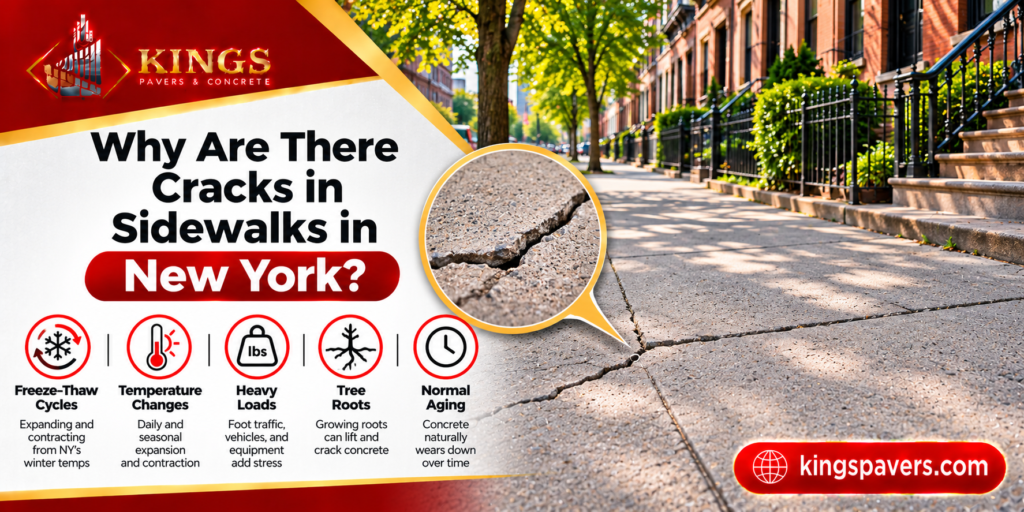
You probably didn’t think much about that hairline crack near your stoop back in October. It was thin, barely wide enough to catch a heel, the kind of thing you step over without noticing. Then March rolled around, the snow melted, and suddenly that same crack has a lip to it. One side sits a little higher than the other. Water pools next to it every time it rains. If that sounds familiar, you’re not imagining things. New York sidewalks take a beating every year, and the damage tends to show up gradually, then all at once. Why Are There Cracks in Sidewalks? Sidewalk cracks usually aren’t caused by one single thing. They’re the result of several forces working on the same slab of concrete over time: moisture getting into small gaps, the ground underneath shifting, roots pushing up from below, the concrete itself aging, and in some cases, a base that wasn’t prepared properly when the sidewalk was poured. Add in a New York winter, and a small imperfection can turn into a real problem faster than most property owners expect. Concrete is strong under compression but much weaker when it’s pulled or flexed, which is exactly what happens when the ground beneath it moves unevenly. Once a crack forms, it becomes an entry point for water, and that’s usually where things start to accelerate. Common Causes of Sidewalk Cracks in New York Freeze-thaw cycles Water gets into a crack, freezes, expands, and widens the opening. This happens repeatedly over a winter, sometimes dozens of times depending on the weather pattern. Tree roots Mature street trees, especially the older plantings common in many New York neighborhoods, have root systems that don’t stop growing just because there’s concrete overhead. Roots push up from underneath, and a slab that was flat can end up tilted or lifted along one edge. Soil settlement and movement The soil under a sidewalk isn’t static. It compacts, shifts, and sometimes washes out from underneath the slab, particularly near older utility work or where drainage has been a long-term issue. When the base loses support, the concrete above it has nothing to rest on evenly. Aging concrete Concrete has a service life. Older sidewalks, especially ones installed decades ago with different materials and standards, are simply more prone to cracking than a slab poured in the last several years. Poor drainage Water that has nowhere to go tends to find its way under the sidewalk instead. Over time, that erodes the base and contributes to uneven settling. Heavy pedestrian and vehicle use Sidewalks near commercial corridors, transit stops, or driveways see far more load and vibration than a quiet residential block. That extra stress adds up. Improper installation Not every sidewalk was poured the same way. A base that wasn’t compacted correctly, or concrete that wasn’t cured properly, tends to crack sooner and more unpredictably than a well-installed slab. How New York Winters Affect Concrete Sidewalks This is the one most property owners underestimate. A crack that looks purely cosmetic in October can look completely different by February. Here’s the basic mechanism: water gets into any small opening in the concrete, whether that’s a hairline crack or a joint. When temperatures drop, that water freezes and expands, which pushes the crack wider. When it thaws, the water drains a little deeper into the gap. Then it freezes again. Repeat that cycle a few dozen times over a New York winter, and a crack that started as a cosmetic issue can turn into something with real depth and width. This is also why so many sidewalk complaints and repair calls pick up in early spring. The damage was building all winter. It just becomes visible once the snow is gone. Tree Roots and Sidewalk Damage Street trees are one of the most common causes of lifted or cracked sidewalk slabs in New York, particularly on blocks with mature trees planted decades ago. As a tree matures, its root system spreads outward, often much farther than people expect, and roots close to the surface can push directly against the underside of a concrete slab. This doesn’t mean the tree needs to come out. In many cases, the tree can stay, and the sidewalk section can be repaired or reset around it. Because trees along New York sidewalks are frequently subject to specific rules, particularly when they’re city-owned, any work near tree roots may require some coordination with the relevant department before repairs move forward. It’s worth checking current requirements before starting work, since root-related sidewalk repairs are handled differently than a standard crack repair. Drainage and Water Problems Water is one of the most consistent culprits behind sidewalk deterioration. When drainage around a property isn’t working the way it should, water can run toward the sidewalk instead of away from it, pool at low points, and eventually find its way underneath the slab. Once water sits under a section of concrete regularly, it starts to erode the base material. That leads to voids, which leads to settling, which leads to cracking or an uneven slab. It’s a slow process, but it’s a steady one, and it’s often made worse by gutters, downspouts, or grading that push water toward the sidewalk rather than away from the building. Does Every Sidewalk Crack Need Repair? Not necessarily. Sidewalk damage exists on a spectrum, and the right response depends on where a specific crack falls on it. None of this can be diagnosed accurately from a description alone. If a crack is growing, if a slab has shifted, or if water is consistently pooling in the same spot, that’s usually the point where a professional inspection makes more sense than guessing. Signs a Sidewalk Problem Is Getting Worse A few practical things worth watching for over time: None of these alone means a full replacement is necessary, but seeing more than one of them together is a reasonable signal to get it looked at. Step-by-Step: What to Do When You Notice