Best Driveway Pavers for New Hyde Park Homes: Materials and Styles
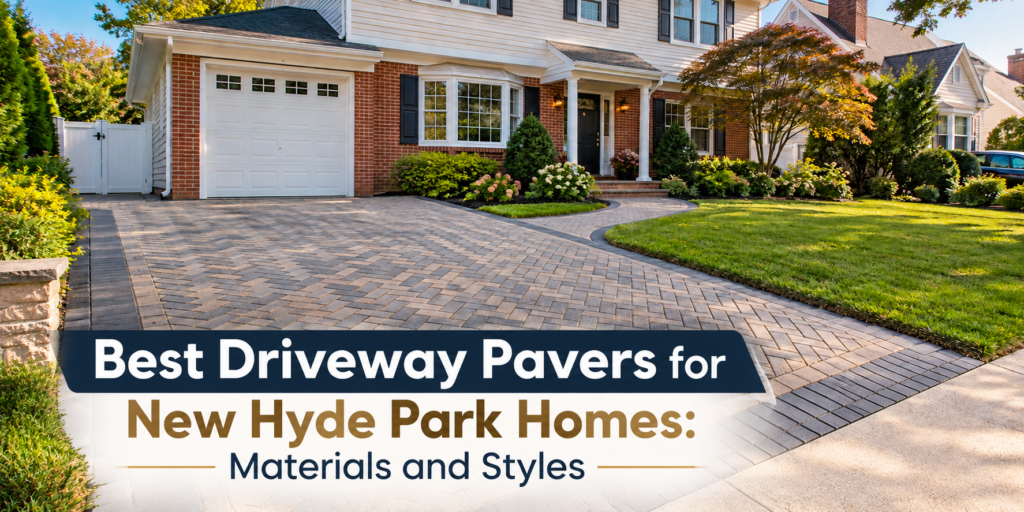
If you’re weighing options for a new driveway, you’ve probably already noticed there’s no shortage of opinions on what’s “best.” Some people swear by natural stone. Others won’t consider anything but concrete pavers because of the price. The honest answer is that the right choice depends on your driveway’s size, how it’s used day to day, and how well it’s installed, not just which material looks nicest in a showroom. For homeowners and property managers in New Hyde Park, there’s an added layer to think about: winters here aren’t gentle. Between freeze-thaw cycles, road salt, and driveways that see everything from a single sedan to a contractor’s truck, picking driveway pavers in New Hyde Park means balancing looks with how a surface actually performs over years of Long Island weather. This guide walks through the materials, styles, and practical considerations that matter most, so you can go into a conversation with a contractor already knowing what questions to ask. What Makes a Good Driveway Paver for New Hyde Park? Appearance matters, obviously. It’s the first thing anyone notices pulling into a driveway. But a paver that looks great in July and starts heaving or cracking by February isn’t doing its job. A few things separate a driveway that ages well from one that becomes a headache: None of these factors work in isolation. A beautiful stone paver installed on a poorly compacted base will still shift and settle. A budget concrete paver, installed correctly with proper drainage, can outperform expectations for a long time. Best Driveway Paver Materials There are three material categories most homeowners end up comparing: concrete, brick, and natural stone. Each has a different personality, and each fits a different kind of property. Concrete pavers are the most common choice for residential driveways, and for good reason. Manufacturers produce them in a huge range of colors, textures, and shapes, which makes it easier to match a specific look without a custom budget. They’re manufactured under controlled conditions, so quality tends to be consistent from paver to paver. On the downside, some lower-end concrete pavers can fade over time with UV exposure, and color consistency across a large driveway depends on ordering enough material from the same production run. Brick pavers bring a classic, traditional look that suits a lot of the colonial and cape-style homes common around Long Island. Clay brick holds its color well since the color runs through the entire paver rather than sitting on the surface, so fading is less of a concern. Brick can be more brittle than concrete under heavy point loads, though, and it tends to cost more per square foot. Natural stone pavers, things like granite, bluestone, or travertine, offer a look that’s hard to replicate with manufactured materials. Every piece is unique, which some homeowners love, and others find inconsistent. Stone is generally very durable, but it’s also the most expensive option, and certain stone types need periodic sealing to resist staining, especially from oil or road salt residue. Material Appearance Maintenance Durability Considerations Best For Concrete Pavers Wide range of colors, textures, and patterns; consistent look Moderate; occasional cleaning and joint sand refresh Strong under vehicle loads when properly installed; some fading possible over time with lower-grade products Homeowners wanting flexibility in design at a moderate budget Brick Pavers Classic, traditional, warm tones that hold color well Low to moderate; color doesn’t fade like surface coatings Can be more prone to cracking under heavy point loads than concrete Colonial, cape, or traditional-style homes Natural Stone Pavers Unique, high-end, varied texture and color Higher; sealing often recommended, more careful cleaning Very durable material, but individual pieces can vary in thickness and finish Homeowners prioritizing a custom, premium look Popular Driveway Paver Styles for New Hyde Park Homes The pattern you choose changes the personality of a driveway almost as much as the material does. A few patterns come up again and again in this area: Herringbone is popular because the interlocking angles genuinely add strength under vehicle traffic, not just visual interest. It’s a common recommendation for driveways specifically because of how well it distributes weight. Running bond is a simpler, brick-like layout where each row is offset from the one before it. It’s clean, doesn’t compete visually with the house, and works well on more traditional properties. Basketweave creates a woven look using pairs of rectangular pavers. It reads as more formal and can suit a home with symmetrical architecture, though it’s used less often on driveways than on patios since it doesn’t lock together quite as tightly under load. Large-format contemporary pavers are gaining ground with newer or renovated homes that lean modern. Fewer joints, cleaner lines, a more minimal look overall. Contrasting borders are less about pattern and more about framing. A darker border paver around a lighter field, or vice versa, can define the edges of a driveway and make it look more intentional, especially on properties with a long or wide apron. The driveway’s dimensions matter here too. A tight, straight driveway on a smaller lot can look busy with an intricate pattern, while a wide, curved driveway often has enough visual space to support something like herringbone with a border. Take a look at your home’s roofline, window trim, and any existing hardscaping like walkways or a front step. Matching those tones, even loosely, ties the whole property together instead of making the driveway look like it was added as an afterthought. Which Pavers Handle New York Weather Well? New Hyde Park sits in a climate zone that goes through real freeze-thaw cycles most winters. Water gets into tiny gaps in a surface, freezes, expands, and repeats that cycle dozens of times over a season. Over years, that process is what causes cracking, heaving, and surface flaking in materials that aren’t suited for it. Denser, low-absorption pavers generally hold up better against this kind of cyclical freezing. That’s one reason properly manufactured concrete and clay brick pavers are common choices here; they’re
What’s Under Your Pavers? Why Base Material is the Key to Longevity
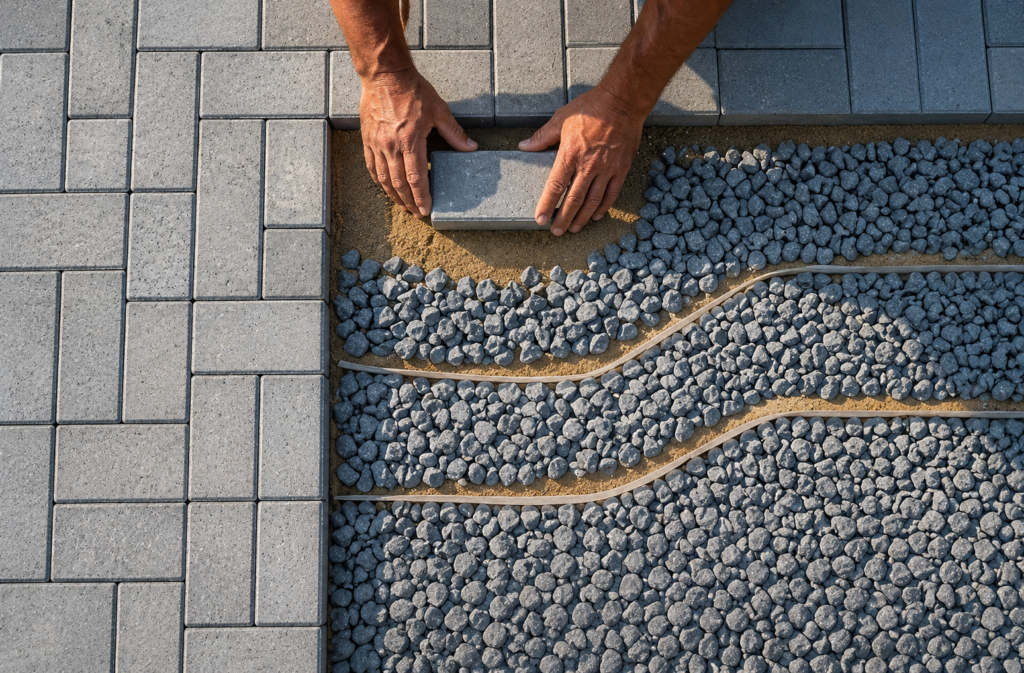
You spent good money on your driveway. Maybe it was a backyard patio, a walkway leading up to your front door, or a full commercial entrance. The pavers looked stunning the day they were laid crisp edges, tight joints, exactly what you envisioned. Then winter hit. Then spring came. And now, a year or two later, you’re looking at sunken sections, cracked stones, and joints that are starting to shift in ways that make you nervous about walking across them. Here’s the truth that a lot of homeowners don’t hear until it’s too late: the pavers themselves rarely fail. What fails is what’s underneath them. The base material is the invisible foundation that determines whether your paver installation lasts five years or fifty. Get it right, and your pavers will outlive the house. Get it wrong, and you’re looking at costly repairs before you’ve even finished paying for the original job. In this guide, we’re going to break down exactly what goes under pavers, how to properly prepare the base, and how deep that base needs to be depending on your specific project. Whether you’re a homeowner trying to understand what you’re paying for or someone who wants to know if a past install was done correctly, this one’s for you. Why Pavers Fail From the Ground Up Let’s start with what’s actually happening when pavers shift, crack, or sink. Most people assume it’s a material quality issue – that they got cheap pavers, or maybe the contractor rushed the job. Sometimes that’s true. But in the vast majority of cases, the problem is underground, and it started before a single paver was ever placed. The Most Common Paver Failures and What’s Actually Causing Them • Sunken pavers after heavy rain – Water has nowhere to go because the base isn’t draining properly. It pools under the surface, softens the ground, and pavers drop. • Cracking and movement after winter – In New York, freeze-thaw cycles are brutal. When water gets trapped in a poorly built base, it freezes, expands, and physically pushes pavers out of position. • Uneven surfaces that create trip hazards – This is almost always a compaction issue. If the base layers weren’t properly compacted during installation, the ground settles unevenly over time. • Pavers that look perfect at install but fall apart within a season or two – A quick, shallow base job might look fine on day one. But the moment it faces real-world stress – traffic, weather, soil movement – it starts to go. Here’s a figure that should make you pause: industry professionals estimate that up to 90% of paver failures can be traced directly back to improper base preparation. Not the pavers. The base. Think about what that means for your investment. You might be paying for premium concrete pavers, beautiful edge detailing, and a well-designed layout – and if the contractor cut corners underground, none of that matters. What Happens When the Base Is Done Wrong – The Real Cost We want to be direct with you here because we’ve seen what poor base work does to people’s properties – and it’s never cheap to fix. A beautiful surface over a bad base isn’t a driveway. It’s a problem that hasn’t shown up yet. What Actually Goes Under Pavers – Done Right Alright, let’s get into the meat of it. Here’s exactly what a properly built paver base looks like, from the ground up. The Layers of a Proper Paver Installation Think of a paver installation like a layered system, where each component has a specific job to do. Skip one layer or rush through it, and the whole system is compromised. 1. Native Soil / Subgrade – The Starting Point Before anything goes down, the existing soil needs to be evaluated and prepared. The subgrade is the native earth that everything else sits on. It needs to be stable, free of organic material (roots, debris, topsoil), and properly compacted. Soft or organic-rich soil must be removed and replaced with stable fill. In New York, where soil conditions vary significantly from one neighborhood to the next, this step is not optional. 2. Crushed Stone / Gravel Base – The Load-Bearing Layer This is the most important layer of the entire installation. Crushed angular stone – not rounded pea gravel, not sand, not dirt – is packed down in lifts to create a stable, load-distributing, water-draining foundation. The angular edges of crushed stone interlock when compacted, creating a base that resists movement and allows water to pass through and away from the surface. 3. Sand Bedding Layer – The Fine-Tuning Layer On top of the compacted gravel base, a thin layer of coarse sand (typically about 1 inch) is screeded to create a perfectly level surface for the pavers to sit on. This layer allows for minor adjustments in height and alignment. It is NOT a structural layer – it’s just there to help set the pavers evenly. Making this layer too thick is one of the most common DIY mistakes. 4. The Pavers – The Visible Surface Finally, the pavers themselves. By this point, if everything below has been done correctly, laying the pavers is almost the easy part. They’re set into the sand bed, tapped into place, and kept in alignment with edge restraints. 5. Polymeric Sand / Joint Sand – The Lock Once the pavers are in place and compacted, the joints between them are filled with polymeric sand. This material hardens when wet, locking the pavers together, preventing movement, and stopping weeds and insects from getting in through the joints. It’s the finishing step that holds the whole surface together. How Deep Should the Paver Base Be? This is one of the most searched questions when it comes to paver installation – and for good reason. The depth of