
Replacing an Old Driveway With Pavers in New Hyde Park: Planning Checklist
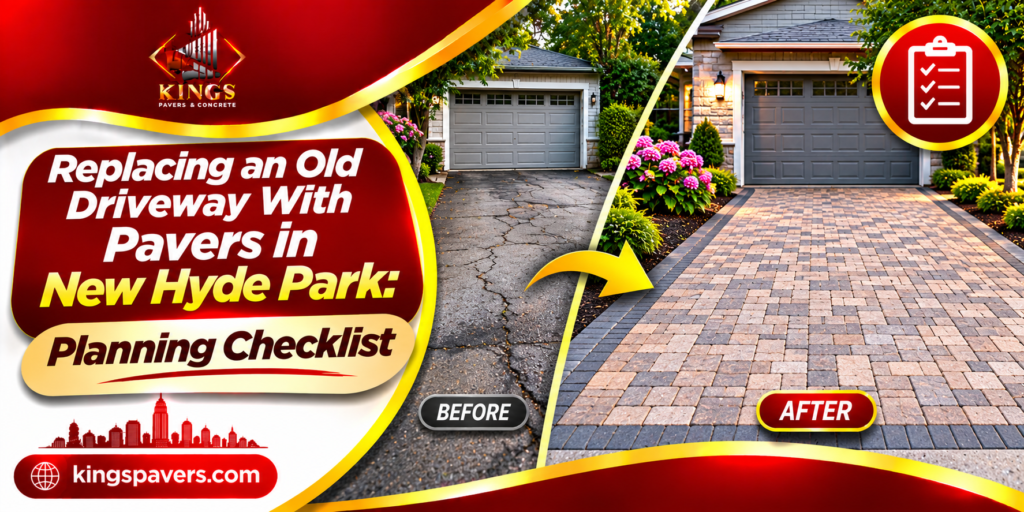
If you plan to replace your driveway with pavers in New Hyde Park, the most important work happens before anyone breaks up the old surface. A handful of early decisions shape the scope, the schedule, and how the finished driveway performs. The short answer: Before replacing an old driveway with pavers, consider these five questions. This guide covers each one and ends with a checklist you can use before you ask anyone for a quote. Repair or Replace? Signs Your Old Driveway Has Run Its Course Repair makes sense when damage is limited. That means a few narrow cracks, some surface wear, no sinking, and water that runs off where it should. Replacement starts to make sense when problems keep coming back or point to something below the surface: These symptoms often trace back to the base, the soil, or drainage under the surface. A new surface laid over the same problem usually inherits it. If you are unsure when an asphalt driveway should be replaced, our guide on how long asphalt lasts in New York is a good starting point. For slab problems, see how to fix cracks in a concrete driveway. One honest note: pavers usually cost more upfront than basic asphalt or poured concrete. If the lowest initial price is your top priority, say so at the estimate. If you want design flexibility and a surface that can often be repaired one section at a time, pavers deserve a serious look. Read Your Old Driveway Before You Call Anyone What you see on the surface tells a contractor where to look underneath. If You Have an Asphalt Driveway Look for a web of connected cracks, soft spots you can feel underfoot, deep ruts, potholes, and edges that have crumbled or dropped. Widespread cracking and soft areas usually mean the base or drainage has failed, not just the top layer. If you want to replace an asphalt driveway with pavers, those spots are exactly what a contractor will want to see. If You Have a Concrete Driveway Walk across the concrete slabs. Do any of them shift or rock when you step on them? Do they sound hollow when tapped? Is one side of a crack higher than the other? Flaking at the surface is often cosmetic. Settlement and uneven joints usually are not. If you are considering replacing a concrete driveway with pavers, the condition of the slab also decides whether an overlay is even on the table, which we cover next. Take photos of what you find. They will help later at the estimate. Does the Old Driveway Have to Come Out? For most aging driveways, yes. A paver driveway works as a system: compacted soil, a compacted stone base, bedding sand, pavers, and edge restraints. Building that system properly usually means removing the old surface and rebuilding what is under it. Covering a failing driveway just carries its problems into the new one. Overlay methods do exist. Industry groups publish guidance for setting pavers over existing asphalt or concrete. But they are meant for pavement that is stable, drains well, and leaves enough height for the added thickness. Because driveways support vehicle traffic, their structural requirements are more demanding than those of patios. Our article on putting pavers over concrete explains how to judge a slab. Whatever a contractor proposes, ask them to name the method in writing. “We’ll lay pavers over it” is not a scope of work. Also ask whether they plan to rebuild the base or keep any part of it, and why. Measure, Photograph, and Map What Surrounds the Driveway Before the estimate visit, gather the details that affect access and layout: What Is Under the Surface Matters More Than What Goes on Top Pavers are the visible layer. The compacted base underneath carries the load. ICPI guidance provides general recommendations for driveway aggregate base thickness, often ranging from approximately 6 to 8 inches depending on site conditions. It also says the right thickness depends on soil strength, drainage, climate, and traffic. In other words, there is no single depth that fits every lot. Water matters here too. In a freeze-thaw climate like Long Island’s, water that sits under a driveway and freezes can move it. That is why a clean, well-compacted base and a plan for runoff are not extras. Ask what the contractor will do if the crew finds soft, wet, or poorly compacted soil after the old driveway comes out, and how the added work will be priced and approved in writing. Our installation process guide walks through excavation, base, and bedding in detail. Drainage, Grading, and Finished Height Drainage is where many replacement projects succeed or fail. Before the estimate, look at these: If runoff is a major concern, ask whether a permeable paver system suits your site. It requires its own design, so it is a conversation for the estimate, not an assumption. Choosing Pavers and Edges for Vehicle Traffic Not every paver is meant for a driveway. ICPI guidance recommends pavers at least 2 3/8 inches (60 mm) thick for residential driveways, and notes that vehicular pavements typically use 3 1/8 inch (80 mm) units. Ask which thickness your contractor plans to use and why, especially if you park heavy vehicles or take deliveries. Two other design points affect performance, not just looks: If you want help narrowing down materials, see our guide to the best driveway pavers for New Hyde Park homes and our driveway borders and edging service page. Apron, Curb, Property Line, and Permits Replacing the surface inside your property line is one thing. Work that touches the driveway apron, the curb, or the sidewalk is another. Confirm which municipality you are in. Not every property with a New Hyde Park mailing address sits inside the Incorporated Village of New Hyde Park. Properties outside the Village may answer to the town or county instead. The simplest first step is to call the Village Building Department at (516) 354-0022, the number printed