
Paver Driveway vs. Poured Concrete in New Hyde Park
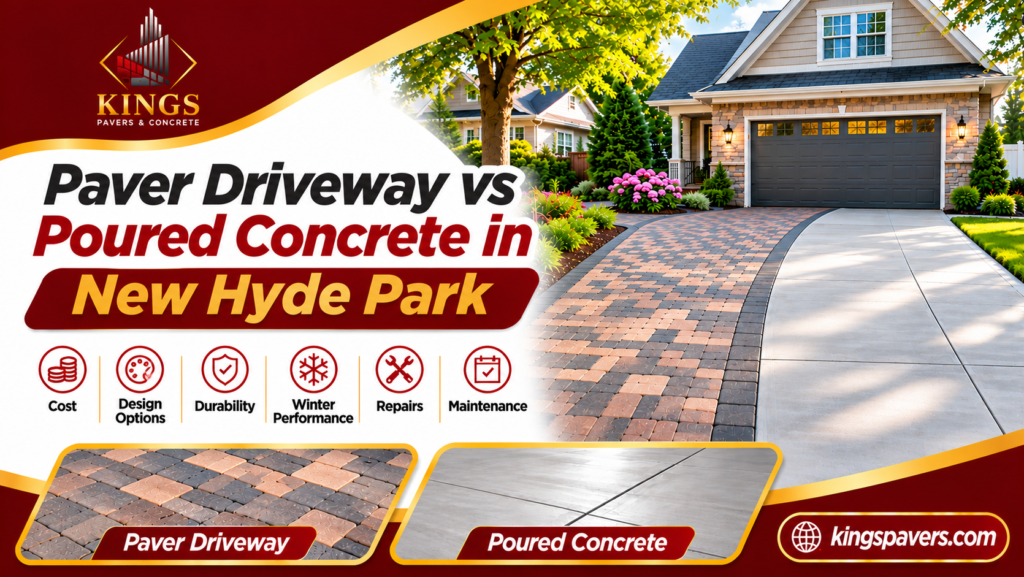
Choosing between pavers and concrete for a driveway comes down to a handful of trade-offs. Pavers generally offer more design flexibility, and you can often lift and reset individual units when one section needs work. Conventional poured concrete usually has a simpler look and often costs less up front for comparable standard projects. Both systems depend on good excavation, a well-prepared base, and sound drainage, and a poorly built version of either will disappoint. So the better driveway for your New Hyde Park home depends on your budget, how much the appearance matters to you, how you feel about ongoing maintenance, and what the site itself needs. The sections below compare the two across the factors that matter most. Paver Driveway vs Poured Concrete: Quick Comparison This table summarizes the general differences. Individual projects vary with materials, site conditions, and workmanship. Factor Paver Driveway Poured Concrete Driveway Upfront cost Often higher for a comparable area; varies with paver type, pattern, and base requirements Often lower for a standard slab; rises with decorative finishes, thickness, and reinforcement Design options Wide range of colors, shapes, patterns, and borders Simpler look by default; coloring, stamping, and exposed aggregate expand the options Durability Depends heavily on base compaction, edge restraint, and drainage Depends on subgrade, slab thickness, reinforcement, joint layout, and mix quality Winter performance Joints allow some movement and water passage; units can shift or heave if the base or drainage is poor Rigid slab; can crack or scale if water, freeze-thaw cycles, and deicers aren’t managed Repairs Individual units can often be lifted and reset; matching replacements depends on availability Cracks are patched or sections replaced; repairs are often visible Maintenance Joint sand, weed control, periodic cleaning, optional sealing Crack and joint sealing, cleaning, optional sealing Drainage Conventional pavers are not permeable; permeable systems are a separate design Conventional concrete is not permeable; pervious concrete is a separate product Installation Excavate, compact aggregate base, set bedding layer, lay units, restrain edges, fill joints Excavate, prepare base, set forms and reinforcement, place, finish, cure Long-term value Appearance and repairability appeal to many owners; results depend on workmanship Lower entry cost; long-term outcome depends on installation quality and upkeep The biggest practical differences are how each driveway looks, how it behaves when something goes wrong, and how the costs are spread over time. Concrete tends to cost less at the start. Pavers tend to offer more flexibility later, whether that means design choices or spot repairs. What Is the Difference Between a Paver Driveway and a Poured Concrete Driveway? A paver driveway is a surface made of individual units laid over a compacted base. A poured concrete driveway is a single continuous slab (or a few large slabs) formed on site. That structural difference drives most of the differences in cost, repair, and appearance. How Paver Driveways Are Constructed A paver driveway is built in layers. The existing surface and soil are excavated, the subgrade is evaluated, and a compacted aggregate base is installed. A thin bedding layer goes on top, the pavers are laid in a pattern, and edge restraints hold the perimeter in place. Joint sand, often polymeric sand, fills the gaps between units and helps lock them together. “Pavers” covers several materials, and they are not interchangeable: When people compare “pavers vs concrete” for a driveway, they usually mean interlocking concrete pavers, but it’s worth confirming the product’s specifications with your contractor. A homeowner exploring this option can read more about professional paver installation. How Poured Concrete Driveways Are Constructed A concrete driveway starts with similar excavation and base preparation. Forms are set to define the edges, reinforcement (such as steel mesh or rebar) is placed where specified, and the concrete is poured, leveled, and finished. Control joints are cut or tool-tied into the slab so that shrinkage cracking occurs along planned lines rather than randomly. The slab then needs time to cure before it reaches its working strength. Reinforcement doesn’t prevent cracks. It helps keep any cracks that form tightly closed. Slab thickness, mix quality, and joint spacing all affect how the driveway performs, so these are worth asking about before signing anything. How Do Paver and Concrete Driveway Costs Compare? Concrete often costs less up front, while pavers often cost more at installation but can change how repairs are handled later. Exact figures depend on the project, so this section covers how the costs are structured, not specific prices. Upfront Costs Paver projects typically involve more material handling and more hand labor per square foot: individual units, a bedding layer, edge restraints, and joint fill. Pattern complexity and borders add time. A standard concrete slab is usually faster to place, which is one reason it often has a lower entry price. Concrete costs climb too. Decorative stamping, coloring, added thickness, and extra reinforcement can narrow the gap. The type of paver also matters, since basic interlocking concrete pavers and natural stone sit at very different price points. Hypothetical example, for illustration only: two neighbors with similar driveways each request quotes. One chooses a plain broom-finish slab, and the other chooses a patterned paver driveway with a border. Even with identical dimensions, the second quote will likely be higher because of materials and labor hours. If the first neighbor then adds stamped patterns and color, the difference may shrink. Maintenance, Repair, and Long-Term Ownership Costs Ownership costs depend on what happens after installation. Paver driveways may need periodic joint sand replenishment, weed control, and occasional re-leveling of a section. Concrete may need crack sealing, joint sealing, and, if a section deteriorates, patching or partial replacement. The repair patterns differ. If a paver section settles, a contractor can often lift the affected units, correct the base, and reset them. With concrete, a cracked or settled section is usually patched, lifted using specialized techniques where appropriate, or removed and replaced, and the repair is often visible against the original surface. Neither material is maintenance-free, and neither has a guaranteed lifespan. For
Paver Driveway vs. Asphalt in New Hyde Park: Which Fits Your Property?
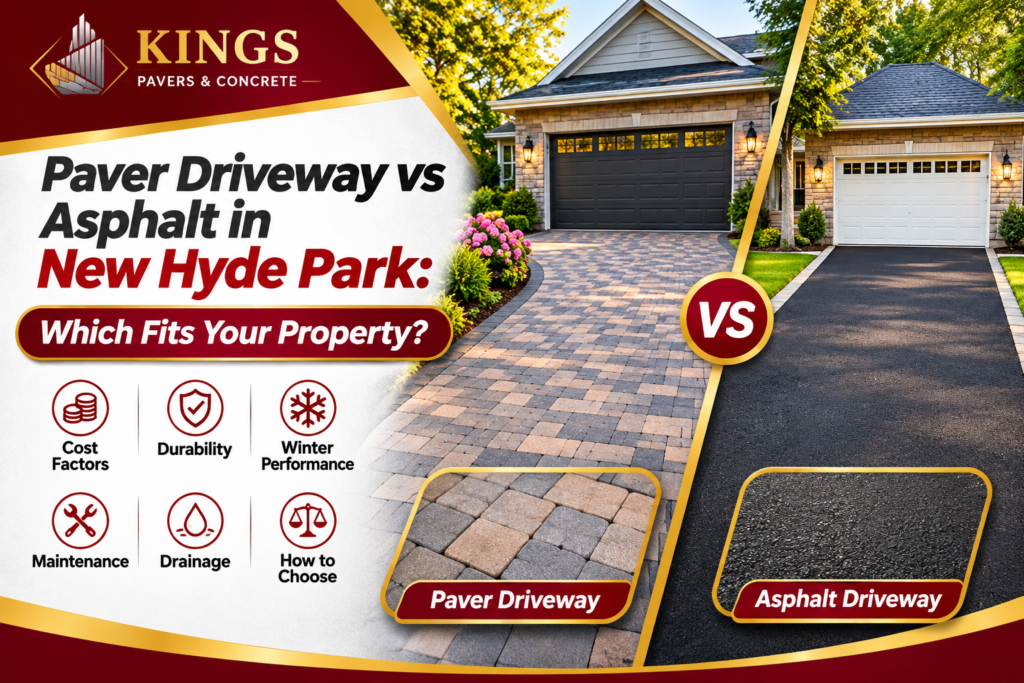
Your driveway is cracked, stained, or just tired, and the quotes you’re collecting point in two directions: a lower price for asphalt, or a higher one for pavers. Neither is automatically the better buy. Asphalt generally costs less to install and gives you a smooth, continuous surface. Pavers generally cost more upfront and offer more design control and easier spot repairs. The right call depends on your budget, your property, and how you feel about upkeep. This guide compares pavers vs. asphalt driveway options for New Hyde Park homeowners across cost, durability, winters, maintenance, appearance, and drainage, so you can decide with realistic expectations. Paver Driveway vs Asphalt: The Short Answer for New Hyde Park Homeowners Asphalt typically wins on initial cost and installation speed. Pavers typically win on design flexibility and the ability to repair individual sections. Neither material is maintenance-free, and both depend heavily on base preparation and drainage. Which one fits best comes down to your budget, your style preferences, and the conditions on your lot. Here’s a general comparison. These are typical characteristics, not guarantees, and actual results depend on the product, the installation, and the site. Factor Paver driveway Asphalt driveway Initial cost Generally higher (more material and labor) Generally lower Appearance Many colors, patterns, and borders Uniform dark surface; limited design options Design flexibility High Low Maintenance Joint sand, cleaning, weed control, occasional re-leveling Periodic sealing (optional but common), crack filling, patching Repairability Individual units can be lifted and reset or replaced Repairs are patches; large areas may need resurfacing or replacement Durability Depends on base, drainage, and installation; individual units can be reset if areas settle Depends on base, drainage, and installation; the continuous surface ages and may eventually need resurfacing Winter considerations Joints and base must drain well; deicer choice matters Cracks let water in; freeze-thaw can widen them; deicer choice matters Drainage Conventional pavers still shed water like a hard surface; engineered permeable systems are a separate category Sheds water; slope and runoff planning matter Long-term value Higher upfront, potentially lower repair cost per fix; not guaranteed Lower upfront, with ongoing upkeep and eventual resurfacing or replacement What Is the Difference Between Paver and Asphalt Driveways? How Paver Driveways Work A paver driveway is made of individual units, typically concrete, brick, or stone, set in an interlocking pattern. The visible pavers are the smallest part of the system. Underneath is an excavated, compacted aggregate base that carries the load, topped with a thin bedding layer where the pavers are set. Joints between units are filled with sand, and edge restraints around the perimeter keep the pavers from spreading outward under vehicle weight. Because the surface is made of separate units that interlock, it can flex slightly under load rather than cracking as a single slab. That’s also why the base matters so much. If the base settles unevenly, individual areas can dip or rut. How Asphalt Driveways Work An asphalt driveway is a continuous surface made of aggregate bound with asphalt cement, laid hot and compacted. Like pavers, it relies on a prepared base, usually compacted stone over graded soil. The asphalt layer is then spread and rolled to form a smooth, seamless surface. Asphalt is a flexible pavement. It can tolerate some movement, but it can also crack, develop potholes, and deteriorate at the edges, especially where water gets in or the base is weak. Both materials are only as good as what’s under them. Paver Driveway vs Asphalt Cost Asphalt usually costs less to install, and pavers usually cost more. The reasons are structural. Pavers involve manufactured units, more labor for setting, cutting, and compacting, and typically more careful base and edge work. Asphalt is laid mechanically over a prepared base and covers an area quickly. This guide doesn’t give dollar figures, because prices depend on the project and any number that isn’t based on your property is a guess. What drives the cost of either option: A fair comparison also includes ownership costs. Asphalt’s lower price comes with ongoing items like sealing, crack repair, and eventual resurfacing or replacement. Pavers have a higher entry price and their own upkeep, such as joint sand, cleaning, and occasional re-leveling. Whether the totals end up close depends on installation quality, maintenance habits, and how long you stay in the home, and it can’t be stated as a fixed percentage. When you collect quotes, ask for itemized, comparable scopes. A hypothetical example: if one quote includes removal of the old surface, a new compacted base, and drainage work, and another assumes paving over the existing surface, the price gap tells you little about the materials themselves. Which Driveway Material Lasts Longer? There’s no honest universal answer. Both materials can perform well for many years when installed properly, and both can fail early when they aren’t. Service life depends on several factors that matter more than the surface material: Pavers are often described as long-lasting because the surface can be repaired and the units themselves are durable. Asphalt can also last for many years, but it ages as a continuous surface and eventually needs resurfacing or replacement. Those are general characteristics. A well-built asphalt driveway can outperform a poorly built paver driveway, and the reverse is also true. Be wary of any contractor who promises a specific number of years. How Do Pavers and Asphalt Handle New York Winters? Both can handle New York winters when they’re built well. Neither is immune to freeze-thaw, and in both cases the base and drainage are what determine how a driveway holds up. Water that gets in and freezes expands, and repeated cycles move the surface. Asphalt. Water enters through cracks, freezes, and widens them, which can lead to more cracking and potholes over time. Sealing and crack repair help limit water infiltration. Snow removal is generally straightforward on a smooth surface. Pavers. Water can enter through the joints, so a well-drained base and properly filled joints matter. If the base holds water or settles,