If you’ve ever called a concrete contractor for an estimate and nearly fell out of your chair when you heard the number, you’re not alone. I’ve been doing concrete work in New York for over 20 years, and the conversation about pricing is one I have almost every day.
Here’s the thing: concrete work looks simple from the outside. You pour some gray stuff, it hardens, done. But the reality is a lot more complicated and a lot more expensive than most people expect. Labor, materials, site prep, permits, equipment, and New York’s cost of living all stack up fast.
This guide breaks down what you’re actually paying for when you hire a concrete contractor here, what typical projects cost, and how to make sure you’re getting fair value for your money.
What Does a Concrete Contractor Actually Charge Per Hour?
Let’s get to the number people always ask first.
In New York, most concrete contractors charge somewhere between $65 and $150 per hour for labor, depending on the type of work and the crew involved. That range is wide, and it’s wide for a reason: skilled finishing work costs more than basic labor.
A laborer helping with excavation or cleanup might be on the lower end. An experienced finisher who knows how to work concrete in cold weather, match an existing surface, or pour a level foundation? That person commands a premium.
For commercial projects, rates often run higher, typically $90 to $160+ per hour, because the work usually involves tighter tolerances, more inspection requirements, and larger crews.
| Service Type | Typical Hourly Rate | Project Examples |
| General concrete labor | $65–$85/hr | Site prep, cleanup, basic forming |
| Residential finishing | $80–$120/hr | Driveways, patios, walkways |
| Structural / foundation work | $100–$140/hr | Foundations, retaining walls |
| Commercial concrete | $110–$160+/hr | Commercial slabs, parking structures |
| Decorative / specialty concrete | $120–$175/hr | Stamped, stained, and polished surfaces |
Most contractors don’t actually bill strictly by the hour on larger jobs; they give you a project price. But that project price is based on an internal estimate of the number of labor hours involved, so understanding the hourly rate helps you evaluate whether a quote makes sense.
Factors That Affect Concrete Contractor Pricing
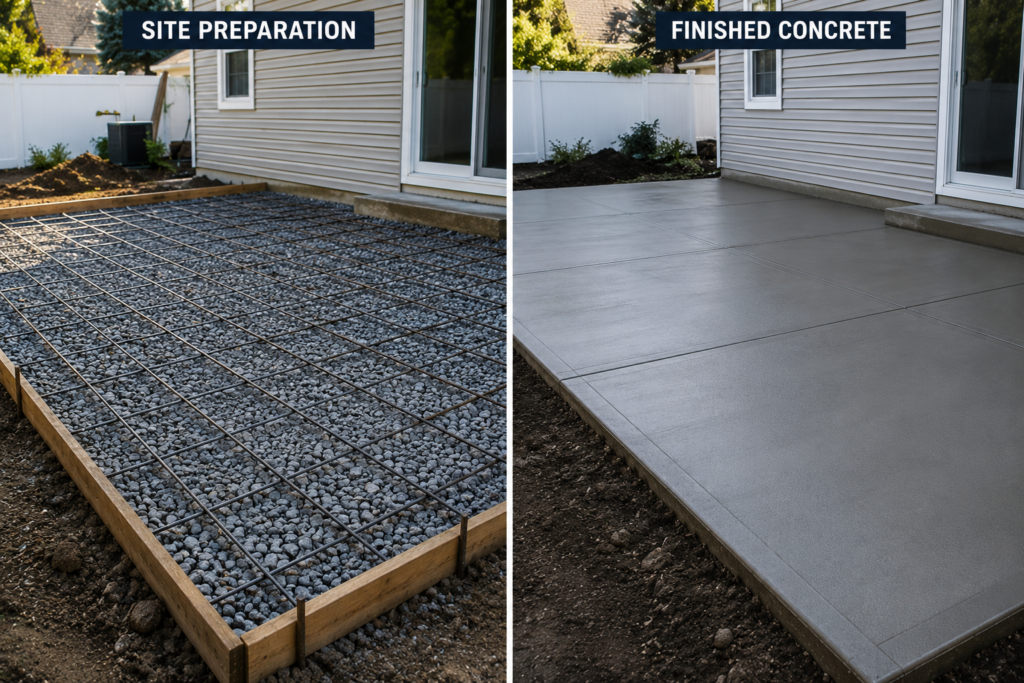
When someone asks me how much a concrete contractor costs for their specific project, my honest answer is: it depends. Here are the things that genuinely move the price up or down.
Project Size
Larger projects generally cost less per square foot than small ones. Mobilizing a crew, renting equipment, and ordering materials all have fixed costs. If you’re pouring a 1,000 sq ft driveway instead of a 200 sq ft pad, those fixed costs get spread out. Don’t expect that logic to work in reverse. Small jobs often cost more per square foot precisely because the overhead doesn’t shrink.
Location Within New York
Manhattan and the other boroughs carry significantly higher costs than upstate. Parking fees, permits, tight access, and simply the cost of doing business in the city all factor in. A patio in Brooklyn will almost always cost more than the same patio in Albany, sometimes 30–50% more.
Material Costs
Concrete pricing fluctuates with supply chains. In recent years, we’ve seen material costs swing considerably. Ready-mix concrete in New York currently runs roughly $130 to $160 per cubic yard, not including delivery, pumping, or additives such as fiber reinforcement or accelerators for cold-weather pours.
Site Preparation
This one surprises people. If there’s an existing concrete slab to demo and haul away, or if the ground needs significant grading, expect that to add real money. Demolition alone can run $2–$6 per square foot depending on thickness and access. I’ve had jobs where the demo cost more than the new pour.
Accessibility
Can a concrete truck get close to the work area? If not, we’re pumping, and pump rentals run $500 to $1,500+ depending on the setup. Tight gates, stairs, or landscaping that has to be protected all add time and cost.
Labor Complexity
A broom-finished walkway and a decorative stamped patio might use the same concrete mix, but the stamped patio takes two to three times as long. Rebar installation, custom forming, or unusual shapes all add to the labor clock.
Permits and Inspections
In New York, certain projects, especially anything structural, require permits. Permit costs vary by municipality, but budget $200–$800 for residential permits in most areas, and potentially more in NYC. Inspections can also add to the timeline, which affects labor costs if the crew is waiting.
Average Cost of Common Concrete Projects in New York
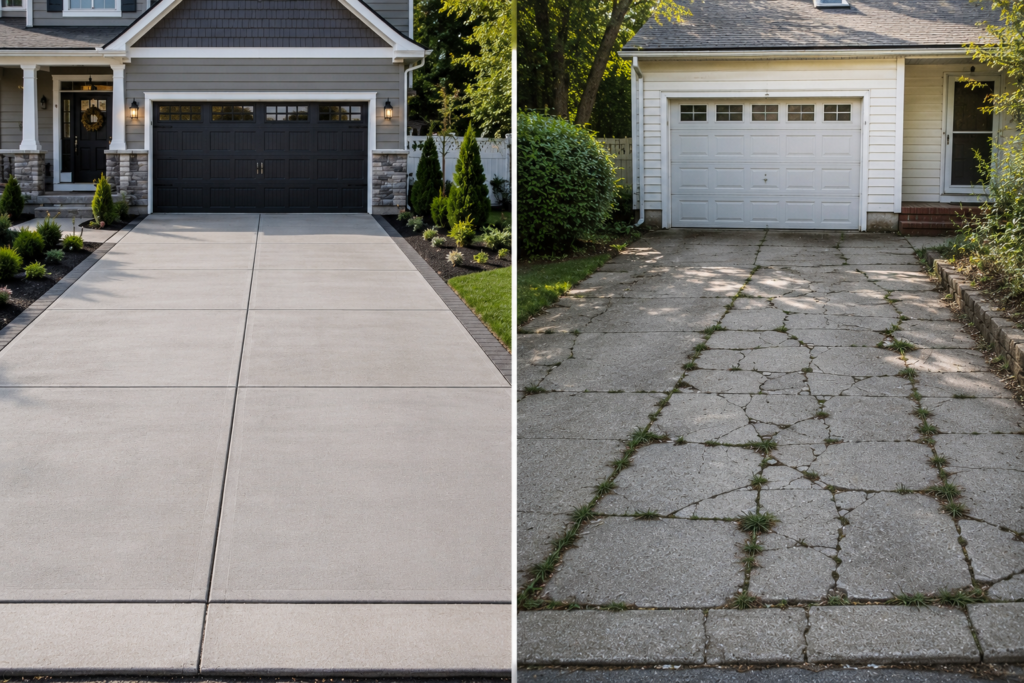
Here’s what real projects actually cost in New York. These are ranges based on typical residential work; commercial projects usually run higher.
| Project Type | Typical Cost Range |
| Concrete driveway (standard, 2-car) | $5,000–$12,000 |
| Concrete patio (400–600 sq ft) | $4,500–$10,000 |
| Concrete sidewalk (50 linear ft) | $1,500–$3,500 |
| Foundation (small residential) | $12,000–$35,000+ |
| Garage floor (standard 2-car) | $3,000–$7,000 |
| Commercial slab (2,000 sq ft) | $18,000–$40,000+ |
| Decorative/stamped patio | $8,000–$18,000 |
| Concrete steps (exterior, 4–6 steps) | $1,500–$4,000 |
| Crack repair/resurfacing | $500–$3,500 |
A few things worth noting: these numbers assume reasonable site conditions and standard finishes. Add decorative elements, difficult access, or major demo work, and prices climb.
Why the Cheapest Quote Isn’t Always the Best Choice
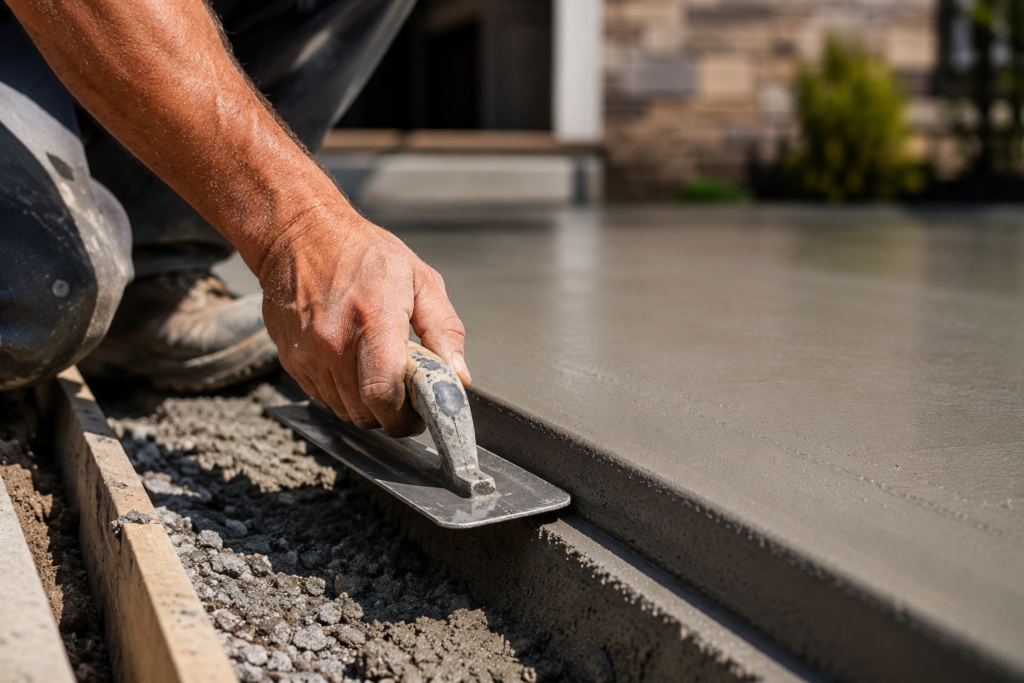
I’ll be straightforward here, because I’ve seen homeowners go with the low bid and end up spending more in the long run than they would have with a fair-priced contractor.
The most common shortcuts I’ve seen from low-bidding contractors:
- Thin slabs. A driveway should be 4 inches thick minimum, 5 to 6 inches if you’re parking heavy vehicles. I’ve seen driveways poured at 2.5 to 3 inches to save on material. They look fine for a year or two, then start cracking.
- Skipping the base prep. Concrete needs a stable, compacted base. Cut corners here, and the slab settles unevenly.
- No rebar or fiber. Reinforcement adds cost but dramatically extends slab life.
- Cheap mix or watered-down concrete. This is hard to detect visually, but it weakens the slab significantly.
Here’s a real example. A homeowner in Westchester called me after a contractor they’d hired, one they chose because his quote was about $2,000 lower than mine, poured their driveway. Within 18 months, cracks had appeared throughout, and by year three, a full section had heaved and broken apart. The repair and replacement ended up costing more than my original quote would have.
I’m not saying every low bid is a red flag. Some contractors are just more efficient. But when a quote is 30–40% below everyone else, there’s usually a reason.
Step-by-Step Guide to Hiring a Concrete Contractor
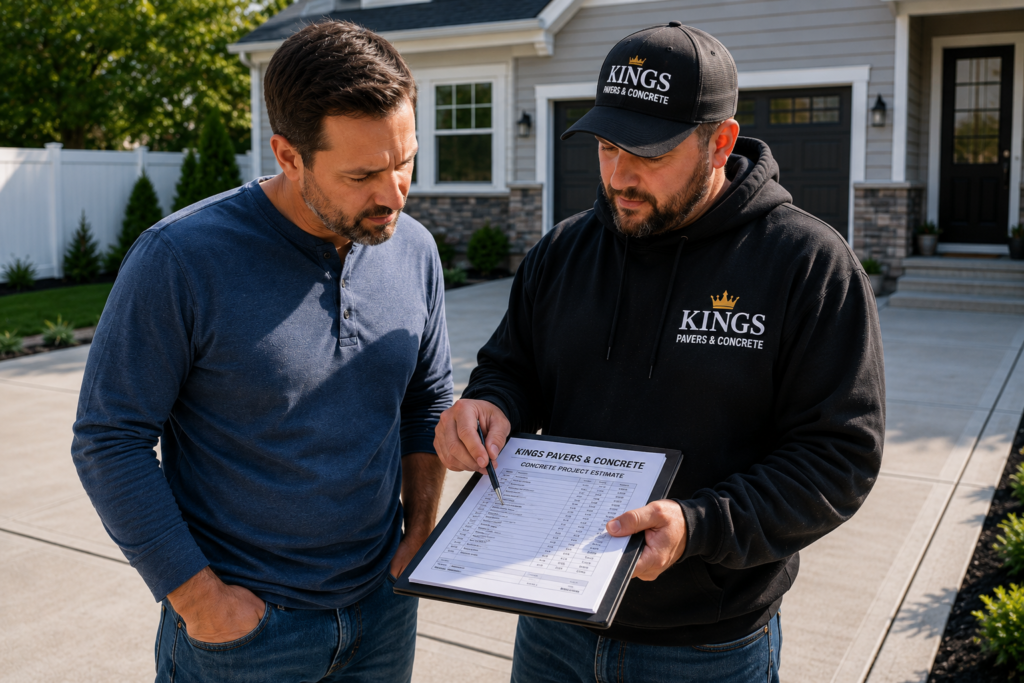
Step 1: Define the Project
Before you call anyone, know what you want. Approximate dimensions, any special finishes, and whether there’s existing concrete to remove. The more specific you can be, the more accurate the estimates you’ll get. “I need a patio” gives a contractor almost nothing to work with.
Step 2: Request Multiple Estimates
Get at least three quotes. Not to find the cheapest to understand the market. If two quotes come in near each other and one is far lower or higher, that’s information worth understanding.
Step 3: Verify Licensing and Insurance
In New York, contractors should carry general liability insurance and workers’ compensation. Ask for certificates. A contractor who hesitates or can’t produce them is a liability risk for you. If a worker gets hurt on an uninsured job at your property, you could be on the hook.
Step 4: Review Past Work
Ask for references or photos of similar completed projects. Most contractors doing quality work are happy to show it. Look for even finishes, clean edges, and, if possible, ask how older projects have held up.
Step 5: Understand the Contract
A written contract should spell out the scope of work, materials to be used (including concrete mix specifications), timeline, payment schedule, and what happens if conditions change. Be cautious of contractors who want large upfront deposits; typically, 10–30% down is reasonable, with the balance due on completion.
Case Study: A Homeowner in Queens Gets It Right
Maria was planning to replace the cracked, frost-damaged concrete in her Queens backyard with a roughly 500-square-foot patio area plus a small set of steps. Her initial budget was $5,000.
She got three quotes. The first came in at $4,200. The second was $7,800. The third mine was $6,400.
Her first instinct was to go with the low bid. She called me back to ask why there was such a difference.
I explained that the $4,200 quote was almost certainly using a thinner pour (probably 3 inches) with no reinforcement, and likely wasn’t including proper base compaction. The $7,800 bid included decorative stamping she hadn’t asked for, which inflated it.
My quote included full demolition and haul-away of the existing patio, a 4-inch reinforced slab with compacted gravel base, a standard broom finish, and new steps with proper footing depth.
Maria decided to stretch her budget and went with my quote. Two years later, the patio is still in excellent shape. She told me she’s glad she didn’t “save” $2,200 on work she’d have to redo.
Expert Insight
“The biggest thing homeowners don’t understand is that concrete pricing isn’t just about materials; it’s about labor hours, and labor in New York isn’t cheap. When you’re looking at a quote, ask the contractor how many workers will be on site and how many days the job will take. That tells you a lot about what you’re actually getting. A crew of two guys doing a driveway in one day is very different from a four-person crew spending two days doing it right, grading, forming, pouring, finishing, and cleaning up properly. The difference shows up years later.”
22-year veteran concrete contractor, based in the New York metro area
How to Save Money on Concrete Projects Without Sacrificing Quality
There are legitimate ways to keep concrete costs reasonable. None of them involve cutting corners on materials or thickness.
Schedule During Slower Seasons
Late fall and winter (when weather allows) and early spring can be less busy for contractors. Some will offer slightly better pricing when their schedule has gaps. Summer and early fall tend to be peak season; everyone wants outdoor work done.
Bundle Projects
If you’re already having work done, consider whether there are adjacent projects worth combining. Adding a small walkway to a patio job costs far less than scheduling a separate mobilization later.
Handle Some Prep Work Yourself
If your contractor is comfortable with it, handling minor tasks, clearing the area, moving furniture, and trimming plants saves labor hours. Ask first; some contractors prefer to control the prep.
Get Specific With the Scope
Vague requests produce padded quotes. If you want a standard broom finish, say so; don’t leave it open-ended and risk being quoted for decorative finishes you don’t need.
Don’t Over-Engineer It
Rebar makes sense for driveways and structural applications. For a basic garden path? Wire mesh or fiber reinforcement may be entirely sufficient. Talk to your contractor about what the project actually needs.
Frequently Asked Questions
How much is a concrete contractor per hour in New York?
Most residential concrete contractors in New York charge between $65 and $150 per hour for labor, depending on skill level and the type of work. Specialty or decorative work typically runs higher. Most projects are quoted as a flat price, but that price is based on estimated labor hours.
What is the average cost of concrete work in New York?
It varies widely by project. A standard 2-car driveway typically runs $5,000–$12,000. A residential patio in the 400–600 sq ft range usually costs $4,500–$10,000. Smaller projects like sidewalk sections or repairs can run $500–$3,500.
Why are concrete labor costs so high?
New York has a high cost of living, and skilled tradespeople command real wages here. Concrete work is also physically demanding, weather-dependent, and requires experience to do correctly. Add in insurance, equipment, fuel, and disposal fees, and the labor rate is really carrying more than just the worker’s hourly pay.
Is it cheaper to hire a contractor or do it yourself?
For small projects like a basic garden border or a small stepping stone path, DIY can save money. For anything structural, driveways, foundations, garage floors, the answer is almost always hire a professional. Bad DIY concrete work is expensive to fix, and you lose the warranty and liability protection that comes with a licensed contractor.
How do contractors calculate concrete project costs?
We estimate material quantities (cubic yards of concrete, rebar, gravel), factor in equipment rental and delivery costs, estimate labor hours based on the complexity and size of the job, add overhead and insurance, and build in a margin. Site conditions like access, demo requirements, and soil conditions all affect that estimate.
Wrapping Up
Concrete pricing in New York isn’t simple, and anyone who gives you an instant number without seeing your site should be approached carefully. The costs are real materials, labor, equipment, permits, and the work has to be done right the first time, because fixing it later is always more expensive than doing it correctly upfront.
What you’re really paying for is experience, proper materials, and work that will still look good in ten or fifteen years. That’s where the value is.
If you’re getting ready to plan a project, get at least a few estimates, ask smart questions, and don’t let price be the only factor. A fair-priced contractor who uses the right materials and knows what they’re doing will cost you less over the life of that driveway, patio, or foundation than a low bid that cuts corners.
Ready to Get an Estimate?
If you’re in New York and want honest, straightforward pricing on a concrete project driveway, patio, foundation, commercial slab, or anything else- reach out for a free estimate. We’ll take a look at your site, give you a clear breakdown of what the work involves, and give you a number you can actually count on.