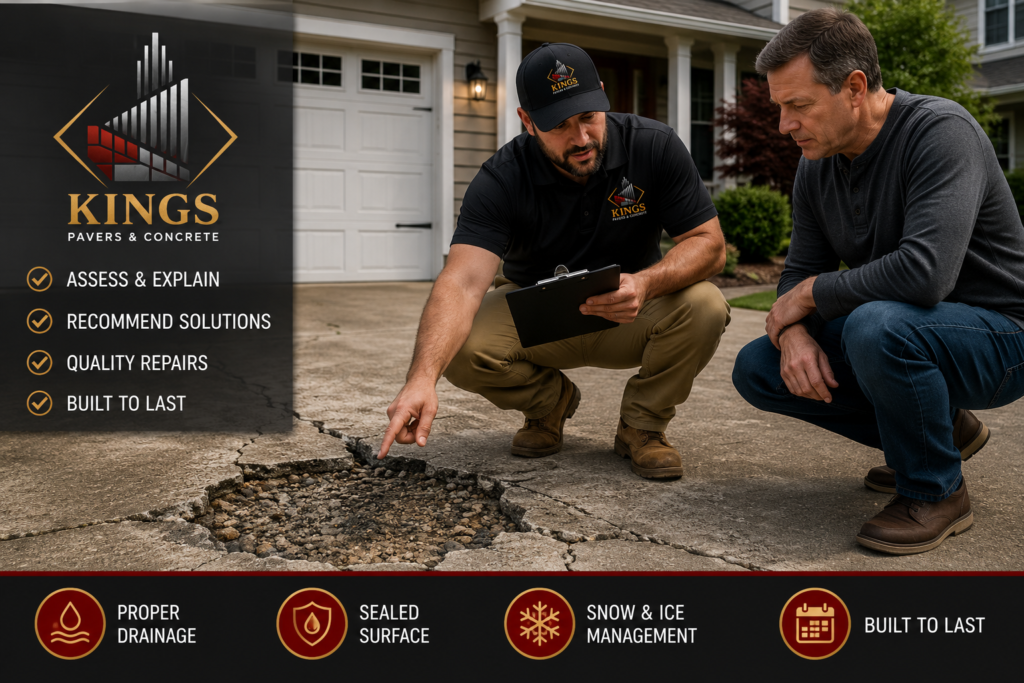
You walk out to the driveway in March, snow’s finally gone, and there it is: a patch near the garage where the top of the concrete has flaked away, leaving behind a rough, pitted surface that wasn’t there last fall. Maybe it’s the front steps. Maybe it’s a section of sidewalk where you can suddenly see the little stones that make up the concrete itself. Whatever the spot, the question is usually the same: what is this, and do I need to worry about it?
In most cases, what you’re looking at is concrete spalling. It’s one of the most common things we get called out for in the spring, and it’s almost always tied back to how New York concrete gets treated over the winter. The short version: spalling is the surface of the concrete breaking away, usually in layers or chunks, because of moisture that got into the slab and then froze. The longer version, including when it’s minor and when it’s a bigger problem, is worth understanding before you decide what to do about it.
What Is Concrete Spalling?
Spalling is what happens when the top layer of a concrete surface flakes, peels, or chips away, exposing the material underneath. It can look like anything from light surface flaking that resembles peeling paint to larger chunks breaking loose and leaving craters behind.
What’s actually happening is that moisture works its way into the concrete through hairline cracks, through the natural pores in the surface, or through poor finishing, and then something puts pressure on that moisture from the inside. Usually it’s freezing. Water expands when it turns to ice, and concrete isn’t flexible enough to handle that expansion without cracking or breaking at the surface. Over a few freeze-thaw cycles, that damage compounds. What starts as a rough patch can turn into a section of missing concrete.
Some people call this spalling concrete, some call it flaking concrete, and some just say the surface is “peeling.” It’s the same issue described in a few different ways. And it’s worth being clear about something early on: a little bit of surface texture change isn’t automatically a crisis. Concrete ages. But spalling that keeps spreading, or that exposes anything underneath the surface, is a different story.
What Does Spalling Concrete Look Like?
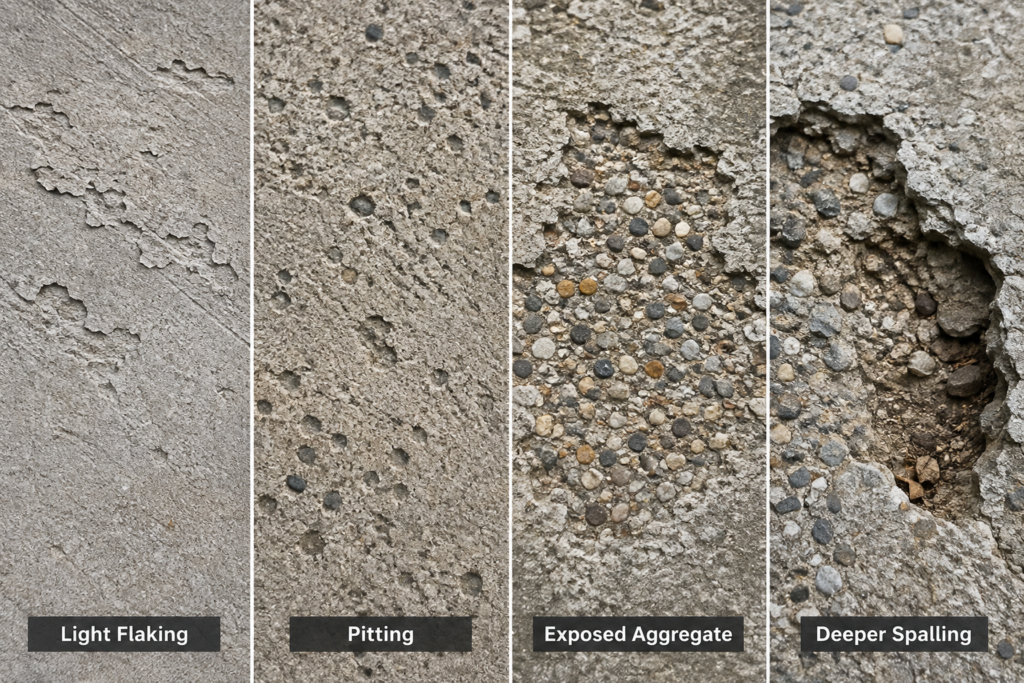
This is usually the easiest way to figure out what you’re dealing with, because spalling has a pretty distinct look once you know what to check for.
Light spalling often shows up as flaking or peeling thin layers of concrete lifting away, sometimes in patches only a few inches wide. Move further along the damage scale, and you start seeing pitting, small craters where pieces have popped out entirely. In more advanced cases, the surface feels rough or sandy underfoot; the aggregate, the gravel mixed into the concrete, becomes visible, and edges near joints or cracks start crumbling when you press on them.
The most serious version is when you can see rebar or wire mesh poking through. That’s not cosmetic anymore, and it usually means water and possibly deicing salt have been getting to that steel for a while.
| What You See | What It Could Indicate | Recommended Next Step |
| Light surface flaking, small patches | Early-stage spalling, possibly a poor finishing layer | Monitor and keep clean; note if it spreads |
| Pitting or small craters | Freeze-thaw damage progressing below the surface | Have it inspected before next winter |
| Visible aggregate (gravel showing) | Loss of the top mortar layer | Repair recommended to prevent further wear |
| Rough, sandy texture over a wide area | Widespread surface deterioration | Professional assessment of repair vs. resurfacing |
| Crumbling near joints or edges | Water collecting and freezing at vulnerable points | Check drainage and repair before it spreads |
| Exposed rebar or wire mesh | Reinforcement corrosion, more serious internal damage | Get a professional evaluation soon |
What Causes Concrete Spalling?
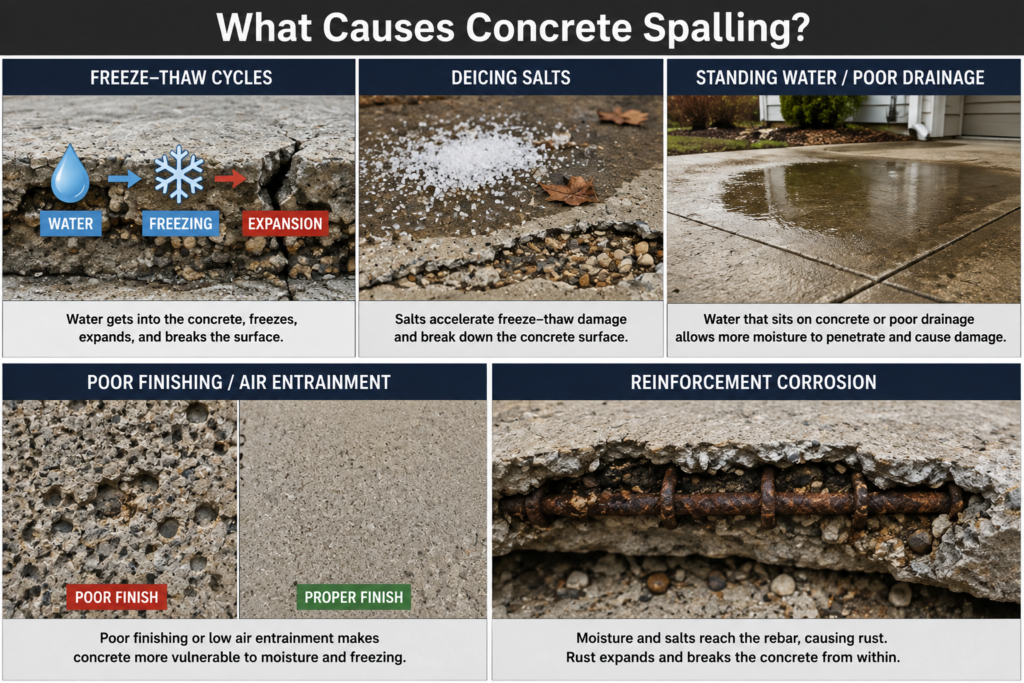
There’s rarely just one cause. Usually, it’s a combination of things working against the slab at the same time.
Freeze-Thaw Cycles
This is the big one in New York. Concrete is porous, not obviously, but at a small scale, water can get in. When temperatures drop, that trapped water freezes and expands, putting pressure on the surrounding concrete from the inside. When it thaws, the pressure releases, but the damage from the expansion is already done. Repeat that cycle over a winter with multiple thaws and refreezes, which is typical for us, and the surface starts to break down layer by layer.
Deicing Salts
Rock salt and other deicing products lower the freezing point of water sitting on the surface, which changes how and when that moisture freezes and refreezes. Over repeated seasons, this can accelerate surface deterioration, especially on concrete that wasn’t finished or sealed well to begin with. It’s not that using salt once will ruin a driveway; it’s the cumulative effect over years that tends to show up.
Excess Moisture and Poor Drainage
Any spot where water tends to pool a low point in a driveway, an area near a downspout, or a section without proper slope is going to spall before the rest of the slab. Standing water means more saturation, and more saturation means more material available to freeze and expand.
Installation or Finishing Problems
Some spalling traces back to how the concrete was placed years earlier. Adding too much water to the mix, finishing the surface too early or too late, or troweling in a way that seals a weak, water-rich layer at the top can all leave a surface that’s more vulnerable than it should be. This isn’t always obvious until years later, when that top layer starts to go.
Corroding Reinforcement
When water and salt reach the steel reinforcement inside the concrete rebar or mesh the steel starts to rust. Rust takes up more space than the original steel, and that expansion pushes outward against the concrete around it, cracking and eventually breaking it away from the inside. This is one of the more serious causes because the damage is happening below what you can see.
Age and Wear
Concrete has a working life, and years of vehicle traffic, foot traffic, weather exposure, and general use will wear down a surface even without a specific triggering event. Older concrete that hasn’t been maintained is naturally more susceptible to spalling once other factors, moisture, freezing, and salt come into play.
| Cause | Typical Warning Sign | Prevention Approach |
| Freeze-thaw cycles | Flaking or pitting appears after winter | Address moisture sources, consider sealing |
| Deicing salts | Gradual surface roughening near treated areas | Use salt sparingly, choose concrete-safe products |
| Poor drainage | Damage concentrated in one low spot | Improve grading or add drainage |
| Finishing issues | Widespread thin flaking soon after installation | Address at time of install; hard to prevent after the fact |
| Reinforcement corrosion | Rust staining, cracking along a line, exposed steel | Keep water and salt away from cracks near the surface |
| Age and wear | Gradual, even deterioration over many years | Routine inspection and timely small repairs |
Why Concrete Spalling Is Common After New York Winters
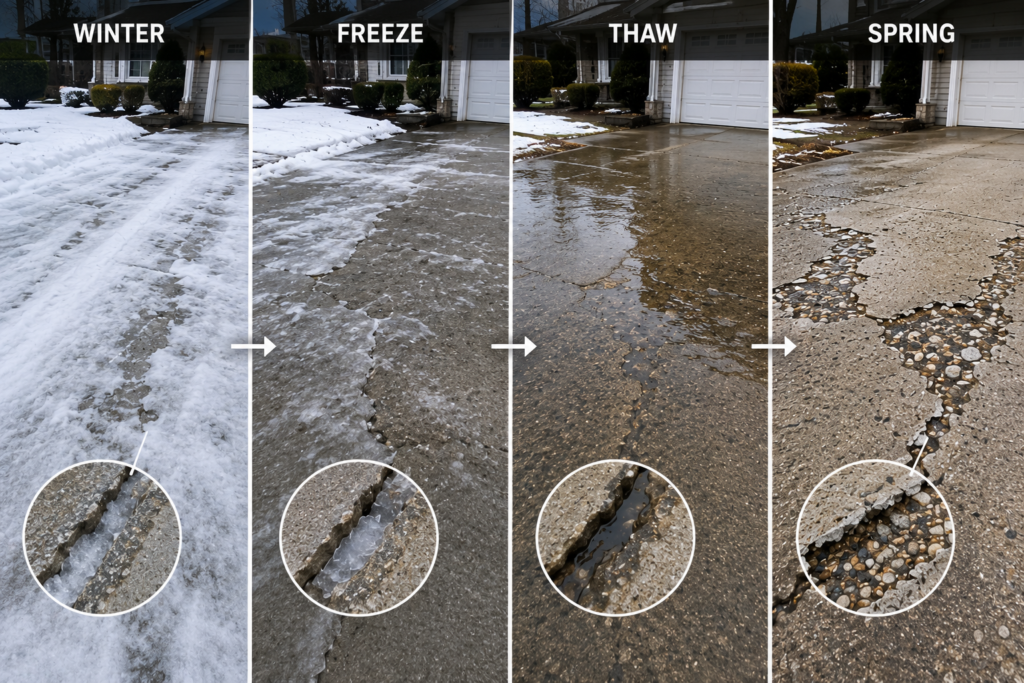
If you’ve owned concrete property in this state for more than a couple of years, you’ve probably seen this pattern: everything looks fine going into winter, and then by March or April there’s new damage that wasn’t there before. That’s not a coincidence; it’s exactly how these winters are built to cause this kind of wear.
We get repeated freezing and thawing, sometimes within the same week. Snow sits on the surface, melts a little during the day, refreezes overnight, and that meltwater has usually found its way into any small crack or porous spot in the concrete before it freezes again. Add deicing salt into that mix, whether it’s yours or a plow service using it on a shared driveway or lot, and you’ve got moisture, salt, and repeated freezing all working on the same surface for months.
Snow removal itself can play a role too. Metal shovel edges and plow blades can scrape and chip concrete that’s already compromised, and piling snow against a foundation or slab edge keeps that section wetter longer than the rest of the surface.
By the time spring comes and the snow is gone, the damage that built up over the winter is finally visible. That’s why so many spalling calls come in during March and April. The problem didn’t happen overnight; it just became visible once the snow melted.
Concrete Spalling vs. Cracking: What’s the Difference?
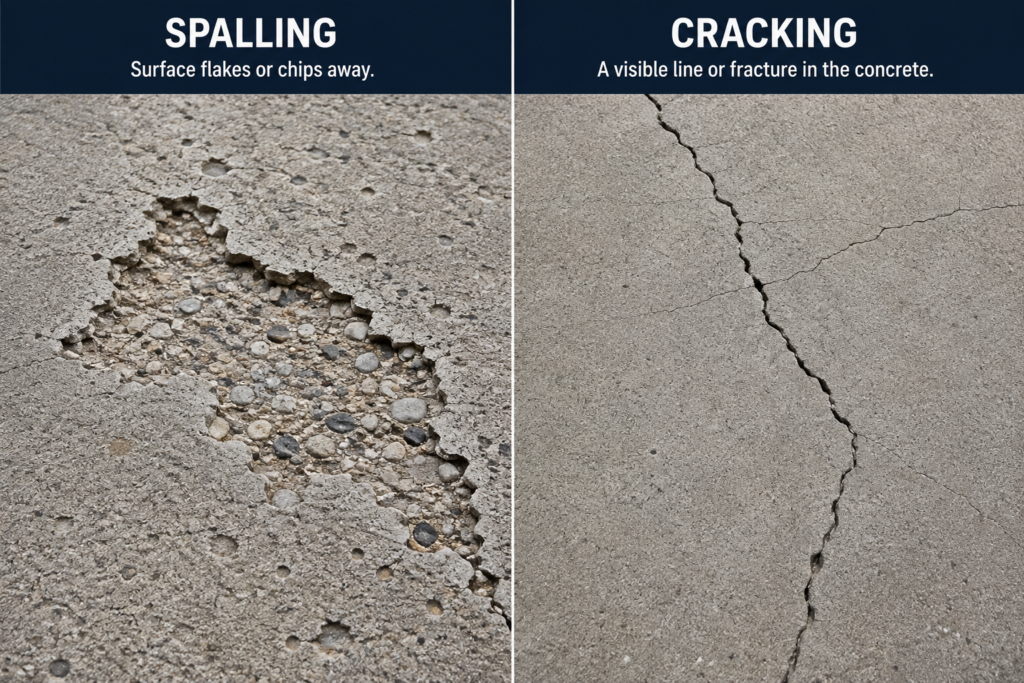
People use “cracked” and “spalled” almost interchangeably sometimes, but they’re describing different things, and figuring out which one you have or whether you have both matters for the repair.
Cracking is a break running through the concrete, whether it’s a fine hairline crack or a wider structural one. Spalling is material actually breaking away from the surface, leaving a rougher or lower area behind. You can have cracks without spalling, and you can have spalling without any visible cracks nearby, though the two often show up together, especially near joints and edges where both moisture and stress tend to concentrate.
| Problem | Appearance | Common Causes | Typical Response |
| Hairline cracking | Thin surface line, no depth or movement | Shrinkage during curing, minor settling | Monitor; usually cosmetic |
| Structural cracking | Wider crack, may have vertical offset | Settlement, tree roots, heavy loads | Professional assessment needed |
| Surface spalling | Flaking, peeling, small craters | Freeze-thaw, moisture, deicing salts | Surface repair once diagnosed |
| Scaling | Broad, shallow flaking over a wide area | Similar to spalling, often finishing-related | Resurfacing may be appropriate |
| Pitting | Small individual holes or pockmarks | Localized freeze-thaw or aggregate issues | Patch repair in most cases |
It’s common to see cracking along a joint and spalling starting right at the edge of that same crack. Water finds its way in through the crack, then does its usual freeze-thaw damage to the surrounding surface.
Is Concrete Spalling Serious?
Depends on what’s underneath it. That’s the honest answer, and it’s why a lot of “how bad is this” questions really need eyes on the actual slab.
A few things we look at to judge severity: how deep the damage goes, how much of the surface is affected, whether it’s spreading or has been stable for a while, where it’s located, whether aggregate is exposed, and the big one: whether there’s any exposed or corroding reinforcement underneath. Surface-level flaking over a small area, especially if it’s been the same size for a year or two, is usually a reasonable candidate for a straightforward patch repair. Spalling that’s spreading, that’s exposing steel, or that covers a large section of a driveway or walkway is a different conversation, and usually worth getting a professional opinion on before doing anything.
Neither extreme is the default assumption. Not every patch of flaking means the whole slab is failing, and not every bit of surface damage is purely cosmetic either.
How to Identify Concrete Spalling
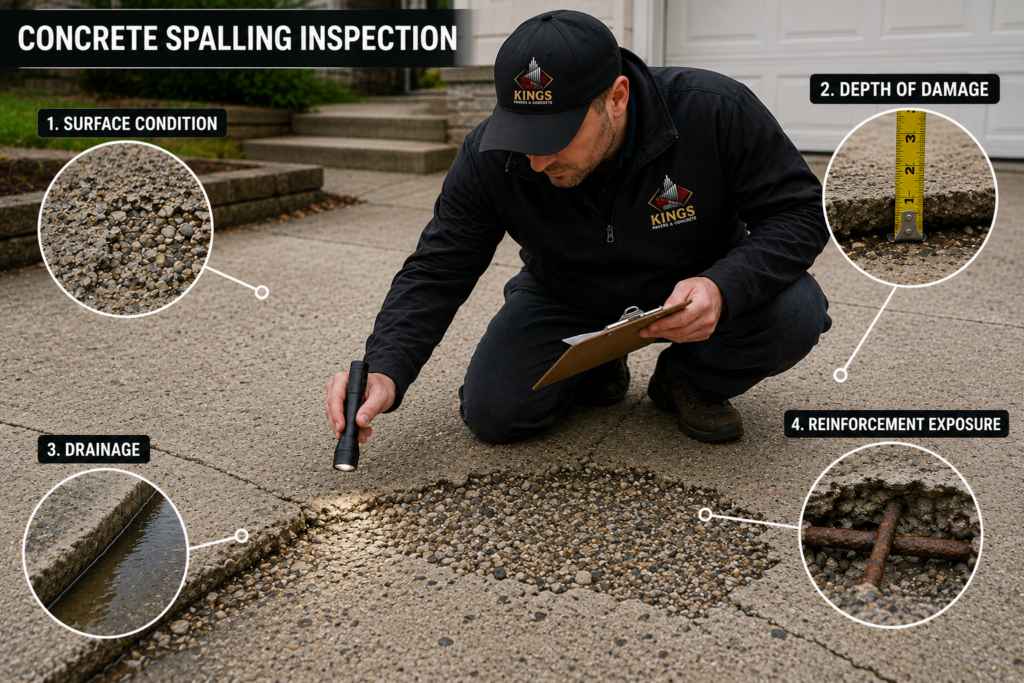
If you want to get a read on what you’re dealing with before calling anyone, here’s a reasonable way to walk through it.
Step 1: Clean the Area
Sweep or hose off loose debris and dirt so you can actually see the extent of the damage, not just the dirtiest-looking spot.
Step 2: Look for Loose or Flaking Concrete
Gently tap or press on the surface near the damaged area. Material that lifts or crumbles easily tells you the deterioration goes beyond just surface staining.
Step 3: Check the Depth of Damage
Is it a thin layer that’s come away, or does the damage go noticeably deeper? Depth is one of the clearer indicators of how serious the underlying issue is.
Step 4: Look for Moisture and Drainage Problems
Notice whether water tends to sit in or near the damaged area after rain or snowmelt. A drainage issue feeding the same spot repeatedly is often part of the cause.
Step 5: Check for Exposed Reinforcement
Look closely for any metal rebar or wire mesh visible in or near the damaged section, and check for rust staining even if the steel itself isn’t fully exposed yet.
Step 6: Decide Whether Professional Inspection Is Needed
If the damage is small, shallow, and isolated, it’s reasonable to keep an eye on it. If it’s spreading, deep, near reinforcement, or you’re just not sure, that’s the point to bring in someone experienced rather than guessing. This isn’t a job for chipping into the slab yourself to “see how bad it is,” which can turn a small repair into a bigger one.
How to Fix Concrete Spalling
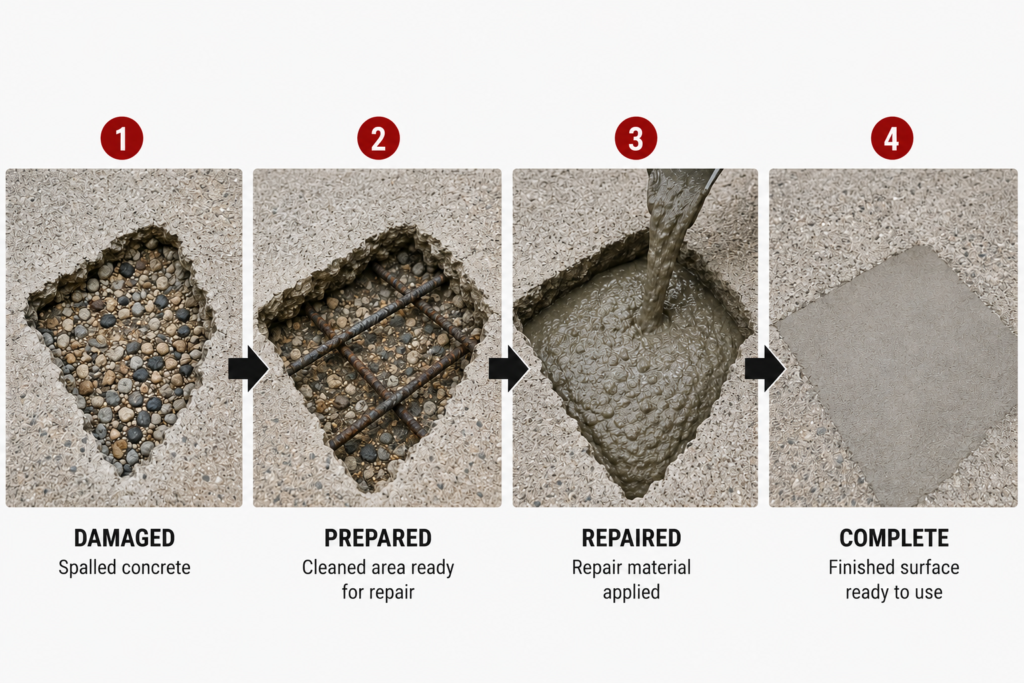
The right fix depends entirely on what caused the damage and how far it’s progressed, which is why a good repair usually starts with figuring out the cause rather than just patching what’s visible.
- Determine why the concrete is spalling. Moisture source, drainage, salt exposure, or something tied to the original installation, the repair approach should account for it.
- Remove unsound or loose material. Anything that’s already detached or loose needs to come out; patching over it just traps the problem.
- Clean and prepare the repair area. A repair material only bonds well to a clean, sound surface.
- Address exposed reinforcement when applicable. Rusted rebar often needs cleaning or treatment before any repair material goes over it.
- Select a compatible concrete repair material. Different repair products are suited to different depths and exposure conditions.
- Apply and finish the repair correctly. Matching the surrounding texture and slope matters for both appearance and how well water sheds off the repaired area.
- Allow proper curing. Repair materials need time to cure correctly, and rushing this step is a common reason repairs fail early.
- Correct drainage or moisture problems that contributed to the damage. Skip this step, and there’s a good chance the same spot will spall again in a season or two.
That last point is worth repeating on its own: patching the visible damage without dealing with why it happened in the first place usually just buys a little time. We’ve seen driveways get the same low spot patched two winters in a row because nobody addressed the drainage issue causing water to collect there.
When Can Spalled Concrete Be Repaired and When Should It Be Replaced?
| Condition | Repair May Make Sense | Replacement May Be Better |
| Small, isolated flaking or pitting | Yes, in most cases | Rarely necessary |
| Damage limited to one section of a larger slab | Often, if the rest is sound | If deterioration is spreading toward it |
| Widespread surface deterioration | Sometimes, with resurfacing | Often more practical than patch after patch |
| Deep spalling reaching reinforcement | Case by case, after addressing the steel | Common if damage is extensive |
| Major structural cracking alongside spalling | Rarely on its own | Usually points toward replacement |
| Settlement or slab movement | No | Yes |
| History of repeated failed repairs | Reassess the cause first | Often the more sensible long-term option |
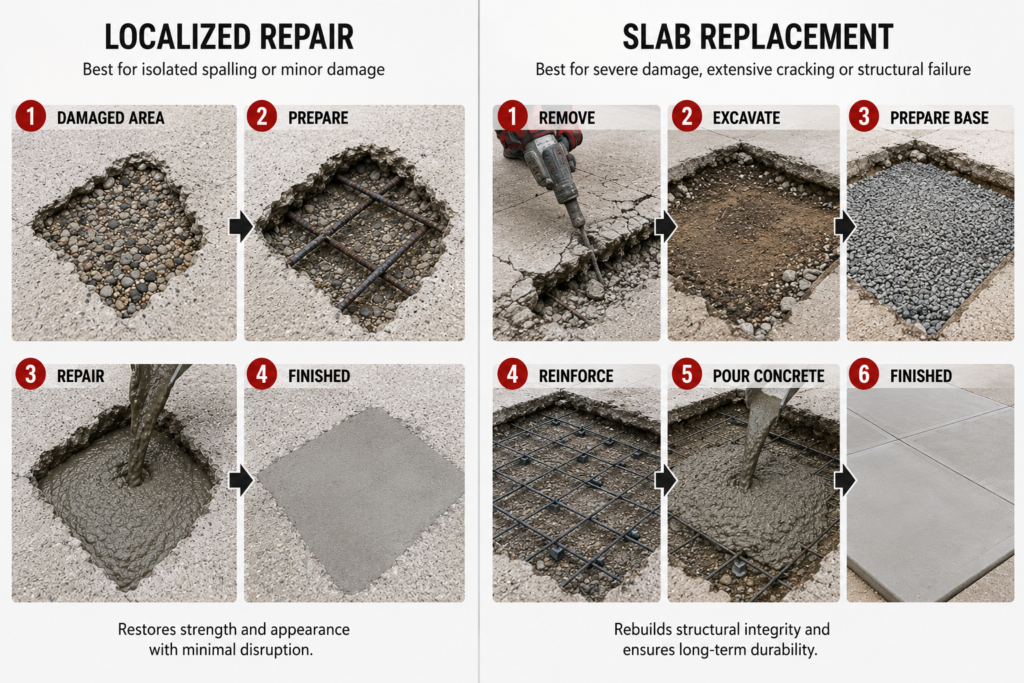
No article can diagnose a specific slab from a description alone. This table is meant to help frame the conversation, not replace someone actually looking at the concrete.
Example: A New York Driveway After Several Winters
This is a hypothetical example meant to illustrate a common pattern we see, not a specific past project.
A homeowner notices a handful of small flaking spots along one side of the driveway after a rough winter. From a few feet away, it looks minor, a little rough texture, nothing dramatic. Looking closer, though, there’s a pattern: the flaking is concentrated in a section where water visibly pools after rain, and that same section has been treated with deicing salt every winter for years because it’s shaded and stays icy longer than the rest of the driveway.
In a case like this, a few things would deserve attention: whether the pitting is still shallow or has started going deeper, whether any aggregate is visible yet, and whether the pooling water has a clear cause: a low spot, a drainage line that’s not working, or grading that slopes the wrong way. The likely contributing factors are the combination of standing water and repeated salt exposure in one spot, compounded by several winters of freeze-thaw cycling.
Repair options worth considering would range from a straightforward surface patch if the damage is shallow, up to a small section resurfacing if it’s gone deeper. But the piece that actually prevents this from happening again in the same spot is correcting the drainage, regrading slightly, adding a drain, or otherwise getting water to stop collecting there, and being more selective about deicing products used on that section going forward.
How to Prevent Concrete Spalling
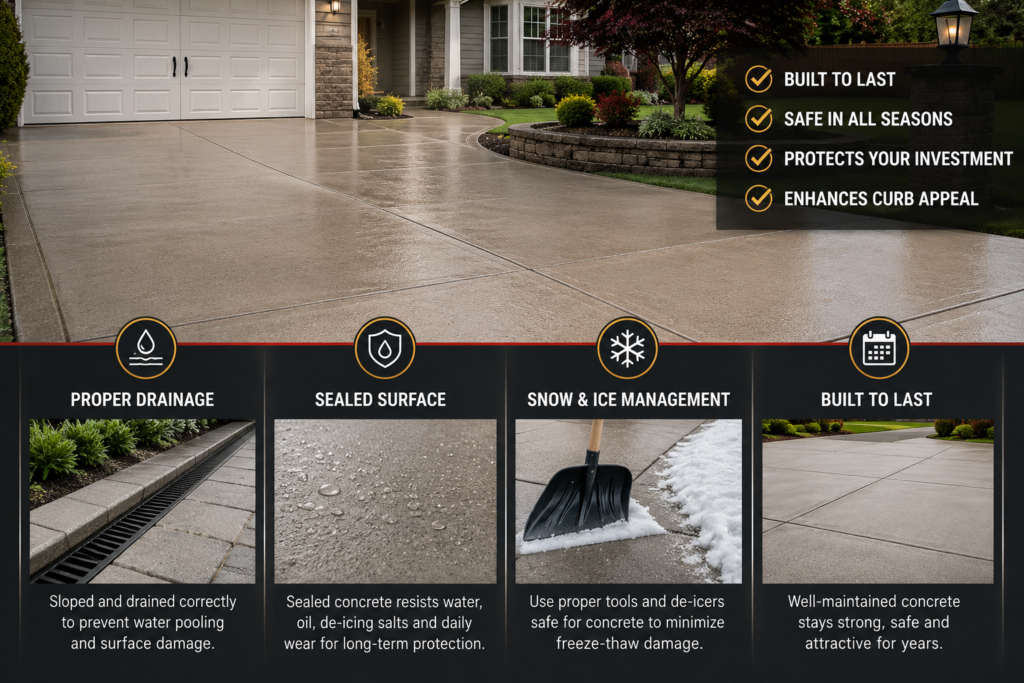
Prevention is less about any single product and more about managing the conditions that lead to spalling in the first place.
Keep water from sitting on the surface where you can; that means paying attention to grading and drainage, especially around low spots that collect rain or snowmelt. Repair small chips, cracks, or flaking early rather than waiting; a small patch job now is a lot less involved than a larger repair later. Be thoughtful about deicing products; some are harder on concrete than others, and using less, applied more strategically, tends to be better for the surface over years of use. If you’re pouring new concrete, proper installation and curing practices make a real difference in how the surface holds up down the line. And sealing, when it’s appropriate for the specific concrete and conditions, can help reduce how much moisture gets into the surface in the first place, though it’s worth being realistic that sealing reduces risk; it doesn’t eliminate it.
Periodic inspection, even just a walk around the property each spring, is honestly one of the more useful habits a property owner can build. Catching a small issue early is almost always cheaper and less disruptive than dealing with it once it’s spread.
Seasonal Concrete Maintenance for New York Properties
| Season | What to Check | Recommended Action |
| Spring | New flaking, pitting, or cracks from winter | Inspect thoroughly; schedule repairs for anything beyond minor wear |
| Summer | How existing repairs are holding up | Complete larger repairs while the weather is favorable |
| Fall | Drainage, grading, and any small cracks | Address issues before freezing temperatures return |
| Winter | Snow and ice buildup, deicing product use | Manage snow removal carefully; use deicing products thoughtfully |
This kind of seasonal rhythm applies whether it’s a single-family driveway or a commercial parking area; the timing of when problems show up and when they’re best addressed doesn’t really change with the size of the property.
Common Mistakes That Make Spalling Worse
A few patterns we see repeatedly, and why each one tends to backfire:
Ignoring small damaged areas for years lets what could have been a minor patch grow into something requiring more extensive repair, simply because moisture keeps getting into the same weak spot. Repairing only the visible surface without addressing the underlying cause, usually moisture or drainage, often means paying for the same repair again a season or two later. Letting water pool near or on damaged concrete keeps feeding the freeze-thaw cycle that caused the problem in the first place.
Using repair materials that aren’t suited to the situation, or applying them over loose or unsound concrete, tends to fail early because there’s nothing solid for the material to bond to. Ignoring exposed reinforcement is a particularly costly mistake, since corroding steel will keep expanding and cracking the surrounding concrete even after a cosmetic patch is applied over it. And on the other end, assuming every damaged slab needs full replacement can mean spending far more than necessary when a proper, well-diagnosed repair would have done the job.
Frequently Asked Questions About Concrete Spalling
What is concrete spalling?
Concrete spalling is when the surface layer of concrete flakes, peels, or breaks away, usually because moisture got into the concrete and then froze, expanded, and damaged the surface from the inside. It can range from light surface flaking to deeper pitting and crumbling.
What causes concrete spalling?
The most common causes are freeze-thaw cycles, deicing salts, poor drainage or standing water, installation or finishing issues, and corroding reinforcement steel inside the concrete. Age and general wear can also contribute, especially when combined with these other factors.
What does spalling concrete look like?
It typically shows up as flaking or peeling on the surface, small pits or craters, rough or sandy texture, visible aggregate where the top layer has worn away, or crumbling near joints and edges. In more advanced cases, rebar or wire mesh may become visible.
Why does concrete spall during winter?
Winter creates repeated freezing and thawing, which is one of the main drivers of spalling. Moisture in the concrete freezes and expands, causing damage, then thaws, and the cycle repeats through the season. Deicing salts and snow removal can add to the effect.
Can spalled concrete be repaired?
In many cases, yes, especially when the damage is shallow, isolated, and the surrounding concrete is still sound. Deeper or more widespread spalling may require resurfacing, and severe cases with structural issues may need replacement instead.
How do you repair spalling concrete?
Repair typically involves removing loose material, cleaning and preparing the area, addressing any exposed reinforcement, applying a repair material suited to the depth and conditions, and finishing and curing it properly. Fixing the underlying moisture or drainage cause matters too.
Does concrete spalling mean the entire slab needs replacement?
Not necessarily. Many cases involve isolated or surface-level damage that can be repaired without replacing the whole slab. Replacement becomes more likely when damage is widespread, deep, or accompanied by significant cracking or settlement.
How can you prevent concrete spalling?
Managing drainage so water doesn’t pool on the surface, repairing small defects early, using deicing products thoughtfully, ensuring proper installation and curing for new concrete, and periodic inspection all help reduce the risk over time.
Is concrete spalling common in New York?
Yes. The state’s repeated freeze-thaw cycles, snow, ice, and common use of deicing salts create conditions that make concrete spalling a fairly regular issue for both residential and commercial properties.
When should I call a professional for concrete spalling?
It’s worth getting a professional opinion if the damage is spreading, covers a large area, is deep, or shows any exposed or rusted reinforcement. Small, stable, surface-level flaking can often be monitored, but when in doubt, an inspection is a reasonable step.
Concerned About Spalling Concrete?
If you’re noticing flaking, pitting, or crumbling concrete on your property, consider having it inspected before another New York winter contributes to further deterioration. Kings Pavers & Concrete can assess the affected surface, evaluate the extent of the damage, and help you understand whether repair or replacement is the more appropriate option.
Whether the problem affects your driveway, walkway, patio, or commercial concrete surface, contact Kings Pavers & Concrete to schedule an inspection and request an estimate.