
Your driveway is cracked, stained, or just tired, and the quotes you’re collecting point in two directions: a lower price for asphalt, or a higher one for pavers. Neither is automatically the better buy. Asphalt generally costs less to install and gives you a smooth, continuous surface. Pavers generally cost more upfront and offer more design control and easier spot repairs. The right call depends on your budget, your property, and how you feel about upkeep.
This guide compares pavers vs. asphalt driveway options for New Hyde Park homeowners across cost, durability, winters, maintenance, appearance, and drainage, so you can decide with realistic expectations.
Paver Driveway vs Asphalt: The Short Answer for New Hyde Park Homeowners
Asphalt typically wins on initial cost and installation speed. Pavers typically win on design flexibility and the ability to repair individual sections. Neither material is maintenance-free, and both depend heavily on base preparation and drainage. Which one fits best comes down to your budget, your style preferences, and the conditions on your lot.
Here’s a general comparison. These are typical characteristics, not guarantees, and actual results depend on the product, the installation, and the site.
| Factor | Paver driveway | Asphalt driveway |
| Initial cost | Generally higher (more material and labor) | Generally lower |
| Appearance | Many colors, patterns, and borders | Uniform dark surface; limited design options |
| Design flexibility | High | Low |
| Maintenance | Joint sand, cleaning, weed control, occasional re-leveling | Periodic sealing (optional but common), crack filling, patching |
| Repairability | Individual units can be lifted and reset or replaced | Repairs are patches; large areas may need resurfacing or replacement |
| Durability | Depends on base, drainage, and installation; individual units can be reset if areas settle | Depends on base, drainage, and installation; the continuous surface ages and may eventually need resurfacing |
| Winter considerations | Joints and base must drain well; deicer choice matters | Cracks let water in; freeze-thaw can widen them; deicer choice matters |
| Drainage | Conventional pavers still shed water like a hard surface; engineered permeable systems are a separate category | Sheds water; slope and runoff planning matter |
| Long-term value | Higher upfront, potentially lower repair cost per fix; not guaranteed | Lower upfront, with ongoing upkeep and eventual resurfacing or replacement |
What Is the Difference Between Paver and Asphalt Driveways?

How Paver Driveways Work
A paver driveway is made of individual units, typically concrete, brick, or stone, set in an interlocking pattern. The visible pavers are the smallest part of the system. Underneath is an excavated, compacted aggregate base that carries the load, topped with a thin bedding layer where the pavers are set. Joints between units are filled with sand, and edge restraints around the perimeter keep the pavers from spreading outward under vehicle weight.
Because the surface is made of separate units that interlock, it can flex slightly under load rather than cracking as a single slab. That’s also why the base matters so much. If the base settles unevenly, individual areas can dip or rut.
How Asphalt Driveways Work
An asphalt driveway is a continuous surface made of aggregate bound with asphalt cement, laid hot and compacted. Like pavers, it relies on a prepared base, usually compacted stone over graded soil. The asphalt layer is then spread and rolled to form a smooth, seamless surface.
Asphalt is a flexible pavement. It can tolerate some movement, but it can also crack, develop potholes, and deteriorate at the edges, especially where water gets in or the base is weak. Both materials are only as good as what’s under them.
Paver Driveway vs Asphalt Cost
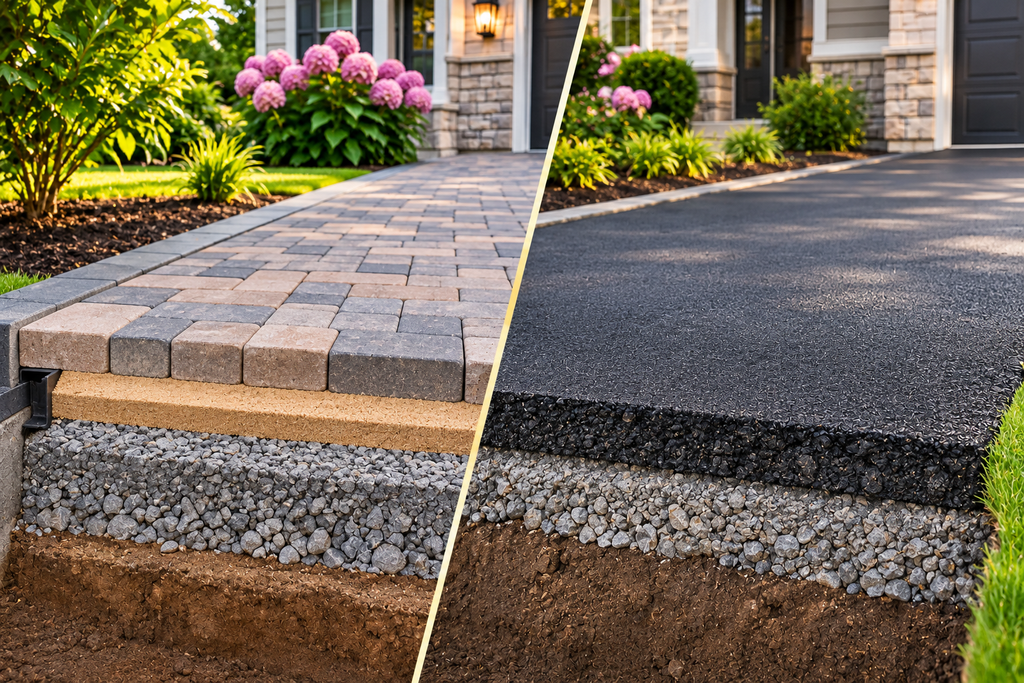
Asphalt usually costs less to install, and pavers usually cost more. The reasons are structural. Pavers involve manufactured units, more labor for setting, cutting, and compacting, and typically more careful base and edge work. Asphalt is laid mechanically over a prepared base and covers an area quickly.
This guide doesn’t give dollar figures, because prices depend on the project and any number that isn’t based on your property is a guess. What drives the cost of either option:
- Materials. The specific paver or asphalt mix and the thickness of the base.
- Labor and complexity. Patterns, borders, curves, and cuts take more time than a simple rectangle.
- Excavation and removal. Tearing out an old driveway and disposing of it adds cost, as does fixing a poor existing base.
- Site access. Tight access can slow equipment and add labor.
- Drainage. Regrading or adding drainage features increases the scope.
- Size and shape. Larger areas cost more in total, though not always proportionally.
A fair comparison also includes ownership costs. Asphalt’s lower price comes with ongoing items like sealing, crack repair, and eventual resurfacing or replacement. Pavers have a higher entry price and their own upkeep, such as joint sand, cleaning, and occasional re-leveling. Whether the totals end up close depends on installation quality, maintenance habits, and how long you stay in the home, and it can’t be stated as a fixed percentage.
When you collect quotes, ask for itemized, comparable scopes. A hypothetical example: if one quote includes removal of the old surface, a new compacted base, and drainage work, and another assumes paving over the existing surface, the price gap tells you little about the materials themselves.
Which Driveway Material Lasts Longer?
There’s no honest universal answer. Both materials can perform well for many years when installed properly, and both can fail early when they aren’t. Service life depends on several factors that matter more than the surface material:
- Base preparation. Depth, material, and compaction of the base and the condition of the soil beneath it.
- Drainage. Standing or trapped water weakens bases and accelerates damage in a freeze-thaw climate.
- Vehicle loading. Heavy or frequent vehicles stress both surfaces, particularly at turning areas.
- Workmanship. Compaction, grading, jointing, and edge detailing.
- Maintenance. Staying on top of small problems prevents large ones.
- Climate exposure. Repeated freezing and thawing, sun, and deicing products.
Pavers are often described as long-lasting because the surface can be repaired and the units themselves are durable. Asphalt can also last for many years, but it ages as a continuous surface and eventually needs resurfacing or replacement. Those are general characteristics. A well-built asphalt driveway can outperform a poorly built paver driveway, and the reverse is also true. Be wary of any contractor who promises a specific number of years.
How Do Pavers and Asphalt Handle New York Winters?
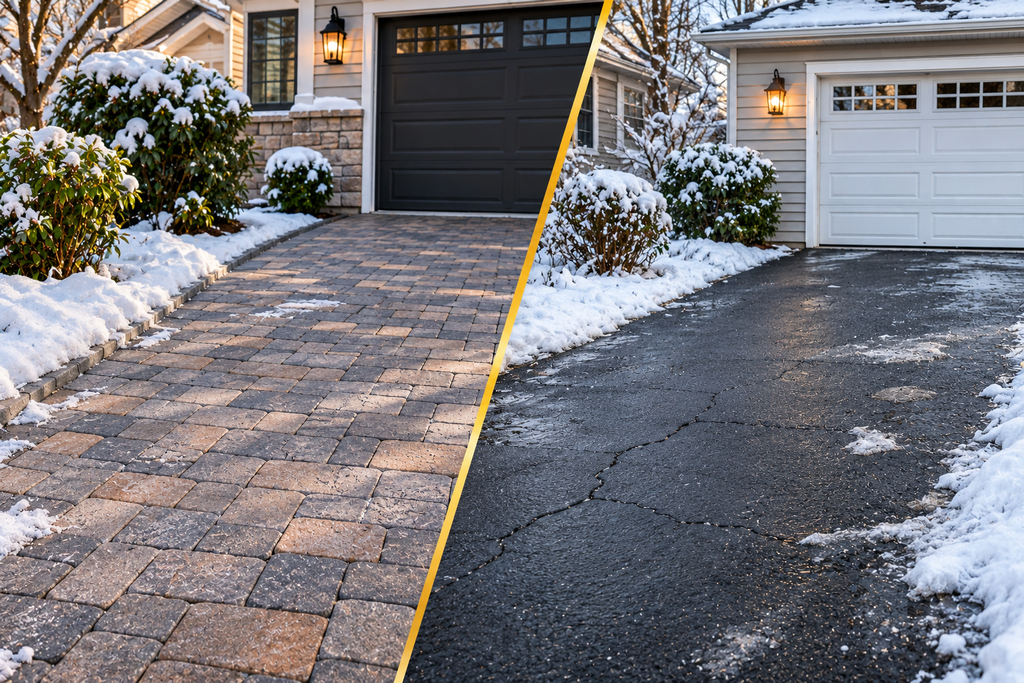
Both can handle New York winters when they’re built well. Neither is immune to freeze-thaw, and in both cases the base and drainage are what determine how a driveway holds up. Water that gets in and freezes expands, and repeated cycles move the surface.
Asphalt. Water enters through cracks, freezes, and widens them, which can lead to more cracking and potholes over time. Sealing and crack repair help limit water infiltration. Snow removal is generally straightforward on a smooth surface.
Pavers. Water can enter through the joints, so a well-drained base and properly filled joints matter. If the base holds water or settles, pavers can shift, heave, or sink in spots. The upside is that affected areas can often be lifted and reset. Snow removal needs a bit more care, because a hard plow or shovel edge can catch joints or chip edges. A plastic blade or a raised plow shoe is commonly recommended.
Deicing products. Harsh deicers can damage some surfaces over time, and different materials tolerate different products. Check recommendations from your installer and the paver manufacturer, and use products that are suitable for your surface. Avoid using deicers excessively.
Which Driveway Requires More Maintenance?

Both need maintenance, and neither is maintenance-free. The nature of the work differs.
Asphalt upkeep commonly includes:
- Filling cracks as they appear, before water gets in.
- Sealing the surface periodically, which many homeowners do to slow oxidation and protect against water and stains. How often depends on conditions and product.
- Patching potholes and edge breakdown.
- Eventual resurfacing or replacement when the surface is worn throughout.
Paver upkeep commonly includes:
- Replenishing joint sand, which can wash out over time.
- Controlling weeds and moss in the joints.
- Cleaning stains and, if desired, applying sealer. Sealing is optional and a matter of preference and product.
- Re-leveling or replacing individual pavers that settle or get damaged.
A practical difference is how repairs look. A patched asphalt crack or pothole is often visible, while a replaced paver can blend in, as long as a matching unit is available. Paver driveways can also require more hands-on cleaning. Which is “more” maintenance depends on your habits and tolerance, not a universal rule.
Which Driveway Looks Better for Your Property?
This one is a matter of taste and architecture. Asphalt gives a uniform, dark, traditional look that suits many homes and keeps attention on the house and landscaping. Pavers add pattern, color, and texture, and can be matched to the home or walkway, with borders and layouts that make a driveway a design feature.
If you want a driveway that echoes brick, stone, or a coordinated front entry, pavers give you more control. If you want a clean, simple surface, asphalt does that well. Neither is objectively better-looking, so the useful question is what suits your house and street.
What About Drainage and Water Management?
Drainage affects both materials. A driveway should slope so water moves away from the house, garage, and neighboring property. Poor grading leads to pooling, ice, and base damage regardless of the surface.
One common misconception is that paver driveways are permeable. Conventional pavers sit on a compacted base and, for practical purposes, shed most water like other hard surfaces. Water can pass through joints, but that doesn’t make the system permeable. Permeable paver systems are a separate, specifically engineered category, with open-graded stone layers designed to absorb and hold runoff. They depend on soil conditions and design, and they aren’t right for every property.
Whether your project needs drainage features, and what rules apply to runoff, depends on your property and jurisdiction. Don’t assume a particular answer. Ask your contractor how they plan to handle water and confirm requirements with the appropriate local authority.
Which Material Fits Which Situation?
When Asphalt May Be the Better Fit
- Your budget is the main constraint. Asphalt’s lower initial cost can make it the practical choice.
- You prefer a simple, continuous surface. A uniform dark driveway is a valid aesthetic.
- The layout is large and straightforward. Open, uncomplicated areas suit machine-laid paving.
- You’re comfortable with periodic crack filling and sealing as ongoing upkeep.
- You’re not planning to stay long-term and want to limit upfront investment.
When Pavers May Be the Better Fit
- Appearance is a priority. Patterns, colors, and borders give you design control.
- You like the idea of repairing individual sections instead of patching or resurfacing.
- Your home’s architecture calls for a specific look, such as brick-style or coordinated with a walkway.
- You’re willing to invest more upfront and expect to stay in the home.
- The site supports proper installation, including adequate base depth and drainage.
Pavers aren’t a guaranteed better long-term value. They’re a better fit when design flexibility and repairability matter to you and your budget allows for a proper installation.
How to Choose the Right Driveway for Your New Hyde Park Home
Work through these questions before you decide:
- Budget. What can you spend now, and what are you comfortable spending on upkeep?
- Size and shape. Is the driveway compact, curved, or complicated? Tight spaces and intricate layouts affect labor and cost.
- Appearance. Which look suits the house and street?
- Vehicle use. How many and what type of vehicles? Do you have turning areas or heavy loads?
- Drainage. Where does water collect now, and where can it go?
- Maintenance expectations. Would you rather fill cracks and seal periodically, or sweep in joint sand and pull weeds?
- Winter conditions. How do you handle snow removal, and which deicers do you use?
- How long you plan to stay. A longer horizon makes higher upfront spending easier to justify.
- Approvals. Whether a permit or approval is needed depends on your property’s actual municipality and the scope of work. New Hyde Park involves several local jurisdictions, so don’t assume rules from another town or New York City apply. Replacing a driveway in the same footprint may be treated differently from widening it or altering a curb cut. Confirm with the appropriate local authority before work begins.
How to Compare Contractor Estimates
Ask each contractor for an itemized, project-specific estimate and compare scope line by line:
- Removal and disposal of the existing surface
- Excavation and base depth, material, and compaction
- Drainage and grading work
- Edge restraints (for pavers) or edge treatment (for asphalt)
- Product specifications, including paver thickness and rating for vehicles
- What the estimate excludes
- Who handles approvals, if required
If you’re leaning toward pavers, you can contact Kings Pavers to discuss suitable paver options and project-specific installation considerations. You can also browse the full list of services.
Frequently Asked Questions
Are pavers better than asphalt for a driveway?
Not universally. Pavers offer more design flexibility and easier spot repairs, while asphalt generally costs less to install and gives a smooth, continuous surface. Which is better depends on your budget, appearance goals, maintenance preferences, and site conditions.
Is a paver driveway more expensive than asphalt?
Usually, at installation. Pavers require more material and labor. Over time, ownership costs differ: asphalt typically involves sealing, crack repair, and eventual resurfacing, while pavers involve joint and surface upkeep. Request itemized estimates for comparable scopes to see the real difference for your property.
Which driveway material lasts longer?
It depends on base preparation, drainage, vehicle loads, workmanship, maintenance, and climate. Pavers are often valued for repairability, and asphalt can also last many years when built and maintained well. Be cautious about guaranteed lifespan claims from anyone.
Do pavers or asphalt perform better in New York winters?
Both can perform well when the base and drainage are right. Asphalt is vulnerable to water entering cracks, and pavers are vulnerable to settling or heaving if the base holds water. Choose deicers carefully and ask your installer what suits your surface.
Are paver driveways easier to repair?
Often. A damaged or settled paver can usually be lifted, the base corrected, and the unit reset or replaced. Asphalt repairs are typically patches, and extensive damage may require resurfacing. Repair appearance and ease still vary by product and installation.
Can you replace an asphalt driveway with pavers?
Generally, yes. The asphalt is typically removed, and the base and grading are evaluated and rebuilt as needed. Replacing within the same footprint may be treated differently from widening it or changing a curb cut, so confirm local requirements before starting.
Which driveway option is better for a small New Hyde Park property?
Both can work. Pavers offer layout and border options that can make a compact driveway feel intentional, while asphalt offers a simple, lower-cost surface. Measure your space, think about vehicle access and drainage, and get comparable estimates for each option.
Choosing What Fits Your Property
Asphalt generally costs less upfront and provides a clean, continuous surface. Pavers generally cost more and give you design flexibility and spot repairs. In New York’s freeze-thaw climate, though, the base, drainage, and installation quality matter at least as much as the surface you choose. The best driveway is the one that matches your budget, your home, and the maintenance you’re willing to take on.
If you’re leaning toward pavers, Kings Pavers can discuss suitable options and the installation considerations for your New Hyde Park property. Learn more about paver installation services and reach out to ask about a project-specific estimate.