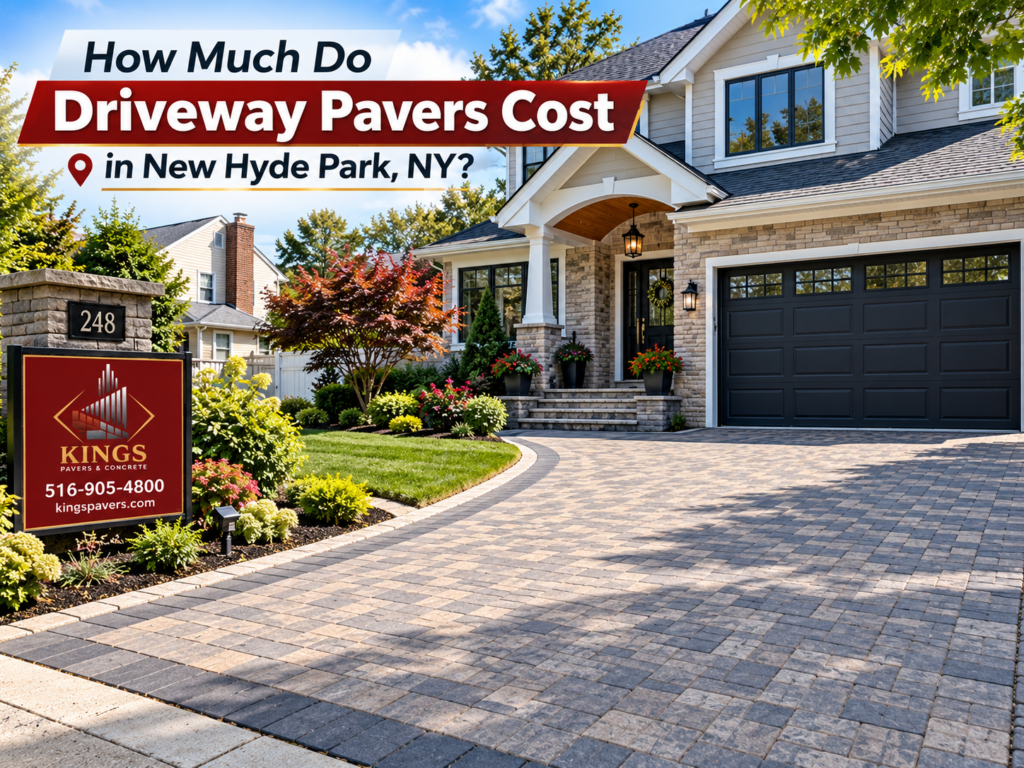
How Much Do Driveway Pavers Cost in New Hyde Park, NY?
If you’re trying to figure out what driveway pavers cost before you call anyone, here’s the honest answer: it depends, but not in a way that’s meant to dodge the question. Nationally, industry cost guides put paver driveway installation somewhere in the range of $10 to $30 per square foot installed, with some premium materials and complex designs pushing higher. That range covers everything from a basic concrete paver job on a driveway with good access and a solid base underneath, to a full tear-out with drainage correction and natural stone. On Long Island, where labor rates, freeze-thaw conditions, and older housing stock all play a role, most homeowners land somewhere in that same general window once a contractor actually looks at the property. We can’t give you a New Hyde Park-specific average with a straight face, because nobody’s compiled one that’s reliable, and any contractor who quotes you a number sight unseen is guessing. What we can do is walk you through why one driveway costs noticeably more than another one that looks similar from the street, so that when you do get an estimate for driveway pavers in New Hyde Park, you understand what’s actually in that number. Why There’s No Single Price for Driveway Pavers in New Hyde Park Two driveways can be the same square footage and end up with estimates that are thousands of dollars apart. That’s not a sales tactic. It’s usually one or more of these: None of these show up in a quick phone estimate. They show up when someone walks the property. The Biggest Factors That Affect Driveway Paver Cost Driveway Square Footage This is the most obvious factor, but it’s not purely linear. A small driveway still needs a dumpster, a compactor, and a crew on site for at least a day, so the cost per square foot on a compact job often runs a bit higher than on a large one. Mobilization and equipment costs get spread across more area on bigger projects. Paver Material Concrete pavers are the most common choice and generally the most budget-friendly. Brick and natural stone options cost more per square foot for the material itself, and natural stone in particular can also take longer to install because the pieces aren’t as uniform. Existing Surface Removal If you’re replacing an asphalt or concrete driveway, that material has to come out, get loaded, and get hauled away before anything new goes in. Removal and disposal typically adds a real line item to the estimate, often somewhere in the range of a dollar or two per square foot depending on thickness and how the material breaks up. Excavation and Base Preparation This is where a lot of the actual work happens, even though it’s invisible once the job is done. A paver driveway needs a properly excavated and compacted base, typically deeper than what a concrete or asphalt driveway needs in this climate, because of how freeze-thaw cycles move soil over the winter. Skimping here is where driveways go wrong two or three years down the road. Labor Labor is a significant share of the total cost on any paver project, generally landing somewhere between $5 and $10 per square foot depending on site conditions and complexity. Hand-laying pavers, cutting them to fit around edges and curves, and compacting the base properly all take time that can’t really be rushed. Drainage If water currently pools on your existing driveway or runs toward the house, that’s worth addressing during installation rather than living with it afterward. Regrading, adding a drain, or adjusting the pitch adds cost, but it’s cheaper to solve once than to deal with erosion or ice buildup every winter. Borders, Edging, and Patterns A contrasting border course or a herringbone pattern instead of a running bond looks sharp, but it adds labor time. Simple, straight-run patterns install faster and cost less without looking cheap. Site Access If a crew can bring equipment right up to the driveway, the job moves faster. If material has to be wheelbarrowed around a fence, through a gate, or across a lawn that can’t handle equipment traffic, that adds hours that show up in the labor line. Grading and Repairs Before Installation Sometimes what looks like a driveway problem is actually a grading problem. If the yard slopes the wrong way toward the house or garage, that needs to get corrected as part of the job, not patched around. Major Driveway Cost Factors Factor How It Affects Price Driveway size Larger areas often lower the per-square-foot rate; small jobs carry more fixed cost Existing surface removal Adds demolition and disposal cost before new work can start Excavation depth Deeper base needed for freeze-thaw climates increases material and labor Paver material Concrete is generally most affordable; brick and natural stone cost more Drainage correction Regrading or adding drainage adds cost but prevents future problems Borders and patterns Decorative layouts increase labor time Site access Limited access means more hand labor, which raises cost Base soil condition Poor or unstable soil may require extra excavation and stabilization Paver Material Comparison Not all pavers are priced or maintained the same way, and the right choice usually comes down to budget, style, and how much upkeep you actually want to do. Paver Type Relative Cost Maintenance Durability Best Fit Concrete pavers Lowest to mid-range Low; occasional sealing and joint sand refresh Strong when properly installed; individual units can be replaced if damaged Most residential driveways looking for value and a clean look Brick pavers Mid-range Low to moderate; can be prone to more visible wear over time Solid, though individual bricks can chip or fade with age Homeowners wanting a traditional or colonial look Natural stone Highest Moderate; sealing recommended, more sensitive to staining Very durable when installed correctly, but installation quality matters more Properties where a premium, one-of-a-kind appearance is the priority Lifespan claims vary a lot depending on installation quality, climate, and maintenance, so we’re not going to hand you