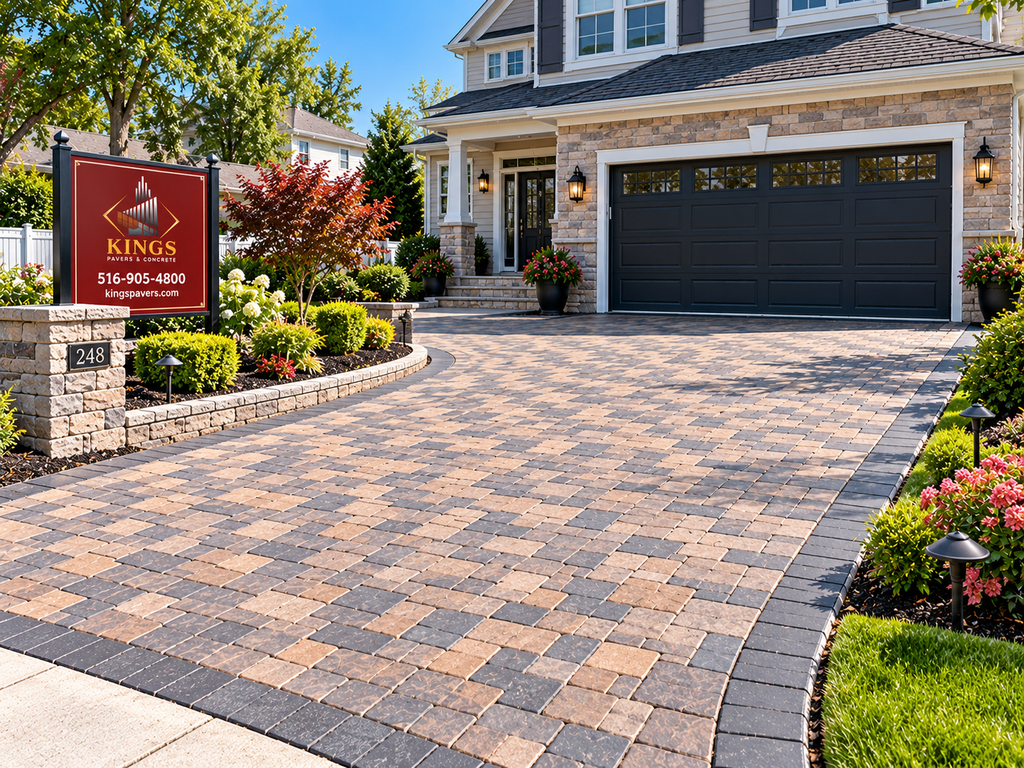
If you’re trying to figure out what driveway pavers cost before you call anyone, here’s the honest answer: it depends, but not in a way that’s meant to dodge the question.
Nationally, industry cost guides put paver driveway installation somewhere in the range of $10 to $30 per square foot installed, with some premium materials and complex designs pushing higher. That range covers everything from a basic concrete paver job on a driveway with good access and a solid base underneath, to a full tear-out with drainage correction and natural stone. On Long Island, where labor rates, freeze-thaw conditions, and older housing stock all play a role, most homeowners land somewhere in that same general window once a contractor actually looks at the property. We can’t give you a New Hyde Park-specific average with a straight face, because nobody’s compiled one that’s reliable, and any contractor who quotes you a number sight unseen is guessing.
What we can do is walk you through why one driveway costs noticeably more than another one that looks similar from the street, so that when you do get an estimate for driveway pavers in New Hyde Park, you understand what’s actually in that number.
Why There’s No Single Price for Driveway Pavers in New Hyde Park
Two driveways can be the same square footage and end up with estimates that are thousands of dollars apart. That’s not a sales tactic. It’s usually one or more of these:
- The old driveway needs to come out first, and what’s underneath it isn’t always what you’d expect.
- The base soil holds water or shifts, which means more excavation and more compacted base material.
- The driveway pitches wrong and water pools near the garage or foundation.
- The homeowner wants a border, a pattern, or a specific paver style that costs more per square foot or takes longer to install.
- Trucks and equipment can’t get close to the work area, so material has to be moved by hand.
None of these show up in a quick phone estimate. They show up when someone walks the property.
The Biggest Factors That Affect Driveway Paver Cost
Driveway Square Footage
This is the most obvious factor, but it’s not purely linear. A small driveway still needs a dumpster, a compactor, and a crew on site for at least a day, so the cost per square foot on a compact job often runs a bit higher than on a large one. Mobilization and equipment costs get spread across more area on bigger projects.
Paver Material
Concrete pavers are the most common choice and generally the most budget-friendly. Brick and natural stone options cost more per square foot for the material itself, and natural stone in particular can also take longer to install because the pieces aren’t as uniform.
Existing Surface Removal
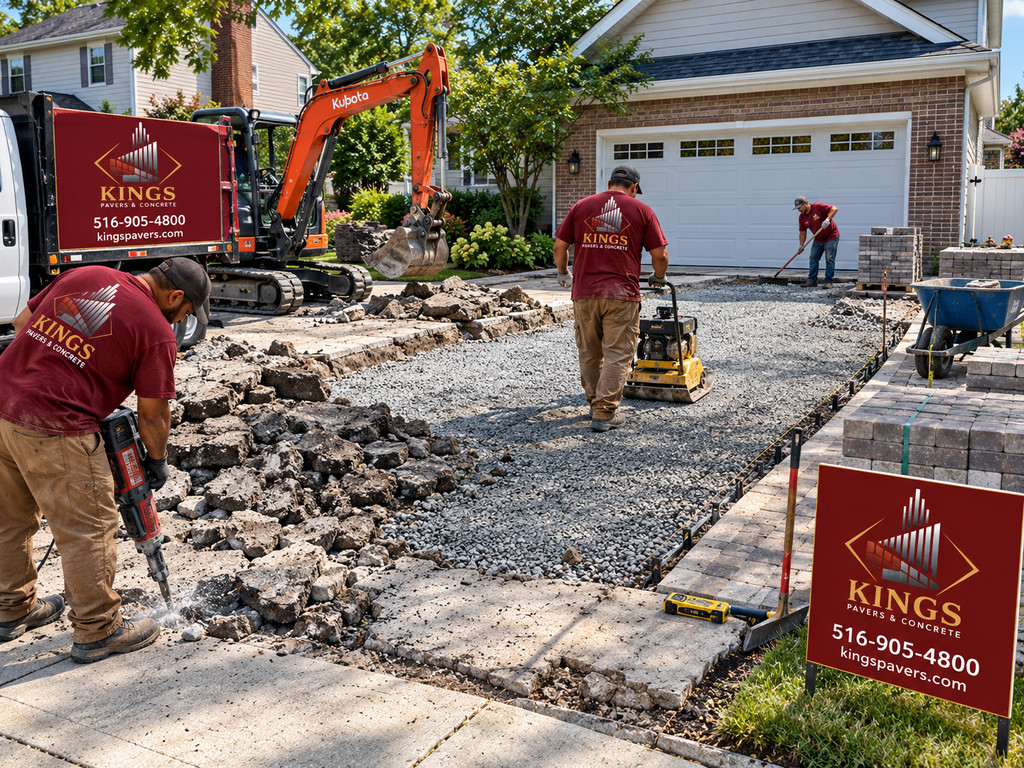
If you’re replacing an asphalt or concrete driveway, that material has to come out, get loaded, and get hauled away before anything new goes in. Removal and disposal typically adds a real line item to the estimate, often somewhere in the range of a dollar or two per square foot depending on thickness and how the material breaks up.
Excavation and Base Preparation
This is where a lot of the actual work happens, even though it’s invisible once the job is done. A paver driveway needs a properly excavated and compacted base, typically deeper than what a concrete or asphalt driveway needs in this climate, because of how freeze-thaw cycles move soil over the winter. Skimping here is where driveways go wrong two or three years down the road.
Labor
Labor is a significant share of the total cost on any paver project, generally landing somewhere between $5 and $10 per square foot depending on site conditions and complexity. Hand-laying pavers, cutting them to fit around edges and curves, and compacting the base properly all take time that can’t really be rushed.
Drainage
If water currently pools on your existing driveway or runs toward the house, that’s worth addressing during installation rather than living with it afterward. Regrading, adding a drain, or adjusting the pitch adds cost, but it’s cheaper to solve once than to deal with erosion or ice buildup every winter.
Borders, Edging, and Patterns
A contrasting border course or a herringbone pattern instead of a running bond looks sharp, but it adds labor time. Simple, straight-run patterns install faster and cost less without looking cheap.
Site Access
If a crew can bring equipment right up to the driveway, the job moves faster. If material has to be wheelbarrowed around a fence, through a gate, or across a lawn that can’t handle equipment traffic, that adds hours that show up in the labor line.
Grading and Repairs Before Installation
Sometimes what looks like a driveway problem is actually a grading problem. If the yard slopes the wrong way toward the house or garage, that needs to get corrected as part of the job, not patched around.
Major Driveway Cost Factors
| Factor | How It Affects Price |
| Driveway size | Larger areas often lower the per-square-foot rate; small jobs carry more fixed cost |
| Existing surface removal | Adds demolition and disposal cost before new work can start |
| Excavation depth | Deeper base needed for freeze-thaw climates increases material and labor |
| Paver material | Concrete is generally most affordable; brick and natural stone cost more |
| Drainage correction | Regrading or adding drainage adds cost but prevents future problems |
| Borders and patterns | Decorative layouts increase labor time |
| Site access | Limited access means more hand labor, which raises cost |
| Base soil condition | Poor or unstable soil may require extra excavation and stabilization |
Paver Material Comparison
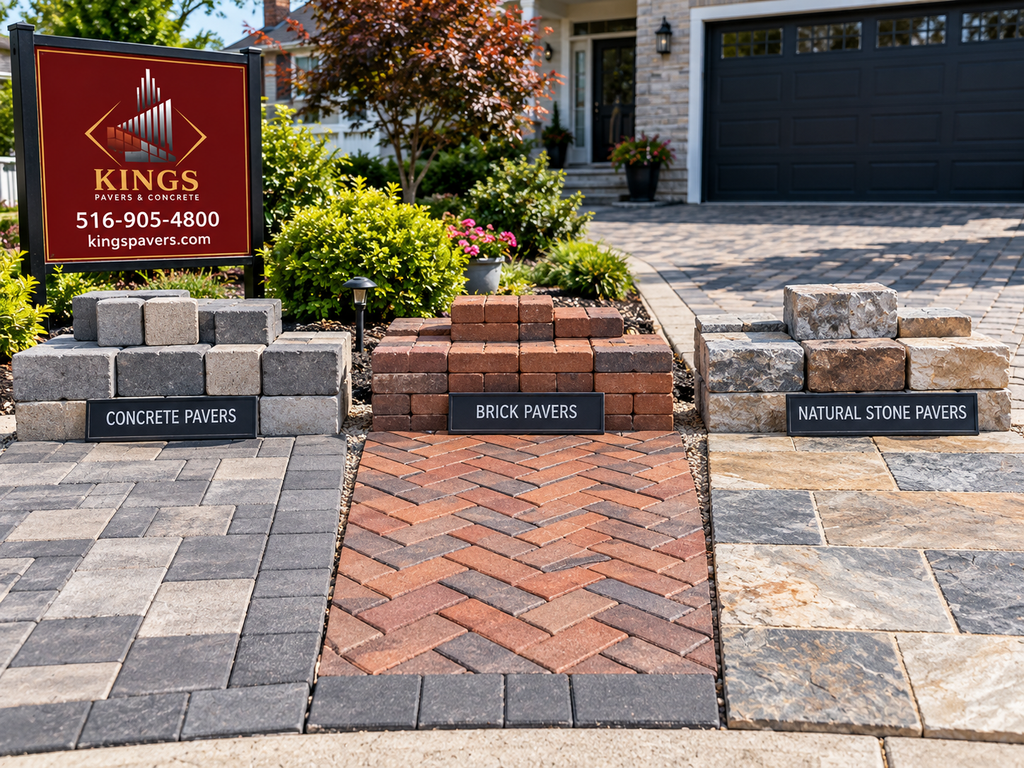
Not all pavers are priced or maintained the same way, and the right choice usually comes down to budget, style, and how much upkeep you actually want to do.
| Paver Type | Relative Cost | Maintenance | Durability | Best Fit |
| Concrete pavers | Lowest to mid-range | Low; occasional sealing and joint sand refresh | Strong when properly installed; individual units can be replaced if damaged | Most residential driveways looking for value and a clean look |
| Brick pavers | Mid-range | Low to moderate; can be prone to more visible wear over time | Solid, though individual bricks can chip or fade with age | Homeowners wanting a traditional or colonial look |
| Natural stone | Highest | Moderate; sealing recommended, more sensitive to staining | Very durable when installed correctly, but installation quality matters more | Properties where a premium, one-of-a-kind appearance is the priority |
Lifespan claims vary a lot depending on installation quality, climate, and maintenance, so we’re not going to hand you a specific number of years for any of these. A driveway that’s installed on a properly compacted base and maintained reasonably will outlast one that isn’t, regardless of which paver you pick.
What’s Actually Included in a Professional Paver Driveway Estimate
A lot of homeowners assume “pavers” means just the visible stone on top. A real estimate for driveway paver installation typically covers:
- Demolition of the existing driveway, if applicable
- Hauling and disposal of removed material
- Excavation to the required depth
- Base material (usually crushed stone)
- Compaction of the base, often in multiple lifts
- A bedding layer of sand or stone dust that the pavers sit on
- The pavers themselves
- Edge restraints to keep the perimeter from spreading over time
- Joint filling material, typically polymeric sand
- Labor for the full installation
- Site cleanup
If a quote skips several of these items or seems unusually low, ask what’s not included. Cutting the base prep or edge restraints is one of the easiest ways for a contractor to lower a number on paper.
Why Base Preparation Matters More Than the Pavers Themselves
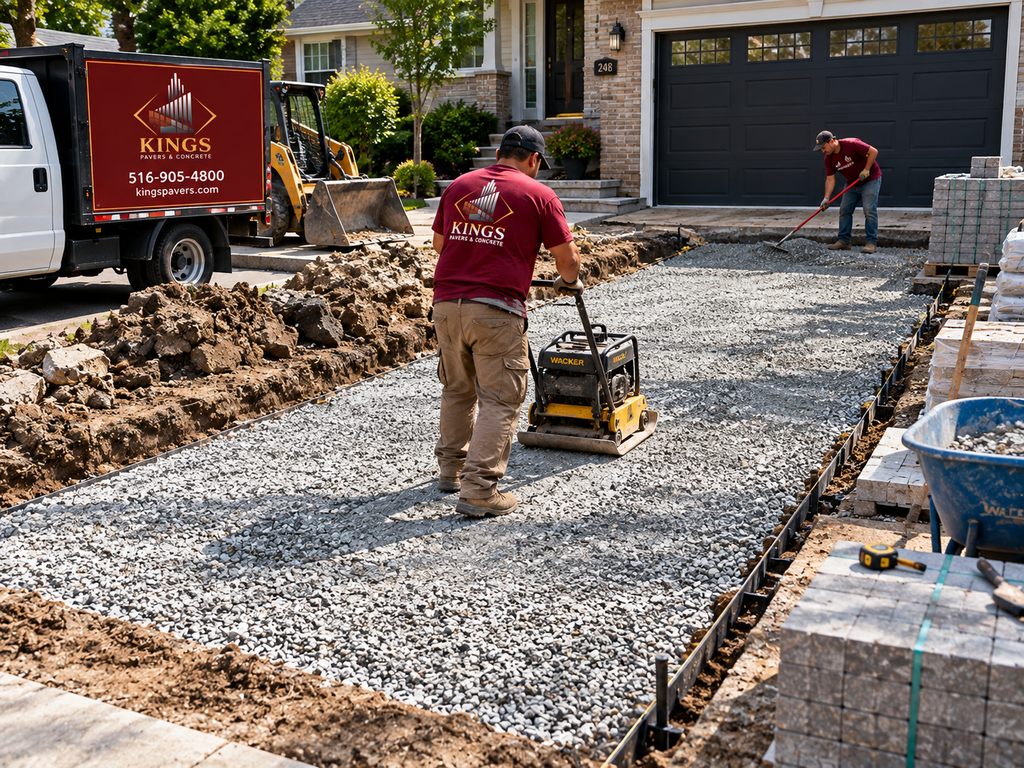
The pavers get all the attention because they’re what you see. The base is what actually determines whether the driveway holds up.
Without enough compacted base underneath, pavers shift under vehicle weight, especially near the tire tracks. Water finds its way under the surface through the joints and, with nowhere to drain, it softens the soil below. Combine that with a Long Island winter, and you get freeze-thaw movement, which shows up as settling, uneven sections, or low spots where water pools. None of that is something you can fix by pressure-washing or re-sanding the joints. It usually means pulling up the affected area and redoing the base.
This is also why two bids for the same driveway can look so different. A lower bid that skips proper excavation depth or compaction steps isn’t actually cheaper. It’s a driveway that needs to be partially redone in a few years.
Step-by-Step: How a Paver Driveway Installation Works
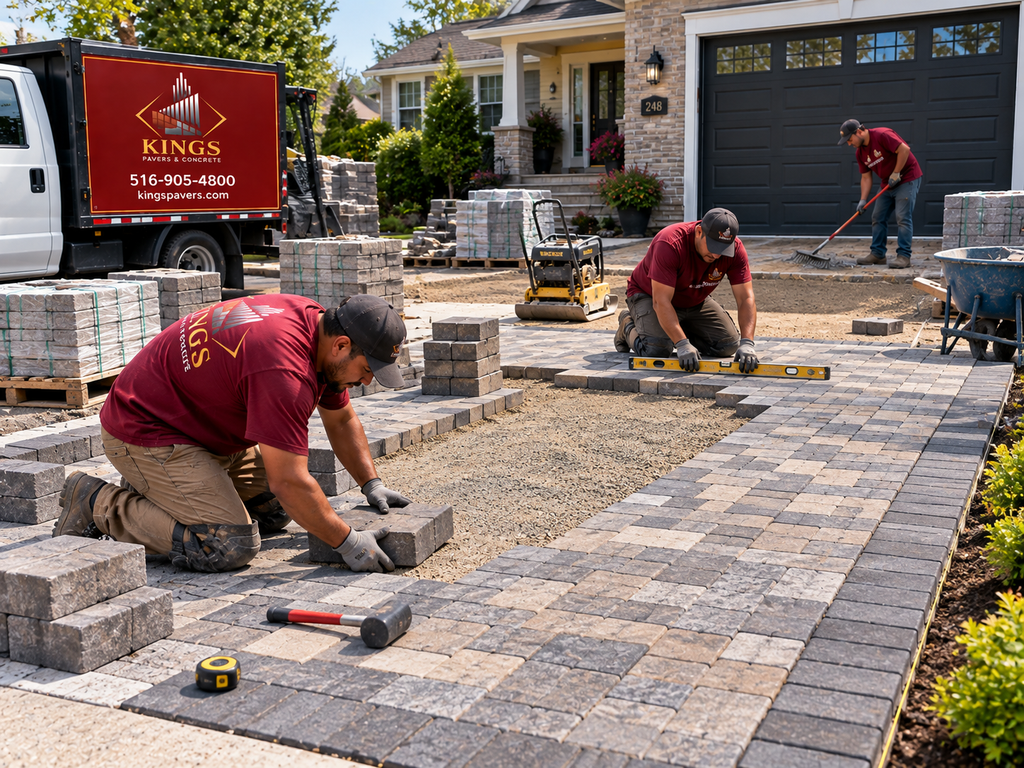
- Site assessment. A contractor looks at drainage, soil, access, and the condition of the existing driveway.
- Measurements and planning. The driveway is measured, and the layout, pattern, and border (if any) are finalized.
- Existing driveway removal, when replacing asphalt, concrete, or another surface.
- Excavation to the depth needed for the base, adjusted for soil conditions and climate.
- Base preparation and compaction, typically done in layers rather than all at once, to avoid weak spots.
- Paver installation, laid according to the chosen pattern on a bedding layer.
- Edge restraint installation along the perimeter to lock the pavers in place.
- Joint filling, usually with polymeric sand swept into the gaps.
- Final compaction and inspection, checking pitch, drainage, and surface stability before the job is called complete.
A Hypothetical New Hyde Park Cost Scenario
To show why the same square footage can price out differently, here’s a hypothetical example not a real project or quote, just an illustration.
Scenario A: A 500-square-foot driveway with good truck access, a stable existing base, standard concrete pavers, and no drainage issues. Work mostly involves removal of the old surface, standard excavation depth, and a straightforward running-bond pattern.
Scenario B: A 500-square-foot driveway on the same block, but the existing surface is heavily cracked with soil erosion underneath, water currently drains toward the garage, access is limited to a narrow side yard, and the homeowner wants a herringbone pattern with a contrasting border.
Same square footage, very different scope. Scenario B involves more excavation, drainage correction, hand-carried materials, and more labor-intensive paver placement. That’s the kind of difference that turns into thousands of dollars between two estimates for driveways that look similar on paper.
Pavers vs. Concrete vs. Asphalt
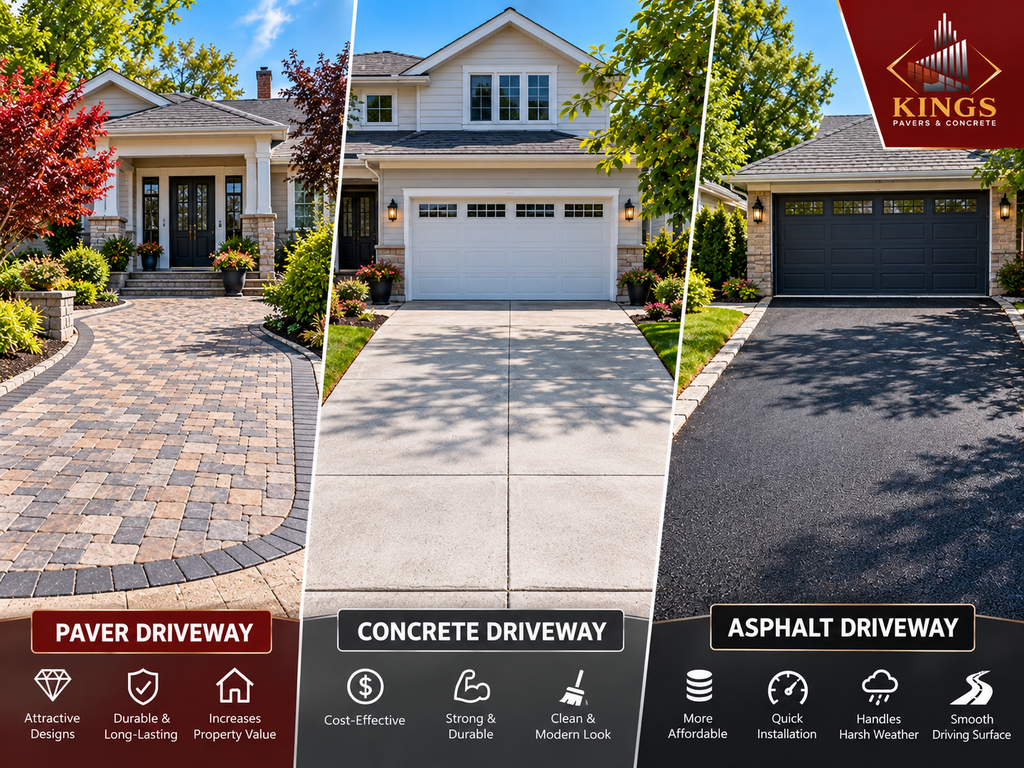
None of these surfaces wins on every count, and the right one depends on what you’re prioritizing.
- Upfront investment: Asphalt is typically the least expensive to install, concrete is in the middle, and pavers usually cost more upfront.
- Repairability: Pavers have an advantage here. Individual units can be lifted and replaced without redoing the whole surface. Concrete and asphalt repairs are harder to blend in and often involve patching that’s visible.
- Appearance: Pavers offer more design flexibility with patterns, colors, and borders. Concrete and asphalt are more uniform.
- Maintenance: Asphalt needs periodic sealing. Concrete is fairly low-maintenance but can crack. Pavers may need occasional joint sand refresh and, over time, releveling if the base settles.
- Long-term considerations: A well-installed paver driveway can be easier to maintain piece by piece over the years, but the upfront cost is real, and a poorly installed one has the same base-related problems as any other surface.
Ways to Control Cost Without Cutting Corners
- Choose a simpler pattern. A running bond or basic grid pattern costs less to install than a herringbone or diagonal layout, without looking low-end.
- Pick a practical paver material. Concrete pavers deliver a solid, attractive result at a lower price point than brick or natural stone.
- Get the site properly evaluated before you get quotes. Knowing your drainage and soil situation upfront helps you compare estimates that are actually scoped the same way.
- Skip decorative add-ons you don’t need. Contrasting borders and inlays are nice, but they’re optional. Save them for later if the budget’s tight now.
- Address drainage during installation. It costs more at the time, but it’s far cheaper than dealing with water damage, ice, or erosion later.
What you shouldn’t cut to save money: excavation depth, base compaction, or drainage correction if it’s genuinely needed. Those are the parts of the job that determine whether the driveway is still doing well in ten years.
Questions to Ask a Driveway Paver Contractor
- What’s the excavation depth and base material you’re planning for this site?
- Is demolition and disposal of the old driveway included in this quote?
- How will you handle drainage if there’s a pooling or pitch issue?
- What edge restraint system are you using?
- Is the joint sand polymeric, and is that included in the price?
- What’s your timeline, and how weather-dependent is it?
- Do you have a written scope that specifies base depth and compaction method, not just square footage and price?
[INSERT VERIFIED EXPERT QUOTE]
Frequently Asked Questions
How much do driveway pavers cost in New Hyde Park? There’s no single verified local average, but based on general industry cost data, paver driveways typically run somewhere between $10 and $30 per square foot installed, depending on material and site conditions. An accurate number for your property requires an in-person assessment.
Are pavers more expensive than concrete for a driveway? Usually, yes, on the upfront cost. Pavers generally cost more per square foot to install than a standard concrete driveway, but they’re also easier to repair piece by piece if a section gets damaged later.
What is the most affordable type of driveway paver? Concrete pavers are typically the most budget-friendly option compared to brick or natural stone, while still holding up well when installed on a properly prepared base.
How long does a paver driveway last? It depends heavily on installation quality, soil conditions, and maintenance, so we won’t put a specific number on it. A driveway installed with adequate base depth and compaction generally holds up far longer than one where those steps were cut short.
Do driveway pavers require maintenance? Some, but it’s manageable. Periodic joint sand refresh, occasional sealing, and keeping an eye on drainage are the main things. It’s less maintenance-intensive than people sometimes expect.
Can pavers be installed over an existing driveway? Generally, this isn’t recommended for a driveway that will carry vehicle weight, since it doesn’t allow for proper base preparation. In most cases, the existing surface needs to come out first.
What makes a paver driveway more expensive? The biggest cost drivers are usually excavation and base depth, drainage correction, limited site access, premium paver materials, and decorative patterns or borders. Size matters too, but scope of work often matters more.
Ready for an Accurate Number?
Every driveway is a little different once you go beyond square footage. If you’re trying to figure out what a paver driveway would actually cost for your property in New Hyde Park, the most reliable way is to have someone look at the site, the drainage, and what’s currently underneath the existing driveway. From there, you get a number that reflects your property, not a national average.