If you’re standing in your driveway right now looking at cracks, sunken sections, or just a surface that’s seen better days, you’ve probably already asked yourself the question: pavers or concrete?
There isn’t a single right answer. The material that makes sense for your neighbor’s house on the next block might not be the one that fits your budget, your soil, or how you actually use your driveway. What matters is understanding how each option performs, what it costs you over time (not just on day one), and how it handles a Long Island winter.
This guide walks through both options honestly, including where each one tends to fall short, so you can make a decision that fits your property rather than a generic recommendation.
Pavers vs. Concrete at a Glance
Here’s a quick side-by-side before we get into specifics.
| Feature | Driveway Pavers | Poured Concrete |
| Appearance | Wide range of patterns, colors, borders | Clean, uniform, can be stamped or colored |
| Initial investment | Generally higher upfront cost | Generally lower upfront cost |
| Expected longevity | Long-lasting when properly installed and maintained | Long-lasting when properly installed and maintained |
| Crack resistance | Individual units flex slightly with ground movement | Rigid slab, relies on control joints to manage cracking |
| Repairability | Individual pavers can often be lifted and reset | Cracks typically require patching or slab replacement |
| Maintenance | Occasional joint sand refill, weed control, periodic sealing | Periodic sealing, crack monitoring, joint maintenance |
| Winter performance | Handles minor shifting without cracking the whole surface | Can perform well with proper drainage, but cracking is a real possibility |
| Installation | More labor-intensive, unit by unit | Faster overall pour, but curing time matters |
| Design flexibility | High, patterns and borders are straightforward to customize | Moderate, mostly through stamping, coloring, or scoring |
Neither column is the “winner” here. A homeowner who wants a distinctive look and doesn’t mind a bit more upfront cost often leans toward pavers. Someone who wants a simpler, more budget-friendly surface and is fine with typical concrete maintenance often goes the other way.
What Is a Paver Driveway?
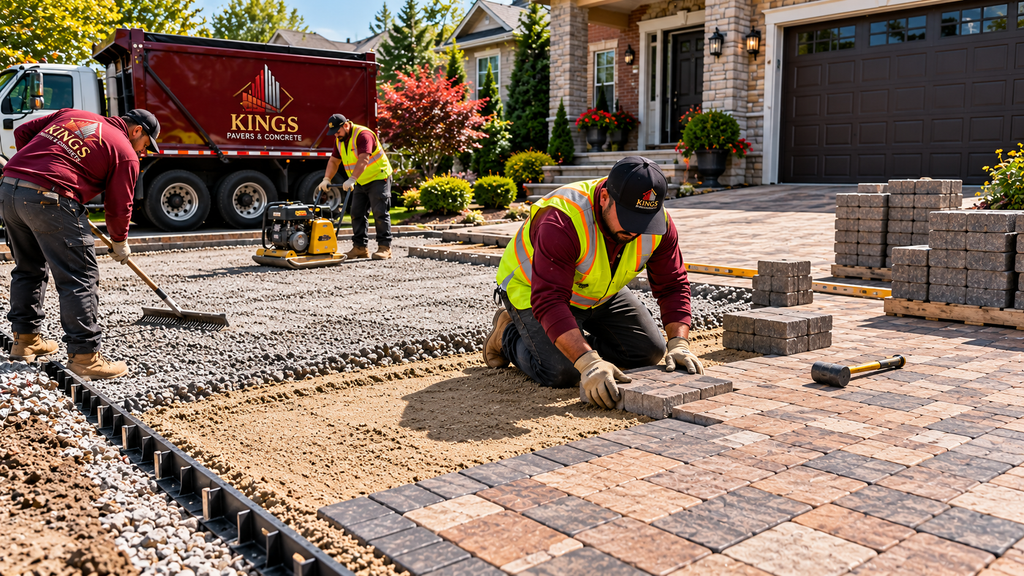
A paver driveway is built from individual units, usually concrete or brick-style pavers, laid over a compacted base and locked together with sand-filled joints. Instead of one continuous surface, you’ve got dozens or hundreds of separate pieces working together.
That joint system is the whole point. Because the units aren’t bonded into one rigid slab, they can shift slightly as the ground beneath them moves, without the surface cracking the way a solid slab would. Edge restraints, typically a hidden plastic or concrete border, keep the outer pavers from creeping outward over time.
What Is a Concrete Driveway?
Poured concrete is exactly what it sounds like: a continuous slab poured into forms, finished, and left to cure. Because concrete doesn’t have the same flexibility as jointed pavers, contractors cut control joints into the surface at regular intervals. Those joints give the concrete a planned place to crack as it naturally expands and contracts, rather than cracking randomly across the slab.
When people talk about concrete driveways developing cracks over the years, they’re usually talking about cracks that show up outside those control joints, often from settlement, drainage issues, or a base that wasn’t compacted well enough to begin with.
Pavers vs. Concrete for New Hyde Park Weather
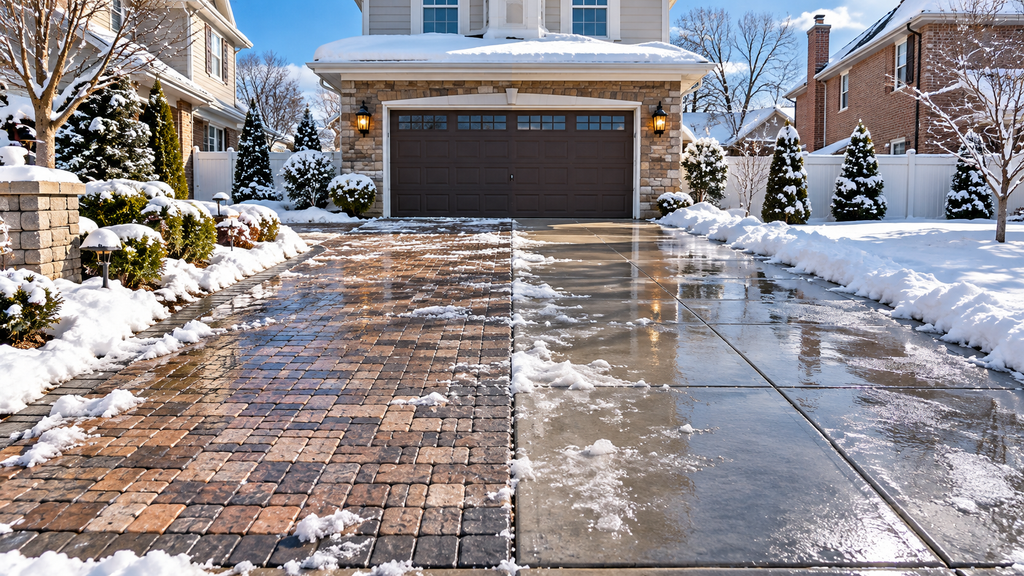
This is where the decision gets real. New Hyde Park winters bring repeated freeze-thaw cycles: water gets into small cracks or joints, freezes, expands, and then thaws again once temperatures rise. Do that dozens of times over a winter, and weak points in a driveway get exposed fast.
Pavers tend to handle this cycle reasonably well because of that joint flexibility. Minor ground movement from frost heave can shift individual units slightly without cracking the whole surface. That doesn’t mean pavers are immune to problems. Poor base preparation or inadequate drainage can still cause settling, and a paver driveway installed on a soft or poorly compacted base will show it, especially after a rough winter.
Concrete can perform well through a New York winter too, when it’s designed and installed correctly. Proper reinforcement, adequate slab thickness, and drainage that keeps water from pooling near the surface all matter. But even a well-installed concrete driveway isn’t crack-proof, and homeowners who go this route should expect that some hairline cracking over the years is a normal part of how concrete ages, not necessarily a sign of failure.
Salt and de-icing products deserve a mention here too. Both surfaces can be affected by certain de-icers over time, particularly ones with harsh chemical compositions, so it’s worth using products labeled safe for your driveway material.
Which One Lasts Longer?
This is a harder question to answer than most marketing material suggests, because service life depends on more than the material itself. Installation quality, base preparation, drainage, how much weight the driveway regularly carries, and how well it’s maintained all factor in.
Generally speaking, both well-installed paver and concrete driveways can last several decades with reasonable care, though sources vary somewhat on exact ranges and a lot depends on local conditions. What tends to separate a driveway that lasts 15 years from one that lasts 30 usually isn’t the material category. It’s whether the base was prepared correctly and whether drainage was handled before the surface ever went down.
Installation and Base Preparation
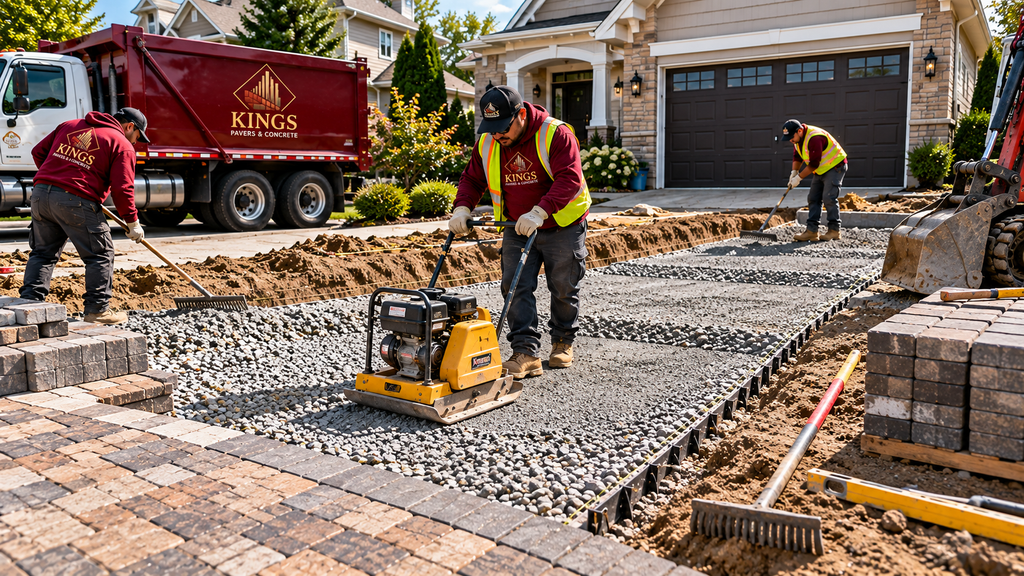
Here’s something that doesn’t show up in a lot of driveway marketing, but it’s the part that actually determines whether either material performs well: the base.
Before any pavers or concrete go down, the site needs to be excavated to an appropriate depth, graded correctly, and built up with a compacted aggregate base. For pavers, that base needs to be uniform enough to support individual units evenly, with edge restraints installed to lock the whole system in place. For concrete, the base needs to provide consistent support across the entire slab so the concrete doesn’t settle unevenly and crack outside its control joints.
A beautiful paver pattern or a perfectly finished concrete surface can’t make up for a base that wasn’t compacted properly. If the ground underneath shifts, whatever’s sitting on top is going to show it eventually, sometimes within the first year, sometimes not for several. This is genuinely the step where corners get cut most often, usually because it’s invisible once the project is finished.
Maintenance: Pavers vs. Concrete
Neither surface is maintenance-free, though the type of upkeep differs.
Pavers generally need occasional cleaning to keep the surface looking sharp, periodic joint sand refills as sand settles or washes out over time, and some attention to weed growth in the joints if it becomes an issue. Sealing is optional for most paver driveways but can help protect color and reduce staining. Settled units can usually be lifted, the base underneath adjusted, and the paver reset.
Concrete needs periodic cleaning as well, along with monitoring for cracks that may need sealing before water gets in and makes them worse. Joint sealant should be checked periodically too, since deteriorated joint filler lets water into places it shouldn’t be. Sealing the surface every few years can help with staining and moisture resistance, particularly for driveways exposed to oil drips or de-icing salt.
What Happens When the Driveway Needs Repair?
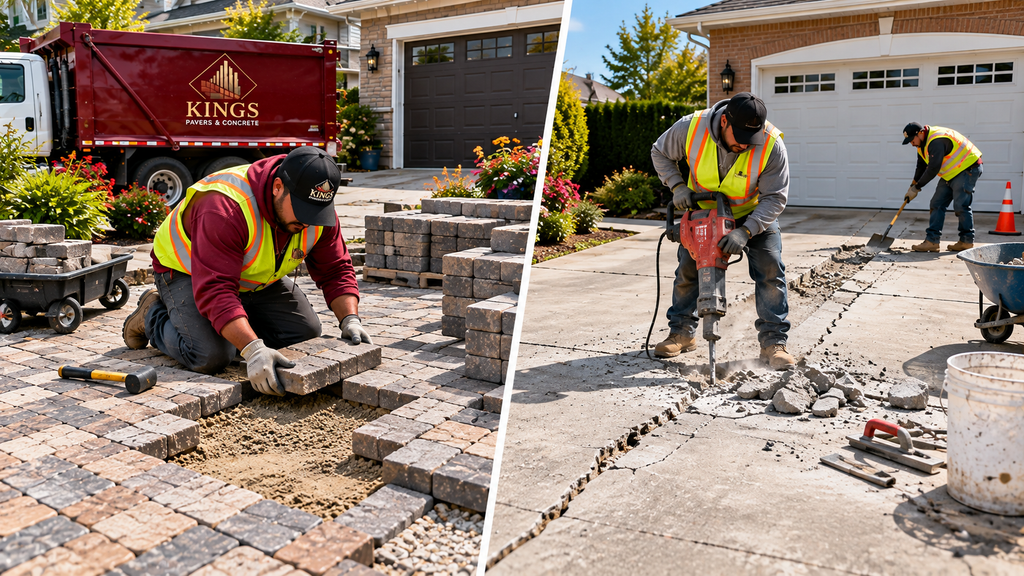
This is one of the more practical differences between the two, and it’s worth thinking through before you commit to either one.
With pavers, if a section settles or an individual unit cracks or stains badly, a contractor can typically lift the affected pavers, address whatever’s going on with the base underneath, and reset the same units or replace just the damaged ones. Done well, that repair tends to blend in reasonably closely with the surrounding surface.
Concrete repairs work differently. A crack usually gets patched, or if the damage is more significant, the affected section gets cut out and replaced with new concrete. Even with a good repair job, it’s fairly common for that patched or replaced section to look slightly different from the surrounding original concrete, at least until it weathers for a while. Color matching aged concrete is genuinely difficult.
Cost: Look Beyond the Installation Price
We’re not going to throw out exact dollar figures here, because pricing depends heavily on the size of your driveway, site conditions, material selection, and current material costs, all of which change and vary by contractor. What we can say is that pavers commonly involve a higher upfront investment than a standard poured concrete driveway of comparable size, largely because of the labor involved in laying individual units.
But installation price is only part of the picture. Over the life of the driveway, factor in repair costs, how noticeable those repairs will be, expected maintenance, and how long you plan to stay in the home. A driveway that costs more upfront but is cheaper and less disruptive to repair over 20 years might end up being the more practical choice for some homeowners, while others will reasonably prioritize the lower initial cost of concrete.
If you want real numbers, get a written estimate for your specific property. Anything else is a guess.
Brick Driveway Paving in New Hyde Park
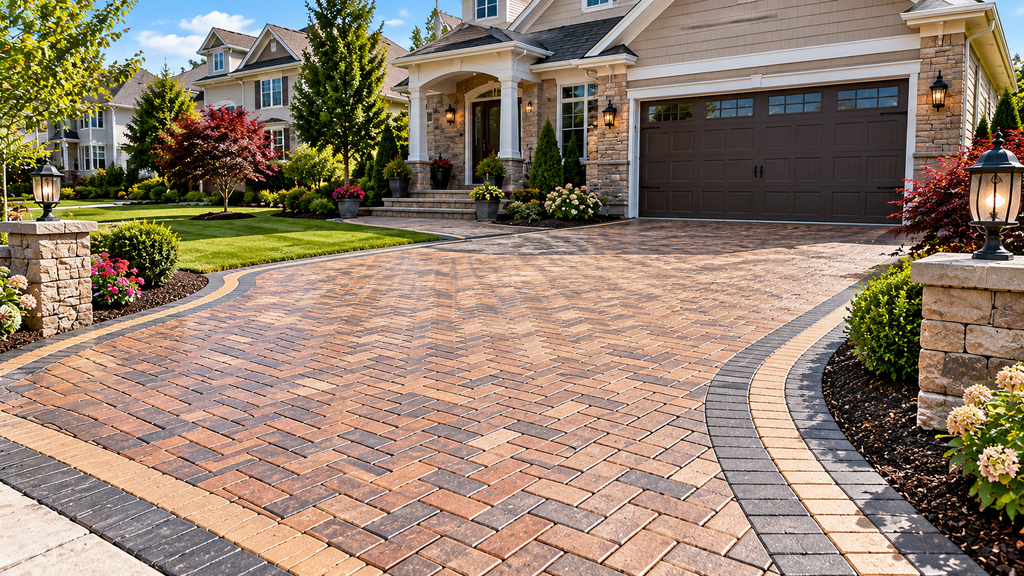
For homeowners specifically drawn to the look of brick driveway paving in New Hyde Park, the appeal usually comes down to a few things: the pattern options, the ability to add a contrasting border, and the fact that individual bricks or paver units can be replaced without redoing the whole driveway.
Brick-style pavers tend to complement the architecture found on a lot of New Hyde Park properties, especially homes with brick or stone accents already on the exterior. They also give homeowners more control over the finished look, since patterns like herringbone, running bond, or basket weave each create a noticeably different appearance from a plain poured slab.
That said, brick-style paving isn’t automatically the right call for every property. If the priority is a lower upfront cost and a simpler, low-fuss surface, concrete may still be the more practical option, even if the visual impact is different.
Which Driveway Material Makes Sense for Your Property?
Instead of naming an overall winner, it helps to think about your own priorities.
Pavers may make more sense if you want design flexibility, you like the idea of repairing individual sections rather than patching a slab, and you’re comfortable with a higher initial investment in exchange for that flexibility.
Concrete may make more sense if you want a simpler, continuous surface, a lower upfront cost, and you’re comfortable with typical concrete maintenance and the possibility of visible patch repairs down the road.
Whichever direction you lean, installation quality matters more than the marketing around either material. A poorly installed paver driveway will underperform a well-installed concrete one, and the reverse is just as true.
Step-by-Step Decision Guide
- Look at your budget, including both the installation cost and what you’re willing to spend on maintenance over time.
- Evaluate your drainage and site conditions. Standing water, poor grading, or a sloped driveway can affect either material.
- Decide how much maintenance you’re comfortable with, and be honest about it.
- Consider appearance and design. Do you want a distinctive pattern, or is a clean, simple surface more your style?
- Think about future repairs, and whether the idea of patched concrete versus reset pavers matters to you.
- Have the site evaluated by a contractor before settling on a material, since soil conditions and drainage vary property to property.
A Realistic New Hyde Park Scenario
Consider a homeowner in New Hyde Park with a concrete driveway poured about 22 years ago. It’s developed several cracks outside the original control joints, and after this past winter, a section near the garage has visibly settled, creating a low spot where water collects.
She’s weighing two options: replace the driveway with new poured concrete, which would cost less upfront and match the simple, clean look she’s used to, or switch to pavers, which would cost more initially but let her add a border detail she’s wanted and give her the option to reset individual units if settling happens again.
This is a hypothetical example, not a documented project, but it reflects a decision a lot of homeowners in similar situations actually face. There’s no universally correct choice here. It comes down to her budget, how long she plans to stay in the house, and how much she values the repair flexibility that pavers offer.
Common Mistakes to Avoid
Choosing based only on the initial price. The cheapest bid doesn’t always reflect the quality of base preparation or materials being used.
Ignoring drainage. A driveway that looks great on installation day but pools water within a year usually points back to grading that wasn’t addressed properly.
Underestimating base preparation. This is the step most likely to get shortcut, and it’s the one most likely to cause problems later.
Hiring based solely on the lowest estimate. A significantly lower bid is worth asking questions about, particularly regarding excavation depth and base material.
Assuming pavers require zero maintenance. They require less intensive maintenance than some people expect, but “less” isn’t “none.”
Assuming all concrete driveways are destined to crack badly. Properly installed and maintained concrete can perform well for a long time. Some hairline cracking over the years is normal, not necessarily a sign of poor work.
Ignoring how repairs will look later. If a seamless appearance after a repair matters to you, that’s worth factoring into your decision now, not after the first crack shows up.
Expert Insight
According to the Portland Cement Association, control joints are intentionally placed in concrete flatwork to guide where cracking occurs as the material naturally shrinks and expands, rather than to prevent cracking altogether. This is a useful reminder that some cracking in a concrete driveway isn’t a defect. It’s part of how the material is designed to behave.
Frequently Asked Questions
Are pavers better than concrete for a driveway?
Not universally. Pavers tend to offer more design flexibility and easier localized repairs, while concrete typically costs less upfront and involves simpler ongoing maintenance. The better option depends on your priorities and site conditions.
How long do driveway pavers last?
Well-installed pavers can last for decades, though the actual lifespan depends heavily on base preparation, drainage, and how well the joints and surface are maintained over time.
Do driveway pavers crack in winter?
Individual pavers are more resistant to cracking from freeze-thaw movement than a solid slab, since the units can shift slightly at the joints. That said, poor base preparation can still lead to settling or shifting regardless of material.
Are brick pavers suitable for New York winters?
Yes, brick-style pavers are commonly used in New York’s climate and generally handle freeze-thaw cycles well when installed on a properly prepared and compacted base with adequate drainage.
Is a paver driveway more expensive than concrete?
Typically, yes, for the initial installation. Pavers usually involve more labor due to the unit-by-unit installation process. Long-term costs depend on maintenance, repairs, and how long you keep the driveway.
Are pavers easier to repair than concrete?
In most cases, yes. Individual pavers can often be lifted and reset or replaced, while concrete repairs typically involve patching or replacing a section of the slab, which can be more noticeable.
Do pavers require a lot of maintenance?
Not a lot, but not none either. Expect occasional cleaning, joint sand refills, and periodic sealing if you choose to seal the surface. Weed growth in joints is something to keep an eye on as well.
What should I consider before installing a driveway in New Hyde Park?
Drainage, soil conditions, your budget for both installation and long-term maintenance, how the driveway will be used, and your tolerance for visible repairs down the road are all worth thinking through before choosing a material.
Ready to Compare Your Options in Person?
Reading about pavers and concrete only goes so far. What actually matters is how your soil drains, how your driveway is graded, and how you plan to use the space day to day.
If you’re a New Hyde Park homeowner or property owner trying to decide between a paver driveway and poured concrete, a site assessment is the most useful next step. We can look at your drainage, base conditions, and budget together and talk through which material genuinely fits your property, rather than guessing from a blog post. Reach out to schedule an estimate whenever you’re ready to move forward.