
I get this question a lot. A homeowner calls, says their driveway is looking rough, and wants to know if it’s time to replace it or if they can get a few more years out of it. It’s a fair question; driveways aren’t cheap, and nobody wants to spend money they don’t have to.
The honest answer is: it depends. The material matters. So does how it was installed, how much weather abuse it’s taken, and whether anyone’s been maintaining it along the way. I’ve inspected driveways here in New York that were 40 years old and still holding up fine. I’ve also seen 10-year-old driveways that were already falling apart because of poor installation or years of neglect.
So let me walk you through what actually affects how long a driveway lasts and how to know when you’ve crossed the line from repair into replacement territory.
How Long Does a Driveway Typically Last?
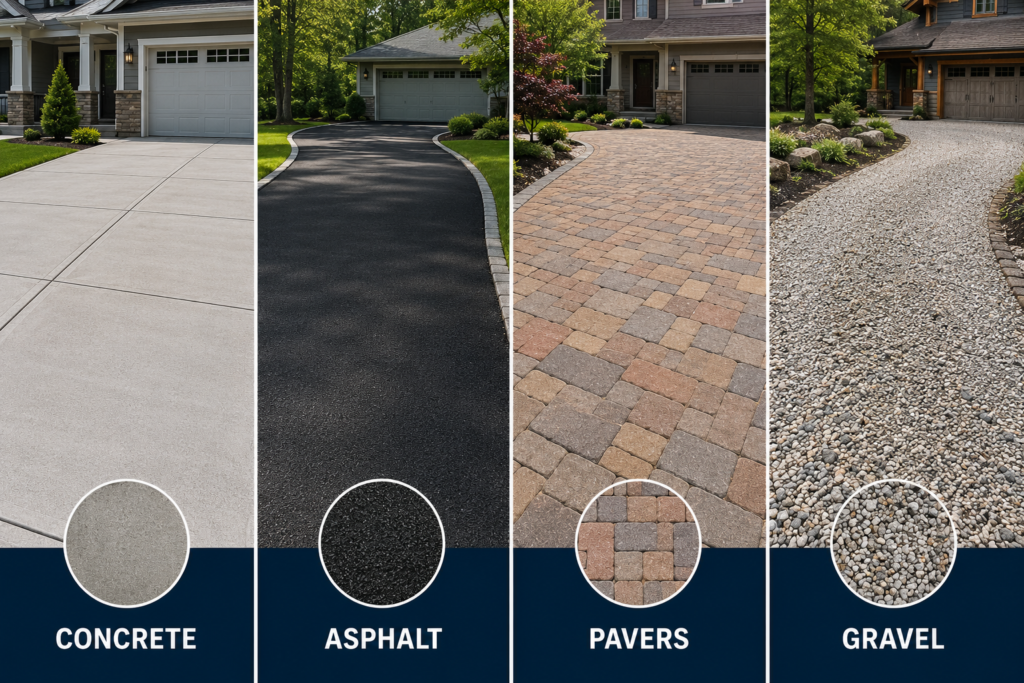
Here’s the short version, based on what I’ve seen across hundreds of jobs in the New York area:
| Driveway Material | Average Lifespan | Maintenance Level |
| Concrete | 30–50 years | Low to moderate |
| Asphalt | 20–30 years | Moderate (sealing required) |
| Pavers (brick/concrete) | 25–50+ years | Low (individual units replaceable) |
| Gravel | 5–15 years (with top-ups) | High (needs replenishment) |
These are averages. A concrete driveway installed on a properly graded base with good drainage can outlast those numbers easily. An asphalt driveway that never gets sealed and sits under three oak trees dropping sap and debris year-round? You might be looking at problems by year 12 or 15.
Concrete Driveway Lifespan
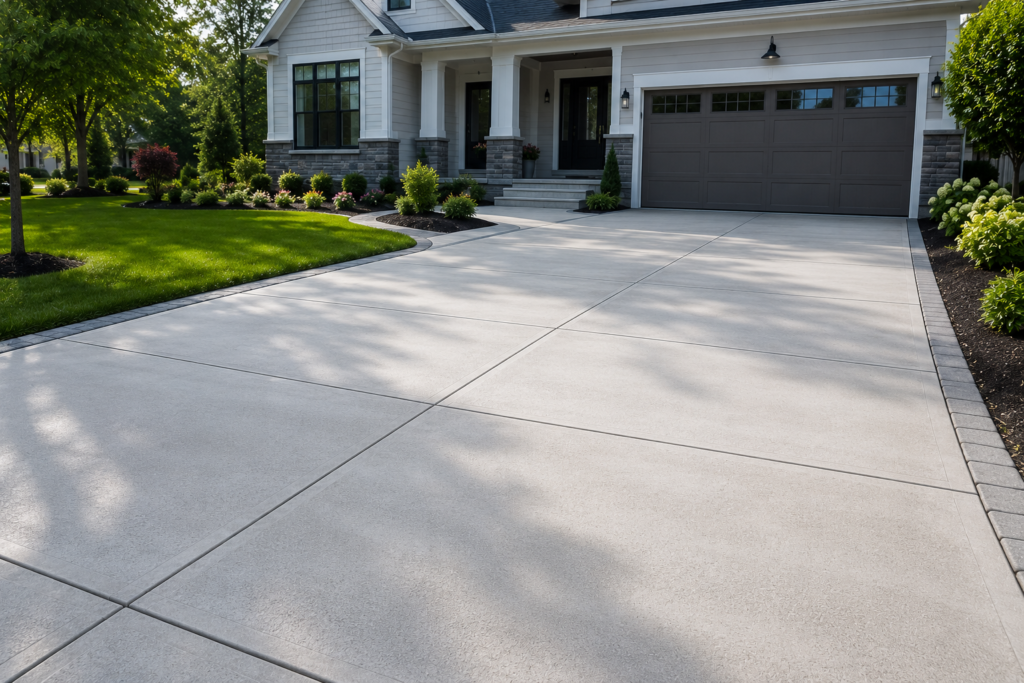
Concrete is the workhorse. A properly installed concrete driveway in New York with the right thickness, reinforcement, and expansion joints should give you 30 to 50 years of reliable service. The main enemies are freeze-thaw cycles and deicing salt, both of which are unavoidable here. Still, with basic care, concrete holds up well. I’ve got clients with original driveways from the 1980s that are still structurally sound.
Asphalt Driveway Lifespan
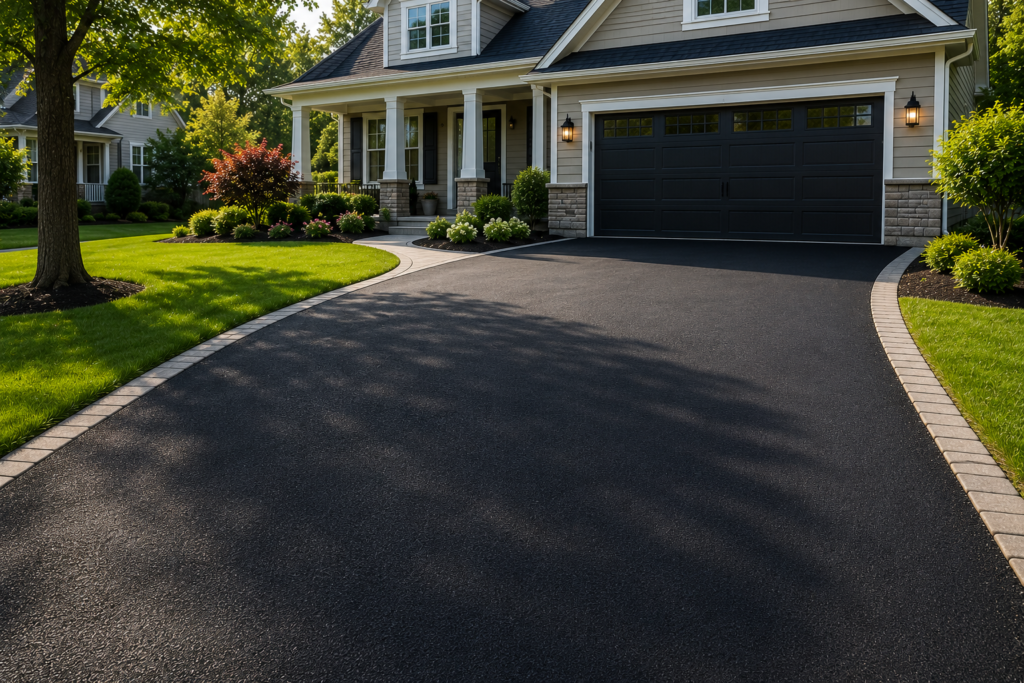
Asphalt is softer and more flexible than concrete, which actually helps in freeze-thaw conditions; it moves with the ground instead of cracking under pressure. But it needs more attention. You should be sealing an asphalt driveway every 3 to 5 years, and small cracks need to be caught early before water gets underneath. With proper maintenance, 20 to 30 years is realistic. Skip the upkeep, and you might be calling me for a replacement at year 15.
Paver Driveway Lifespan
Pavers are my favorite to talk about because the math works out so well for homeowners. The individual units themselves can last 50 years or more. If something goes wrong- a section shifts, a few pavers crack- you pull up the affected area and reset it. You’re not tearing out the whole driveway. The weak point is usually the base and the joint sand, not the pavers themselves.
Gravel Driveway Lifespan
Gravel is the most affordable option upfront, but it demands the most ongoing attention. It migrates. It washes out. You’re constantly raking it back in and adding new material. In a place like New York, with the rain and snow we get, gravel driveways need replenishment every few years just to stay functional.
What Affects the Lifespan of a Driveway?
More than the material itself, how long a driveway lasts comes down to a handful of factors I see play out on every job.
Installation Quality
This is the biggest one, and I say it to every homeowner I meet: the work you can’t see matters more than the work you can. The base preparation- how deep it goes, how well it’s compacted, what materials were used- determines whether your driveway lasts 15 years or 40. I’ve torn out plenty of driveways that looked fine on the surface but had a base that was never right to begin with. No amount of sealing or patching can fix a bad foundation.
New York Weather Conditions
We get it all here. Brutal winters, wet springs, hot summers, heavy storms. The freeze-thaw cycle alone is tough on any driveway material; water seeps into small cracks, freezes, expands, and makes those cracks bigger. By the time spring comes around, what was a hairline crack in October is now something you can get your finger into.
Drainage
Water sitting on or under your driveway is bad news. If your driveway doesn’t slope away from your house and toward the street, or if low spots have developed over time, that standing water is speeding up the deterioration. I always look at drainage first when I’m assessing a driveway. You can fix a lot of surface issues, but if the drainage problem isn’t addressed, the damage will come back.
Freeze-Thaw Cycles
New York typically sees dozens of freeze-thaw cycles each winter. Each one puts stress on the surface and the base. Concrete is more vulnerable to surface scaling from this than asphalt, especially if deicing salts are used. Asphalt holds up better through the cycles but softens in summer heat and can rut under heavy loads.
Vehicle Traffic
The average residential driveway is designed for passenger cars, maybe a pickup truck. If you’re regularly parking heavy equipment, a loaded contractor’s van, or an RV on a standard residential driveway, you’re putting more stress on it than it was built for. I’ve seen asphalt driveways develop ruts from nothing more than a heavy SUV always parking in the same spot.
Routine Maintenance
Sealing, crack filling, cleaning- none of it is glamorous, but it adds years to a driveway’s life. I’ll say more about this in the maintenance section, but the short version is: small problems addressed early rarely become big problems. Small problems ignored almost always do.
Tree Roots and Soil Movement
This one catches people off guard. That oak tree at the edge of the driveway looks harmless, but the roots go wherever they want. Over time, roots can lift sections of concrete, shift pavers, and create uneven areas that hold water. Soil movement from settling or erosion does the same thing. If you’ve got trees close to your driveway, you need to keep an eye on the surface near them.
Signs Your Driveway May Need Repair or Replacement
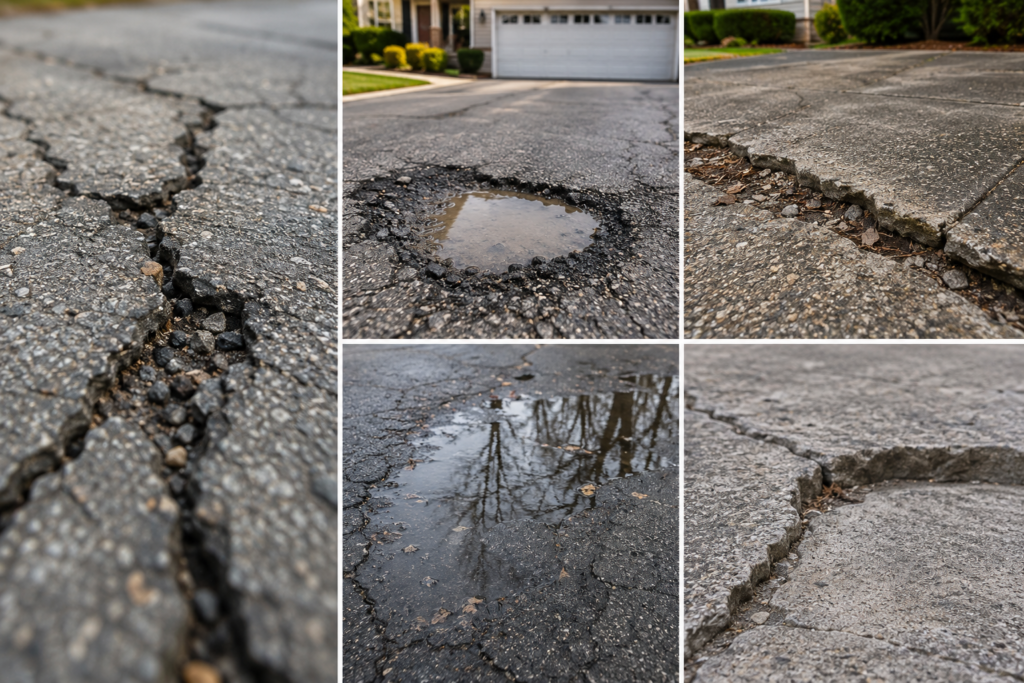
Knowing what to look for can save you money. Catching problems early usually means repair is still an option. Wait too long, and you’re looking at a full replacement.
| Problem | Repair Possible? | Replacement Recommended? |
| Hairline cracks | Yes | No |
| Wide or interconnected cracks | Sometimes | Often |
| Potholes (isolated) | Yes | No |
| Widespread potholes | No | Yes |
| Surface scaling (shallow) | Yes | No |
| Deep surface deterioration | No | Yes |
| Isolated uneven sections | Yes | Sometimes |
| Widespread heaving or sinking | No | Yes |
| Water pooling in low spots | Sometimes | Depends on cause |
| Fading/discoloration only | Yes (sealing) | No |
| Loose or sunken pavers | Yes (reset) | No |
Cracks
Not all cracks are equal. A hairline crack in concrete or asphalt that hasn’t widened is usually a sealing job. A crack that’s wider than a quarter-inch, one that’s branching out in multiple directions (what we call alligator cracking in asphalt), or cracks that show vertical displacement- meaning one side is higher than the other- those tell a different story. Alligator cracking in asphalt almost always means the base has failed. You can patch the surface, but it won’t hold.
Potholes
A single pothole in an otherwise solid driveway is repairable. A driveway with multiple potholes spread across the surface is telling you the base has deteriorated and the whole thing needs to come out.
Surface Scaling
Scaling is when the top layer of concrete starts to flake off in thin sheets. It’s common in New York because of the salt and freeze-thaw abuse. Light scaling is a cosmetic issue. If it’s gone deep enough that you’re seeing aggregate (the small stones in the mix) across large areas, resurfacing or replacement is probably the better move.
Uneven Sections
Some settling is normal over decades. But if sections have heaved significantly, if there are trip hazards, or if water is now running toward your garage or foundation instead of away from it, that’s a structural issue, not just cosmetic.
Water Pooling
Standing water on a driveway after rain indicates that either the surface has settled into low spots, or the original slope wasn’t correct. Beyond being a nuisance, that water is working its way into cracks and speeding up deterioration. It can also be a sign of base failure if it develops in areas that previously drained well.
Fading
Fading is normal on asphalt; it goes from black to gray as the oils in the mix oxidize. A good seal coat brings it back. For concrete, fading and discoloration are usually cosmetic. Neither requires replacement.
Step-by-Step Guide to Extending Your Driveway’s Lifespan
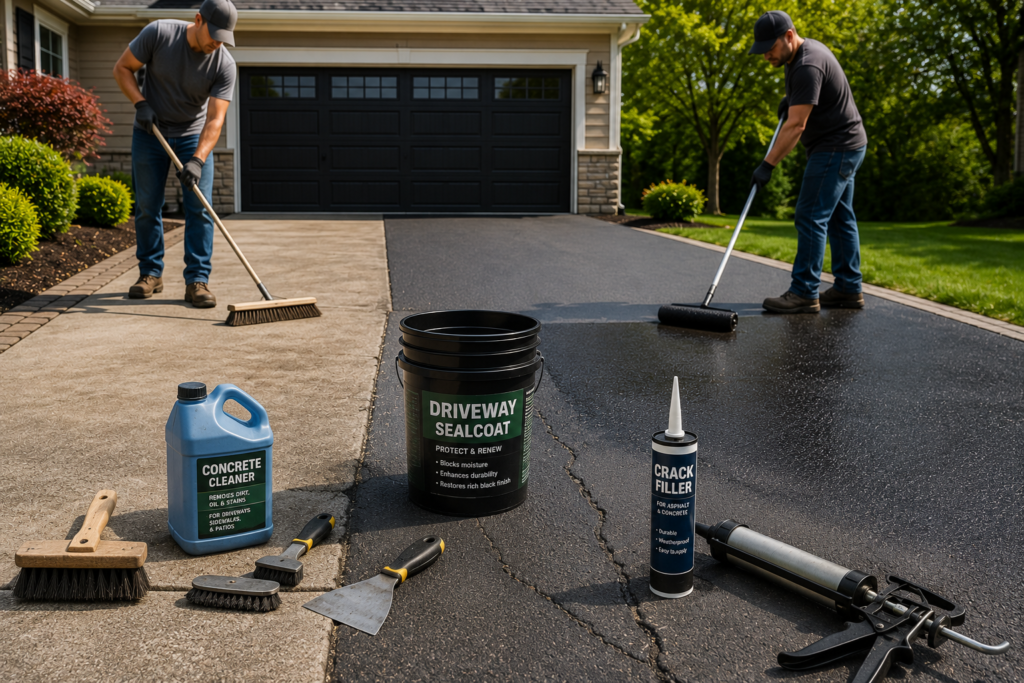
These are the things that actually make a difference. I’ve seen homeowners add 10 or 15 years to a driveway just by being consistent with these.
Step 1: Clean Regularly
Dirt, leaves, and organic debris hold moisture against the surface. Oil and fuel leaks from vehicles break down asphalt binders over time. A simple rinse with a garden hose every few weeks keeps debris from sitting. For oil stains, use a concrete or asphalt degreaser; the sooner you get to it, the easier it comes out.
Step 2: Repair Small Cracks Early
I can’t say this enough. A $15 tube of crack filler in October can prevent a $400 repair in April. Water gets into cracks, freezes, and expands the crack. By spring, what was a minor surface crack can be a serious problem. Walk your driveway in the fall before the first frost and fill anything you find.
Step 3: Seal When Appropriate
Asphalt should be sealed every 3 to 5 years. Wait until the driveway is at least 6 to 12 months old before the first seal; fresh asphalt needs time to cure. Concrete benefits from sealing too, though it’s less critical. A good penetrating concrete sealer helps resist water intrusion and salt damage. Don’t over-seal asphalt; too many thin coats stacked up start to peel.
Step 4: Improve Drainage
If water consistently pools in the same spot, have it addressed. Sometimes this is as simple as a small regrading job. In other cases, it means adding a trench drain or channel drain to redirect runoff. The cost of a drainage fix is almost always less than the cost of replacing a driveway damaged by chronic water problems.
Step 5: Avoid Heavy Loads
Residential driveways aren’t designed for heavy construction equipment, large delivery trucks, or dumpsters sitting for days. If you’re having work done on your home and heavy trucks need access, talk to the contractor about how to protect the surface- plywood spreading boards help, or planning routes that avoid the most vulnerable areas.
Step 6: Schedule Professional Inspections
Every three to five years, it’s worth having someone take a look. Not because something is necessarily wrong, but because a trained eye catches things most homeowners miss- early signs of base movement, deteriorating sealant, drainage shifts. Catching a problem when it’s minor is always cheaper than waiting for it to become major.
Repair vs. Replacement – How Do You Decide?
This is the question I get most often, and the answer usually comes down to three things: the extent of the damage, the age of the driveway, and the cost comparison.
Here’s how I think about it: if the damaged area is less than 25 to 30 percent of the total driveway surface, and the base underneath is still solid, repair usually makes sense. If damage covers more than a third of the surface, if the base has failed, or if the driveway is already past its expected lifespan, replacement is typically the better long-term value.
A repair on a driveway that’s at the end of its life is often money that delays the inevitable by two or three years. A replacement gives you 20 to 40 years of reliable service.
A realistic homeowner example: A client in Westchester called me about her 22-year-old asphalt driveway. There were cracks throughout, a few soft spots, and a section near the garage that had sunk about an inch. She wanted to know if patching made sense. I told her honestly: the base near the garage had failed, and the overall condition suggested the whole driveway was close to the end of its serviceable life. Patching would probably cost $1,200 to $1,500 and give her maybe two more winters before she was calling again. A full replacement was $6,500. She went with the replacement and three years later, she’s glad she did. No more patches, no more worrying about it every fall.
How New York Weather Affects Driveways
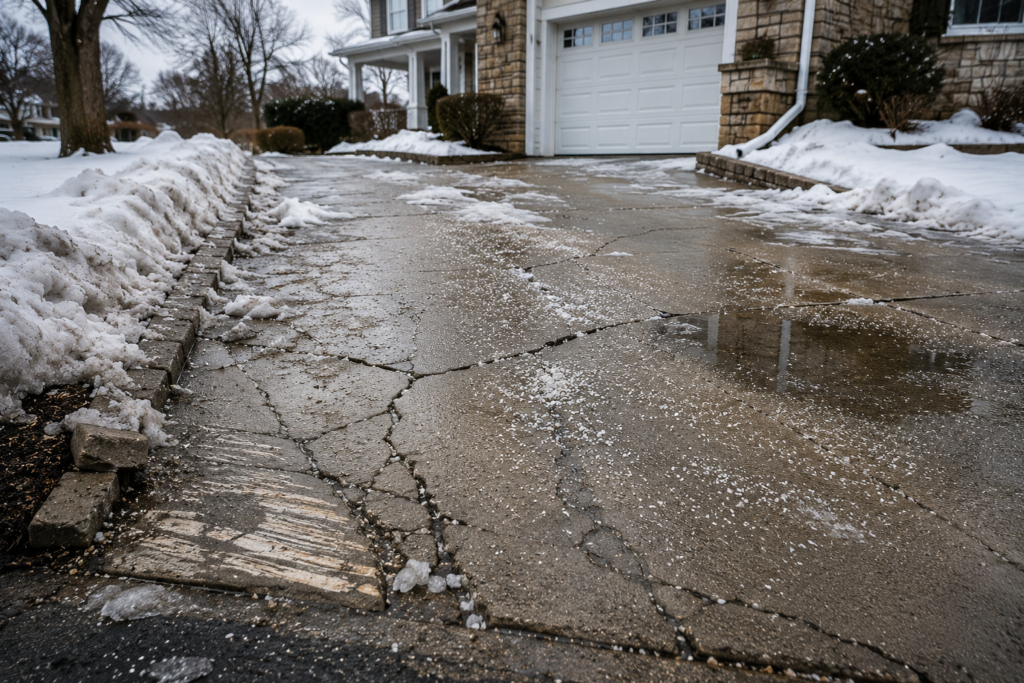
New York is not an easy place for driveways. If you’ve lived here any length of time, you already know that.
Snow and Ice: Heavy snow loads aren’t typically a problem for the driveway surface itself, but the plowing and shoveling that comes with it can damage edges and surfaces, especially on brick or concrete pavers. Metal plow blades on residential driveways do more harm than people realize.
Salt and De-icers: Rock salt is tough on concrete. It accelerates the freeze-thaw damage by lowering the freezing point of water, causing more freeze-thaw cycles at borderline temperatures. It also chemically attacks the surface of concrete over time, contributing to scaling and spalling. If you have a concrete driveway, consider using sand for traction or a concrete-safe de-icer instead of straight rock salt. Asphalt is more resistant to salt damage.
Freeze-Thaw Cycles: New York averages somewhere between 30 and 60 freeze-thaw cycles per winter, depending on the year. Each one is a small stress event for your driveway. Water in cracks expands by about 9% when it freezes. Do that 40 or 50 times a winter and small cracks become big ones.
Heavy Rainfall: Spring rainfall and the runoff from snowmelt put a lot of water through and around driveways. If drainage is poor, that water sits and works its way under the base, softening the sub-grade and causing settlement. Good drainage design during installation is what separates a driveway that handles New York weather and one that doesn’t.
Frequently Asked Questions
How long does a driveway last? It depends on the material and how well it’s been maintained. Concrete driveways typically last 30 to 50 years. Asphalt lasts 20 to 30 years with regular sealing and maintenance. Paver driveways can last 25 to 50 years or more, since individual damaged units can be replaced without redoing the whole surface. Gravel driveways need ongoing replenishment and realistically last 5 to 15 years between significant refurbishments.
How often should a driveway be sealed? Asphalt driveways should be sealed every 3 to 5 years. The first seal should happen 6 to 12 months after installation, once the asphalt has had time to cure properly. Concrete driveways benefit from a penetrating sealer as well, especially in climates with salt exposure and freeze-thaw cycling. Every 5 years is a reasonable schedule for concrete.
Can cracked driveways be repaired? Yes, in many cases. Hairline cracks and cracks up to about a quarter-inch wide are typically good candidates for crack filling. Wider cracks, cracks with displacement, or the “alligator” pattern cracking across asphalt usually indicate base failure and often require more extensive work or replacement rather than surface repair.
What shortens a driveway’s lifespan? The main culprits are poor installation quality, inadequate drainage, deicing salt on concrete, heavy vehicle loads beyond the driveway’s design capacity, freeze-thaw cycling without crack maintenance, and tree roots lifting or cracking the surface from below. Neglecting small repairs until they become large ones also shortens lifespan significantly.
How do I know when replacement is necessary? Generally, replacement makes more sense than repair when: damage covers more than 25 to 30 percent of the surface, the base layer has failed, multiple problems are occurring at once (cracking, sinking, drainage issues), or the driveway is already past its expected lifespan. A professional inspection can help clarify which situation you’re dealing with.
Does New York weather reduce driveway lifespan? Yes, somewhat. The combination of harsh winters, road salt exposure, and a high number of freeze-thaw cycles per year is harder on driveway materials than climates with milder winters. That said, driveways installed with proper thickness, reinforcement, and drainage perform well in New York for decades. The climate is manageable; it just requires appropriate materials and installation practices.
Wrapping Up
A driveway that’s starting to show its age doesn’t automatically mean you need a full replacement. But it does mean it’s time to take a closer look. The difference between a repair and a replacement is often just timing- catch problems early, and your options are better. Wait too long, and the decision gets made for you.
The material, the installation quality, and the ongoing maintenance all play a role in how long a driveway lasts. So does the New York climate. The homeowners who get the most out of their driveways are the ones who don’t ignore small problems and who treat sealing and crack repair as routine upkeep rather than optional tasks.
If you’re unsure where your driveway stands, the best first step is to have someone take a look before you spend any money. A quick professional assessment can tell you whether you’re dealing with a simple maintenance issue, a repair job, or the beginning of the end for your current driveway.
Ready for a Professional Opinion?
If your driveway is showing signs of wear, cracks, uneven areas, drainage problems, or just looking worse every year, we’re happy to take a look. We serve homeowners and commercial properties throughout the New York area, and there’s no cost for an initial inspection and estimate.
Contact us today to schedule your free driveway evaluation. We’ll give you a straight answer on what your driveway actually needs- no overselling, no pressure.