
The best paver driveway design for a compact property depends on which limit you’re working with: width, total area, or both. A pattern, border, or color can change how a driveway looks, but it can’t add vehicle clearance. Start with accurate measurements and how you use the space, then choose a look that fits.
This guide covers six distinct design concepts, how pattern, border, and color choices affect a tight space, and the practical planning issues that protect the design over time: clearance, drainage, base preparation, and winter exposure. It also covers what to confirm locally before you commit to a layout.
Small vs. Narrow: Why the Difference Matters for Your Design
A small driveway has limited total area. A narrow driveway has limited width. A driveway can be one, both, or neither, and each problem calls for different design thinking.
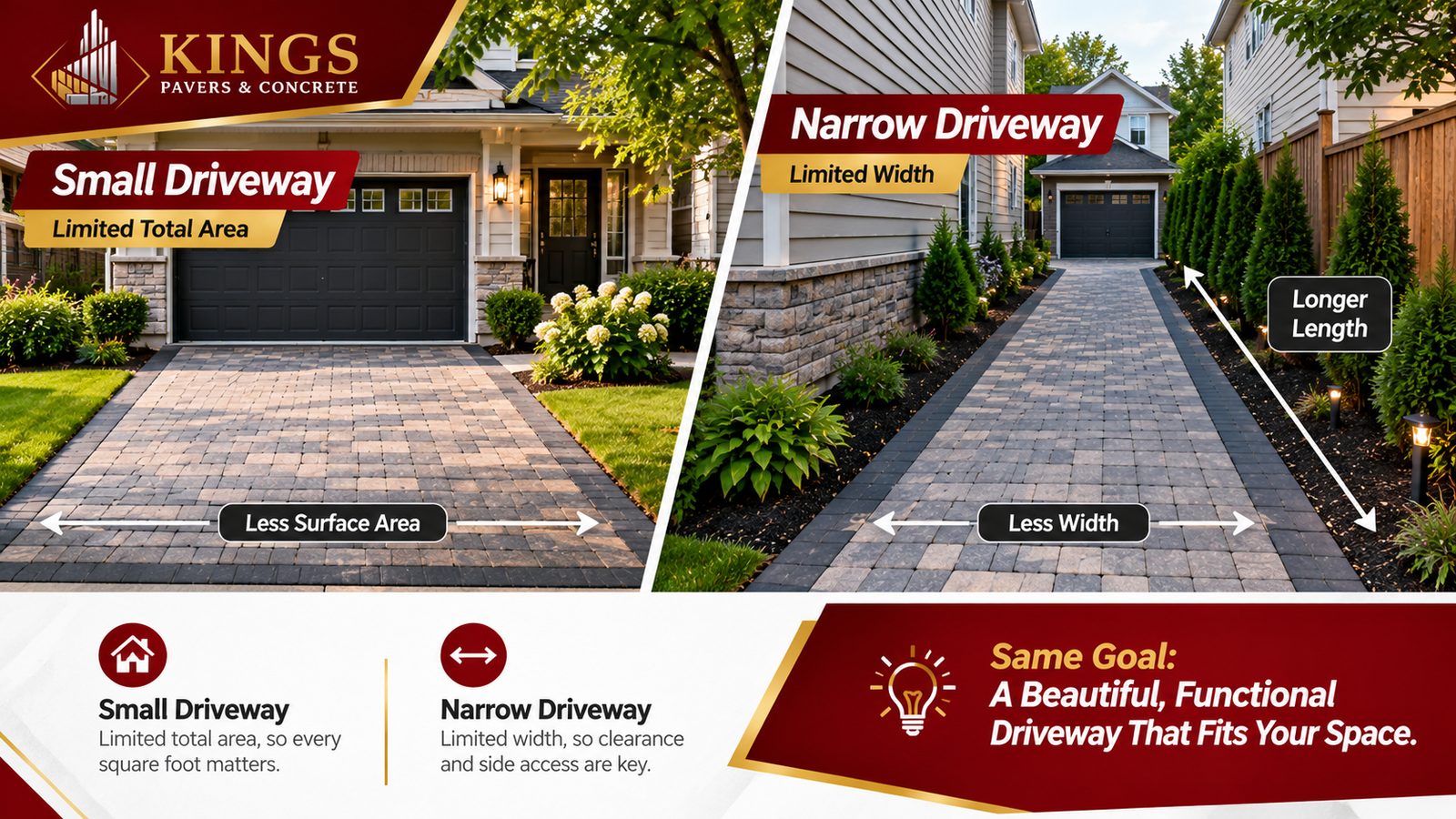
- Narrow but long: Width is the constraint. Your main concerns are door clearance, side access, and making sure the surface doesn’t feel like a tunnel.
- Wide but short: Area is the constraint. You may have room to maneuver but not much surface to organize, so scale and simplicity matter more.
- Small and narrow: Every design decision carries more weight. Busy patterns, thick borders, and extra features can crowd the space quickly.
We’re not giving a single dimension that counts as “narrow.” What feels tight depends on your vehicles, your garage or parking arrangement, and how you move through the space day to day. Not every New Hyde Park property is small or narrow either, so treat the ideas below as options to match against your own lot, not a one-size-fits-all list.
Paver Driveway Design Ideas for Compact Properties
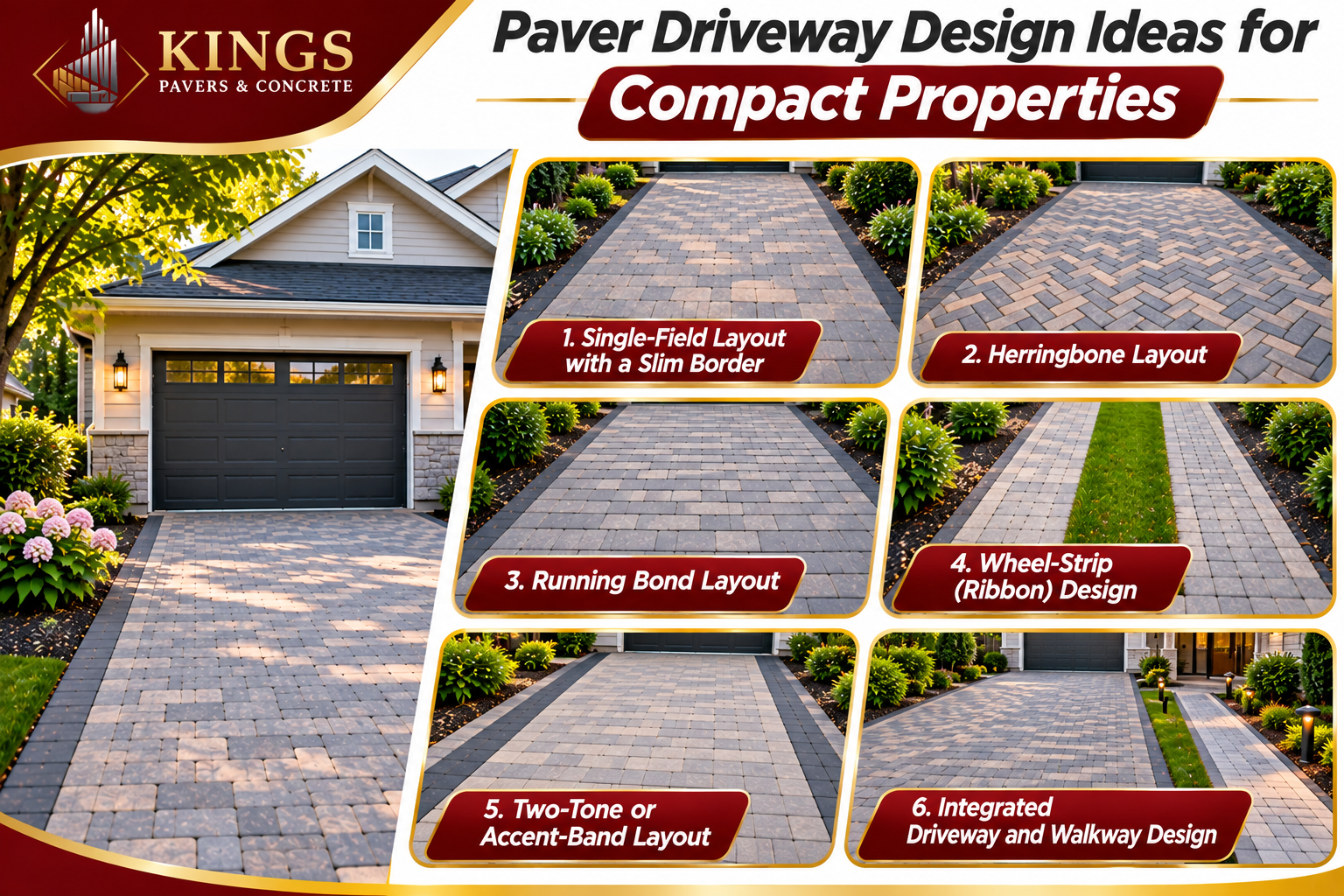
These six concepts are genuinely different approaches. Each lists where it fits best, how it looks, what to consider functionally, and where it falls short.
1. Single-Field Layout with a Slim Border
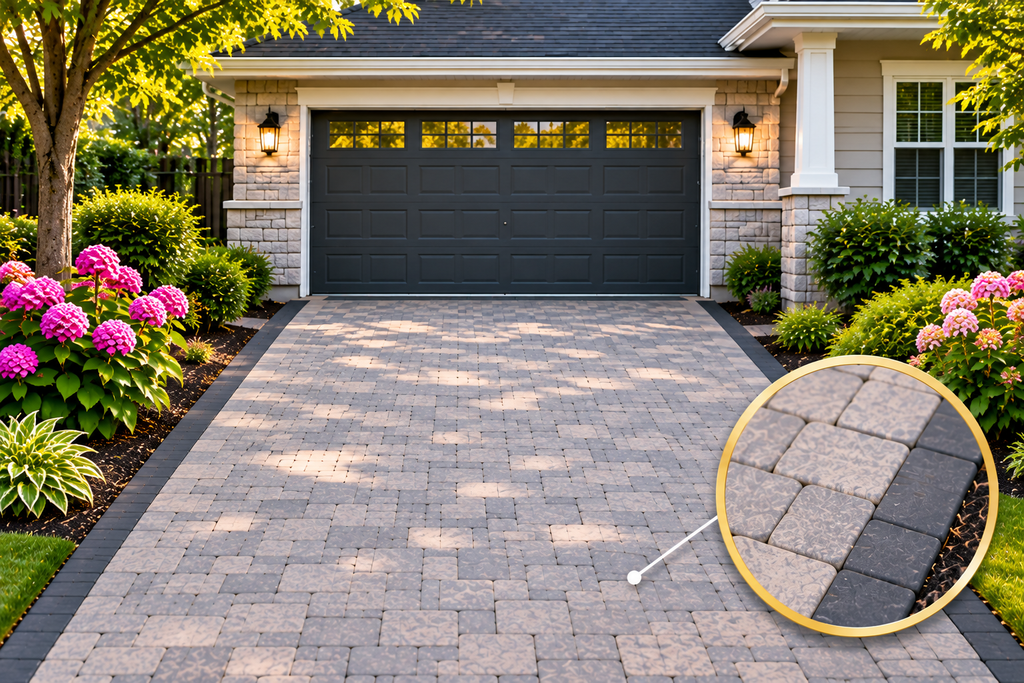
Best fit: Small or narrow driveways where you want a clean, uncluttered look.
Visual effect: One paver color and pattern across the whole surface, outlined by a thin border in the same color family or a modest contrast. The restraint keeps the eye from breaking the space into pieces.
Functional notes: A border can finish the edges neatly, and a border along the pavement edge is often part of how edges are held in place. Your installer can explain how edge restraints work with your chosen design.
Limitation: A wide border takes up space that would otherwise be part of the central field. On a tight driveway, keep it slim.
2. Herringbone Layout
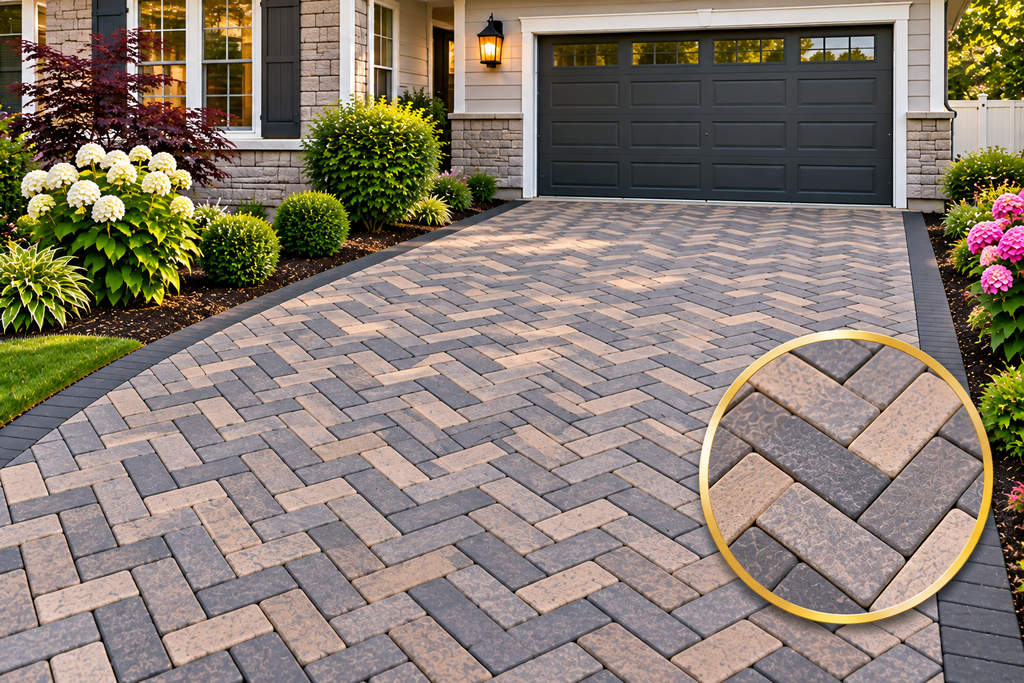
Best fit: Driveways where you want a classic look with a lot of interlock between pavers.
Visual effect: The angled, zigzag arrangement adds visual movement. In a narrow space, a strong herringbone can draw the eye along the driveway’s length, but the effect depends on paver size, color contrast, and angle. It doesn’t universally make a driveway look wider.
Functional notes: Many installers and manufacturers favor herringbone for vehicle areas because the interlocking arrangement helps spread loads. Whether it’s right for your project depends on the paver system, expected traffic, and manufacturer guidance, so confirm that with your installer instead of assuming a pattern guarantees performance.
Limitation: Herringbone requires more cutting at edges and curves than simpler patterns, which can affect labor and edge appearance. High-contrast color mixes can look busy in a small space.
3. Running Bond Layout
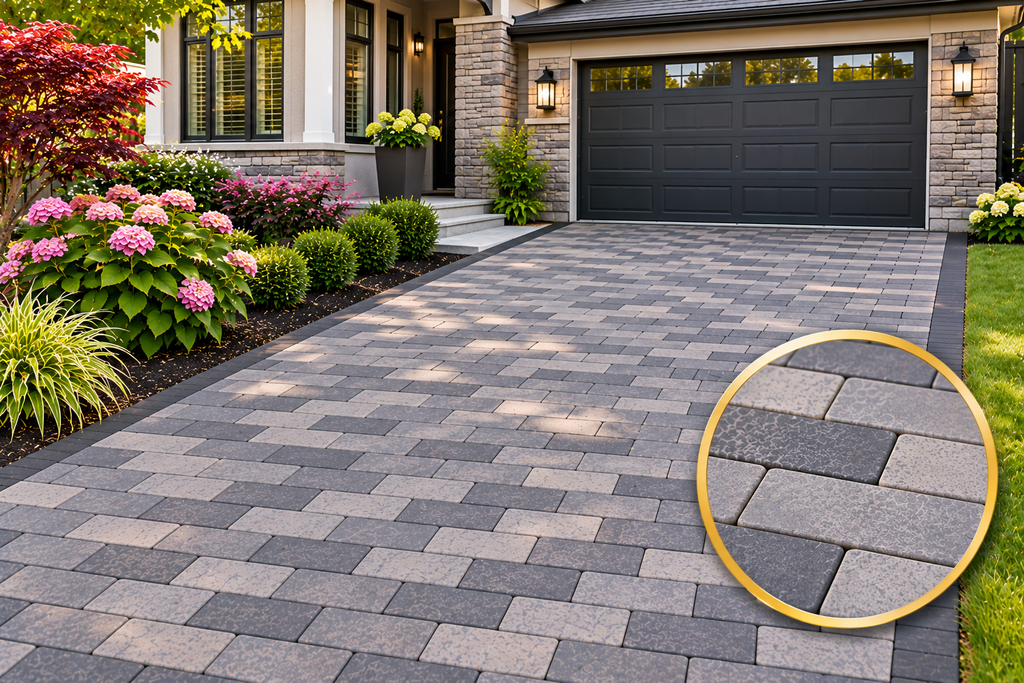
Best fit: Narrow driveways where you want a calm, linear look, or properties where the architecture is clean and modern.
Visual effect: Rectangular pavers laid in staggered rows, like brickwork. Laid lengthwise, the rows lead the eye toward the garage or street. Laid across, they can emphasize width. The visual effect depends on proportions, so it’s worth looking at a layout drawing or sample before deciding.
Functional notes: The simple geometry usually means fewer awkward cuts. Pavers in vehicle areas still need a suitable system and base, and some installers prefer other patterns where braking or turning loads are concentrated. Ask what they recommend for your use.
Limitation: Straight joint lines can emphasize any slight unevenness in the base or edges. Good base preparation matters even more with this pattern.
4. Wheel-Strip (Ribbon) Design
Best fit: Longer, narrow driveways where you want to break up a large hard surface with planting or gravel.
Visual effect: Two paver tracks for the tires, with a strip of gravel or low planting between them. It looks softer and more residential than a full-width surface.
Functional notes: It can reduce the amount of hard surface, though how it manages water depends on the design and soil, so don’t assume a drainage benefit without checking.
Limitation: It’s less comfortable for walking, harder to shovel and plow, and the strip between the tracks needs upkeep. It also requires precise vehicle alignment, which can be frustrating in a tight space. It’s a poor fit if people regularly walk along the driveway.
5. Two-Tone or Accent-Band Layout
Best fit: Compact driveways where you want a defined edge or entry without a heavy border.
Visual effect: A single-color field with a narrow accent strip, perhaps at the garage threshold or where the driveway meets the sidewalk. It adds interest without dividing the space into many parts.
Functional notes: A band can mark a transition, such as where the driveway meets a walkway or garage entry, and it can visually separate zones.
Limitation: Too many bands or strong contrasts can make a small driveway feel chopped up. One accent is usually enough.
6. Integrated Driveway and Walkway Design

Best fit: Narrow properties where the driveway also serves as the main path to the front door or side entrance.
Visual effect: The driveway and walkway share a paver family, pattern, or border, so they read as one coordinated surface.
Functional notes: This design addresses a real daily issue on tight lots: where people walk while a car is parked. A clearly marked pedestrian path, even one defined only by a change in pattern or tone, can improve usability.
Limitation: The design needs thoughtful transitions between areas, including height changes and drainage, so it takes more planning than a plain driveway.
Quick Comparison
| Concept | Best for | Main visual effect | Main tradeoff |
| Single field, slim border | Very tight spaces | Clean, uncluttered | Plain without added interest |
| Herringbone | Classic look, vehicle areas | Movement and texture | More cutting, can look busy |
| Running bond | Linear, modern look | Calm, directional | Shows base flaws more |
| Wheel strips | Long, narrow driveways | Softer, residential | Harder maintenance and walking |
| Accent band | Defined entries | Subtle contrast | Overuse chops up the space |
| Integrated walkway | Lots with shared paths | Cohesive and coordinated | More planning for transitions |
How Pattern, Orientation, and Scale Change the Look (and What They Can’t Change)
A short answer: pattern, orientation, and paver size change perception, not dimensions. A driveway that’s too narrow for a vehicle and its open doors stays too narrow no matter what’s laid on it.
Things that tend to influence perception:
- Orientation: Lines that run along the length emphasize depth. Lines that run across emphasize width. The effect is real but modest, and it depends on the surrounding house, fence, and landscaping.
- Pattern complexity: Simple patterns generally read as calmer in a small space. Complex patterns can add character but also visual noise.
- Paver size: Larger pavers mean fewer joints and a cleaner look. Smaller pavers add detail and conform to curves more easily. Neither is automatically better for a compact driveway, so look at samples in your own light.
What patterns can’t do: they can’t create extra door-opening space, make a turn easier, or compensate for poor drainage. Treat the visual choices as the final layer, after the functional layout is settled.
If you’re comparing options, ask an installer to show how each pattern would look at your actual dimensions. If you’d like to discuss which concepts could suit your property, you can contact Kings Pavers to talk through your project.
Borders, Colors, and Textures for Tight Spaces
Border Width Tradeoffs
Borders frame a driveway and finish its edges, but on small properties they take up room. A wide border can shrink the central field and make the space feel smaller. A thin border, or a border in the same color family as the field, usually keeps things open.
Color and Tone Considerations
Lighter and more uniform colors can feel more open, while darker or high-contrast colors give definition but can make a tight space feel enclosed or busy. Consider the home’s brick, siding, roof, and trim. Surface color also affects how dirt, oil, leaves, and weathering show over time, and it can look different in sun and shade, so view samples outdoors before deciding.
Texture and Paver Size
Smoother textures read as more modern, while tumbled or textured finishes look more traditional and may hide minor wear better. Ask about slip resistance, especially if the driveway is shaded or may hold moisture in winter. Product characteristics vary, so rely on the manufacturer’s information for the specific paver you’re considering.
Layout Planning: Vehicle Clearance, Garage Access, and Walkways
A good design starts with how you actually use the driveway. Before choosing a pattern:
- Measure the available width at several points, not just one. Driveways often change width between the street and the garage.
- Think about door clearance. Consider how far your vehicle doors open and whether anyone needs to pass alongside the car.
- Note the vehicles you park now and might park later. A larger vehicle changes the layout.
- Map pedestrian routes. Where do people walk between the car, the front door, and any side gate?
- Check transitions. The points where the driveway meets the garage, sidewalk, and street affect both usability and drainage.
- Consider existing pavement removal. Access for equipment and demolition of an old surface affects how the project is planned.
We’re not giving specific widths or turning radii here because the right numbers depend on your vehicles and property. A qualified installer can review your measurements, and local rules may set requirements for driveway openings and approaches. Those are worth confirming before design decisions are final.
Paver Materials Compared: Concrete, Brick, and Natural Stone
| Material | Typical character | Design considerations | Things to confirm |
| Concrete pavers | Wide range of shapes, colors, and textures | Flexible for most patterns and styles | Product suitability for vehicle use |
| Clay brick pavers | Classic, warm appearance | Traditional look, tends to suit period homes | Availability, sizing, and installation requirements |
| Natural stone | Distinctive, varied surface | Strong visual character, irregular edges | Thickness, slip resistance, and suitability for vehicle loads |
This is general guidance, not a ranking. Products vary in strength and performance, so check manufacturer specifications for any paver you’re considering for a driveway.
Drainage, Base, and Freeze-Thaw: What Protects the Design Over Time
A beautiful pattern won’t last on a poor foundation. Three factors do most of the work.
Base preparation. Pavers sit on a compacted base, usually layers of aggregate, topped with a bedding layer. The base spreads loads and keeps the surface level. Shortcuts here are a common reason pavers settle or shift. The right depth and materials depend on site conditions and expected use, so ask your installer to explain their approach.
Drainage and grading. Water needs somewhere to go. Surfaces are generally sloped so water moves away from the house and garage, but the right slope and drainage approach depend on the property and on the neighbors’ and street’s conditions. On a small lot, there may be limited room to direct water, so it’s worth planning early. Drainage and Permeable Paver Options for Compact Driveways.
Freeze-thaw exposure. The Northeast has winters with freezing and thawing, and water that enters and freezes in a poorly prepared base or joint can contribute to movement over time. Good drainage, proper base work, and well-chosen materials help. If you use deicing products, check manufacturer guidance, since some products can affect certain surfaces.
Edge restraints. These hold the outer pavers in place. On narrow driveways with limited margins, edge details deserve attention in the design stage.
Planning Cautions for New Hyde Park Projects
New Hyde Park is a Long Island community, not one of New York City’s five boroughs, so don’t assume city rules or contractor practices from Brooklyn or Queens apply to your address. Which local authority governs your property can depend on where it sits.
Before finalizing a design, it’s wise to check:
- Whether your project needs a permit or approval
- Any requirements for driveway openings, curb cuts, or sidewalk work
- Rules about drainage, runoff, or the amount of paved surface
- Property line and setback considerations
We can’t state those requirements here because they vary by jurisdiction and project scope. Your local municipal office and your installer can help you find what applies. Keeping those checks early avoids redesigning later.
Common Design Mistakes and Questions to Ask an Installer
Mistakes to avoid:
- Choosing a pattern before measuring the space
- Assuming a pattern or color will increase usable width
- Using a wide border on a narrow driveway
- Combining too many colors, patterns, and accents
- Overlooking drainage until after the design is chosen
- Ignoring how people walk through the space
- Skipping a check on local requirements
Questions to ask a contractor:
- How will you measure and confirm the layout before work begins?
- Which paver systems and patterns do you recommend for my use, and why?
- How will you prepare the base and manage drainage on my lot?
- How will edges be held and finished?
- What happens at transitions with the garage, walkway, and street?
- Do you handle removal of the existing surface?
- How will permits and local approvals be handled, and who is responsible?
If you’d like help evaluating options, you can learn more about paver installation with Kings Pavers or browse the full range of services. [INTERNAL LINK OPPORTUNITY: How to Compare Paving Contractor Design Proposals — URL pending]
Frequently Asked Questions
What paver pattern works best for a narrow driveway?
There’s no single best pattern. Herringbone is popular for vehicle areas because of its interlock, and running bond offers a calm, linear look. Choose based on how the pattern suits your paver system, traffic, and style, and confirm suitability with your installer. A pattern can change how a space looks but not its usable width.
Can pavers make a small driveway look bigger?
They can influence perception. Simple patterns, consistent colors, slim borders, and orientation that suits the space can help. They don’t add physical space, so measure clearance separately.
Do borders make a driveway look smaller?
They can. A wide or high-contrast border breaks up the surface and reduces the visible central field. A slim border, or one close in color to the field, usually works better on compact driveways.
What color pavers are best for a small driveway?
It depends on the home and surroundings. Lighter, more uniform tones often feel more open, while darker tones add definition. Look at samples outdoors, in sun and shade, and consider how the color will age.
Do I need a permit for a paver driveway in New Hyde Park?
It depends on your property’s jurisdiction and the scope of work, such as whether you’re changing the curb cut or sidewalk. Check with the appropriate local office before you start, and ask your installer how they handle approvals.
Are permeable pavers a good option for small driveways?
They can be worth considering where drainage is a concern, but suitability depends on soil, site conditions, and the system’s design. Discuss it with an installer who can assess your property.
How do I know if my driveway is wide enough for my vehicle?
Measure the width at several points, then think through how you park and open doors. Specific numbers depend on your vehicle and layout, so confirm with your installer before finalizing a design.
Next Steps
Start with the facts of your property: width at several points, the vehicles you park, how people walk through the space, and where water goes. Then narrow the design options to the ones that fit those facts, and weigh the visual choices last.
When you’re ready to talk through your project, reach out to Kings Pavers to ask about design options, layout, and an estimate for your property.