
What Is a Retaining Wall? Everything New York Property Owners Need to Know

Most people don’t think about retaining walls until they’ve got a problem. Maybe you’ve noticed soil washing down your slope every time it rains. Maybe there’s water pooling near your foundation that wasn’t there a few years ago. Or maybe your yard just looks like it’s slowly sliding toward your neighbor’s fence. That’s usually when I get the call. I’ve spent over 20 years building retaining walls across New York, on everything from small backyard slopes to commercial properties with serious grading challenges. In this guide, I’ll walk you through what a retaining wall actually is, how it works, the different types available, and how to tell if your property might need one. What Is a Retaining Wall? A retaining wall is a structure built to hold back soil and keep it from shifting, sliding, or eroding, usually on a sloped or uneven property. It works by resisting the earth’s natural pressure behind it, creating a stable, level area in front. Think of it as a barrier that lets you take a hillside and turn part of it into usable, stable ground. I always tell homeowners to picture a set of stairs cut into a hill. Each flat step needs something holding the soil above it in place, or it would eventually slump down onto the step below. A retaining wall does exactly that, just usually on a larger and more permanent scale. How Does a Retaining Wall Work? A retaining wall isn’t just a decorative barrier. It’s doing real structural work, even when it looks simple from the outside. Holding back soil. The wall physically resists the weight and pressure of the soil behind it, known in the trade as lateral earth pressure. Without something holding it back, that soil naturally wants to move downhill over time. Managing water runoff. A well-built wall directs water away from your home instead of letting it pool or cut new erosion channels through your yard. Reducing pressure on slopes. By breaking a steep grade into smaller, more manageable sections, a retaining wall reduces the stress on the land above and below it. Improving landscape stability. Once the soil is held in place, everything above it- plants, patios, sheds, even your foundation- becomes much more stable long term. Function Why It Matters Benefit to Property Owner Holding back soil Prevents shifting and sliding Protects landscaping and structures Managing water runoff Reduces pooling and erosion channels Keeps water away from your foundation Reducing slope pressure Lowers stress on the land Fewer landslides or slumping issues Improving stability Creates a level, usable surface More functional outdoor space Why Would You Need a Retaining Wall? Sloped properties. New York has no shortage of hilly lots, especially outside the city. A slope that looks fine today can start eroding badly after a few seasons of heavy rain. Soil erosion. Once soil starts washing away, it rarely stops on its own. I’ve seen small erosion channels turn into full trenches within a single wet season. Drainage issues. Water that doesn’t have anywhere to go will find the path of least resistance, and that’s often straight toward your foundation. Foundation protection. I’ve walked plenty of properties where the real issue wasn’t the wall itself; it was soil pressure or water slowly working against the foundation for years. Creating usable outdoor space. A lot of homeowners come to me not because of a problem, but because they want a flat patio or garden area on a lot that’s otherwise all slope. Preventing landscape damage. Retaining walls also protect the investment you’ve already made in landscaping, patios, and walkways from being undermined by shifting soil. I see this on both residential lots and commercial properties. A parking area with a graded edge, a backyard with a steep drop-off, an office building with a sloped landscape bed- they all deal with the same underlying issue: soil that wants to move and needs something to stop it. Types of Retaining Walls There’s no single “best” retaining wall. The right choice depends on your slope, your budget, and what you want the finished wall to look like. Retaining Wall Type Best For Pros Maintenance Concrete block Most residential yards Affordable, durable, wide design options Low Natural stone High-end landscaping Attractive, long-lasting, blends with nature Low to moderate Poured concrete Taller or commercial walls Very strong, highly customizable Low Timber Small, budget-friendly walls Inexpensive, easy to install Higher; wood decays over time Segmental retaining wall Sloped residential lots Flexible, good drainage integration Low For most New York homeowners, I recommend concrete block or segmental walls. They hold up well through our freeze-thaw winters and give you a lot of design flexibility without the higher cost of natural stone or poured concrete. Signs Your Property May Need a Retaining Wall If you’re noticing even one or two of these, it’s worth having someone take a look before it turns into a bigger repair. Step-by-Step Guide to Building a Retaining Wall Step 1: Site evaluation. We walk the property, assess the slope, soil type, and drainage patterns, and figure out exactly what the wall needs to accomplish. Step 2: Drainage planning. This step gets skipped far too often by inexperienced installers. Proper drainage behind the wall is what keeps it standing for decades instead of years. Step 3: Material selection. Based on the height, look, and budget, we help choose between concrete block, natural stone, poured concrete, or another option. Step 4: Excavation and foundation preparation. A solid base is dug and compacted. This is one of the most important steps and one of the easiest to rush. Step 5: Wall installation. The wall is built in level courses, with attention to proper setback so it can resist soil pressure over time. Step 6: Backfilling and drainage. Gravel backfill and a drainage pipe are installed behind the wall to move water away instead of letting it build up pressure. Step 7: Final inspection. We check the wall for level, drainage function, and overall stability before calling
How a Retaining Wall Can Protect Your Home Foundation and Prevent Erosion
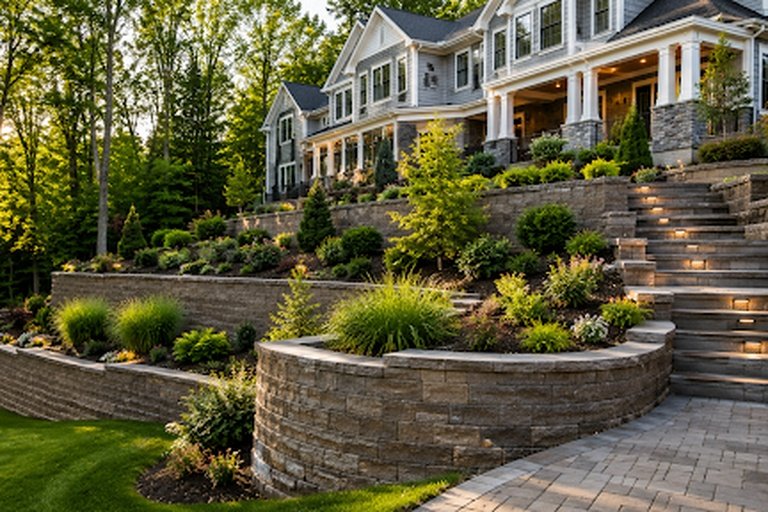
I’ve been doing hardscaping and retaining wall work in the New York area for over twenty years. And one thing I’ve learned is that the people who call me in a panic almost always say the same thing: “I thought it was just a little erosion.” It’s never just a little erosion. What starts as some topsoil washing away after a heavy rain can turn into a cracked foundation, a flooded basement, or a slope that’s actively moving toward your house. I’ve seen it dozens of times on properties in Westchester, Long Island, Staten Island, and all over the Hudson Valley. The terrain here doesn’t forgive a lack of drainage planning. So if you’re wondering why you need a retaining wall, the honest answer is this: you might not. Some properties are perfectly fine without one. But if your yard has any slope, if water drains toward your house, or if you’ve noticed soil moving after storms, you probably need one more than you realize. Let me walk you through what I’ve actually seen in the field, what goes wrong, and what a well-built wall can do for your property. What a Retaining Wall Actually Does A retaining wall is a structure designed to hold soil in place where the ground changes elevation. That’s the textbook version. Here’s the practical version: It’s the thing standing between the soil on your hillside and the foundation of your house. Without it, that soil follows gravity and water. Over time, it migrates. And it carries moisture along, often straight toward the base of your home, your driveway, or your neighbor’s property. Retaining walls can be built from a lot of materials. Concrete segmental block is the most common in residential work right now; it’s durable, drains well with the right backfill, and you can get a good-looking finish. Natural stone looks great but costs more in labor. Timber is cheap upfront, but I’d never recommend it for anything over three feet or anything load-bearing; it rots, it shifts, and you’ll be rebuilding it in fifteen years. For commercial properties or anything holding a significant grade, we use poured concrete or engineered CMU block. The stakes are higher, the engineering requirements are tighter, and the material needs to match. Why Do You Need a Retaining Wall? The Real Reasons The marketing version is: “Retaining walls improve curb appeal and add value.” That’s true, but it’s not why you actually need one. Here’s what I tell my customers: Your slope is pushing water toward your foundation This is the big one. In New York, we get heavy rain events, sometimes three or four inches in a day. If your property slopes toward your house, every one of those rain events is forcing water into the soil near your foundation. Over the years, that pressure builds up. It’s called hydrostatic pressure, and it’s one of the top causes of basement cracks and water intrusion in this region. A properly built retaining wall with a French drain behind it intercepts that water and redirects it. The wall holds the soil. The drainage system carries the water away. Your foundation stays dry. You’re losing topsoil and don’t know it yet Erosion is quiet. You don’t notice it the way you’d notice a pipe burst. It happens a little at a time, every storm, for years. Then one day your landscaping looks thin, your tree roots are exposed, and the grade near your house has shifted noticeably. At that point, you’re not just dealing with erosion; you’re dealing with the downstream effects of it. Your slope is becoming unstable Anything steeper than a 3:1 ratio (three feet of horizontal run for every one foot of drop) starts to carry meaningful erosion risk. Once you get past 2:1, you’re in territory where professional stabilization is usually warranted. I’ve seen slopes fail in ways that damaged fences, pools, driveways, and, in one case, part of a garage foundation. That’s not hyperbole. That’s a Tuesday in Westchester. You’re trying to use the space Plenty of homeowners don’t have a drainage crisis; they just have a yard that’s mostly unusable because of the slope. A retaining wall system lets you terrace that slope into flat usable areas. Patios, gardens, play spaces, outdoor kitchens. It changes how you actually live in your outdoor space. How a Retaining Wall Protects Your Foundation Let me get a little technical here because I think it matters for homeowners to understand what’s actually happening underground. When soil gets saturated, it expands. That expansion creates pressure. If that pressure is pushing against your foundation wall even slightly, it’s working on that wall every single time it rains. Concrete and block can resist it for a long time. But over the years and decades, cracks form. Water gets in. Rebar corrodes. The wall weakens. A retaining wall upstream of your foundation, combined with a drainage system, does two things: it stabilizes the soil so it doesn’t shift and push laterally, and it intercepts water before it ever saturates the ground near your home. You’re solving the problem at the source rather than patching the symptom in your basement. I always use this analogy with customers: imagine your foundation is downstream in a river. You can keep bailing water out of your basement, or you can redirect the river. A retaining wall redirects the river. How Retaining Walls Actually Stop Erosion Erosion is a water-velocity problem as much as it’s a slope problem. When rain falls on a slope, it accelerates. The faster it moves, the more soil it picks up. By the time water reaches the bottom of a long, uninterrupted slope, it’s carrying real material with it. A retaining wall breaks that run into sections. Each tier slows velocity. The drainage layer behind the wall gives water a path that doesn’t involve carrying your topsoil away. You’re managing energy, basically. The other thing people underestimate is freeze-thaw in New York winters. Soil that’s saturated and then freezes expands.