
I’ve been doing hardscaping and retaining wall work in the New York area for over twenty years. And one thing I’ve learned is that the people who call me in a panic almost always say the same thing: “I thought it was just a little erosion.”
It’s never just a little erosion.
What starts as some topsoil washing away after a heavy rain can turn into a cracked foundation, a flooded basement, or a slope that’s actively moving toward your house. I’ve seen it dozens of times on properties in Westchester, Long Island, Staten Island, and all over the Hudson Valley. The terrain here doesn’t forgive a lack of drainage planning.
So if you’re wondering why you need a retaining wall, the honest answer is this: you might not. Some properties are perfectly fine without one. But if your yard has any slope, if water drains toward your house, or if you’ve noticed soil moving after storms, you probably need one more than you realize.
Let me walk you through what I’ve actually seen in the field, what goes wrong, and what a well-built wall can do for your property.
What a Retaining Wall Actually Does
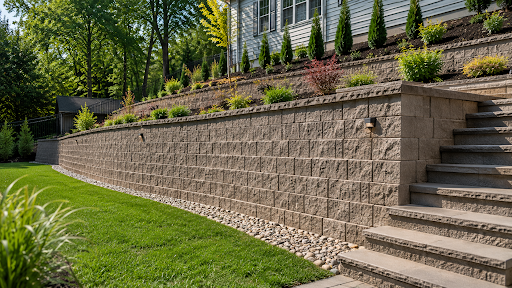
A retaining wall is a structure designed to hold soil in place where the ground changes elevation. That’s the textbook version. Here’s the practical version:
It’s the thing standing between the soil on your hillside and the foundation of your house.
Without it, that soil follows gravity and water. Over time, it migrates. And it carries moisture along, often straight toward the base of your home, your driveway, or your neighbor’s property.
Retaining walls can be built from a lot of materials. Concrete segmental block is the most common in residential work right now; it’s durable, drains well with the right backfill, and you can get a good-looking finish. Natural stone looks great but costs more in labor. Timber is cheap upfront, but I’d never recommend it for anything over three feet or anything load-bearing; it rots, it shifts, and you’ll be rebuilding it in fifteen years.
For commercial properties or anything holding a significant grade, we use poured concrete or engineered CMU block. The stakes are higher, the engineering requirements are tighter, and the material needs to match.
Why Do You Need a Retaining Wall? The Real Reasons
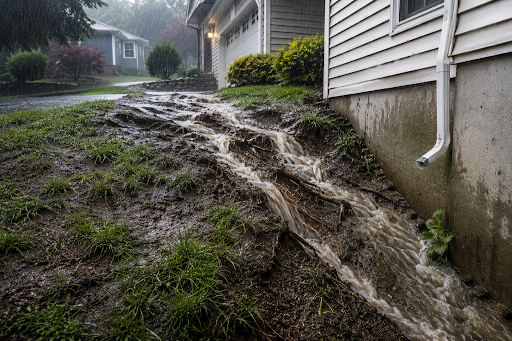
The marketing version is: “Retaining walls improve curb appeal and add value.” That’s true, but it’s not why you actually need one.
Here’s what I tell my customers:
Your slope is pushing water toward your foundation
This is the big one. In New York, we get heavy rain events, sometimes three or four inches in a day. If your property slopes toward your house, every one of those rain events is forcing water into the soil near your foundation. Over the years, that pressure builds up. It’s called hydrostatic pressure, and it’s one of the top causes of basement cracks and water intrusion in this region.
A properly built retaining wall with a French drain behind it intercepts that water and redirects it. The wall holds the soil. The drainage system carries the water away. Your foundation stays dry.
You’re losing topsoil and don’t know it yet
Erosion is quiet. You don’t notice it the way you’d notice a pipe burst. It happens a little at a time, every storm, for years. Then one day your landscaping looks thin, your tree roots are exposed, and the grade near your house has shifted noticeably.
At that point, you’re not just dealing with erosion; you’re dealing with the downstream effects of it.
Your slope is becoming unstable
Anything steeper than a 3:1 ratio (three feet of horizontal run for every one foot of drop) starts to carry meaningful erosion risk. Once you get past 2:1, you’re in territory where professional stabilization is usually warranted. I’ve seen slopes fail in ways that damaged fences, pools, driveways, and, in one case, part of a garage foundation. That’s not hyperbole. That’s a Tuesday in Westchester.
You’re trying to use the space
Plenty of homeowners don’t have a drainage crisis; they just have a yard that’s mostly unusable because of the slope. A retaining wall system lets you terrace that slope into flat usable areas. Patios, gardens, play spaces, outdoor kitchens. It changes how you actually live in your outdoor space.
How a Retaining Wall Protects Your Foundation
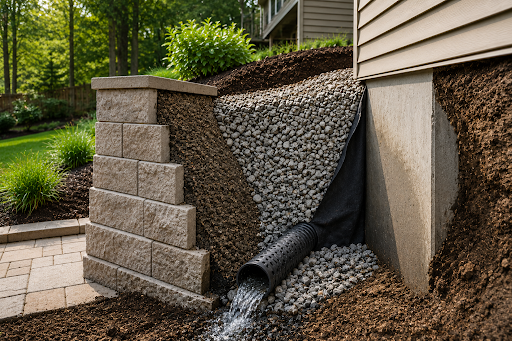
Let me get a little technical here because I think it matters for homeowners to understand what’s actually happening underground.
When soil gets saturated, it expands. That expansion creates pressure. If that pressure is pushing against your foundation wall even slightly, it’s working on that wall every single time it rains. Concrete and block can resist it for a long time. But over the years and decades, cracks form. Water gets in. Rebar corrodes. The wall weakens.
A retaining wall upstream of your foundation, combined with a drainage system, does two things: it stabilizes the soil so it doesn’t shift and push laterally, and it intercepts water before it ever saturates the ground near your home. You’re solving the problem at the source rather than patching the symptom in your basement.
I always use this analogy with customers: imagine your foundation is downstream in a river. You can keep bailing water out of your basement, or you can redirect the river. A retaining wall redirects the river.
How Retaining Walls Actually Stop Erosion
Erosion is a water-velocity problem as much as it’s a slope problem. When rain falls on a slope, it accelerates. The faster it moves, the more soil it picks up. By the time water reaches the bottom of a long, uninterrupted slope, it’s carrying real material with it.
A retaining wall breaks that run into sections. Each tier slows velocity. The drainage layer behind the wall gives water a path that doesn’t involve carrying your topsoil away. You’re managing energy, basically.
The other thing people underestimate is freeze-thaw in New York winters. Soil that’s saturated and then freezes expands. When it thaws, it moves. Year after year, that cycle shifts unretained slopes noticeably. I’ve seen properties where the grade near a foundation dropped two to three inches over a decade just from freeze-thaw erosion. That’s a lot of movement.
Property Outcomes: Without vs. With a Retaining Wall
| Situation | Without a Retaining Wall | With a Retaining Wall |
| Heavy rain event | Topsoil washes downslope toward the home | Water intercepted, soil stays in place |
| Foundation moisture | Hydrostatic pressure builds over the years | Water was redirected before reaching the foundation |
| Winter freeze-thaw | Slope shifts gradually each season | Stabilized grade, minimal movement |
| Sloped yard usability | Mostly unusable, maintenance-heavy | Terraced flat areas, functional outdoor space |
| Long-term cost | Reactive repairs: $15K–$50K+ | Proactive investment: $5K–$20K |
These aren’t hypothetical scenarios; they’re patterns I’ve observed across hundreds of properties in the metro New York area.
Signs Your Property Needs a Retaining Wall
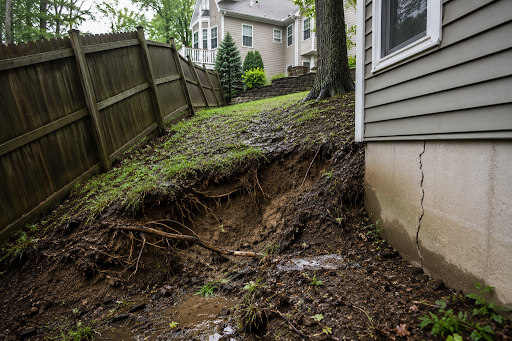
Here’s my informal checklist. If you’re checking off two or more of these, it’s worth getting a site assessment.
- Water pools near your foundation after rain and takes more than a day to drain
- You’ve noticed topsoil washing toward the house, the driveway, or the street
- There are visible cracks in your basement or foundation walls, especially horizontal ones
- Your slope is steeper than roughly 3:1 and faces your house or any structure
- Tree roots near slopes or foundations are starting to show above grade
- Landscape beds near slopes need constant re-mulching because rain washes it away
- You see standing water on your lawn that doesn’t drain naturally
- Fences or posts on a slope are leaning, that’s soil movement talking
That last one is underrated. A leaning fence on a slope isn’t a fence problem. It’s a soil problem. The fence is just showing you what’s happening underground.
How to Approach a Retaining Wall Project Step by Step
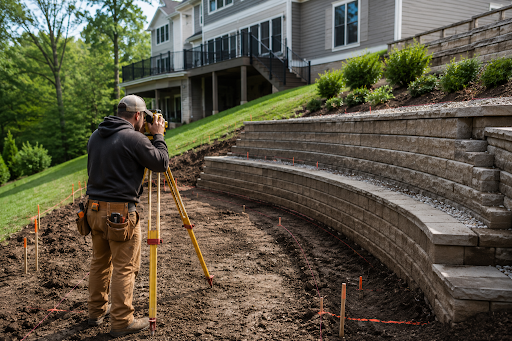
I’m going to walk through this the way I’d walk through it with a customer standing in their backyard.
Step 1: Measure your slope honestly
Don’t eyeball it. Use a level and a tape measure, or get someone with a transit level to give you real numbers. The difference between a 3:1 and a 2:1 slope isn’t obvious visually, but it’s enormous in terms of what the wall needs to do and how it needs to be engineered.
Step 2: Figure out where your water goes
Go outside during heavy rain if you can do it safely. Watch where water flows. Where does it pool? Where does it accelerate? Where does it end up? That tells you more about your drainage situation than any dry-day inspection.
Step 3: Understand your height requirements
In New York State, most municipalities require a permit for any retaining wall over four feet high. Some require a licensed engineer’s stamp on anything over three feet. Don’t skip this step. A wall built without proper permits can create problems when you sell the property, and it may not be built to code.
Step 4: Choose materials based on function, not just aesthetics
I get it natural stone looks beautiful. But if you need a structural wall to hold six feet of grade near your foundation, it needs to be engineered for that load. Material choice follows function. Once you know what the wall needs to do structurally, you choose the look.
Step 5: Don’t skip the drainage
This is where so many DIY walls fail. A retaining wall without drainage behind it is just trapping water. That water builds pressure. The wall eventually fails, sometimes in one big rain event, sometimes over a couple of seasons. Every wall I build has crushed stone backfill and a perforated drainage pipe. No exceptions.
Step 6: Get a professional involved for anything complex
I’m not saying this to drum up business. I’m saying it because I’ve rebuilt enough failed DIY walls and contractor-cut-corners walls to know what happens when someone tries to skip the engineering on a significant slope. The cost to rebuild a failed wall is often double what a proper installation would have cost.
Mistakes I See All the Time
Twenty years of doing this means twenty years of seeing what goes wrong. Here are the patterns that keep showing up.
Building the wall without solving the drainage
I touched on this above, but it’s worth saying again because it’s so common. A wall without drainage is a dam. And dams fail.
Underbuilding for the height
A four-foot wall needs a fundamentally different design than a two-foot wall. The lateral pressure on a four-foot wall is dramatically higher. I’ve seen homeowners build what looks like a solid block wall and have it blow out after one wet season because there was no batter (the slight backward lean that counteracts pressure), no deadman anchors, no geogrid, none of the structural elements that make taller walls work.
Using timber for structural walls
Timber has its place. Low decorative garden borders, sure. But I’d never use it for anything holding meaningful grade or anything near a foundation. It rots from the soil side first, so you don’t see the deterioration until it’s already structurally compromised.
Ignoring permits and setbacks
Every municipality in New York has different rules on wall height, setbacks from property lines, and engineering requirements. I’ve had to tear down walls built by previous owners who violated setback rules, and the new homeowner found out during the sale.
Treating it as a landscaping decision instead of a structural one
This one gets people in trouble. A retaining wall that’s holding grade near your foundation isn’t a landscaping decision; it’s a structural decision. It should be treated with the same seriousness as a foundation repair or a drainage system. That means real engineering, real permits, and a contractor who understands soil mechanics, not just someone who lays pretty stone.
Things Most Contractors Won’t Tell You
I genuinely think homeowners deserve to know this stuff.
- Ask any contractor you’re getting a quote from whether they pull permits. If they say permits aren’t necessary for your project and you have any doubts, call your municipality yourself. It takes ten minutes and can save a major headache.
- The cheapest bid almost always skips drainage or undersizes the wall for the load. I’ve seen it too many times. Get three bids. If one is dramatically lower than the others, ask specifically what drainage system is included and how the wall is engineered for its height.
- A wall that’s slightly over-built costs maybe ten to fifteen percent more upfront. A wall that fails costs two to three times the original project. The math is pretty clear.
- • If you have a wall already and it’s bulging, even slightly, get it looked at before winter. Freeze-thaw can turn a manageable repair into a full rebuild in one season.
- •Good topsoil backfill behind a wall is a mistake. You want crushed stone or gravel for drainage, not soil, not compost, not anything that retains water. I know that sounds counterintuitive when you’re trying to grow plants above the wall, but the drainage layer needs to stay permeable.
Frequently Asked Questions
Why do you need a retaining wall?
You need one when soil movement, water drainage, or slope instability threaten your property, structures, or foundation. Specifically: if your yard slopes toward your house, if you see erosion or soil loss after rain, if water pools near your foundation, or if your slope is steeper than 3:1, a retaining wall is likely the right solution.
Can a retaining wall actually protect a home foundation?
Yes, significantly. A retaining wall with proper drainage intercepts water before it saturates soil near your foundation, reduces lateral soil pressure on foundation walls, and stabilizes the grade around your home. It’s one of the most effective proactive measures a homeowner can take against foundation damage.
How does a retaining wall stop soil erosion?
It does two things: it physically holds soil in place on slopes, and the drainage system behind it gives water a managed path away from your property rather than letting it flow freely and carry topsoil with it. Breaking a long slope into terraced sections also slows water velocity, which is a primary driver of erosion.
Do all sloped properties in New York need retaining walls?
No. Gentle slopes with good natural drainage and stable soil may be fine without one. The risk increases with slope steepness, proximity to structures, soil type, and how much rainfall the site receives. A site assessment from a landscape contractor or civil engineer is the best way to know where your property stands.
How long do retaining walls last?
Concrete block and stone walls, properly built with drainage, routinely last forty to sixty years or more. Timber walls typically last ten to twenty years. The biggest variable isn’t the material; it’s whether the wall was built with proper drainage. A beautiful stone wall without drainage will fail faster than a plain concrete block wall with a proper French drain.
The Bottom Line
If your property has a slope that drains toward any structure, your house, your garage, or your driveway, and you haven’t addressed drainage or soil stabilization, you’re working on borrowed time. Maybe a long time. Maybe a short time. But erosion and hydrostatic pressure don’t stop because you’re not watching.
A well-built retaining wall isn’t a luxury project. It’s maintenance. It’s the same mindset as cleaning your gutters or sealing your driveway, except the consequences of skipping it are a lot more expensive.
Get a site assessment. Walk your property after the next rain and really look at where the water goes. If what you see makes you uncomfortable, trust that instinct.
In twenty years of doing this work, I’ve never had a customer say, “I wish I’d waited longer to address this.” Not once.
Ready to Protect Your Property? Let’s Start With a Conversation.
You don’t need to commit to a full project to start. Schedule a free property assessment, and we’ll walk your site, identify your erosion and drainage risks, and give you an honest picture of what, if anything, needs to be done.