Replacing a driveway is a decision you’ll live with for decades, and the surface you pick is only part of it. A paver that looks right in the showroom can still heave after a few Long Island winters if the base underneath is thin or water has nowhere to go.
This guide covers what matters most when choosing driveway pavers in New Hyde Park: which materials suit vehicle traffic, how patterns affect strength, what the base and edges need, and which permit questions to settle before work begins. It also includes questions to ask any contractor, so you can compare estimates on more than price.
What a Driveway Paver Has to Handle
A driveway paver works harder than one on a patio. It carries vehicle weight, takes contact from shovels and plows, and goes through freeze-thaw cycles, where water that has entered the surface freezes, expands, and thaws again. Deicing salt adds chemical exposure on top of that.
For concrete pavers, the benchmark is ASTM C936. It sets a minimum average compressive strength of 8,000 psi, caps average water absorption at 5 percent, and requires evidence of freeze-thaw resistance. ASTM C1645 is the test method for freeze-thaw and deicing salt durability. Rather than accepting “commercial grade” as a selling point, ask your contractor or supplier for documentation showing the product meets C936. Standards get revised, so ask which edition applies.
Thickness matters too. The Interlocking Concrete Pavement Institute (ICPI) recommends pavers at least 2 3/8 inches thick for residential driveways and 3 1/8 inches where heavier vehicle traffic is expected. If delivery trucks, a dumpster, or landscaping equipment will use your driveway, mention it at the estimate stage.
Concrete, Brick, or Natural Stone
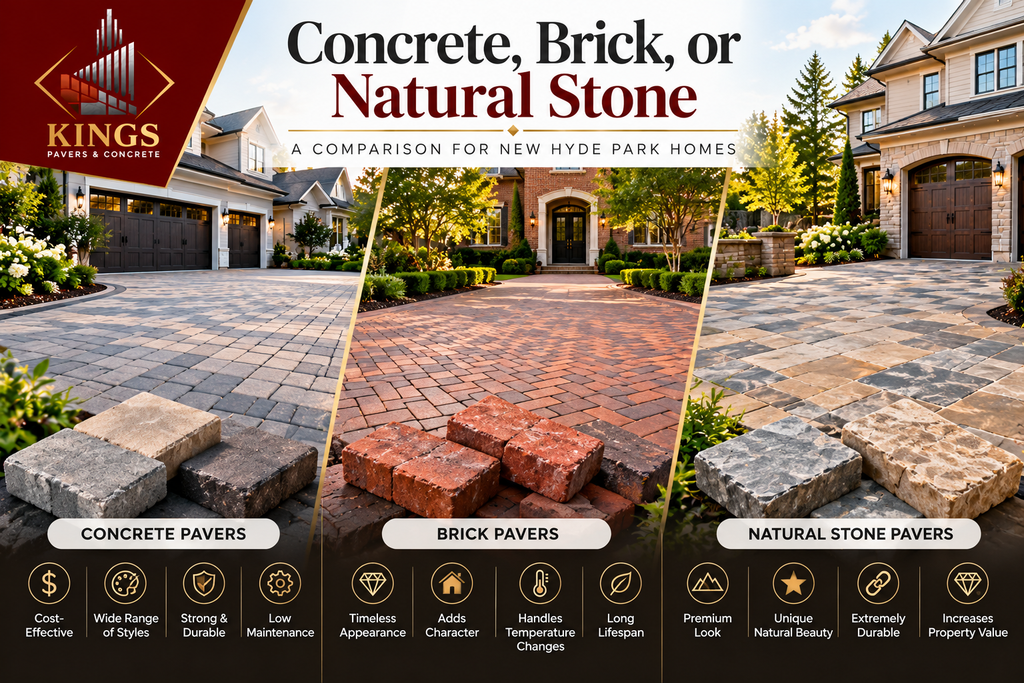
| Material | Strengths | Trade-offs | Often a fit for |
| Concrete pavers | Wide range of shapes, colors, and textures; made under controlled conditions; flexible on budget | Surface color can fade over time depending on the product; order all material from one production run to keep color consistent | Most standard residential driveways |
| Clay brick pavers | Color runs through the unit; traditional look | Often higher cost; confirm the specific product is rated for vehicle loads | Colonial, Cape, and other traditional homes |
| Natural stone pavers | Distinctive character; premium appearance | Highest cost; thickness and finish vary piece to piece; some stone needs sealing and not every type suits vehicles | Custom or high-end designs |
No material wins on every count. A well-made concrete paver on a properly built base will outperform a premium stone laid over a weak one. Match the material to how the driveway is used, your home’s style, and how much upkeep you’re willing to do.
Permeable interlocking pavers are a fourth option for properties where stormwater runoff is a concern. They rely on open joints and a different base design, so they have to be specified for that purpose rather than swapped in for standard pavers.
Patterns That Help and Patterns That Don’t
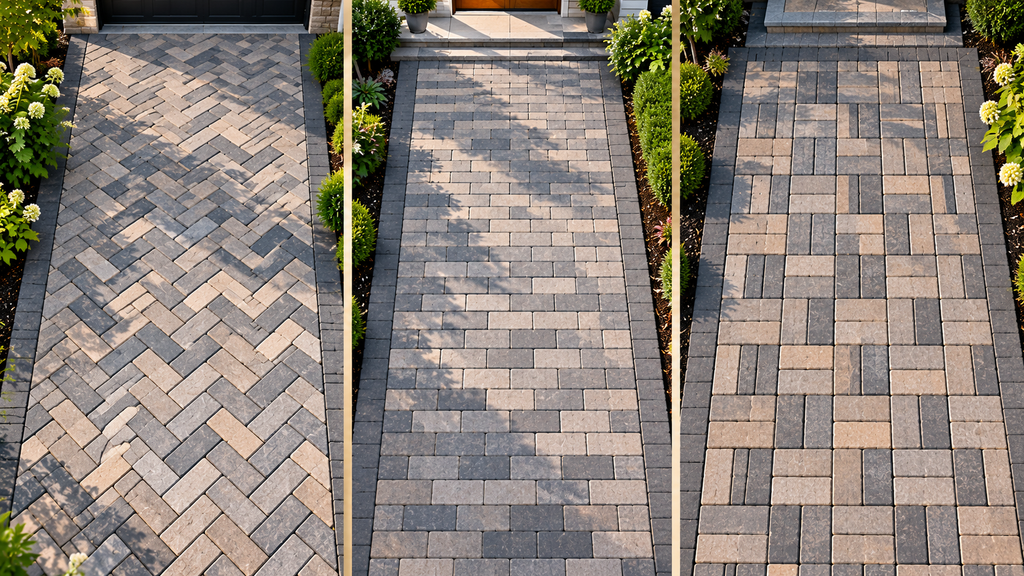
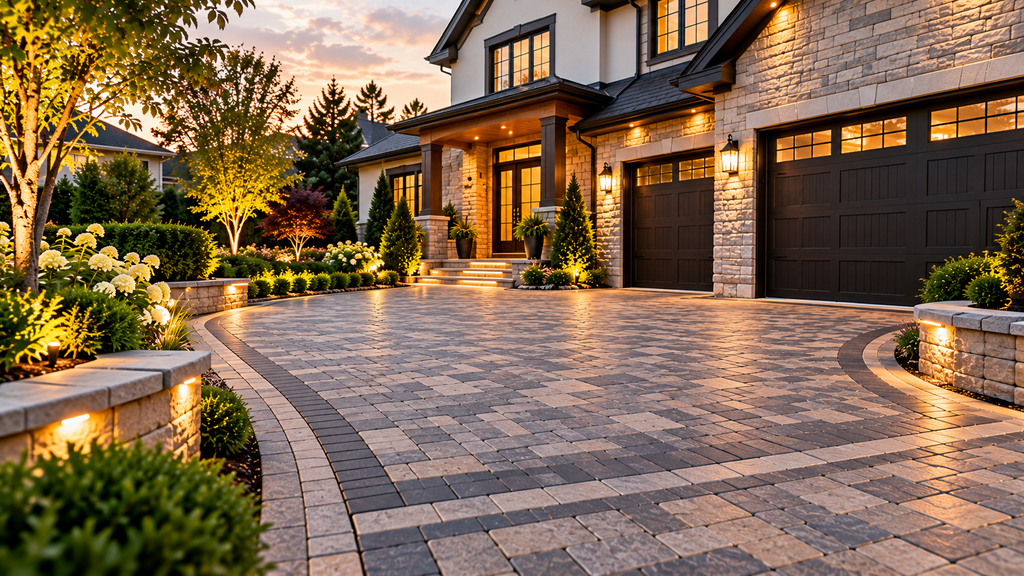
Herringbone is more than a look. ICPI recommends 45- or 90-degree herringbone where traffic is continual, because it produces the most interlock. Running bond suits lightly used driveways and gives a quieter, brick-like layout. Basketweave tends to work better on patios and walkways than where cars turn and brake.
A contrasting soldier-course border frames the driveway and ties into the edge restraint, which makes it as practical as it is decorative. To see how patterns and borders come together in a finished layout, Kings Pavers’ interlocking driveway installation page is a good starting point.
The Part You Won’t See: Base, Edges, and Drainage
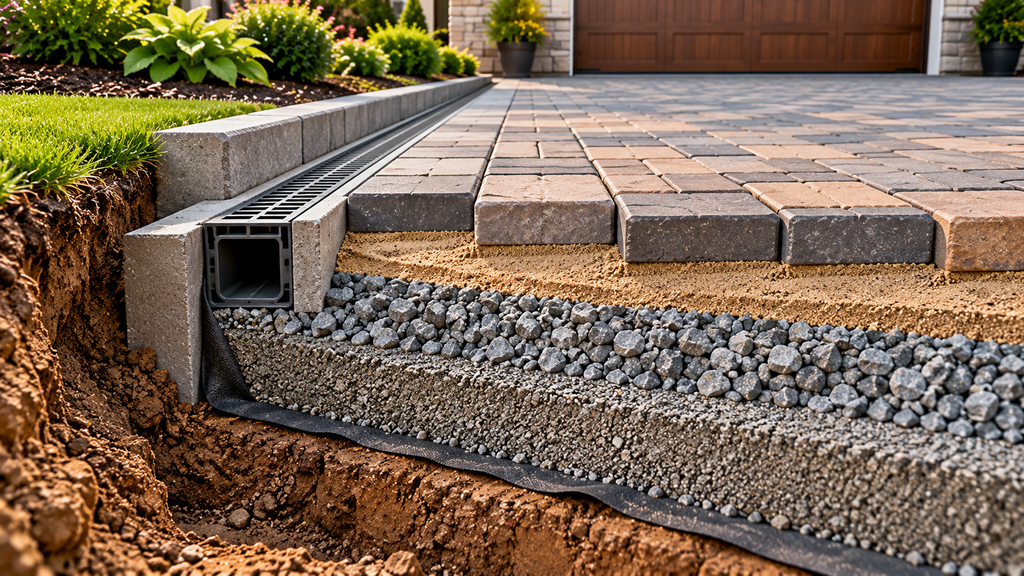
Most paver driveway problems trace back to what’s under the surface. ICPI’s guidance for residential driveways calls for a compacted soil subgrade, then a compacted aggregate base of roughly 6 to 8 inches, placed in lifts no thicker than 6 inches and compacted to at least 98 percent of standard Proctor density. Bedding sand goes down 1 to 1.5 inches thick and shouldn’t be used to fill dips in the base. These are general guidelines. Soft or wet soil can call for more depth, stabilization, or added drainage, so ask for the base specification for your lot in writing.
Edge restraints matter just as much. They hold the pavers and joint sand together, and without them the field can slowly spread under turning tires. Drainage deserves attention at the design stage too. The surface needs enough slope to move water away from the house and garage, and low spots or downspout discharge points should be planned for, not discovered after the first heavy rain.
One scheduling point for this climate: ICPI’s inspection checklist says no sand or pavers should be placed on a frozen base, so late-season installs can run into delays.
Permits and Curb Cuts: Check Which Rules Apply
New Hyde Park addresses fall under more than one jurisdiction, and the requirements depend on where your property sits and who maintains the street in front of it. The Incorporated Village of New Hyde Park publishes a Sidewalk, Curb, Apron and Driveway Permit Application through its Building Department. Properties outside the village limits may be governed by the town instead. The Town of North Hempstead, for example, requires a Highway Department permit for work in its right-of-way and publishes a maximum residential curb cut width of 18 feet.
Rules and fees change, so confirm current requirements with the municipality that governs your address before work is scheduled. If your project touches the apron, curb, or sidewalk, ask your contractor who will apply for the permit. Kings Pavers also lists curb cut work among its services.
Winter Wear and Care
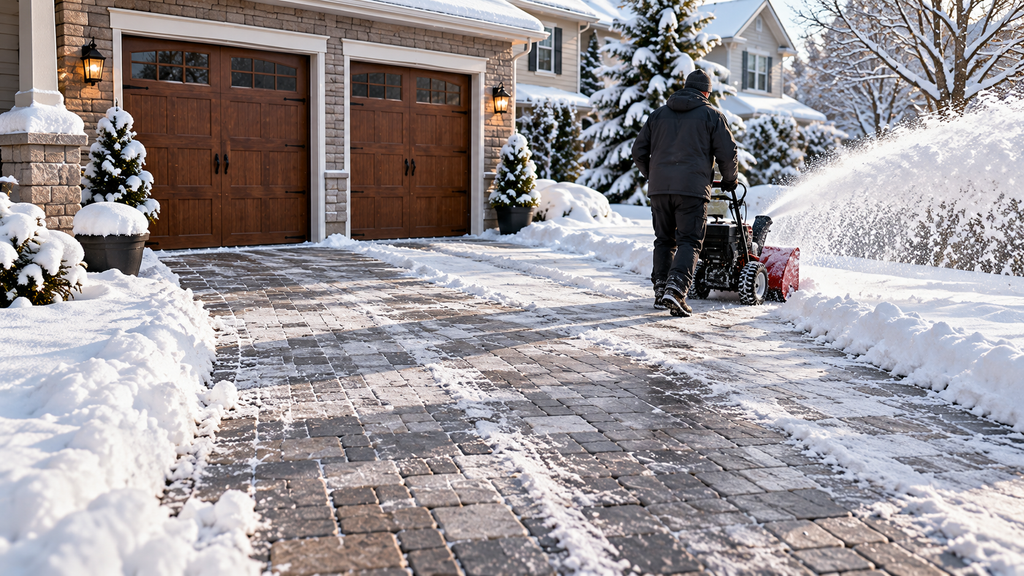
According to ICPI, concrete pavers resist deicing salts better than many conventional paving materials because they are dense, strong, and low in absorption. That doesn’t make salt harmless. Heavy, repeated use can still dull surfaces, and sealed natural stone can stain. Use deicer sparingly, choose plastic or rubber-edged shovels, and watch any spot where meltwater refreezes. Joint sand loss is the other early warning sign, and the seasonal care guide walks through what to check each season.
Some homeowners also consider radiant snow-melt tubing under the pavers. ICPI notes these systems are installed by specialty contractors and must be secured before the bedding sand and pavers go down, so the decision has to be made at the design stage.
What Drives the Cost
Any per-square-foot number would be out of date quickly and wouldn’t reflect your site, so it’s more useful to know what moves the price:
- Driveway size and shape
- Paver material and thickness
- Pattern complexity and borders, which add cuts and labor
- Excavation depth and removal of the old asphalt or concrete
- Base, drainage, and soil conditions
- Edge restraint type
- Curb, apron, and permit work
Paver driveways typically cost more up front than asphalt or poured concrete. The trade-off is repairability. Individual units can be lifted and reset, and ICPI notes interlocking pavements can be reopened for utility work without jackhammers. Ask for an itemized estimate so you can compare bids line by line.
Questions to Ask Before You Hire
- What base depth and compaction method will you use, and will it be written into the estimate?
- How will water drain, and where will it go?
- Which edge restraint do you specify?
- Do your installers hold ICPI Concrete Paver Installer certification? ICPI recommends it, though not every capable crew has it.
- Who handles the permit and the curb cut?
- Can I see current insurance and any licenses required for this work?
- What does the written warranty cover, and for how long?
Straight answers to these tell you more than a glossy portfolio. For a closer look at the process, see Kings Pavers’ driveway paver installation page.
Putting the Decision Together
The right driveway paver comes down to four things: a product rated for the loads it will carry, a pattern that locks together, a base and edge system built for freeze-thaw, and permit and drainage details settled before the first shovel goes in. Material choice and style are personal. The underlying construction is not negotiable.
FAQs
What type of pavers are best for a driveway in New Hyde Park?
Concrete pavers are the most common choice because they come in many styles and, when made to ASTM C936, are built for vehicle loads and freeze-thaw exposure. Clay brick and natural stone suit certain home styles and budgets. The best choice depends on how the driveway is used, how it drains, and the quality of the installation.
Are concrete pavers better than brick pavers?
Neither is better across the board. Concrete offers more shapes, colors, and price flexibility. Clay brick has color throughout the unit and a traditional look but often costs more. Confirm that any product, brick included, is rated for vehicle traffic and that the base is built correctly.
How do driveway pavers perform during New York winters?
Well-made pavers on a compacted, well-drained base handle freeze-thaw cycles because the joints allow slight movement without cracking a slab. Problems usually trace to poor drainage, a weak base, or lost joint sand. Use deicer sparingly and plastic or rubber-edged shovels.
Can damaged driveway pavers be replaced individually?
Usually yes. Interlocking pavers are individual units, so a cracked or stained one can often be lifted and replaced. If the same area keeps sinking, the cause is typically the base or drainage underneath, and resetting that section is the more lasting fix.
How much does driveway paver installation cost?
It varies widely with driveway size, material, pattern, excavation, base and drainage needs, and permit work. Paver driveways generally cost more up front than asphalt or poured concrete. An itemized written estimate based on a site visit is the only reliable way to get a number for your property.
Do I need a permit to replace my driveway in New Hyde Park?
It depends on the work and your location. Changes to the curb, apron, or sidewalk typically require municipal permission, and the Village of New Hyde Park and the Town of North Hempstead each have their own process. Confirm with the authority for your address before work begins.
Plan Your New Hyde Park Driveway With Kings Pavers & Concrete
If you’re planning a paver driveway, Kings Pavers & Concrete can talk through materials, patterns, base preparation, and drainage for your property. Contact us with your address and a few details about the driveway, and we’ll confirm availability and set up an estimate.
2 Responses