Most driveway conversations in New Hyde Park start the same way. A homeowner has a cracked asphalt or concrete drive, or a paver driveway that has sunk in the wheel tracks, and wants to know what to put down next. Within a few minutes, the question shifts from “what looks nice?” to “what will still look right after fifteen winters and a few thousand trips in and out of the garage?”
A driveway material has to balance appearance, vehicle use, maintenance, weather resistance, repairability, installation quality, and budget. Improving one often costs you another.
The short answer: for most New Hyde Park homes, a properly installed interlocking paver driveway in either clay brick or concrete is a sensible choice. Brick suits traditional homes and owners who value color that holds up over time. Concrete pavers offer more styles and shapes, and they often cost less. Natural stone is beautiful but is a premium option that doesn’t suit every driveway. In every case, the base under the pavers matters at least as much as the pavers themselves.
The rest of this guide explains why, so you can compare options for your own property.
What to Consider Before Choosing Driveway Pavers
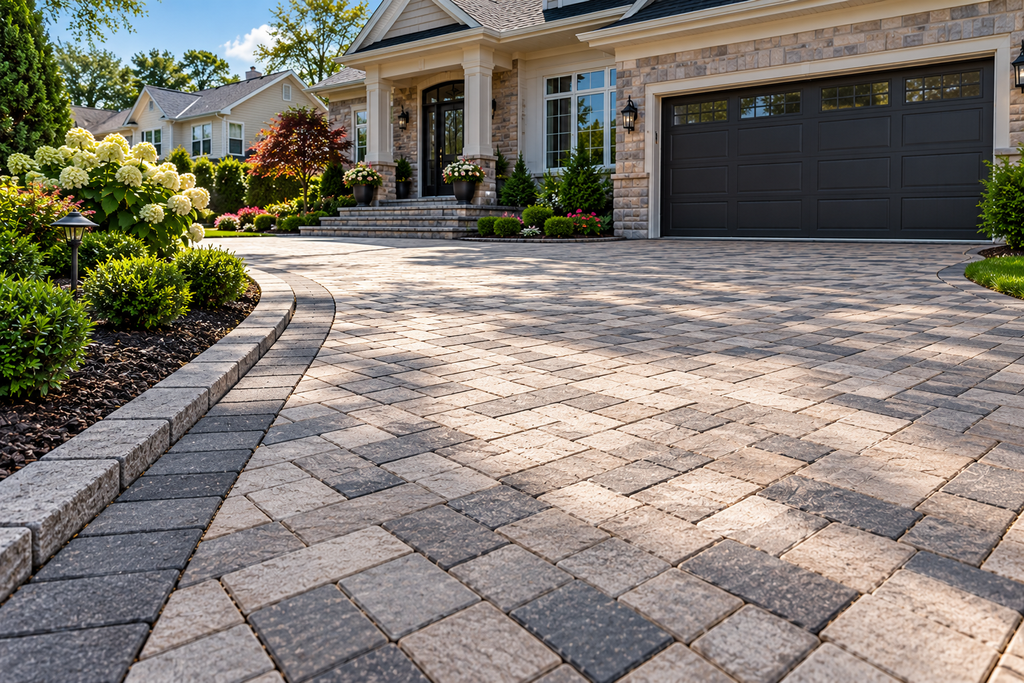
A paver that works on one street can struggle on another, so it helps to look at the whole situation before picking a color.
Freeze-thaw cycles. Long Island winters don’t stay cold. Temperatures swing above and below freezing many times a season, and that is harder on a driveway than steady cold. Water gets into joints and small gaps, freezes, expands, and thaws again. Over time, that movement can loosen joints, lift edges, and show up any weak spot in the base or the pavers.
Rain and drainage. Water needs somewhere to go. A driveway that sheds water toward the street, a lawn, or a drain behaves very differently from one that holds water against the garage slab or the foundation. Much of Long Island has sandy soil that drains well, but that isn’t universal. Fill material, clay pockets, and compacted older driveways can all change how water moves. Look at where water sits after a heavy rain.
Snow and ice. Shoveling, plowing, and deicing all affect the surface. Some paver edges catch snow blades more than others. Some surfaces hold up to salt better than others, depending on the product’s quality and how it was made.
Vehicle traffic and weight. A driveway for two sedans is a different job from one that sees SUVs, delivery trucks, or the occasional heavy vehicle. Turning movements, like pulling into a tight garage, put more stress on the surface than straight driving. The paver thickness and base depth should match the loads.
Existing soil and base. What’s under the old driveway, and what is the soil like? Removing an old asphalt drive often exposes a base that is thin, contaminated, or uneven. That is useful information before you commit to a material.
Maintenance expectations. Some owners are happy to rinse the drive, top up joint sand, and reseal now and then. Others want to do as little as possible. Be honest about which you are.
Home style. A red-brown brick drive suits a traditional Cape or colonial. A clean-lined, gray modern home may call for larger-format concrete pavers. The driveway should look like it belongs with the house, the walkway, and the neighbors.
Brick Pavers for Driveways
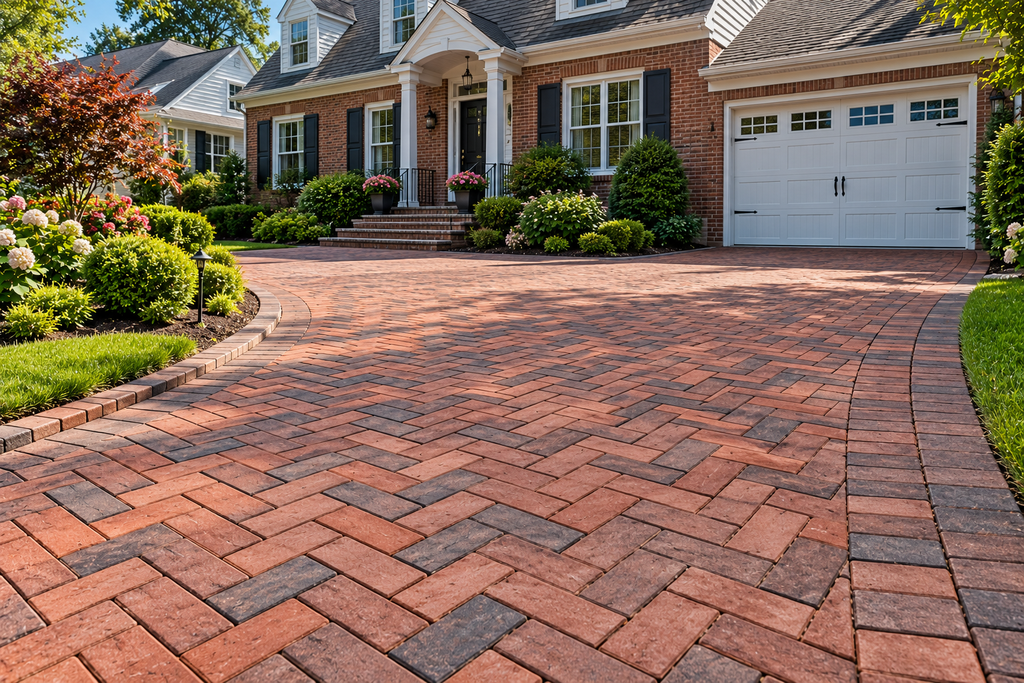
Clay brick pavers are made from fired clay, and the color runs through the whole unit rather than sitting on the surface. That is a big part of their appeal. They tend to keep their color well over the years, and they age gracefully, with a warmth that suits older neighborhoods.
Appearance. The classic look is a range of reds, browns, and charcoals, often laid in a herringbone pattern. Herringbone also adds mechanical strength for vehicle traffic, which is why you see it so often on driveways.
Durability. Quality clay pavers handle vehicle loads well when they are made for that use and installed on a good base. Because clay absorbs water differently from concrete, it’s worth asking your supplier whether the product is rated for severe weathering and vehicular traffic. Standards such as ASTM C902 and ASTM C1272 cover clay pavers, and a reputable supplier should be able to tell you what a product meets.
Maintenance. Brick is fairly forgiving. It needs occasional cleaning, joint sand that is kept topped up, and attention to weeds and moss in shaded spots. Sealing is optional, mainly to deepen color, resist stains, or help hold joint sand in place.
Repairability. Pavers can be lifted, the base corrected, and the same pavers set back down. That is a real advantage over poured surfaces, where a repair usually shows.
Potential drawbacks. Brick often costs more than basic concrete pavers. The color range is narrower than with concrete, and a poor-quality brick can chip or flake. If you’re matching an existing walkway or steps, it can also be hard to find an exact color match later.
Where brick works well. Brick driveway paving in North New Hyde Park often makes sense on traditional homes, on streets with older housing stock, and for owners who want a driveway that looks better with age. It also suits homeowners who want to be able to repair a section down the line without redoing the whole drive.
Concrete Pavers
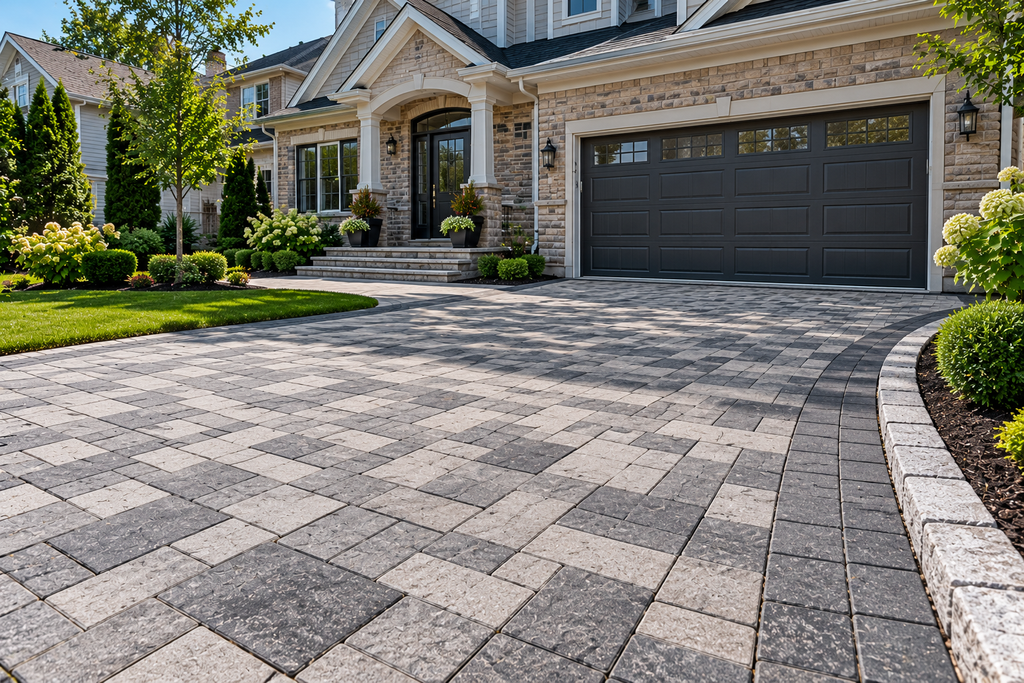
Concrete pavers are made from molded concrete, and they are the most widely used driveway paver. A large part of the reason is flexibility.
Where they make sense. If you want a specific color, shape, or texture, there are many options: tumbled and aged finishes, large-format slabs for a modern look, and designs that imitate stone or wood. They suit both traditional and modern homes, and they’re often a good fit when budget matters and the owner still wants the benefits of an interlocking system.
Practical advantages. Pavers are manufactured under controlled conditions, so size and thickness are consistent. That helps with laying patterns and tight joints. ASTM C936 covers concrete pavers, and a good supplier will be able to show you product specifications. Like brick, they can be lifted and re-laid for repairs.
Maintenance. Expect similar upkeep to brick: cleaning, joint sand, weed control, and periodic inspection. Sealing is more common with concrete pavers because sealers can refresh color, protect against oil and rust stains, and help with efflorescence, the whitish haze that can appear on new concrete products.
Potential disadvantages. Color can fade over the years, especially in surface-pigmented products. Quality varies between manufacturers, and lower-grade pavers can scale or wear when exposed to deicing salts and repeated freeze-thaw cycles. Cheaper isn’t always wrong, but it is worth comparing product specs rather than only the price per square foot.
Natural Stone Pavers
Natural stone, such as granite setts (often called Belgian block), bluestone, or other cut stone, has an appearance that manufactured products only approximate. No two pieces are identical.
Appearance. Granite and bluestone look distinctive and suit high-end homes, historic properties, and architectural designs that call for something unique.
Durability. Many stones are very durable, but not all stones suit all uses. Some are too soft or too slippery for a driveway, and some absorb water in ways that don’t suit freeze-thaw conditions. Stone needs to be matched to the application.
Cost. Stone typically sits at the top of the price range. Material cost, shipping, thickness, cutting, and the more labor-intensive installation all add up. Costs vary widely depending on stone type, source, and pattern, so it’s better to get a specific quote than rely on a general figure.
Installation requirements. Stone is heavy, irregular, and less forgiving of a poorly prepared base. A driveway that will see vehicles needs a strong, well-compacted base and stone of appropriate thickness.
Does it make sense for every driveway? No. It’s a good choice when appearance is the main priority, and the budget supports it. For a typical family driveway, brick or concrete usually delivers better value.
Interlocking Pavers
“Interlocking” describes the system more than the material. Individual pavers are set on a compacted base and a layer of bedding sand, with narrow joints filled with sand between them. Each paver is held in place by its neighbors and by friction in the joints. When a vehicle crosses the surface, the load spreads across many pavers rather than being carried by one.
That is why the system works for driveways: it’s designed to flex slightly and share loads rather than crack. But it only works if everything underneath is right. If the base settles unevenly, if the edges aren’t restrained, or if the bedding layer is too thick, pavers shift, rut, or open up at the joints.
Both brick and concrete pavers are commonly installed as interlocking systems. The paver choice affects the look and feel. The installation determines whether it still looks right in ten years.
Comparing Paver Types
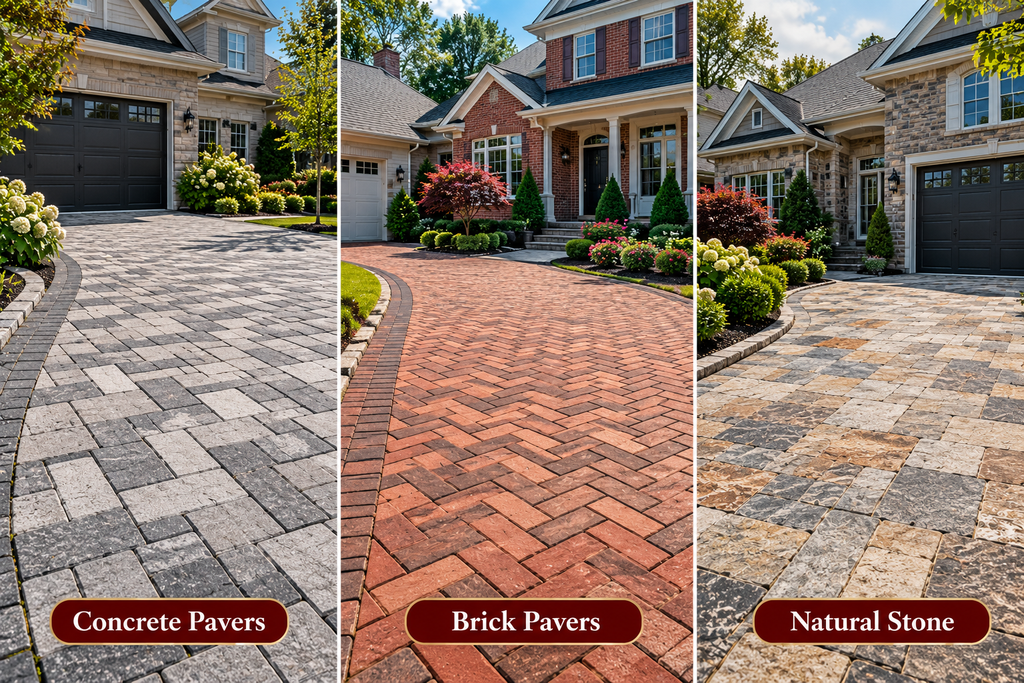
| Paver Type | Appearance | Durability | Maintenance | Repairability | Relative Cost | Best For |
| Clay brick | Traditional, rich color that stays consistent | Strong with proper product and base | Moderate: cleaning, joint sand, optional sealing | Good: pavers can be lifted and re-laid | Mid to upper | Traditional homes, long-term color, easy repairs |
| Concrete | Wide range of colors, shapes, and textures | Strong with quality product and base | Moderate: sealing more common | Good: pavers can be lifted and re-laid | Lower to mid | Budget-conscious projects, modern or varied styles |
| Natural stone | Distinctive, natural variation | Often very durable, depends on stone type | Moderate to low depending on stone | Fair to good: needs skill to re-lay | Upper | Premium projects, historic or high-end homes |
| Interlocking system (applies to brick or concrete) | Depends on paver | Depends on installation quality | Depends on paver | Good: individual units can be repaired | Varies | Most residential driveways |
Cost and lifespan vary a lot with product quality, pattern, site conditions, access, base depth, drainage work, and edge details, so rather than quote numbers that may not fit your property, it’s more useful to get a written quote based on a site visit.
Which Driveway Paver Handles New York Weather Best?
No paver is immune to weather. What matters is how well the product and installation handle repeated freezing, thawing, and wet conditions.
Freeze-thaw. Water causes most winter damage. A well-built driveway lets water drain through joints into a free-draining base, so there’s little standing water to freeze. A poorly built one traps water under the surface, where it freezes and pushes things around. Both clay and concrete pavers can perform well here if the product is suitable and the base drains properly.
Water penetration. Pavers with low absorption generally cope better with freezing. Ask suppliers about product specifications rather than relying on brand reputation.
Drainage. The surface should slope away from the house and garage, with a typical target of around a quarter inch of fall per foot. Where the ground can’t absorb runoff, a drain, a swale, or a connection to a dry well may be needed. On Long Island, rules about stormwater and work near the street can vary by village and town, so it’s worth checking whether permits are needed, especially for work on the apron or curb cut.
Deicing. Rock salt can be hard on some concrete products and on adjacent landscaping. Many installers suggest using deicers sparingly, following the paver manufacturer’s guidance, and using sand for traction when possible. Avoid products that are known to be harsh on masonry.
Snow removal. Pavers with sharp, pronounced edges can catch plow blades. If you use a plow service or a snow blower, tell your installer. Raising plow shoes slightly and using plastic-edged shovels helps protect the surface.
Seasonal movement. Small amounts of movement through the seasons are normal. What you want to avoid is progressive settlement, a dip that gets deeper each year. That points to a base or drainage problem, not a paver problem.
Why Base Preparation Can Matter More Than the Paver
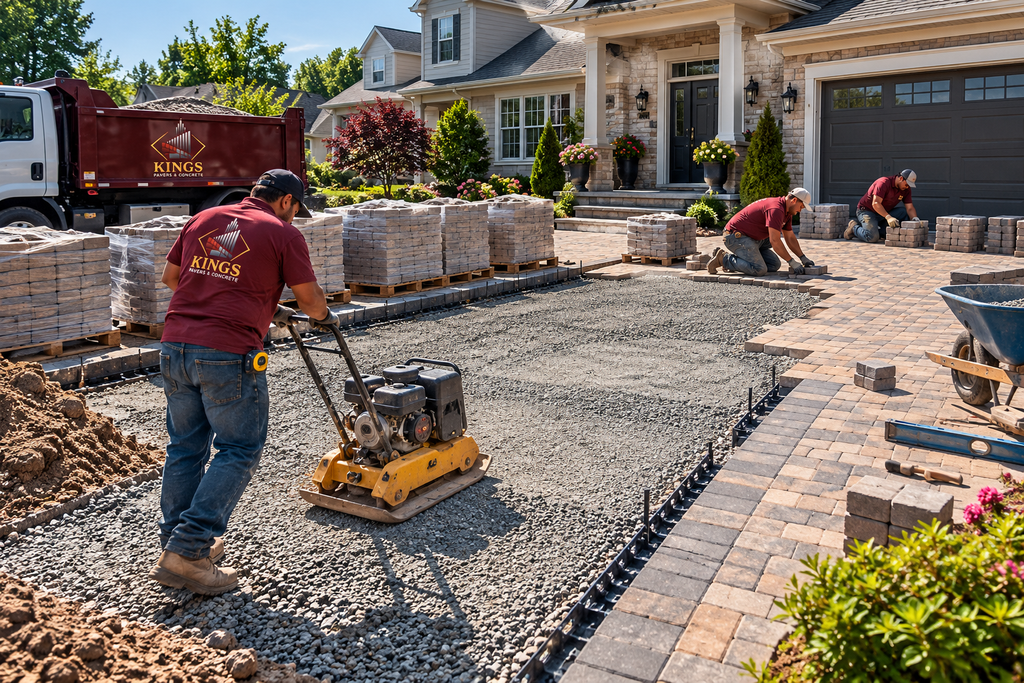
If I had to pick one thing that decides whether a paver driveway lasts, it would be what you can’t see.
A good paver driveway usually starts with excavation to the depth the soil and traffic require. For residential driveways, a compacted aggregate base is often in the range of eight to twelve inches or more, depending on soil conditions and loads. Softer or wetter soils may need more. Then comes grading, so the base itself slopes correctly and water doesn’t pool beneath the pavers. The aggregate is placed in layers and compacted in lifts rather than dumped in one pass. On top of that goes a bedding layer, typically about an inch of screeded material, which is only there to level the pavers. It isn’t a structural layer, and making it thicker to fix a wavy base is a common shortcut that eventually shows.
Edge restraints hold everything in place. Without them, pavers creep outward under traffic, joints open, and the surface spreads. A rigid, properly anchored edge matters on driveway edges, where the load pushes outward.
Drainage is part of the base too. Where water can’t leave on its own, the base needs help.
Here is how an expensive paver still fails. Imagine a premium brick laid over a thin base that was never fully compacted and sits on soft soil. For the first year it looks great. Then wheel tracks start to dip, joints open, and water collects in the low spots. By the second or third winter, freeze-thaw cycles make it worse. The pavers aren’t the problem. The base was. Lifting and re-laying can fix it, but it costs far more than doing the base right the first time.
A Step-by-Step Guide to Choosing Driveway Pavers
Step 1: Look at how the driveway will be used.
Count the vehicles. Think about what they weigh, how often they come and go, and whether delivery trucks, trailers, or work vehicles use the driveway. Note the turning areas near garages and gates. Heavier use calls for thicker pavers, a deeper base, and often a herringbone pattern.
Step 2: Evaluate drainage and site conditions.
Walk the property during or just after heavy rain. Where does water run? Does it reach the garage, a neighbor’s yard, or the street? Check grade changes, nearby trees whose roots may push up the surface, and any soil that stays soft. Problems you find now are far cheaper to deal with before paving than after.
Step 3: Compare suitable paver materials.
Narrow the options to those that fit the use and the house. Brick and concrete cover most driveways. Natural stone suits specific cases. Ask for product specifications, not only samples, and look at the pavers in daylight against your home’s brick, siding, and roof.
Step 4: Consider maintenance and repair requirements.
Ask yourself how much upkeep you’ll accept. Do you want to reseal? Will you re-sand joints? Can the installer match pavers if a section needs repair later? A material that suits you now should still make sense when you’re doing the maintenance in year ten.
Step 5: Compare long-term value rather than appearance alone.
A less expensive paver on a strong base often outperforms an expensive one on a weak base. Look at the quote line by line: excavation depth, base material, drainage, edge restraints, joint sand, and warranty terms. A low price that skips base work is not a saving.
Step 6: Have the site assessed before making the final choice.
A site visit shows things photos can’t: soil, slope, tree roots, existing base condition, and access for equipment. It also lets you ask how the installer would handle drainage and edges on your property.
Common Driveway Paver Mistakes
Choosing only by appearance. A beautiful paver on the wrong base is still a poor driveway. Appearance is one factor among several.
Ignoring drainage. Standing water is behind more driveway failures than any other single cause. Water pooling near the garage or foundation should be dealt with before paving.
Insufficient base preparation. Skipping depth, skipping compaction, or using the wrong material under the pavers leads to settlement and rutting.
Poor edge restraint. Without a firm edge, pavers spread outward over time. It’s easy to overlook because it’s hidden.
Using unsuitable materials. Pavers made for patios aren’t always right for vehicles. Thickness and product ratings matter.
Ignoring small settlement problems. A shallow dip is easier to correct than a deep one. Waiting usually means a larger repair.
Assuming every paver performs the same way. Pavers vary in quality, absorption, strength, and finish. Two that look alike can behave differently after a few winters.
Realistic Case Study (Illustrative Example)
This is a hypothetical scenario created to show how the decision process works. It is not a completed project or a real customer story.
Imagine a homeowner in North New Hyde Park with a 1950s Cape and a short, single-width asphalt driveway that is cracked and sunken near the garage. They want to replace it with pavers and are comparing red-toned clay brick with a charcoal concrete paver.
The situation. The driveway slopes slightly toward the garage, and water collects at the door after heavy rain. Two cars use the drive daily, and a contractor’s van occasionally parks there. The homeowner likes the traditional look of brick but is concerned about cost.
What to evaluate. First, the slope: the new driveway needs to shed water away from the garage, which may require regrading and possibly a drain at the garage threshold. Second, what is under the old asphalt: if it sits on a thin, mixed base, that needs to be removed and replaced. Third, vehicle loads: the occasional van means the paver should be rated for vehicular use and the base built accordingly.
Why one material might suit better. If the house has red brick steps and a matching walkway, clay brick could tie everything together and age consistently. If the budget is tight or the homeowner wants a modern look after updating the exterior, a quality concrete paver may make more sense. Neither choice is wrong. Both can work if the installation is right.
Installation details that affect the decision. Excavation depth, drainage work, and edge restraint may change the total cost more than the paver does. A herringbone pattern would improve strength where cars turn. The homeowner should also ask what happens if a section needs repair, and whether matching pavers will be available later.
Long-term considerations. Brick may cost more up front but keeps its color. Concrete may cost less and offer more styles but may need sealing to keep its color. In both cases, the homeowner should plan for periodic joint sand top-ups and an annual inspection.
Expert Insight
Experienced installers tend to agree on a few points. The base and drainage decide how a paver driveway performs. Edge restraint is easy to skip and expensive to skip. And the best paver for a property is the one that suits its traffic, drainage, and style, installed to the manufacturer’s guidelines, rather than whichever material is popular this year. Small settlement problems are cheaper to fix early, and a site visit is the most reliable way to match the material to the property.
Driveway Paver Maintenance
A paver driveway isn’t maintenance-free, but the work is manageable.
Cleaning. Sweep regularly and rinse with a hose. For tougher dirt, a gentle pressure wash can help, but too much pressure can blow sand out of the joints and mark the surface.
Joint sand. Joint sand holds the pavers together. It washes out over time, so top it up when you see gaps. Polymeric sand can resist washout and weeds, but it must be applied on dry pavers and cured properly, or it can leave a hazy residue.
Weed growth. Weeds usually mean the joints have opened or soil has collected in them. Clearing, re-sanding, and keeping debris off the surface helps.
Drainage. After heavy rain, check where water goes. Keep drains, swales, and downspout outlets clear.
Stains. Treat oil and rust stains as early as you can. Sealers can reduce staining, but they need to be suitable for the paver type.
Sealing where appropriate. Sealing is optional. It can deepen color and ease cleaning, but film-forming sealers can become slippery or look cloudy if misapplied, and they need to be reapplied over time. Ask the installer about options for your pavers.
Settlement. If you see a dip, a rocking paver, or a widening joint, deal with it early. Lifting and re-laying a small area is much easier than correcting a larger one.
Winter care. Use a plastic-edged shovel, raise plow shoes slightly, and use deicers sparingly. Sand adds traction without chemical exposure.
Periodic inspections. Walk the driveway each spring and fall. Look at the edges, joints, low spots, and the area near the garage and street.
Which Paver Is Actually Best?
There isn’t a single winner. The right choice depends on the house, the driveway, and the owner.
Traditional homes. Clay brick is a natural fit, especially where it matches existing brickwork or the character of an older neighborhood.
Modern homes. Large-format concrete pavers with clean lines and a restrained color palette suit contemporary architecture.
Premium projects. Natural stone or high-end clay pavers, laid in a custom pattern, suit owners who want a distinctive result and are comfortable with the cost.
High-traffic driveways. Choose pavers rated for vehicles, a deeper base, and a pattern such as herringbone. Brick and concrete can both work.
Owners concerned about easier repairs. Interlocking pavers in general are repairable, and a widely available product makes matching easier later.
Owners prioritizing appearance. Brick for lasting color, stone for natural character, or concrete if you want a particular shape or finish.
Commercial properties. Durability, drainage, and snow removal matter most. Pavers rated for heavy loads, a robust base, and edges designed for plows are the priorities.
FAQs
Which type of paver is best for a driveway?
There isn’t one best type. Clay brick and concrete pavers, installed as an interlocking system on a properly built base, are the most common and practical choices. Natural stone suits premium projects. The right one depends on your traffic, drainage, budget, and the style of your home.
Are brick pavers good for driveways in New York?
Yes, when the product is made for vehicle use and suited to freezing conditions, and the base is properly built. Ask your supplier about weathering and traffic ratings. Poor drainage or a thin base can cause problems with any paver.
How long do driveway pavers last?
It varies, and any single number would be a guess. Lifespan depends on the paver quality, base depth, drainage, edge restraint, traffic, snow and deicing practices, and maintenance. A well-installed driveway can last for decades, and individual pavers can be re-laid if the surface needs correcting.
Are pavers better than concrete for a driveway?
It depends on what matters to you. Pavers cost more up front in many cases, but they can be repaired by lifting and re-laying units, and they flex with movement instead of cracking. Poured concrete is a solid surface that costs less initially but is harder to repair invisibly if it cracks.
Do driveway pavers crack during New York winters?
Individual pavers rarely crack when they are good quality and properly installed. Winter problems are more often caused by water trapped in a poor base, which can lift or shift pavers. Good drainage and a compacted base reduce the risk.
How do you maintain a paver driveway?
Sweep and rinse it regularly, top up joint sand, remove weeds early, and keep drains clear. Treat stains quickly, consider sealing if it suits your pavers, and fix small settlement problems before they spread. Inspect the driveway each spring and fall.
Get Your Driveway Looked At Before You Decide
Samples and photos only tell part of the story. The same paver can look right on one property and be a poor fit on the next, depending on the slope, soil, drainage, and how the driveway is used.
If you’re replacing a driveway in New Hyde Park or North New Hyde Park, or comparing options for a commercial property, it’s worth having someone look at the site first. A walk-through can help identify how water moves, what’s beneath the existing surface, and which paver and base design may suit the property best.
Contact Kings Pavers & Concrete to request an assessment or estimate for your driveway project.

One Response