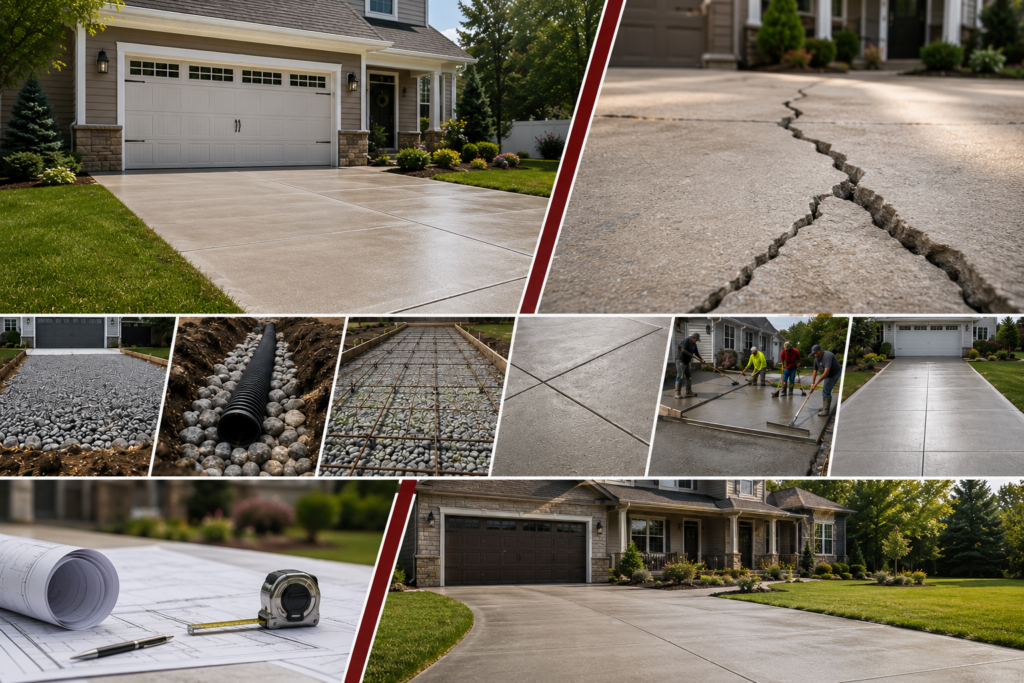
If you’re standing in your driveway right now trying to figure out whether to go with 4 inches or 6, here’s the short answer: for most homes with regular cars and SUVs, 4 inches of concrete is the standard starting point. But that number isn’t the whole story, and in a lot of New York driveways, it’s not actually the number I’d recommend.
So how thick should a concrete driveway be?
For a typical residential driveway carrying passenger cars and light trucks, 4 inches is the accepted minimum. If you’re regularly parking a pickup, an SUV, a work van, or you deal with New York’s freeze-thaw winters, 5 to 6 inches is usually the smarter call. Commercial driveways that see delivery trucks or heavier equipment often need 6 to 8 inches, sometimes more, depending on the loads involved.
That’s the baseline. What actually determines the right number for your specific driveway comes down to a handful of things working together: how heavy the vehicles are, what kind of soil is under there, how well the base gets prepared, whether there’s reinforcement, and how the site handles water and freezing. Thickness matters, but it’s one piece of a bigger puzzle. I’ve seen 4-inch driveways outlast 6-inch driveways because the base and drainage were done right, and I’ve seen the opposite happen just as often.
Let’s walk through where these numbers come from and how a contractor actually arrives at a thickness for a specific job, not just a generic rule of thumb.
What Is the Standard Concrete Driveway Thickness?
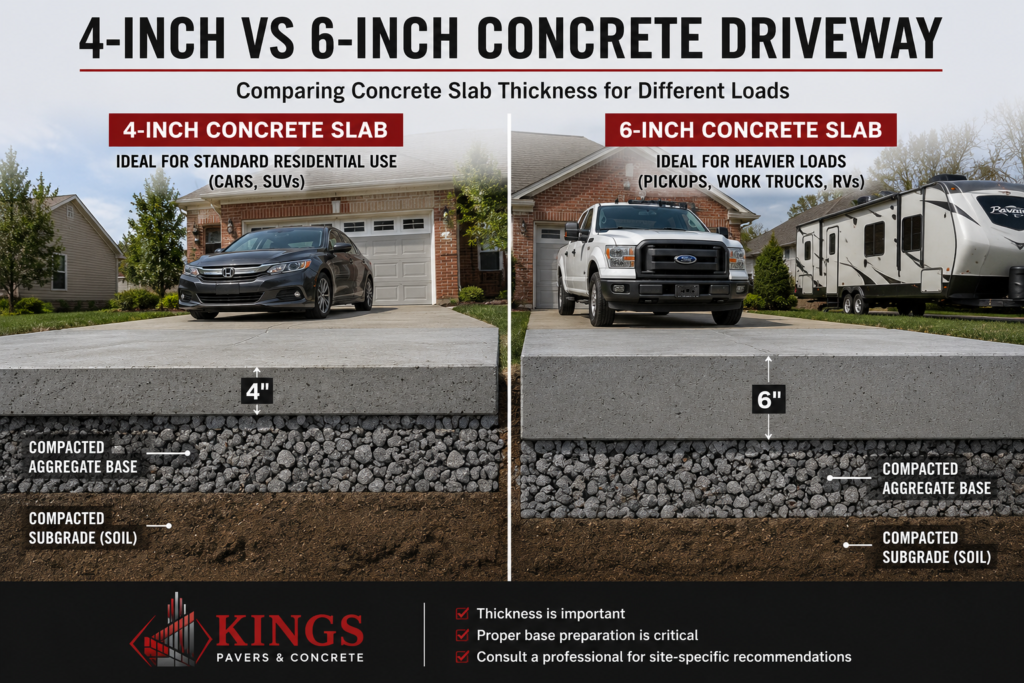
For a standard residential concrete driveway, 4 inches is the commonly cited minimum for slabs supporting passenger vehicles. That’s the number you’ll see repeated across the industry, and it holds up fine for a lot of driveways. A family with two sedans and maybe an occasional visitor’s car isn’t putting much stress on the slab.
Where it gets more nuanced is the difference between “meets the minimum” and “built for the long haul.” A 4-inch slab poured over a well-compacted base, with the right concrete mix and proper joints, can perform well for decades. A 4-inch slab poured over soft or poorly prepared ground is a different story regardless of what’s written on the concrete truck’s ticket.
Here’s where people sometimes get into trouble: they hear “4 inches is standard” and assume that’s a universal answer for every situation, including driveways that regularly see trucks, RVs, or multiple vehicles parked side by side. That’s not really how it works. The 4-inch number is a baseline for light residential use, not a one-size-fits-all spec.
| Driveway Use | Typical Thickness | What to Consider |
| Passenger vehicles | 4 inches | Normal residential use, stable soil |
| SUVs / pickups | 4–5 inches | Vehicle weight and how often they’re parked in the same spot |
| Heavy vehicles (RVs, boats, work trucks) | 5–6 inches | May need thicker slab and reinforcement |
| Commercial traffic | 6–8+ inches | Project-specific, generally needs engineering input |
Keep in mind these ranges are general guidance, not a substitute for a site-specific evaluation. Local code requirements, soil reports, and the actual vehicles using the driveway should determine the final number.
Is 4 Inches of Concrete Enough for a Driveway?
For most cars and light trucks, yes, 4 inches is generally considered adequate, assuming the base underneath is properly prepared and the concrete itself is a suitable mix for the climate. That doesn’t necessarily mean you need a thicker slab just because you own an SUV. Plenty of SUVs and light trucks fall well within what a 4-inch driveway can handle over a solid base.
Where 4 inches starts to fall short is when the driveway sees regular heavier traffic, think delivery trucks, moving trucks, a boat trailer parked in the same spot every summer, or a work vehicle that comes and goes daily. Concentrated, repeated loads in the same location wear on a slab differently than the occasional car rolling across it.
The other factor that pushes people toward a thicker slab, even for otherwise normal residential use, is New York’s climate. In areas that see real freeze-thaw cycles, going to 5 inches adds a margin of durability that a lot of contractors around here consider worth the extra cost, especially for driveways that will be in service for decades.
If you’re on the fence, this is a good conversation to have with whoever is doing your concrete driveway installation before the pour, not after.
When Should a Concrete Driveway Be Thicker?
A handful of situations tend to push the recommendation past that 4-inch baseline:
- Heavy vehicles. RVs, boats on trailers, dually trucks, and similar loads put more weight per square inch on the slab than a typical car.
- Frequent truck traffic. A driveway that sees delivery vans, contractor trucks, or garbage trucks regularly is under different stress than one that mostly sees a couple of sedans.
- Commercial applications. Parking lots, loading areas, and driveways serving commercial properties are a different category entirely and usually call for engineering input rather than a rule-of-thumb thickness.
- Poor soil conditions. Expansive clay, loose fill, or soil with drainage problems can undermine even a well-poured slab, and a thicker driveway with a properly engineered base helps compensate.
- Driveway edges. Edges see more flexing and cracking than the interior of a slab because there’s less material supporting them on one side. Thickened edges are a common detail for exactly this reason.
- Garage entrances. The transition point where a vehicle’s full weight shifts onto the slab, often combined with turning motion, concentrates stress right at that spot.
- Areas receiving concentrated loads. Trailer jacks, dumpsters, or anywhere weight sits in one small footprint for extended periods.
None of this means every driveway needs to be overbuilt. It means the decision should match the actual use, not a generic number pulled from a website.
Why the Base Under the Concrete Matters Just as Much
Here’s something that doesn’t get said enough: pouring thicker concrete over a bad base is like putting a better roof on a house with a cracked foundation. It might buy you some time, but it doesn’t fix the underlying problem.
The base is what everything else sits on, and it needs a few things done right:
Excavation. The area needs to be dug out to the correct depth, removing topsoil, organic material, and anything else that will settle or decompose over time. Skipping this or excavating unevenly is one of the more common shortcuts I’ve seen cause problems years later.
Compaction. Loose soil settles. If the ground under a driveway isn’t properly compacted before the base material goes down, the slab above it will eventually follow that movement, and that’s when you start seeing cracks and low spots.
Aggregate and subbase preparation. A layer of crushed stone or gravel, properly compacted, gives the concrete a stable, well-drained surface to sit on. This layer also helps with drainage, which matters a lot more in a state that deals with snowmelt and spring thaw every year.
Soft areas. Any pockets of soft or wet soil found during excavation need to be addressed before the pour, not covered up and hoped away. This is a spot where cutting corners tends to show up later as a sunken section of driveway.
Drainage. Water that has nowhere to go will find the path of least resistance, and sometimes that’s straight down into your base material. Grading the site so water moves away from the slab is part of doing this correctly.
Soil movement. Certain soil types expand and contract with moisture and temperature changes. A base that accounts for this behavior holds up better than one that ignores it.
The concrete itself is only part of the equation. A lot of driveway failures that get blamed on “thin concrete” actually trace back to a base that wasn’t prepared correctly.
Concrete Thickness vs. Base Thickness
This is a mix-up I run into constantly. Someone searches “how deep should a concrete driveway be” expecting one number, and they’re really asking about two different things.
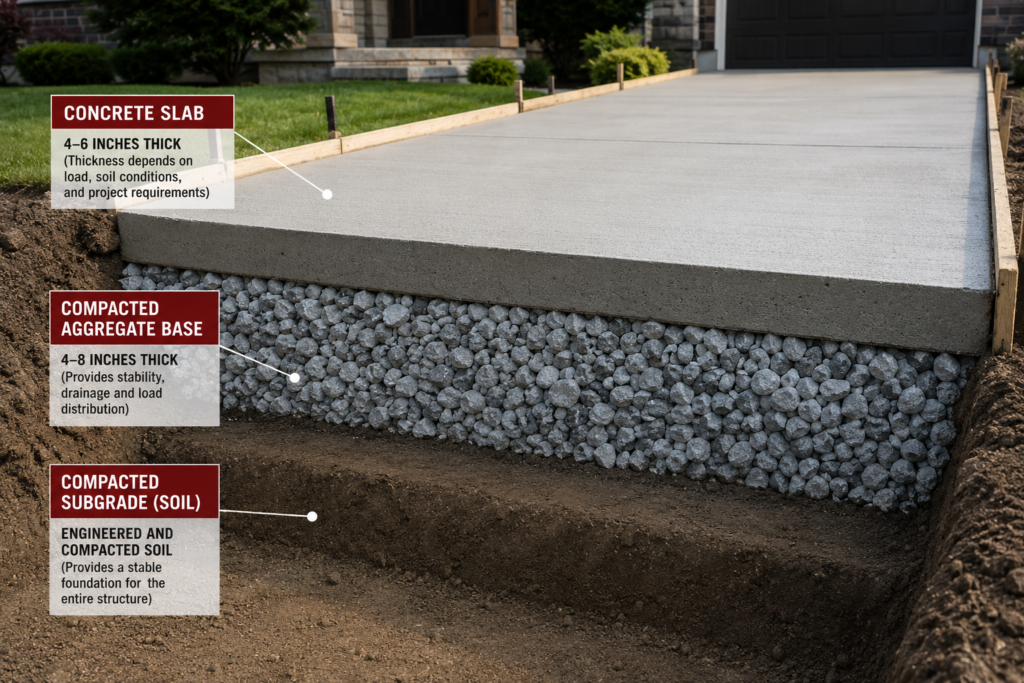
Concrete slab thickness is just the depth of the poured concrete itself, the 4 to 6 inches we’ve been talking about.
Total excavation depth includes the concrete plus everything underneath it: the compacted aggregate base, and sometimes additional layers depending on soil conditions. That combined depth is often somewhere in the range of 8 to 12 inches or more once you add the base material below the slab, though the exact number depends on your specific site.
A simple way to picture it, if you were looking at a cross-section cut straight down through the driveway:
Top layer: the finished concrete slab (4–6 inches). Middle layer: compacted aggregate or gravel base (several inches, varies by site). Bottom layer: the compacted natural soil, or subgrade, that everything else rests on.
Knowing the difference matters when you’re comparing quotes or reading about driveway specs online, since “how deep” and “how thick” get used interchangeably even though they’re describing different parts of the system.
Does Reinforcement Change the Required Thickness?
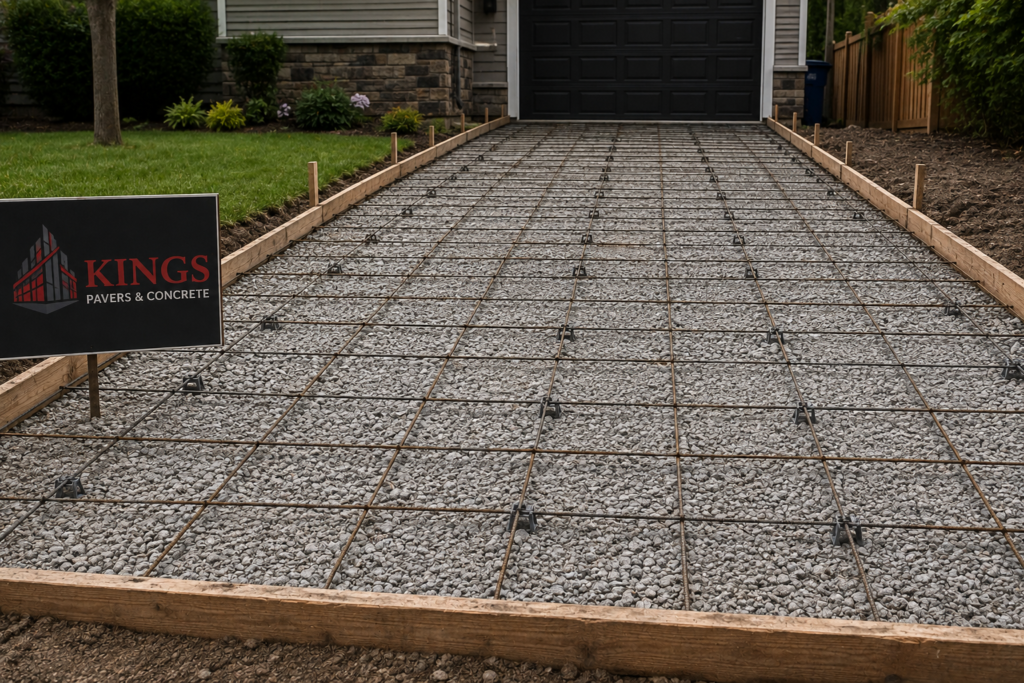
Reinforcement steel rebar, welded wire mesh, or synthetic fiber mixed into the concrete helps control cracking and improves how the slab handles stress across joints and edges. What it doesn’t do is make up for a slab that’s too thin or a base that wasn’t prepared properly. I’ve had homeowners ask if adding rebar to a 3-inch pour would make it as strong as a 4-inch pour without reinforcement, and that’s not really how it works. Reinforcement improves performance within a given thickness; it’s not a substitute for adequate thickness in the first place.
Fiber reinforcement, mixed directly into the concrete, helps reduce surface cracking and is common on residential driveways. Rebar or wire mesh placed within the slab provides more structural reinforcement and tends to show up on driveways expecting heavier loads or where engineering specs call for it. Which option makes sense for a given driveway is worth discussing directly with your contractor, since it depends on the specifics of the project.
How New York Weather Affects Concrete Driveways
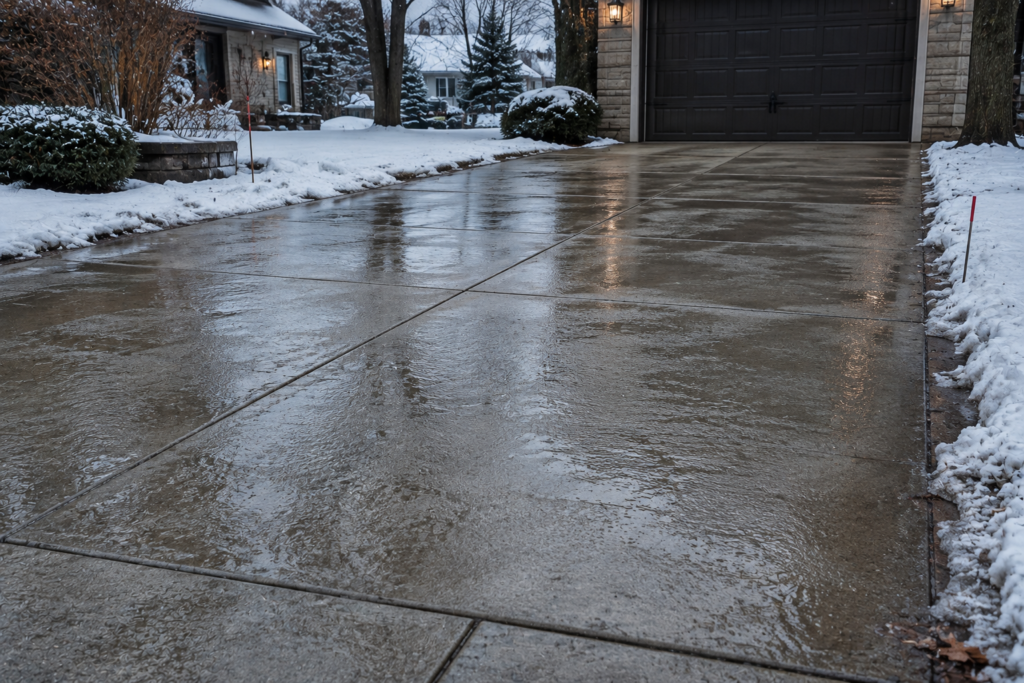
New York winters are hard on concrete, and it’s worth understanding why, because it changes some of the decisions around a driveway project.
Freeze-thaw cycles are the big one. Water gets into small cracks or the pores of the concrete, freezes, expands, and puts pressure on the surrounding material. Do that dozens of times over a winter, year after year, and you get spalling, surface flaking, and cracks that widen over time. This is why air-entrained concrete, a mix with tiny, intentionally created air bubbles, is generally recommended for exterior concrete in this climate. Those air bubbles give freezing water somewhere to expand into instead of pushing against the concrete itself.
Snow and ice bring their own issues. Plowing can scrape and chip a surface that isn’t finished or cured properly, and deicing salts, especially in that first year after a pour, can accelerate surface damage on new concrete. A lot of contractors recommend avoiding traditional rock salt on a brand-new driveway for at least the first winter and using sand or a concrete-safe deicer instead.
Drainage ties back into all of this. Water that pools on or near a driveway is water that’s going to freeze there. Proper grading, so water moves away from the slab rather than sitting on it, reduces how much of this freeze-thaw stress the concrete actually has to deal with.
Seasonal ground movement is the last piece. Soil expands and contracts with moisture and temperature, and that movement transfers to whatever’s built on top of it. A well-prepared base with good drainage handles this far better than a base that traps water.
None of this means you have to over-build every driveway in the state. It means that in this climate, getting the mix design, base prep, and drainage right often matters as much as adding another inch of concrete, sometimes more.
Residential vs. Commercial Concrete Driveway Thickness
| Factor | Residential Driveway | Commercial Driveway |
| Typical traffic | Passenger cars, occasional visitors | Frequent vehicle turnover, delivery trucks, customer traffic |
| Vehicle weight | Generally under 6,000 lbs per vehicle | Often includes delivery trucks, forklifts, or heavier equipment |
| Thickness considerations | 4–6 inches depending on use | 6–8 inches or more, project-specific |
| Base preparation | Compacted aggregate base, standard drainage | Often requires a deeper base and engineered drainage design |
| Engineering needs | Usually handled by an experienced contractor | Frequently requires a structural or civil engineer’s input |
Commercial work tends to involve more variables, loading dock traffic, delivery truck axle weights, and expected service life that go beyond what a general thickness guideline can cover. If you’re planning a commercial project, treat any thickness number you read online as a starting point for a conversation with a concrete contractor who can evaluate the actual site and use.
Step-by-Step: How a Contractor Determines Driveway Thickness
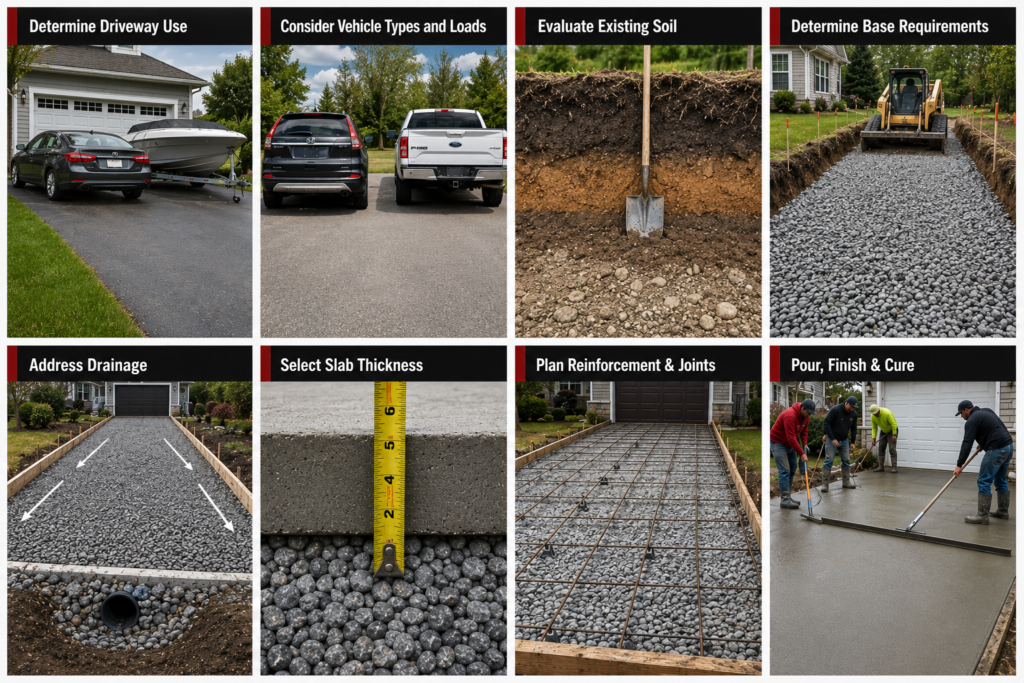
Determine how the driveway will be used. Is this daily use for two cars, or does it also need to handle a boat trailer twice a summer? The answer shapes everything downstream.
Consider vehicle types and loads. Passenger cars, SUVs, and trucks put different amounts of stress on a slab, and how often heavier vehicles use the driveway matters as much as their weight.
Evaluate the existing soil. Some New York properties sit on stable, well-draining soil. Others deal with clay-heavy ground or areas prone to holding water. This affects both the base design and, sometimes, the concrete thickness.
Determine excavation and base requirements. Based on the soil evaluation, a contractor figures out how deep to excavate and what base material and thickness make sense for the site.
Address drainage. Grading and drainage decisions are made before the pour, not adjusted afterward. Where the water goes matters as much as what’s holding the water back.
Select an appropriate slab thickness. With use, vehicle loads, soil, and drainage accounted for, the actual concrete thickness gets specified, often somewhere in that 4 to 6-inch range for residential work, and more for commercial.
Determine reinforcement and joint requirements. Fiber, rebar, or wire mesh gets specified based on the expected loads, and control joints get planned out to manage where cracking happens.
Pour, finish, cure, and protect the concrete correctly. Even a perfectly specified driveway can underperform if it’s finished poorly, cured too fast, or exposed to heavy traffic before it’s ready. This last stretch matters more than people usually expect.
Common Concrete Driveway Thickness Mistakes
Pouring too thin. Sometimes this comes from trying to save on material cost; sometimes it’s just an inexperienced crew not screeding to the right depth consistently.
Inconsistent slab thickness. A driveway that’s 4 inches in one spot and 3 in another has a weak point built right in, and it’s usually the result of an uneven base rather than a deliberate decision.
Weak or poorly compacted base. This is probably the single most common issue I see traced back to driveway failures, not the concrete thickness at all, but what’s underneath it.
Ignoring drainage. A driveway that channels water toward the garage, or lets it pool against the slab edge, is setting itself up for freeze-thaw problems regardless of how thick the concrete is.
Poor joint placement. Control joints that are spaced too far apart, or placed without regard to how the slab will actually crack, lead to random cracking instead of clean, controlled joints.
Allowing heavy traffic too early. Concrete needs time to cure and gain strength. Driving on it, or parking a heavy vehicle on it, before it’s ready can cause damage that shows up down the line.
Assuming more concrete automatically fixes poor preparation. This one comes up a lot. Adding an extra inch of concrete over a bad base is treating the wrong problem.
How to Make a Concrete Driveway Last Longer
Thickness gets a lot of attention, but it’s not the only thing determining how long a driveway lasts. A few things matter just as much:
- Proper base preparation: compacted, stable, and well-drained before anything gets poured
- Correct drainage grading the site so water moves away from the slab
- Appropriate control joints spaced and placed to manage cracking rather than fight it
- Proper curing gives the concrete the time and moisture it needs to reach full strength
- Sealing, when appropriate, a good sealer helps protect against moisture intrusion and deicing salt damage, particularly here in New York
- Crack maintenance: small cracks left unaddressed let water in, which becomes a bigger issue once winter hits
- Snow and ice management using concrete-safe deicers, especially in the first year or two
- Avoiding excessive loads, not parking equipment or heavy vehicles in one spot for extended periods if the driveway wasn’t designed for it
A driveway that gets this kind of ongoing attention will generally outperform a thicker driveway that gets none of it.
Frequently Asked Questions
How thick should a concrete driveway be?
For most residential driveways with cars and light trucks, 4 inches is the standard minimum. Many contractors recommend 5 to 6 inches for heavier vehicles or for added durability in freeze-thaw climates like New York’s.
How thick is a standard residential concrete driveway?
Typically 4 inches, with many homeowners and contractors opting for 5 inches when the driveway sees SUVs, trucks, or regular heavy use.
Is 4 inches thick enough for a concrete driveway?
For standard passenger vehicles over a properly prepared base, yes. It becomes less adequate as vehicle weight, traffic frequency, or soil challenges increase.
Should a driveway be 4 inches or 6 inches thick?
It depends on use. Four inches suit typical car traffic on stable soil. Six inches is more appropriate for heavier vehicles, frequent heavy loads, or areas with poor soil conditions.
How thick should concrete be for heavy vehicles?
Driveways regularly supporting RVs, trucks, or similar loads are commonly built at 5 to 6 inches, sometimes with added reinforcement.
How deep should you excavate for a concrete driveway?
Excavation depth includes both the concrete slab and the compacted base beneath it, often totaling roughly 8 to 12 inches or more depending on soil conditions and site-specific requirements.
Does a thicker concrete driveway last longer?
Thickness helps, but it’s one factor among several. Base preparation, drainage, concrete mix, reinforcement, and proper curing all play a significant role in how long a driveway lasts.
Does a concrete driveway need rebar?
Not always. Many residential driveways use fiber reinforcement instead. Rebar or wire mesh is more common where heavier loads or specific engineering requirements call for it.
How thick should a commercial concrete driveway be?
Commercial driveways are typically 6 to 8 inches or more, but the exact specification is project-specific and usually involves engineering input based on expected vehicle loads.
The Bottom Line
The right concrete driveway thickness depends on how the driveway will be used, the condition of the soil and base, drainage, and the types of vehicles it needs to support. While 4 inches is common for standard residential driveways, heavier vehicles and site-specific conditions may require a thicker slab.
Thickness alone does not determine how well a driveway will perform over time. Proper base preparation, drainage, appropriate reinforcement, joint placement, and correct installation all play an important role. If your existing driveway is cracking, sinking, or showing signs of deterioration, a professional assessment can help determine whether concrete driveway repair or replacement is the more appropriate long-term solution.
Ready to Plan Your Concrete Driveway?
Planning a new concrete driveway in New York or concerned about the condition of your existing one? Kings Pavers & Concrete can evaluate your property, base conditions, drainage, and project requirements to help determine the right approach for your driveway.
Contact Kings Pavers & Concrete today to request an estimate for your concrete driveway project.