
I get this question on almost every job. The crew packs up, the driveway or parking lot looks brand new, and the customer is standing there with their keys in hand asking, “So when can I actually drive on this?”
It’s a fair question. You just paid good money for a fresh asphalt driveway, and naturally you want to use it. But here’s the thing: asphalt doesn’t work like paint. It doesn’t just “dry.” It cures, and that process takes longer than most people expect.
Drying occurs on the surface. Curing is what happens all the way through, as the asphalt slowly hardens and gains its full strength. You can have asphalt that looks dry and solid on day one, but underneath, it’s still soft enough that a car sitting in one spot for too long will leave a permanent dent. I’ve seen it happen more times than I can count.
So let’s walk through what actually matters here: how long to wait, why it matters, and how to protect your new pavement so it lasts as long as it’s supposed to.
Can You Drive on Fresh Asphalt?
Short answer: not right away, and definitely not the same day.
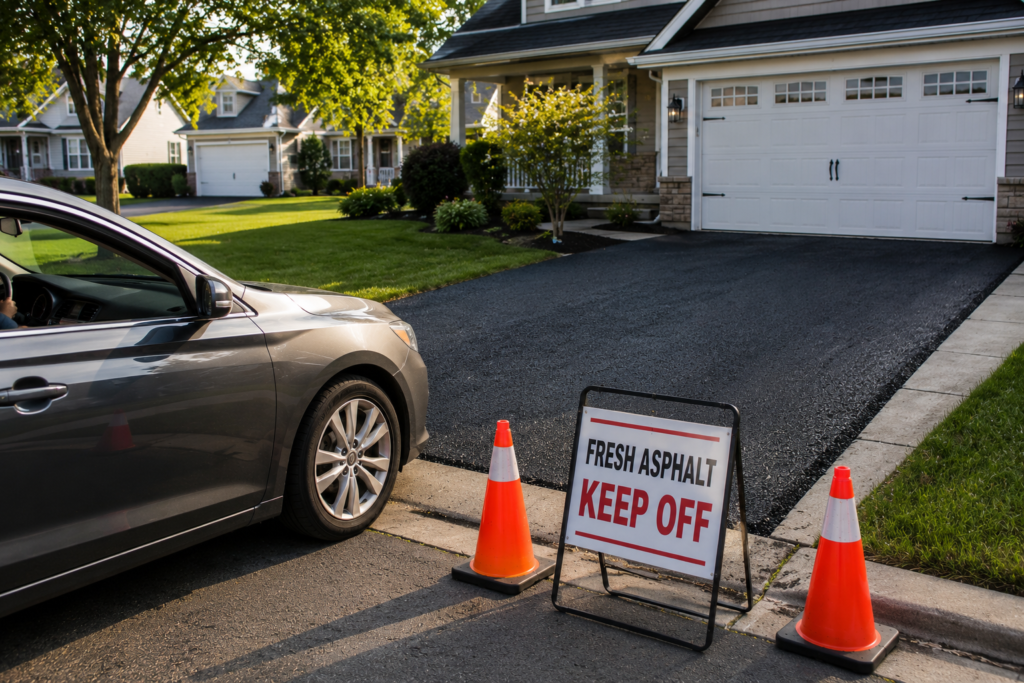
For a typical residential driveway, plan on staying off it completely for at least 24 to 48 hours after installation. That’s the bare minimum. Full curing, where the asphalt reaches its maximum hardness, actually takes anywhere from 6 months to a year, but you don’t need to wait that long to drive on it. You just need to get past the early, vulnerable stage.
The exact waiting period depends on a few things: the asphalt mix your contractor used, the outdoor temperature, how much sun the area gets, and what kind of project it is. A private road or commercial lot that sees heavier vehicles needs more patience than a driveway that just handles a couple of sedans.
Here’s a general breakdown I give my own customers:
| Surface Type | Recommended Waiting Time | Notes |
| Residential driveway | 24–72 hours before driving, 3–5 days before regular use | Avoid parking in one spot during this window |
| Commercial parking lot | 3–5 days minimum before opening to traffic | Line striping usually happens after this period |
| Private road | 5–7 days before regular vehicle traffic | Heavier vehicles need extra curing time |
| Public roadway | 24–48 hours for light traffic, longer for full loads | Municipal specs vary by contractor and mix design |
These numbers assume decent weather. If it’s a scorching July afternoon or a cold, damp October morning, add some extra time. I’ll get into why in a minute.
Why Fresh Asphalt Needs Time to Cure
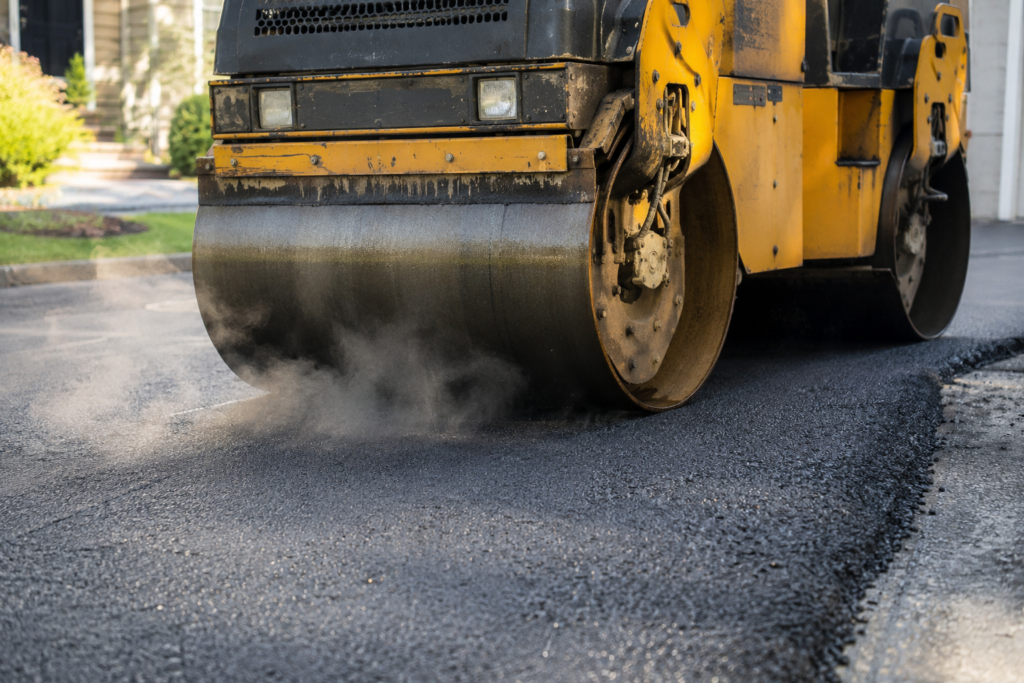
Asphalt is a mix of aggregate (stone, sand, gravel) held together by liquid asphalt cement, which is basically a petroleum-based binder. When it’s installed hot, that binder is soft and workable. As it cools, it starts to firm up; that’s the drying part, and it happens fairly fast, usually within the first day.
Curing is different. It’s a slower chemical and physical process where the asphalt oxidizes and hardens all the way through. During this stage, the pavement is still somewhat flexible. That flexibility is actually a good thing long-term; it’s what lets asphalt handle temperature swings without cracking the way concrete does. But in the short term, it means the surface can still be dented, scratched, or gouged if it’s not treated carefully.
If you drive on it too early, here’s what tends to happen:
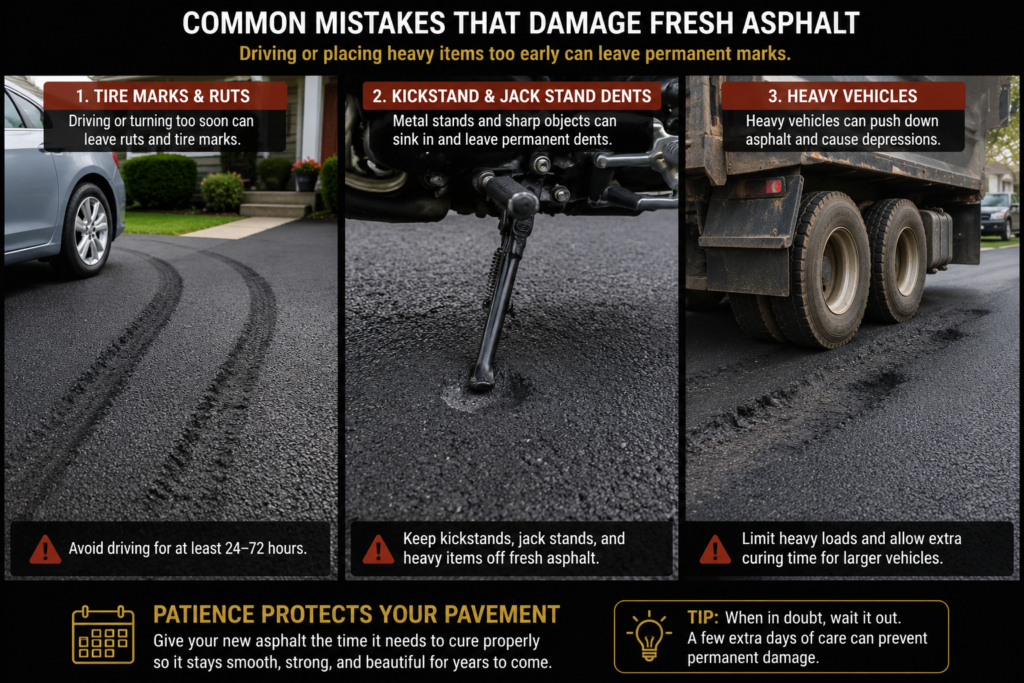
- Tire marks and ruts from vehicles sitting or turning
- Indentations from kickstands, jack stands, or lawn furniture
- Aggregate getting pushed around instead of staying compacted
- Uneven texture that never quite smooths back out
None of this is permanent damage in the sense that it can’t be fixed, but it’s damage you didn’t need to have, and it shows up right where you’ll see it every day for years.
Factors That Affect Asphalt Curing Time
I always tell customers there’s no single number that applies to every job. Curing time moves around based on real conditions on your property.
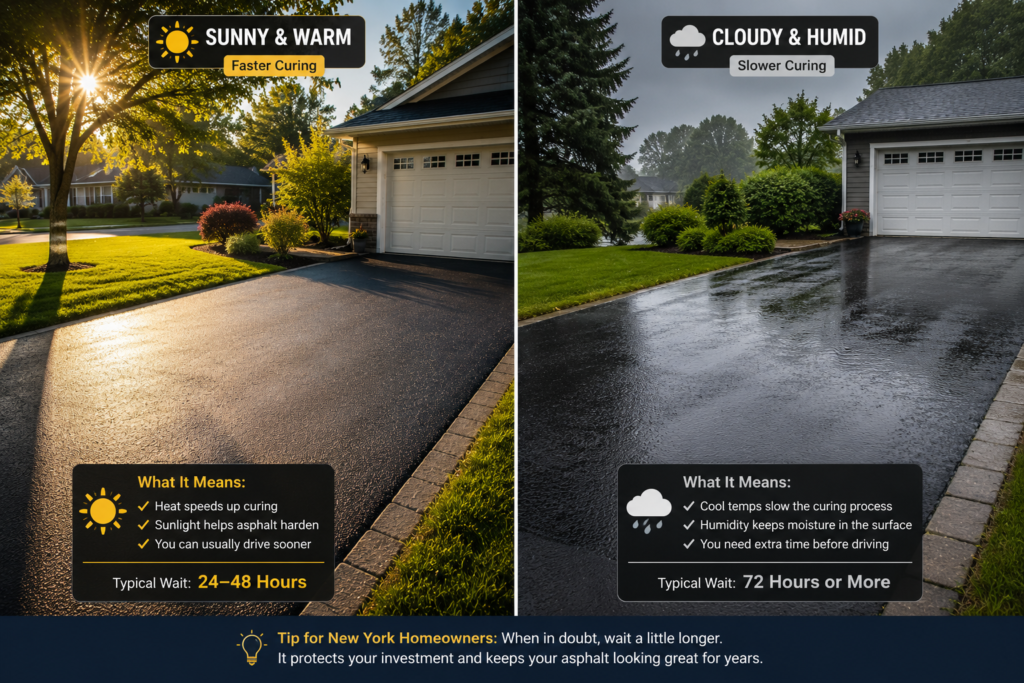
Temperature matters a lot. Warm weather speeds up curing because heat helps the binder oxidize faster. Cold weather slows everything down. I’ve had jobs in late fall where the asphalt stayed soft for close to a week longer than a summer job would have.
Sunlight helps too. A driveway in full sun cures faster than one shaded by a big oak tree or a north-facing wall.
Humidity works against you. Moisture in the air slows the hardening process, which is one reason spring paving in New York can take a little longer than mid-summer work.
Traffic volume is the one people control the most. Heavy or repeated traffic during the early curing window is the fastest way to damage new pavement.
Asphalt thickness plays a role as well. A thicker base layer holds heat longer, which can actually help curing in some cases, but it also means more material needs to harden all the way through.
Seasonal conditions in New York are worth calling out specifically, since our weather swings hard. Humid August days behave differently than crisp October afternoons or a rainy May week. If your asphalt paving in New York happens during a heat wave, don’t be surprised if your contractor tells you the wait is shorter than the fall job your neighbor had.
| Factor | Speeds Up Curing | Slows Down Curing |
| Temperature | Warm, sunny days | Cold or freezing temps |
| Sunlight exposure | Full sun exposure | Heavy shade, tree cover |
| Humidity | Low humidity, dry air | High humidity, damp air |
| Traffic | Light or no traffic | Heavy or repeated traffic |
| Thickness | Thinner overlay | Thick base layers |
| Season | Late spring, summer | Late fall, early spring, winter |
Step-by-Step Guide to Protect New Asphalt
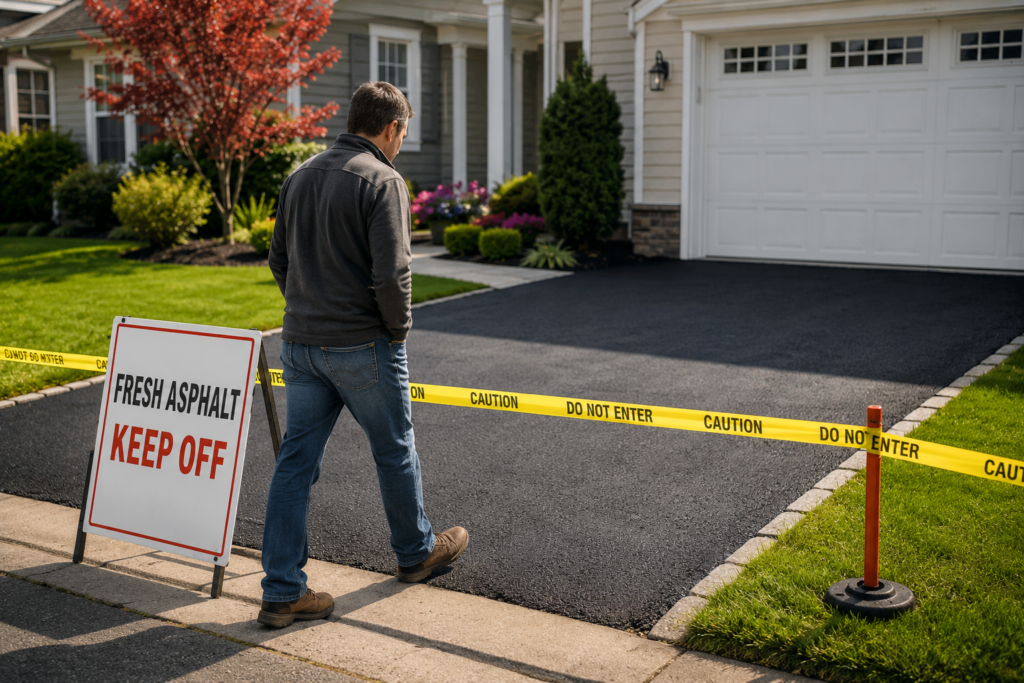
Step 1: Wait the recommended time before driving. Don’t guess. Ask your contractor for the specific window based on your job, and stick to it even if the surface looks ready sooner.
Step 2: Avoid parking heavy vehicles immediately. Passenger cars are one thing. RVs, box trucks, and anything with a lot of axle weight need extra curing time before they sit on the surface.
Step 3: Don’t make sharp turns while stationary. This is the one that catches people off guard. Turning your steering wheel while the car isn’t moving twists the top layer of asphalt and leaves scuff marks or divots, especially in warm weather when the surface is softer.
Step 4: Keep kickstands, ladders, and heavy equipment off the surface. A motorcycle kickstand or a ladder leg concentrates a lot of weight into a tiny point. On fresh asphalt, that’s enough to leave a permanent mark.
Step 5: Sealcoat at the recommended time. Most contractors recommend waiting 6 to 12 months before the first sealcoat application. Sealing too early traps moisture underneath and can actually shorten your asphalt driveway lifespan instead of extending it.
Common Mistakes That Damage Fresh Asphalt
I’ve fixed a lot of driveways that didn’t need fixing if a few simple things had been avoided.
Parking too soon is the number one issue. People get excited, pull in the same afternoon, and end up with tire impressions they’ll notice every time they pull up.
Turning the wheels while parked is a close second. It’s such a normal habit that people don’t even think about it, but on new asphalt it leaves a very visible mark.
Heavy trucks during curing deliveries, moving trucks, and dumpsters put more stress on the surface than it can handle in the first week.
Fuel spills are sneaky. Gasoline and asphalt binder don’t mix well, and a small drip from a lawn mower or a leaking hose can soften and stain the surface long after installation.
Parking in the same spot every day during the first few months keeps that one area from curing evenly compared to the rest of the driveway. I always suggest customers move their parking position around a little for the first couple of months if they can.
How Long Before You Can Park on New Asphalt?
This depends heavily on what you’re parking.
Passenger cars are the lightest and most forgiving. Most driveways can handle light passenger vehicle traffic after about 3 days, assuming reasonable weather.
SUVs aren’t dramatically heavier than cars, but I’d still lean toward the longer end of that 3-to-5-day window.
Pickup trucks, especially larger ones, carry more weight over a smaller tire contact area. Give them an extra day or two beyond what you’d wait for a sedan.
Commercial vehicles need the most patience. Anything with dual rear wheels or a heavy payload should stay off for at least a week, sometimes longer depending on the mix and weather.
Delivery trucks are a common problem for both homeowners and businesses, since they show up on their own schedule. If you know a delivery is coming, it’s worth calling the driver ahead of time and asking them to park on the street instead of your new lot for the first week.
Case Study
A homeowner in Westchester County had her driveway repaved in early June. It was a full tear-out and repave, about 800 square feet, done over two days. The crew finished on a Thursday afternoon, and like most people, she asked the same question everyone asks: can I drive on it this weekend?
We told her to hold off completely through the weekend and wait until Monday evening before pulling a car onto it, and to avoid parking in the same spot for the first month. She also had a delivery scheduled for that Friday, so she called the company and had them leave packages at the curb instead of pulling into the driveway.
She followed the plan. No tire marks, no ruts, no scuffing from turning wheels. Eight months later, when we came back to apply the first sealcoat, the surface was in great shape, even coloring, no dents, no soft spots. That’s really the whole story with fresh asphalt. It’s not complicated. It just takes a little patience early on.
Expert Insight
“The single biggest mistake I see is people treating day one like it’s just a normal driveway again. It’s not. That first week is when almost all the damage happens, and almost all of it is preventable. If customers just wait the time we tell them and avoid turning their wheels while parked, the driveway holds up beautifully for years.”
Tips to Extend the Life of Your Asphalt Driveway
Regular cleaning keeps debris, leaves, and standing water from breaking down the surface over time. A simple hose-down a few times a year does most of the work.
Sealcoating every 2 to 3 years protects against UV exposure, oil, and water penetration, and it keeps that fresh black color longer.
Crack repair matters more than people think. A hairline crack left alone lets water underneath, and once water gets under asphalt in a New York winter, freeze-thaw cycles turn small cracks into big ones fast.
Drainage should be checked every season. Water pooling on your driveway is one of the fastest ways to shorten its lifespan.
Seasonal maintenance, clearing snow with a plastic-edged shovel instead of metal, avoiding harsh de-icing chemicals, and checking the surface each spring goes a long way toward protecting your investment.
Frequently Asked Questions
Can you drive on a freshly paved road?
Not immediately. Most residential driveways need at least 24 to 72 hours before any driving, and longer for commercial lots or private roads.
How long should I wait before driving on new asphalt?
Plan on 2 to 3 days for light-vehicle traffic and up to a week for heavier vehicles or larger paving projects.
What happens if I drive on asphalt too early?
You risk tire marks, ruts, and surface indentations, especially from turning the wheel while the vehicle is stationary.
Can I park on fresh asphalt overnight?
It’s best to avoid it during the first few days. Overnight parking concentrates weight in one spot for hours, which can leave impressions before the asphalt has hardened enough.
Does hot weather affect asphalt curing?
Yes. Warm, sunny weather generally speeds up curing, while cold or humid conditions slow it down.
How can I protect a new asphalt driveway?
Wait the recommended time before driving, avoid sharp turns while parked, keep heavy equipment off the surface, and hold off on sealcoating until the asphalt has fully cured.
Conclusion

Fresh asphalt just needs a little patience. Give a residential driveway a few days, give commercial lots and private roads a bit longer, and pay attention to the weather along the way. Avoid turning your wheels while parked, keep heavy vehicles off it early on, and hold off on sealcoating until the driveway has had time to properly cure.
Do that, and you’ll get the full asphalt driveway lifespan you’re paying for: a smooth, solid surface that holds up through New York winters and summers alike for years to come.
If you’re planning a new installation, dealing with a driveway that’s already showing wear, or want a professional opinion on your current pavement, reach out for an asphalt installation, inspection, or maintenance consultation. It’s a lot easier to protect a driveway from the start than to fix one after the fact.