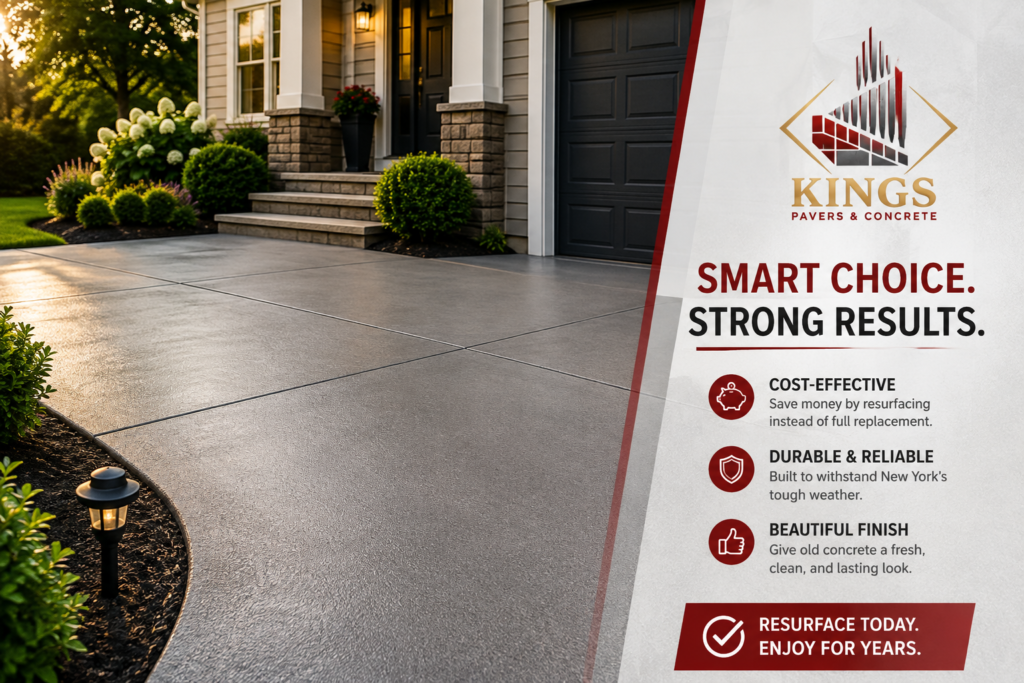
Yes, you can pour new concrete over existing concrete, but only if that old slab earns the privilege. A driveway with light surface wear and no real structural problems is often a good candidate. A driveway with a two-inch height difference across a crack, or one that’s been heaving every spring for years, usually isn’t. The concrete underneath doesn’t just sit there quietly once you cover it. Whatever problems it has tend to show up again, and sometimes faster than homeowners expect.
If you’re standing on an old patio or driveway in New York right now, trying to decide whether it’s worth saving, here’s what actually goes into that decision.
Can You Pour Concrete Over Existing Concrete?
Technically, yes. Contractors do it all the time, and there’s nothing unusual about adding a new layer of concrete on top of an old slab. The real question isn’t whether it’s possible; it’s whether it’s the right call for your specific slab.
Here’s the distinction that matters: pouring fresh concrete over an existing slab is different from what most people mean when they say “resurfacing” or “overlaying.” A true concrete overlay is a thin, specialized layer, often somewhere between a fraction of an inch and a couple of inches, designed specifically to bond to old concrete and give it a new wearing surface. Pouring a full-depth slab on top of an existing one is a heavier undertaking, and it comes with its own set of clearance and elevation issues around doors, garage openings, and drainage.
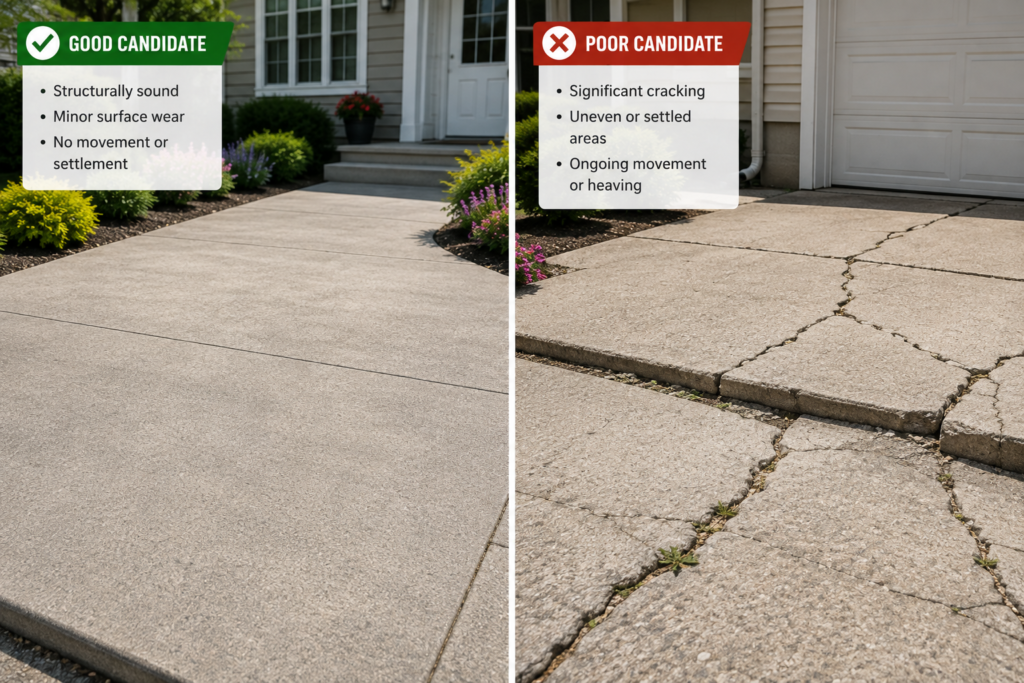
Both approaches depend on one thing above everything else: the existing slab needs to be structurally sound. Not perfect. Not crack-free. Just sound enough that it isn’t actively moving, settling, or failing underneath whatever gets placed on top of it.
Cosmetic damage: surface scaling, discoloration, shallow spalling, hairline cracks that have stopped moving – those are usually fine to build over. Structural problems are a different story, and covering them up rarely makes them go away.
When Is Pouring Over Existing Concrete a Good Idea?
A patio that’s held up fine for fifteen years but looks tired and pitted on the surface is a textbook case for resurfacing. So is a walkway with some staining and minor scuffing, or a basement floor that’s structurally solid but visually rough.
Driveways are a little more situational. If the slab is level, drains properly, and the cracking is limited to hairline stuff that isn’t shifting, an overlay can extend its life and improve how it looks without the cost of tearing everything out. The trouble comes when a driveway has been patched repeatedly over the years, or when one section has settled lower than the rest. At that point, you’re not resurfacing a problem; you’re hiding it.
Commercial properties see this question a lot too, especially older parking areas, loading zones, and walkways around retail buildings. If the base underneath is still stable and the slab isn’t tracking any drainage or settlement issues, resurfacing can be a reasonable way to refresh a worn surface without shutting down a lot of the property for demolition.
The common thread across all of these situations is stability. Surface wear is something an overlay was built to solve. Movement is not.
When Should You NOT Pour Concrete Over Existing Concrete?
Some warning signs should stop the conversation before it starts.
Major cracks the kind wider than a pencil line, or ones where you can feel a lip between one side and the other usually point to something happening below the surface, not on it. Uneven settlement is another one. If part of a slab has sunk relative to the rest, that’s a base problem, and a new layer of concrete on top isn’t going to correct the grade or stop it from continuing to settle.
Heaving is its own category, and it’s common enough in this region that it deserves its own mention below. Drainage problems matter too if water already pools against a slab or runs toward a foundation instead of away from it, adding material on top can make the pitch worse, not better.
An unstable base is probably the least visible of these issues and the most important. Concrete only performs as well as what’s underneath it. Voids, washed-out soil, or a base that was never compacted properly will eventually cause new concrete to crack in the same spots as the old, no matter how well the surface work was done.
The practical point here is simple: a crack or movement problem in the old slab doesn’t stay contained. Left alone, it tends to reflect whatever gets placed on top, sometimes within a year or two, sometimes longer. Covering a problem isn’t the same as solving it.
Concrete Resurfacing vs. Concrete Replacement
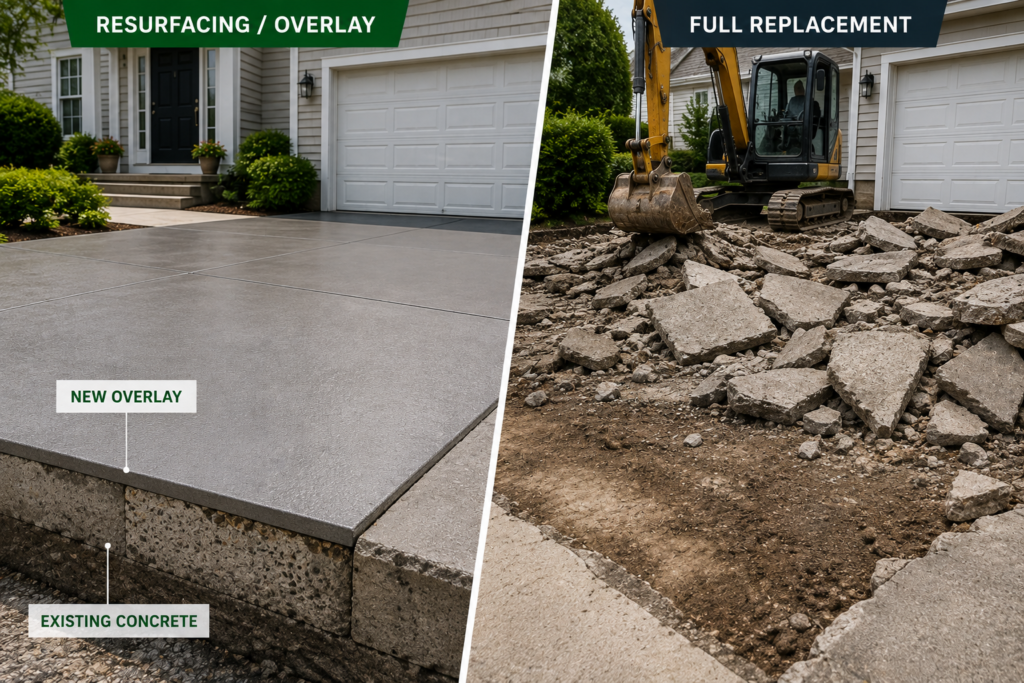
| Factor | Resurfacing/Overlay | Full Replacement |
| Existing slab condition | Structurally sound, cosmetic or surface-level wear | Cracked, settled, heaving, or base is compromised |
| Typical use | Patios, walkways, some driveways, interior floors, commercial surfaces in stable condition | Driveways with major cracking, slabs with drainage or settlement failure |
| Preparation required | Cleaning, crack treatment, bonding agent, surface profiling | Demolition, disposal, base regrading and compaction |
| Disruption | Lower often a shorter project timeline | Higher full excavation and rebuild |
| Appearance options | Stamping, staining, broom or trowel finishes, similar to new concrete | Full design flexibility since it’s built from scratch |
| Best suited for | Slabs with wear, staining, or minor stable cracking | Slabs with structural, drainage, or base problems |
| Main limitation | Can’t fix what’s happening underneath the slab | Higher cost and more disruption to the property |
How Contractors Decide Whether Existing Concrete Can Be Resurfaced
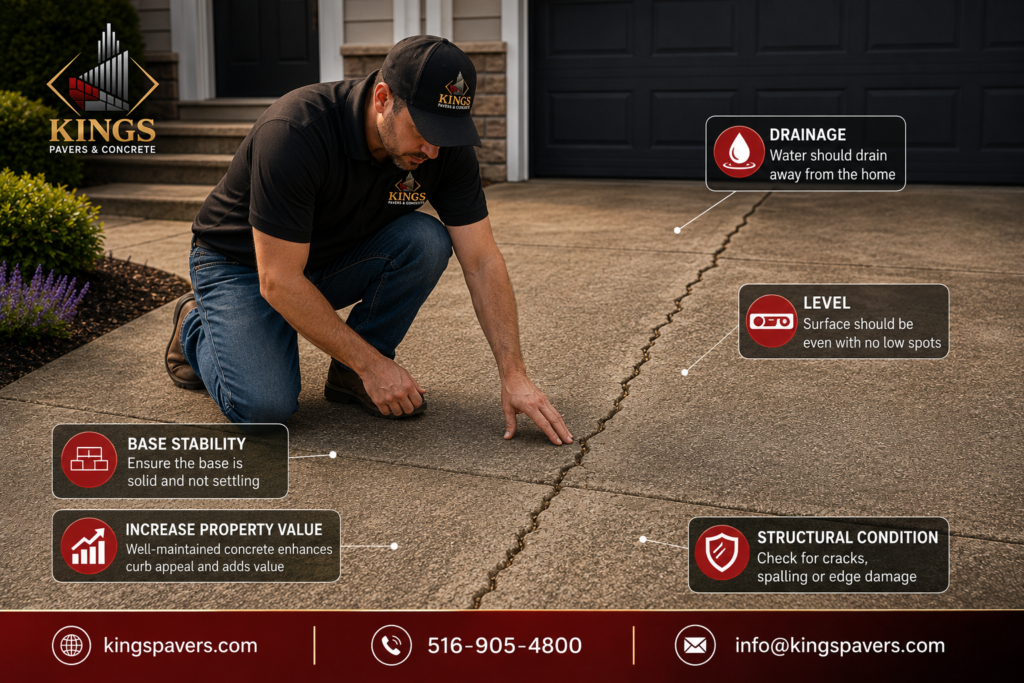
A contractor evaluating a slab isn’t just glancing at the surface. They’re reading it.
Crack patterns tell a story. A single hairline crack that hasn’t widened in years reads very differently than a spiderweb pattern radiating from one corner, which often points to a base or drainage issue. Settlement gets checked by eye and sometimes with a level to see if one section is lower than the section next to it, and if so, by how much.
Drainage gets walked, not just looked at. Where does water go when it rains? Does it pool anywhere, and does that pooling sit against a foundation wall, a garage slab, or a door threshold? Surface deterioration, scaling, spalling, and exposed aggregate get checked for depth, since shallow damage behaves very differently from damage that’s eaten several inches into the slab.
Base stability is harder to see but easy to feel. A contractor will often walk the slab and note any soft spots, hollow-sounding areas, or sections that flex slightly underfoot.
Then there’s the part homeowners tend to forget about: height and clearance. Adding even an inch of material changes where a slab meets a door threshold, a garage opening, or a set of steps. Slope matters for the same reason if the existing pitch already carries water away from the house, an overlay needs to preserve that pitch, not flatten it out. Anything built up against a foundation wall, a fence post, or an adjoining walkway needs to be checked so the new surface doesn’t create a trip hazard or redirect water somewhere it shouldn’t go.
How to Pour or Resurface Concrete Over Existing Concrete
Step 1: Inspect the Existing Slab
Everything starts here. A contractor walks the slab, checks cracks, settlement, drainage, and base condition before recommending anything. This step decides whether the rest of the process even makes sense.
Step 2: Repair Appropriate Damage
Cracks that have stabilized get routed and filled. Spalled or crumbling areas get patched. The goal isn’t a perfect surface; it’s a stable one that won’t keep moving after the new material goes down.
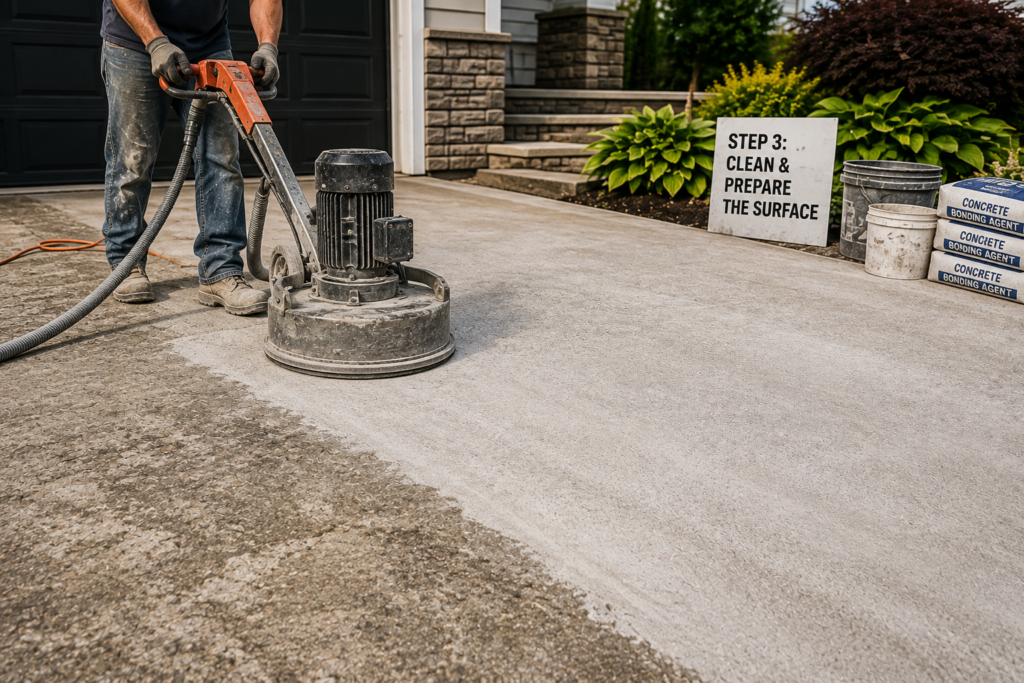
Step 3: Clean and Prepare the Surface
Dirt, oil, old sealers, and loose material all interfere with bonding. Surfaces typically get pressure-washed and, in many cases, mechanically profiled- think grinding or shot blasting- so the new layer has something to grip onto.
Step 4: Address Bonding Requirements
Fresh concrete doesn’t naturally stick to old, cured concrete on its own. A bonding agent is usually applied to help the new layer chemically and mechanically attach to the old surface, which is part of what separates a proper overlay from just pouring wet concrete on top of dry concrete and hoping for the best.
Step 5: Plan Thickness, Elevation and Drainage
This is where the door threshold, garage transition, and existing slope all get factored in. The finished thickness has to work with the surrounding structures, not against them, and the pitch has to keep water moving away from the building.
Step 6: Place the Overlay/New Concrete
The material gets placed, screeded, and worked to the planned thickness and slope. Depending on the product and the application, this might be a specialty polymer-modified overlay or a heavier standard mix, depending on what the project calls for.
Step 7: Finish and Cure It Properly
Finishing determines the texture and appearance broomed, troweled, stamped, whatever fits the project. Curing determines whether that finish actually holds up. Rushed curing is one of the more common reasons overlays fail early, particularly in variable New York weather.
Why Surface Preparation Matters
This is the step that gets skipped most often, and it’s usually the one that decides whether an overlay lasts five years or twenty.
New concrete needs a clean, sound surface to bond to. Dirt, oil stains, old sealers, paint, or efflorescence sitting on top of the old slab will sit between the two layers like a barrier, and no bonding agent works well over contamination. Loose or crumbling material creates a weak layer that the new concrete has nothing solid to grab onto it might look fine on day one and start delaminating within a season or two.
Existing coatings are a particular problem because they’re not always obvious. A slab that was sealed years ago might look clean but still have a film on it that keeps new material from properly bonding. This is part of why a professional evaluation, rather than a quick visual check, tends to catch issues homeowners wouldn’t think to look for.
How New York Weather Affects Concrete Resurfacing
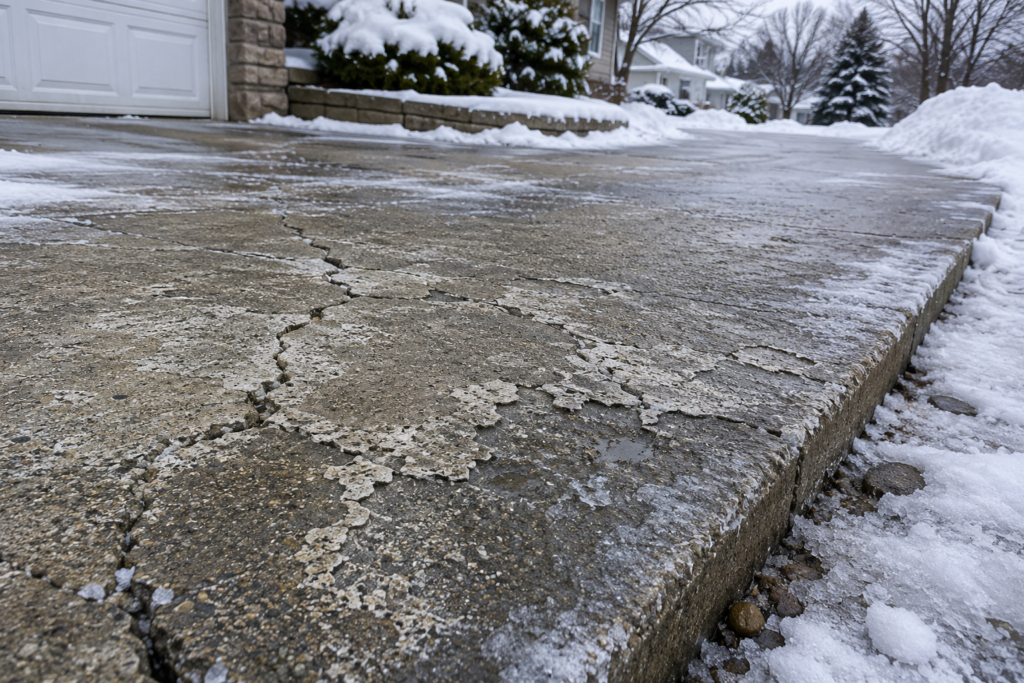
New York’s climate isn’t a footnote in this decision; it’s one of the bigger factors in whether a resurfaced slab holds up.
Freeze-thaw cycles are the main issue. Water gets into small cracks or porous surface areas, freezes, expands, and pushes the concrete apart from the inside. This happens repeatedly over a winter, and it’s a big part of why concrete that looked fine in the fall can look noticeably worse by spring. If moisture is already getting into an old slab through cracks or a porous surface, resurfacing over it without addressing that moisture path can trap the same freeze-thaw cycle underneath the new layer.
Snow and ice management adds another layer to it. Deicing salts, especially some of the harsher chloride-based products, can accelerate surface scaling on concrete that isn’t sealed or isn’t holding up well to begin with. This matters for older slabs that have already seen years of winter salt exposure, since that history plays into how well they’ll take a new overlay.
Drainage ties back into all of this. A slab that holds water rather than sheds it gives that water more time to seep into cracks before winter hits. And timing matters for the work itself. Concrete needs the right temperature range to cure properly, which is why resurfacing projects in this region are typically planned for warmer months rather than squeezed in during late fall or winter.
None of this means resurfacing doesn’t work in New York. It means the prep work and timing carry more weight here than they would in a milder, more consistent climate.
What Can Cause a Concrete Overlay to Fail?
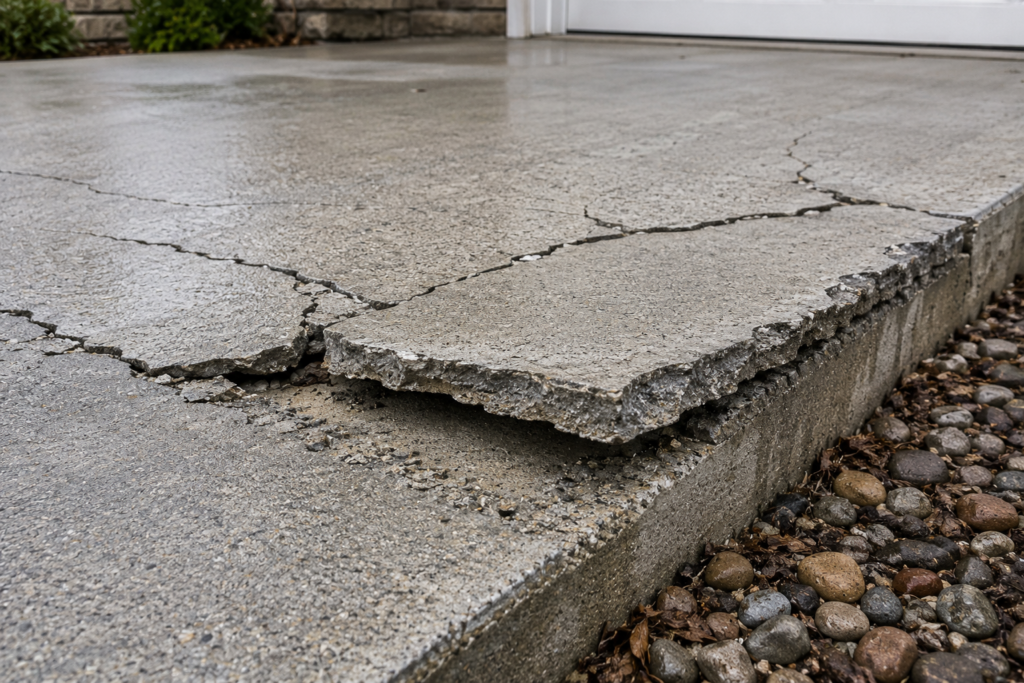
Most overlay failures trace back to a handful of avoidable mistakes.
Covering a badly damaged slab is the big one. Resurfacing a slab that should have been replaced usually just delays the problem and adds a layer of cost on top of it. Ignoring drainage is close behind; if water was already pooling or draining toward the house before the overlay, it usually still will be after.
Poor surface preparation shows up as delamination, the new layer separating from the old, sometimes in sheets, sometimes as isolated bubbles or hollow-sounding spots. Incorrect application, like the wrong thickness for the product being used, can lead to cracking that has nothing to do with the original slab at all. Existing slab movement, if it wasn’t caught during inspection, will typically telegraph through the new surface as a matching crack within a year or two. Improper curing, not keeping the surface protected and appropriately moist during the curing window, often leads to a weak, dusty, or cracked finish regardless of how well everything else was done.
Homeowners can watch for a few things after the fact: hollow sounds when tapping the surface, hairline cracks appearing in the same location as old ones, or edges that seem to be lifting or peeling. Any of those are worth a follow-up look sooner rather than later.
Example Scenario
To make this more concrete (no pun intended), here are two hypothetical New York properties that illustrate how this decision typically plays out.
Property A is an older backyard patio, poured about eighteen years ago. The surface has some staining, a bit of pitting from years of weather, and one hairline crack near a corner that hasn’t changed in years. The base underneath is stable, drainage is fine, and nothing is settling. This is a strong candidate for resurfacing. The slab is doing its job; it just looks tired.
Property B is a driveway with a different history. There’s a crack running diagonally across the middle with a noticeable height difference on either side; one corner has clearly sunk relative to the rest, and water pools near the garage after heavy rain. In this case, resurfacing would be covering up problems that are still active. Replacement, including fixing the base and regrading for drainage, is the more realistic path here.
Every property is different, and these two examples aren’t meant to cover every situation. They’re meant to show that the same question, resurfaced or replaced, can have two completely different answers depending on what’s actually going on underneath the surface.
Questions to Ask Before Resurfacing Existing Concrete
Before calling a contractor, it helps to walk your own slab and think through a few things:
- Is the slab moving, sinking, or noticeably uneven in any section?
- Does water drain away from the house, or does it pool anywhere?
- Are the cracks stable, or have they gotten wider or longer recently?
- Has any part of the slab settled compared to the rest?
- Will added height create a clearance problem at a door, garage, or step?
- What’s the slab actually used for, and does that affect how thick the new layer needs to be?
- How long do you realistically expect the resurfaced area to last?
Having answers or at least observations ready for these questions makes the contractor’s evaluation faster and gives you a better sense of whether resurfacing is even on the table.
Frequently Asked Questions
Can you pour concrete over existing concrete?
Yes, in many cases. It depends on whether the existing slab is structurally sound, free of major cracking, settlement, or base problems, rather than simply whether concrete is already there.
How thick does concrete need to be over existing concrete?
It varies quite a bit depending on the product and the application. Thin decorative overlays can be a fraction of an inch, while a full new layer poured over an old slab is typically several inches. The right thickness depends on the intended use, the condition of the base, and the specific overlay material a contractor recommends.
Will new concrete bond to old concrete?
Not on its own. Fresh concrete needs proper surface preparation and, in most cases, a bonding agent to adhere reliably to cured concrete. Skipping this step is one of the more common reasons overlays fail early.
Can you pour concrete over a cracked driveway?
Sometimes, if the cracks are stable and not tied to settlement or an unstable base. Active cracking, significant height differences across a crack, or ongoing movement usually mean the driveway needs repair or replacement rather than a straightforward overlay.
Is concrete resurfacing cheaper than replacement?
Resurfacing is generally less expensive and less disruptive than full replacement, since it avoids demolition and base rebuilding. That said, the actual cost depends on the size of the area, the condition of the existing slab, and the type of overlay used.
How long does resurfaced concrete last?
A well-prepared overlay on a sound slab can last many years, but the lifespan depends heavily on surface preparation, the product used, and how the slab is maintained afterward, especially through New York winters.
Can you resurface concrete damaged by New York winters?
Often, yes, if the underlying slab is still structurally sound. Freeze-thaw damage that’s limited to the surface, scaling, minor spalling, is a reasonable candidate for resurfacing. Deeper freeze-thaw damage tied to moisture infiltration or base movement usually needs to be addressed first.
Every concrete slab is different, and the right solution depends on its current condition. If you’re deciding between resurfacing and replacing a driveway, patio, or walkway in New York, Kings Pavers & Concrete can inspect the existing surface and help you understand your options.
Not sure whether to resurface or replace your concrete? Call Kings Pavers & Concrete at 516-905-4800 today to schedule an on-site evaluation.