Most property owners don’t notice sidewalk problems until they’ve already been living with them for a while. Maybe it’s a hairline crack near the property line that’s been there since spring. Maybe it’s a corner slab that’s started to crumble at the edge. Or maybe someone tripped over a spot where one slab sits half an inch higher than the next, and now you’re looking at it differently.
That’s usually how it starts. A small, easy-to-ignore flaw that sits there quietly getting worse, especially once winter hits. New York’s freeze-thaw cycles, heavy foot traffic, and aging concrete infrastructure mean that sidewalk damage rarely stays the same size for long. What looks minor in October can turn into a real trip hazard and a real liability by the following spring.
This guide walks through the sidewalk problems New York property owners run into most, what’s usually behind them, and how to tell the difference between something you can patch and something that needs to come out and be poured again.
What Causes Sidewalk Damage in New York?
Concrete sidewalks don’t fail for no reason. There’s almost always an underlying cause, and figuring out that cause is half the battle when you’re trying to fix a damaged sidewalk for good instead of patching it every couple of years.
Freeze-thaw cycles are probably the single biggest factor in this region. Water gets into small cracks or pores in the concrete, freezes, expands, and pushes the surrounding material apart. It happens again with the next freeze. Over a winter with several freeze-thaw swings, that repeated expansion does real damage, even to concrete that looked fine the previous fall.
Water infiltration and poor drainage go hand in hand with that. If water is pooling against a slab instead of running off, it’s sitting there working its way into the concrete every time the temperature drops. A downspout dumping water right next to a sidewalk edge, or a yard that slopes toward the walkway instead of away from it, will accelerate damage in that exact spot year after year.
Tree roots are everywhere in New York’s older residential neighborhoods, and they don’t stop growing just because there’s concrete in the way. As roots thicken beneath a slab, they push it upward unevenly, which is why you’ll often see raised sidewalk slabs concentrated near mature street trees.
Soil settlement does something similar in reverse. If the base beneath a slab wasn’t compacted properly, or if it shifts over time, sections can sink instead of rise. Heavy loads, delivery trucks parked on a sidewalk apron, dumpsters left in one spot too long, put stress on concrete that wasn’t built for that kind of weight.
Deicing salts are worth calling out specifically because so many property owners don’t connect them to the damage they see later. Salt lowers the freezing point of water sitting on the concrete’s surface, which sounds helpful, but the chemical reaction and the extra freeze-thaw cycling it triggers actually accelerate scaling and pitting on the surface.
And then there’s simple age. A lot of New York sidewalks are decades old. Concrete has a service life, and once it’s past it, cracking and crumbling become more of a when than an if, especially in sections that got a rushed or poor-quality installation in the first place.
Common Types of Sidewalk Damage and How to Fix Them
Not all damage is created equal. Some of it is cosmetic. Some of it is a warning sign of something happening below the surface. Here’s how to tell the difference.
1. Hairline and Surface Cracks
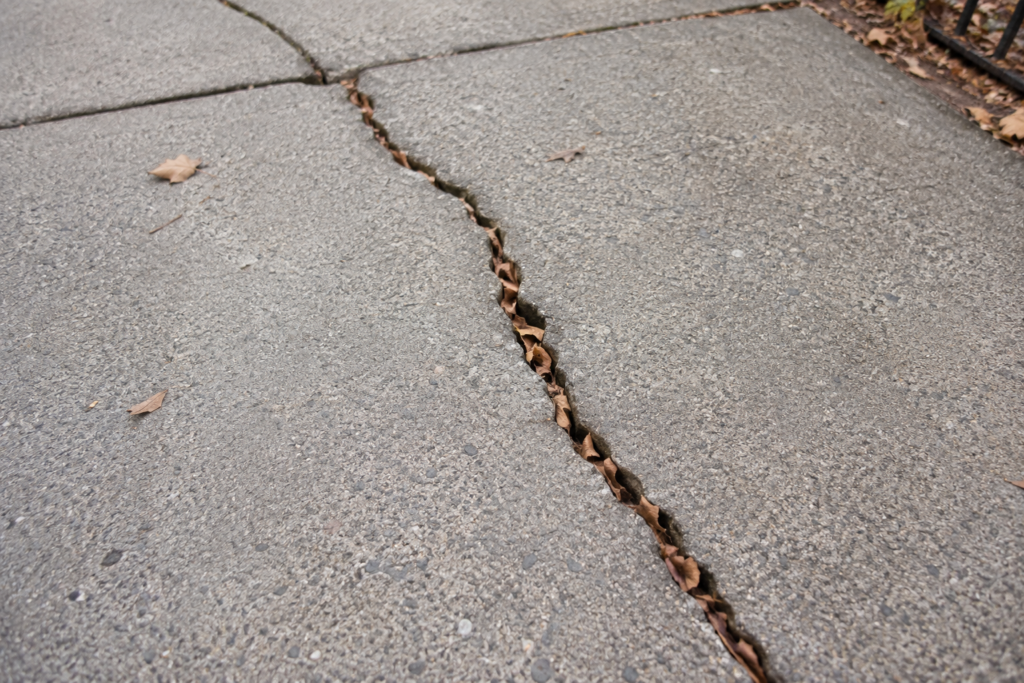
These are the thin cracks, often less than an eighth of an inch wide, that show up on the surface of a slab. They’re usually caused by normal concrete shrinkage as it cures, minor surface stress, or the early effects of freeze-thaw cycling.
In most cases, hairline cracks are cosmetic. They don’t go through the full depth of the slab, and they’re not moving or widening. If a crack has stayed the same size for a year or two and there’s no vertical offset at either edge, it’s usually not urgent.
The problem is when a hairline crack starts widening, multiplying, or running toward an edge or joint. That can mean it’s connected to something underneath: settlement, root pressure, or water working into the slab. A simple concrete crack filler or sealant handles the cosmetic version. If it keeps coming back in the same spot, that’s a sign to look deeper rather than just refilling it again.
2. Wide or Deep Cracks
Once a crack opens beyond about a quarter inch, or you can see it runs through the full thickness of the slab, it’s a different situation than a surface crack. Wide cracks usually mean the concrete has actually separated, not just shrunk, which points to movement from a root, from settling soil, or from water erosion beneath the slab.
Patching a wide crack without addressing its cause tends to be a short-term fix. The patch material bonds to the edges of the existing crack, but if the ground underneath is still shifting, the crack or a new one right next to it comes back within a season or two. For wide or deep cracking, it’s worth having someone check what’s happening below the slab before deciding whether a repair will actually hold.
3. Uneven or Raised Sidewalk Slabs
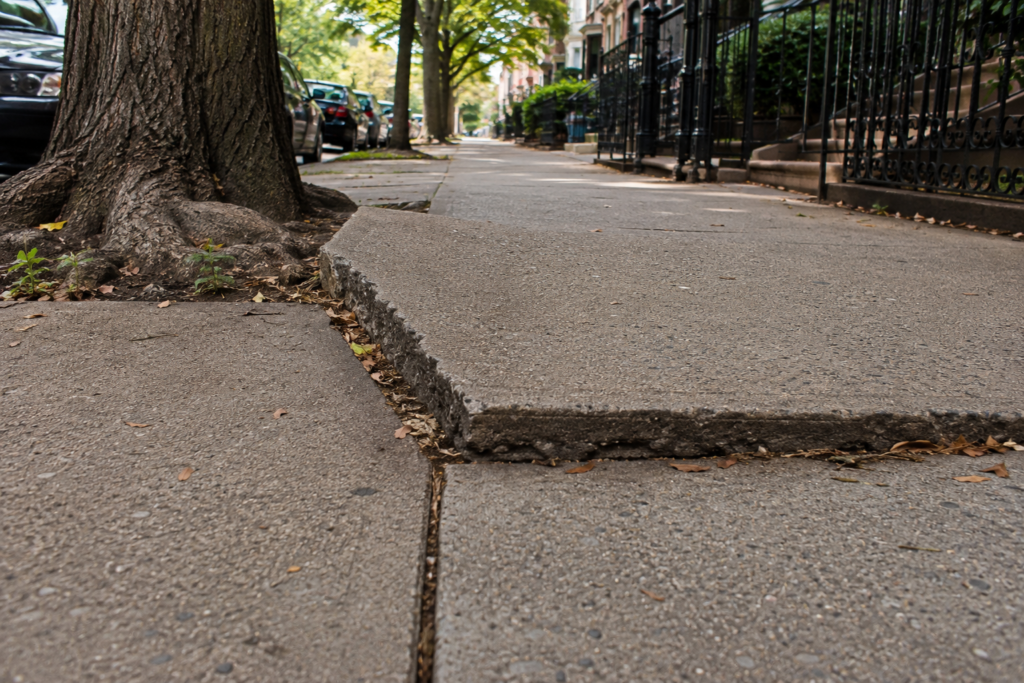
This is one of the most common calls property owners deal with, and it’s almost always caused by one of three things: tree roots pushing up from below, soil settlement causing one slab to sit lower than its neighbor, or general ground movement over time.
An uneven sidewalk is also one of the more serious issues from a liability standpoint, because it’s the classic trip-hazard scenario: a raised lip where pedestrians expect a flat surface. Even a half-inch height difference between adjacent slabs is enough to catch a shoe.
Repair options here depend on the cause and the severity. If a slab has lifted from root pressure but the concrete itself is still in decent shape, grinding down the raised edge or mudjacking (raising the lower slab to match) can sometimes solve it without a full replacement. If the slab is cracked or badly deteriorated in addition to being raised, replacement is usually the more durable route.
4. Sinking Sidewalk Sections
Sinking works in the opposite direction from raised slabs, but it points to a similar root issue: something changed underneath the concrete. Common causes include soil erosion from poor drainage, a void left behind after a root died and decomposed, or a base that was never compacted properly during the original installation.
The mistake a lot of property owners make with a sinking section is treating it like a cosmetic problem: filling the low spot, smoothing it over, calling it done. If the base underneath is still unstable, that section will keep sinking. Before any surface repair, it’s worth figuring out whether water is pooling there, whether there’s a drainage issue nearby, or whether the sub-base needs to be rebuilt before new concrete goes down.
5. Spalling and Flaking Concrete
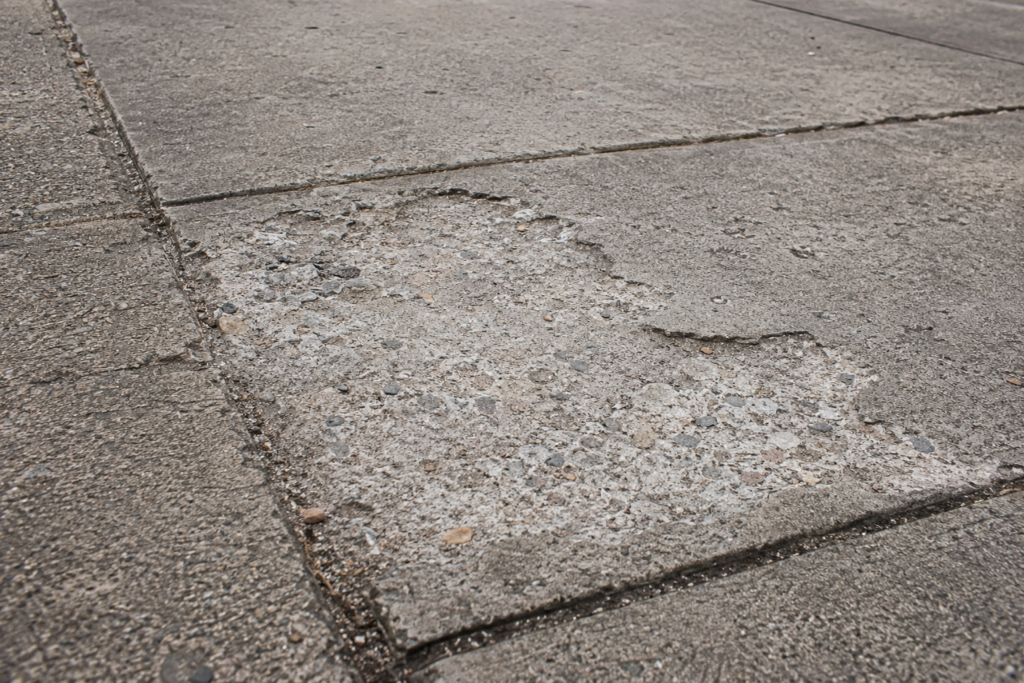
Spalling is what happens when the top layer of a concrete slab starts chipping, flaking, or peeling away, sometimes exposing the aggregate underneath. In plain terms, it looks like the surface of the concrete is falling apart in small chunks or flakes rather than cracking straight through.
This is heavily tied to New York winters. Moisture gets into the surface layer, freezes and expands, and that outer layer separates from the rest of the slab. Deicing salts make it worse, since they intensify the freeze-thaw reaction right at the surface. Concrete that was poured with too much water in the mix, or that wasn’t properly finished, is also more prone to spalling.
Minor spalling can sometimes be addressed with a resurfacing overlay, as long as the underlying slab is structurally sound. Once spalling has gone deep enough to expose the rebar or aggregate across a wide area, resurfacing usually won’t hold, and replacement becomes the more sensible option.
6. Pitting and Surface Deterioration
Pitting looks like small pockmarks or divots scattered across the concrete surface rather than one continuous crack or a peeling layer. It’s often caused by the same freeze-thaw and salt exposure that causes spalling, just at a smaller and more scattered scale, sometimes described as concrete scaling.
The key difference from major cracking is that pitting is a surface-level issue. It doesn’t usually mean the slab has structural problems. If pitting is limited and the slab is otherwise solid, a resurfacing treatment can restore a smoother, safer surface. If pitting covers most of the slab and the concrete underneath feels soft or crumbly when tested, resurfacing over it just delays a replacement that’s coming anyway.
7. Tree Root Damage
Tree roots are one of the more delicate sidewalk problems to deal with, because the fix isn’t always as simple as removing what’s in the way. Cutting a large structural root to save a sidewalk slab can destabilize the tree or kill it outright, and in New York, many street trees are protected, meaning root removal isn’t something to handle without proper guidance from an arborist or the appropriate city department.
The more sustainable approach usually involves working around the root rather than through it: adjusting the slab design, using a root barrier to redirect future growth, or in some cases installing a slightly raised or beveled transition instead of forcing a perfectly flat slab over an established root system. If a root has already caused significant lifting or cracking, a professional assessment can help figure out whether a repair is possible without harming the tree, or whether root pruning by a qualified arborist is genuinely necessary.
8. Broken or Severely Deteriorated Slabs
At a certain point, a slab isn’t a candidate for repair anymore. Multiple deep cracks, large missing chunks, extensive spalling, or a slab that’s shifted or sunk significantly all point toward replacement rather than patching.
The tell is usually that repairs stop holding. If a section has already been patched more than once and the same damage keeps returning, that’s the concrete telling you it’s done. Continuing to patch it usually costs more over time than replacing it once and dealing with whatever underlying issue caused the failure in the first place.
Comparison Table: Sidewalk Damage at a Glance
| Type of Damage | What You May Notice | Common Cause | Typical Solution |
| Hairline/surface cracks | Thin lines, no offset | Curing shrinkage, minor freeze-thaw | Crack sealant; monitor for growth |
| Wide/deep cracks | Cracks over ¼ inch, full-depth | Ground movement, root or water pressure | Investigate cause, then patch or replace |
| Uneven/raised slabs | One slab higher than the next | Tree roots, settlement | Grinding, mudjacking, or replacement |
| Sinking sections | Low spots, pooling water | Base failure, drainage issues | Rebuild base, then repour |
| Spalling/flaking | Surface chipping or peeling | Freeze-thaw, deicing salts | Resurfacing or replacement |
| Pitting/scaling | Small pockmarks across surface | Salt exposure, freeze-thaw | Resurfacing if slab is sound |
| Tree root damage | Lifting near tree pits | Root growth beneath slab | Root barrier, redesign, arborist review |
| Broken/deteriorated slabs | Large cracks, missing chunks | Age, repeated failure | Full replacement |
How to Tell If a Damaged Sidewalk Needs Repair or Replacement
This is the question most property owners actually want answered, and the honest answer is: it depends on more than how the surface looks.
Crack size and depth matter more than crack length. A long but hairline-thin crack can be less concerning than a short crack that goes through the full slab.
Vertical displacement is a big factor for safety. Any height difference between adjacent slabs is a potential trip hazard, and even a repair that fixes the surface without addressing why one side is higher than the other tends to be temporary.
How many areas are affected tells you something too. One isolated crack is a repair job. A sidewalk with cracking, unevenness, and spalling across multiple slabs usually points to an aging system that’s better addressed as a whole rather than patched piece by piece.
The condition of the concrete around the damage matters just as much as the damage itself. Patching a crack in concrete that’s otherwise soft, crumbly, or already showing surface deterioration rarely produces a lasting result.
Repeated movement in the same spot, cracking or lifting again after a previous repair, is usually the clearest sign that the underlying cause was never fixed the first time.
Drainage problems and tree-root involvement both suggest the damage will keep happening unless that root cause is dealt with, not just the visible crack.
The bottom line: a damaged sidewalk with a clear, contained, cosmetic issue is often a repair. A damaged sidewalk with an unresolved underlying cause water, roots, or a failing base is heading toward replacement, whether it happens now or two winters from now.
Step-by-Step Guide for Property Owners
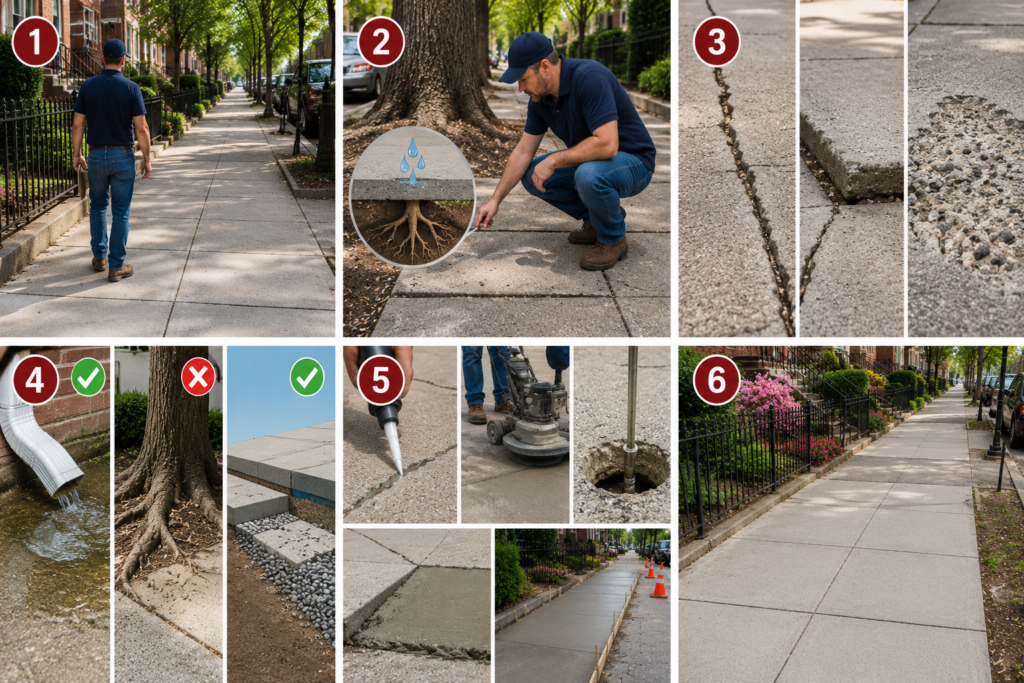
Step 1: Inspect the entire sidewalk, not just the obvious spot. It’s easy to focus on the one crack or raised slab that prompted you to look in the first place. Walk the full length of the sidewalk in front of and alongside your property. Damage in one area sometimes has a related issue starting a few feet away that hasn’t become visible yet.
Step 2: Look for drainage, roots, settlement, or movement that may explain the damage. Check whether water pools anywhere along the sidewalk after rain. Look at nearby tree locations. Note any slabs that feel like they rock or shift slightly when you step on them; that’s often a sign of a void or unstable base underneath.
Step 3: Determine whether the issue looks superficial or involves slab movement. A crack with no offset and no rocking is a different situation than a slab that’s lifted, sunk, or shifted. This distinction changes what kind of repair actually makes sense.
Step 4: Address the underlying cause before making cosmetic repairs. If drainage is pushing water against a slab, redirect it before repairing the crack. If a root is the culprit, get a professional opinion on how to handle it before pouring new concrete over the same spot.
Step 5: Choose an appropriate repair method. Sealants and patching compounds work for surface-level issues. Grinding can fix minor height differences. Mudjacking or slab-jacking can raise a sunken slab without full replacement in some cases. Severe cracking, extensive spalling, or repeated failure points toward replacement.
Step 6: Monitor repaired areas and maintain drainage to reduce recurring problems. After a repair, keep an eye on that section through at least one winter. If the same damage starts reappearing, the underlying cause likely wasn’t fully resolved, and it’s worth a second look before it grows.
A Realistic Example
Picture a two-family home in Queens where the owner first noticed a slab near the property line sitting slightly lower than the one next to it. It wasn’t dramatic maybe half an inch but it got a little worse every winter for three years running.
A closer look showed the real issue: a downspout a few feet away was draining directly onto the ground next to that slab instead of into a proper drain line. Water had been collecting against the edge of the concrete for years, and each freeze-thaw cycle through the colder months was eroding the base underneath just a little more.
If the owner had simply had the low slab mudjacked back into place without touching the drainage, the same settling would likely have started again within a year or two the water had nowhere else to go. Instead, the downspout was redirected away from the sidewalk, the base under the slab was rebuilt and properly compacted, and the slab was repoured level with its neighbors. That combination is what actually stopped the problem from returning, rather than just hiding it for another season.
Common Repair Mistakes
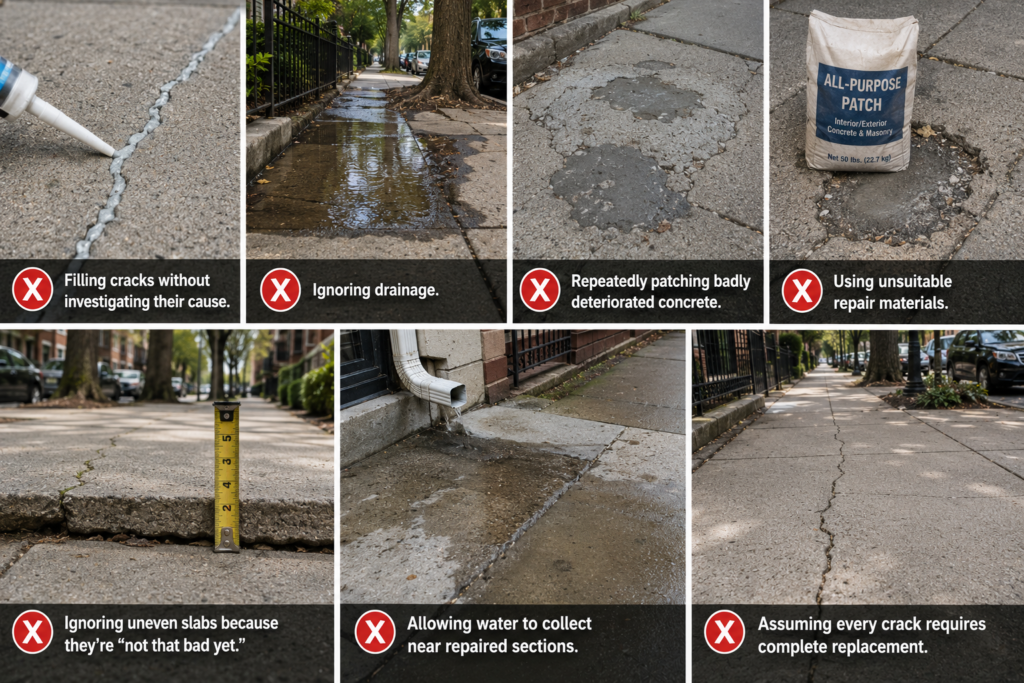
Filling cracks without investigating their cause. A crack filler looks like a fix, but if something is still moving underneath, the same crack or one right next to it comes back.
Ignoring drainage. Water sitting against a slab is one of the most common reasons repairs fail to last in this climate. If drainage isn’t corrected, freeze-thaw cycling picks up right where it left off.
Repeatedly patching badly deteriorated concrete. At some point, patching costs more over several years than one proper replacement would have. If a section has needed the same repair more than twice, it’s usually time to stop patching and start replacing.
Using unsuitable repair materials. Not every patching compound is designed to handle New York’s freeze-thaw exposure or salt contact. A product that isn’t rated for that kind of cycling can fail faster than the original damage did.
Ignoring uneven slabs because they’re “not that bad yet.” Trip hazards don’t improve on their own, and the liability exposure from an uneven sidewalk doesn’t wait for the damage to get worse before it becomes a problem.
Allowing water to collect near repaired sections. A brand-new patch or slab sitting next to a drainage problem is on the same timeline as the damage it replaced.
Assuming every crack requires complete replacement. On the flip side, some property owners over-correct and think any crack means tearing out the whole sidewalk. That’s not accurate either; plenty of cracks are cosmetic and don’t need anything more than monitoring or a simple seal.
How to Reduce Future Sidewalk Damage
Check your drainage after heavy rain. Walk the sidewalk during or right after a storm and note anywhere water is pooling instead of running off. That’s the spot most likely to develop problems next winter.
Keep the sidewalk clean and clear of debris. Dirt and organic material trapped in small cracks hold moisture against the concrete longer than it would otherwise sit there.
Deal with small cracks while they’re small. A hairline crack sealed early keeps water from getting into the slab in the first place, which slows the freeze-thaw damage that turns a small crack into a bigger one.
Be selective with deicing products. Where you have a choice, products with less impact on concrete surfaces reduce the scaling and pitting that heavy rock-salt use tends to cause over several winters.
Walk the sidewalk once or twice a year, specifically looking for changes. Seasonal inspection once before winter and once after catches new movement or cracking while it’s still a repair instead of a replacement.
Keep an eye on nearby tree roots as they grow. If you have a mature tree close to the sidewalk, root-related lifting is often gradual and predictable. Catching it early gives you more repair options than waiting until a slab has fully heaved.
Address settlement as soon as you notice it. A slab that’s just starting to tilt or sink is far easier and cheaper to fix than one that’s been sinking for two or three years.
None of this guarantees a sidewalk that never cracks; concrete exposed to New York winters is going to show some wear eventually. But catching problems early consistently means smaller, cheaper repairs instead of full sections needing to come out.
Expert Insight
The crack you can see is usually only part of the story. Before deciding how to fix a section of damaged concrete, it’s worth figuring out what actually caused it to move, sink, or deteriorate in the first place. A repair that only addresses the surface, without touching the cause underneath, tends to buy a season or two at most. Property owners who ask “why did this happen here” before asking “how do I patch this” generally end up with repairs that actually hold.
Frequently Asked Questions
What causes sidewalk damage?
The most common causes in New York are freeze-thaw cycling, water infiltration, poor drainage, tree-root growth, soil settlement, heavy loads, deicing salts, and simple concrete age. Most visible damage traces back to one or a combination of these.
Can a damaged sidewalk be repaired without replacing it?
Yes, in many cases. Hairline cracks, minor pitting, and small height differences can often be repaired through sealing, resurfacing, or grinding, as long as the underlying concrete is structurally sound and any root cause has been addressed.
How do you fix cracks in a concrete sidewalk?
Small surface cracks are typically cleaned out and filled with a concrete-rated sealant. Wider or deeper cracks usually need the underlying cause identified first settlement, roots, or water before a lasting repair, such as patching or partial replacement, makes sense.
Why do sidewalk slabs become uneven?
Uneven slabs are usually caused by tree roots pushing up from below or soil settling unevenly beneath the concrete. Both create a height difference between adjacent slabs, which is also a common trip hazard.
Can tree roots damage a concrete sidewalk?
Yes. As roots grow and thicken beneath a slab, they can lift, crack, or unevenly raise the concrete above them. Because many New York street trees are protected, addressing this kind of damage often calls for professional guidance rather than simply cutting the root.
Does winter weather damage sidewalks in New York?
Yes, significantly. Freeze-thaw cycling is one of the leading causes of cracking, spalling, and scaling in this region, and deicing salts used through the winter can intensify that damage on the concrete surface.
When should a concrete sidewalk be replaced?
Replacement generally makes sense when a slab has multiple deep cracks, significant spalling, repeated failed repairs, or has sunk or lifted enough to create an ongoing safety hazard. If patching the same spot hasn’t held more than once, replacement is usually the more cost-effective path.
Conclusion
Sidewalk damage is rarely just about how bad a crack or an uneven slab looks on the surface. The property owners who deal with it most successfully are the ones who take a minute to figure out what’s actually happening underneath a drainage problem, a growing root, a settling base before deciding how to repair it. Small cracks caught early, water redirected away from vulnerable slabs, and movement addressed before it compounds all make the difference between a quick fix that holds and a repair you’re redoing again in two years.
If your sidewalk is uneven, has deteriorated significantly, keeps cracking in the same spot despite repairs, or presents a real trip hazard, that’s a good point to bring in a professional for an assessment rather than guessing at the fix yourself.
Get a Sidewalk Inspection
If you’re not sure whether what you’re looking at is a simple patch job or something that needs a closer look, a sidewalk inspection can settle that question before you spend money on a repair that might not hold. Reach out for an estimate and a straight answer about what your sidewalk actually needs.