
I’ve been patching, replacing, and arguing with New York sidewalks for over twenty years now. And if there’s one thing I’ve learned, it’s that concrete doesn’t crack for no reason. Something is always going on underneath it.
Most homeowners call me after they’ve tripped over their own sidewalk, or worse, after a neighbor or a mail carrier has. By then the crack has usually been sitting there for a year or two, slowly getting worse every winter.
Sidewalks crack because the ground under them moves. New York winters freeze and thaw the soil over and over, tree roots push up from below, water finds its way underneath the slab, and eventually something has to give. Add in decades of foot traffic, delivery carts, and the occasional car pulling onto the curb, and it’s honestly surprising sidewalks last as long as they do.
Here’s the part that actually matters to you as a property owner: in New York City, the sidewalk in front of your building is your responsibility, not the city’s. If someone gets hurt on a cracked or uneven section, you can be held liable. The Department of Transportation also issues violations for sidewalk defects, and those fines add up fast if you ignore them.
The good news is that most sidewalk damage can be repaired without a full replacement, as long as you catch it early. This guide walks through how that repair process actually works, based on jobs I’ve done, not textbook theory.
What Causes Concrete Sidewalk Damage?
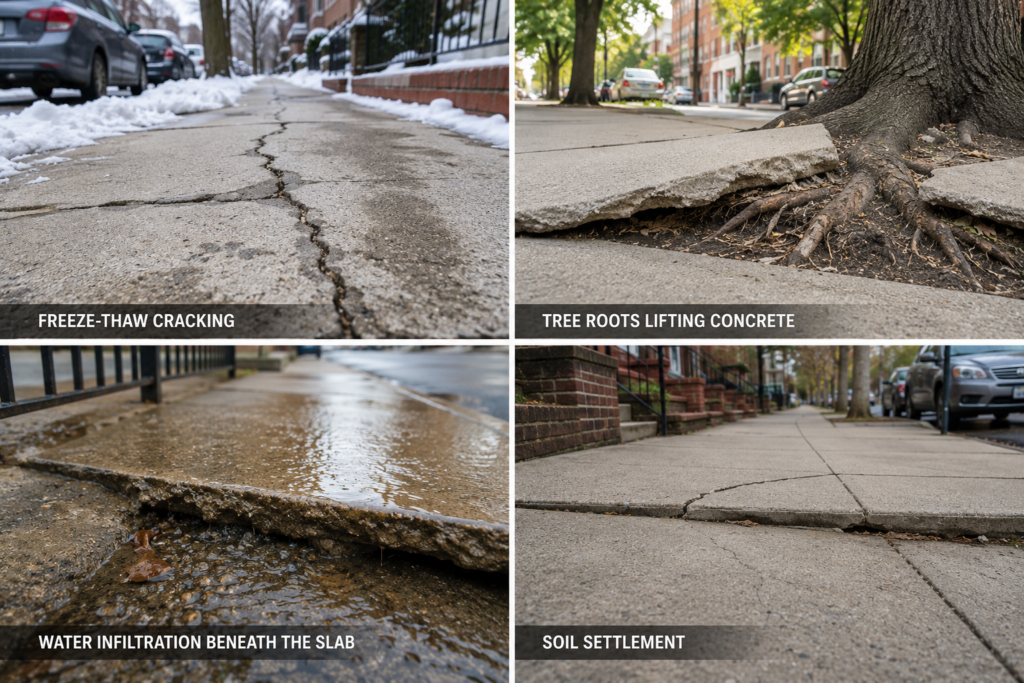
Every sidewalk crack has a story behind it. After enough jobs, you start recognizing the pattern before you even get out of the truck.
Freeze-thaw cycles. Water gets into tiny pores in the concrete, freezes, expands, and pushes the surface apart. This is the number one cause of sidewalk crack repair calls I get every spring.
Heavy foot and cart traffic. Sidewalks in front of commercial buildings and busy residential blocks take a beating. Repeated weight on a slab that’s already settling unevenly speeds up cracking.
Tree roots. This one’s huge in New York. Street trees look great, but their roots grow shallow and wide, and they will lift a slab right off its base. I’ve pulled up sections where a root as thick as my arm was sitting directly under the crack.
Water infiltration. Poor drainage lets water pool against or under the slab. Over time, that softens the base material and the concrete loses its support.
Soil settlement. Some parts of New York sit on fill soil that was never compacted properly decades ago. It settles slowly, and the sidewalk settles with it.
Poor original installation. Not every sidewalk was poured correctly. Thin slabs, no rebar or mesh, poor base prep. I still see it on properties built forty or fifty years ago.
Age. Concrete has a lifespan. Most sidewalks are good for 25 to 30 years before general wear starts showing up as surface cracking and spalling.
| Cause | Common Symptoms | Recommended Repair |
| Freeze-thaw cycles | Surface cracking, flaking, spalling | Crack sealing, surface patching |
| Heavy traffic | Wearing, hairline cracks, edge chipping | Resurfacing, patching |
| Tree roots | Raised or tilted slabs, trip hazards | Slab lifting, root barrier, partial replacement |
| Water infiltration | Soft spots, staining, undermining | Drainage correction, mudjacking, sealing |
| Soil settlement | Sunken or sloped slabs | Slab leveling, base stabilization |
| Poor installation | Early cracking, thin or crumbling slabs | Full slab replacement |
| Aging concrete | Widespread surface wear, discoloration | Resurfacing or replacement depending on condition |
Can Every Concrete Sidewalk Be Repaired?
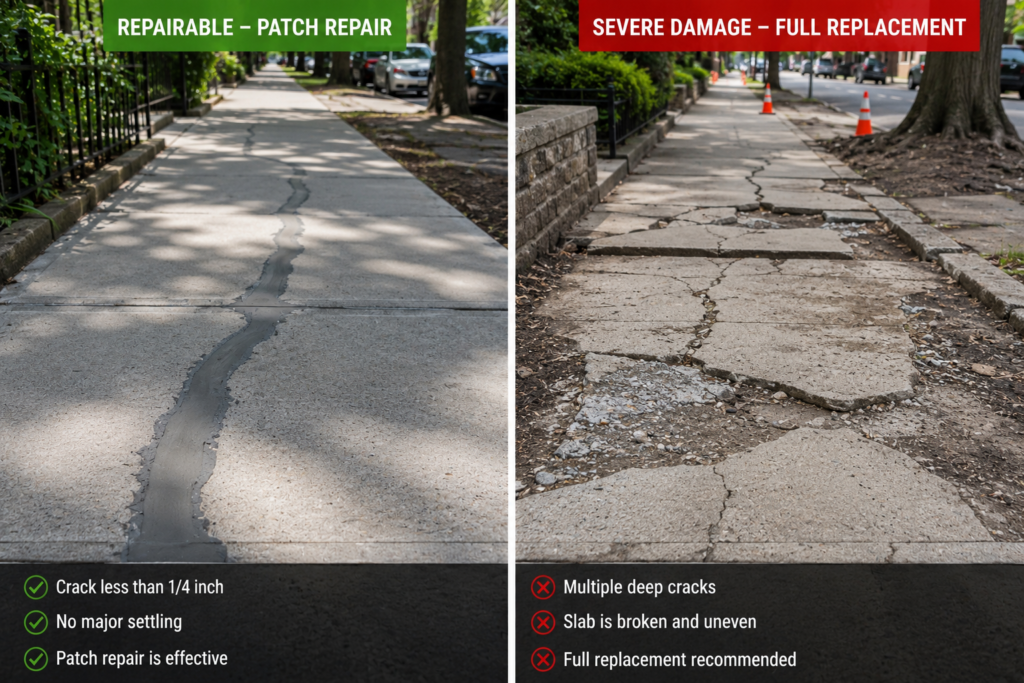
Not always, and I’ll tell you that straight rather than sell you a repair that won’t hold.
Minor cracks under a quarter inch wide are usually a simple fix. Clean it, fill it, seal it, done.
Surface spalling, where the top layer is flaking or pitting, can often be resurfaced if the slab underneath is still structurally sound.
Uneven slabs are trickier. If one slab has sunk or lifted less than an inch or two relative to the next, I can often level it without replacing anything.
Trip hazards: anything with a height difference of half an inch or more between slabs needs to be addressed one way or another, either by grinding down the high edge, lifting the low one, or replacing the section. This is also the type of defect that gets flagged in a DOT sidewalk inspection.
Severe structural damage, meaning the slab is broken into multiple pieces, badly undermined, or shifted at an angle, usually means replacement is the more honest answer. Patching a broken slab is a temporary fix at best, and I’d rather tell a client that upfront than have them call me back in eight months.
| Repair | Replacement |
| Lower upfront cost | Higher upfront cost, longer-lasting fix |
| Good for isolated cracks or minor unevenness | Necessary for broken, shifted, or undermined slabs |
| Faster turnaround, less disruption | Requires demolition, forms, and full cure time |
| Best when the base and drainage are still sound | Often needed when the underlying base has failed |
| May need to be revisited in future years | Resets the clock on the sidewalk’s lifespan |
How to Repair a Concrete Sidewalk (Step-by-Step)
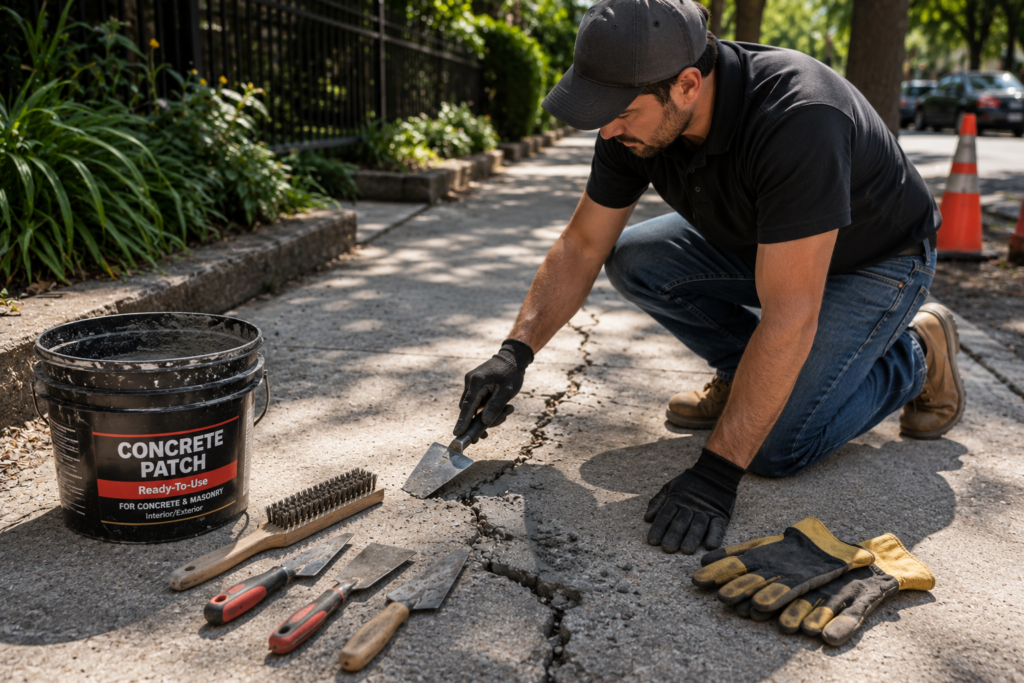
This is the process I actually use on job sites, not the version you’d find in a manual.
Step 1: Inspect the damage
Before anything gets touched, I walk the whole section and check what’s really going on. Is it just surface-level, or is there movement underneath? I’ll tap the slab, check for hollow sounds, and look at how water has been draining across it. This step decides whether you’re looking at a repair or a replacement, so don’t skip it or guess.
Step 2: Clean the repair area
Dirt, loose debris, and old sealant all need to come out before new material goes in. I usually use a wire brush or a pressure washer depending on how much buildup there is. Repair material won’t bond properly to a dirty surface, and that’s one of the most common reasons DIY patches fail within a season.
Step 3: Remove loose concrete
Any concrete that’s crumbling, spalled, or not solidly attached has to go. I’ll chip it out with a hammer and chisel or a small demo tool, back to solid material. Patching over loose concrete is like painting over rust. It looks fine for a little while and then fails.
Step 4: Apply the appropriate repair material
This is where experience matters most. Hairline cracks get a flexible polymer sealant. Larger cracks and small spalled areas usually call for a concrete patching compound with good bonding strength. Bigger sections might need a proper concrete resurfacer. Using the wrong product for the size and location of the damage is probably the single biggest mistake I see homeowners make.
Step 5: Level and finish the surface
Once the material is in, it needs to be screeded and floated so it sits flush with the surrounding concrete. I match the surrounding texture as closely as I can, whether that’s a broom finish or smooth trowel, so the repair doesn’t stick out like a patch job.
Step 6: Allow proper curing
This is the step people rush, especially in warmer months when it looks dry within a few hours. Surface dry and fully cured are two different things. Depending on the product and weather, full cure can take anywhere from a few days to a couple of weeks. Foot traffic too early is a common reason repairs crack again.
Step 7: Seal the repaired area
A good concrete sealer protects the new patch from water intrusion and helps it handle freeze-thaw cycles the way the surrounding slab does. Skipping this step is one of the most common reasons I get called back to the same address a year later.
Common Sidewalk Repair Mistakes Homeowners Make
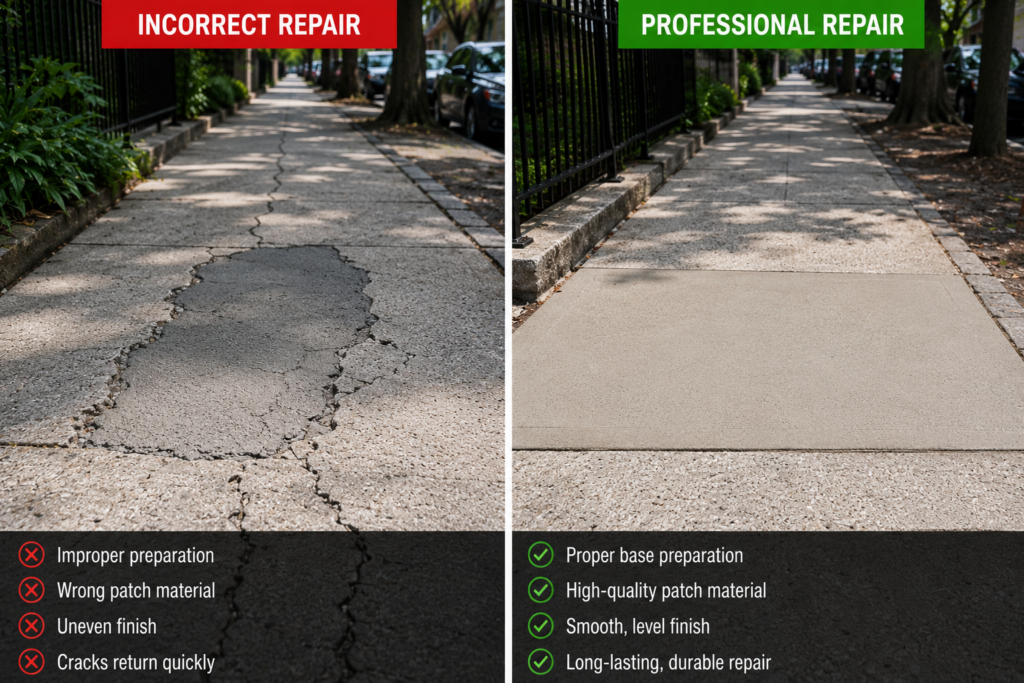
Ignoring drainage problems. If water is pooling on or near your sidewalk, fixing the crack without fixing the drainage just buys you a year or two before it cracks again.
Using the wrong repair products. Hardware store crack fillers work fine for hairline surface cracks. They are not built for structural gaps or areas that carry regular foot traffic.
Repairing in poor weather. Concrete repair materials need a certain temperature range to cure properly. Patching a sidewalk in freezing temperatures, or right before rain, almost always leads to a repair that fails early.
Waiting too long to fix cracks. A quarter-inch crack today is a half-inch trip hazard in two winters. The longer water gets into that crack, the more it expands the damage.
Skipping sealing. I mentioned this above, but it’s worth repeating because it’s so common. An unsealed patch is exposed to the same freeze-thaw cycle that likely caused the original damage.
When Should You Hire a Professional?
Small hairline cracks and minor surface wear are reasonable DIY projects if you’re comfortable with basic concrete work. Beyond that, I’d generally recommend calling a sidewalk repair contractor.
Bring in a professional if you’re dealing with:
- A DOT sidewalk violation notice, since the repair usually needs to meet specific code requirements and pass reinspection
- Trip hazards half an inch or higher between slabs
- Cracking that runs across multiple slabs or through a large section of the sidewalk
- Any visible structural movement, tilting, or sections that feel unstable underfoot
DOT violations in particular are worth taking seriously. The fines increase the longer a defect goes unaddressed, and a repair that doesn’t meet code specifications can get rejected on reinspection, which means paying for the work twice.
Case Study
A homeowner in Queens called me last spring about a crack running along the edge of her front walkway. She’d first noticed it two years earlier, just a thin line near a street tree, and figured it wasn’t worth worrying about.
By the time she called, that thin line had become a half-inch height difference between two slabs. Her mail carrier had nearly tripped on it that week, which is what finally prompted the call.
When I inspected it, the cause was obvious. A tree root had grown directly under the joint and was slowly lifting one slab while the other stayed put. This is an extremely common pattern on tree-lined blocks throughout the city.
Since the slab itself wasn’t cracked or broken, just displaced, we were able to grind down the raised edge slightly and install a root barrier to redirect future growth, rather than replacing the whole section. Total repair time was about a day, plus curing.
Her takeaway, in her own words, was that she wished she’d called after noticing the original hairline crack instead of waiting for it to become a hazard. The early fix would have cost a fraction of what the later one did, and there wouldn’t have been a close call with someone getting hurt.
Expert Insight
“Sidewalk cracks are one of the cheapest problems in construction to fix early and one of the most expensive to ignore. I’d rather patch a hairline crack for a few hundred dollars than come back in two years to replace a whole slab for a few thousand. Early repair is really just protecting your wallet and protecting the people walking past your property.”
How to Prevent Future Sidewalk Damage
Annual inspections. Walk your sidewalk once a year, ideally after winter, and look for new cracks, height differences, or soft spots.
Sealing concrete. A sealer applied every few years helps block water from getting into the pores of the concrete, which cuts down on freeze-thaw damage.
Improving drainage. Make sure water from downspouts, driveways, or graded areas isn’t running across or pooling on the sidewalk.
Managing tree roots. If you have a street tree near your sidewalk, root barriers installed early can prevent a lot of future lifting and cracking.
Regular cleaning. Keeping the sidewalk free of dirt buildup and standing water helps any existing sealant do its job.
Prompt crack repairs. This is the single biggest thing you can do. A small crack fixed today is a fraction of the cost of a trip hazard fixed later.
Frequently Asked Questions
How do you repair a concrete sidewalk?
Repair generally involves cleaning the damaged area, removing any loose or crumbling concrete, applying the appropriate patching or resurfacing material, leveling it to match the surrounding surface, allowing it to cure fully, and then sealing it.
Can cracked sidewalks be repaired?
Most cracked sidewalks can be repaired, especially when the crack is isolated and the surrounding slab is still structurally sound. Wider cracks, broken slabs, or sections with significant undermining may need replacement instead.
What is the best material for sidewalk repair?
It depends on the damage. Hairline cracks generally do well with a flexible polymer sealant, while larger cracks and spalled areas typically call for a bonding concrete patch compound or a full resurfacing product.
How much does sidewalk repair cost?
Costs vary widely based on the size of the damage, the type of repair needed, and current material and labor rates in your area. Minor crack repairs tend to be relatively affordable, while slab replacement costs more due to demolition, forms, and materials. A contractor can give you an accurate quote after an inspection.
When should a sidewalk be replaced instead of repaired?
Replacement is usually the better option when a slab is broken into multiple pieces, significantly undermined, shifted at an angle, or when the underlying base has failed. Patching severe structural damage tends to be a short-term fix rather than a lasting solution.
How long do concrete sidewalk repairs last?
A properly done repair, using the right materials and allowed to cure and seal correctly, can last many years. Repairs that skip proper curing or sealing tend to fail much sooner, often within a season or two.
Conclusion
Sidewalk damage rarely fixes itself, and it rarely stays the same size for long. What starts as a hairline crack this year can turn into a real trip hazard within a couple of winters, especially with the freeze-thaw cycles we get in New York.
The good news is that most sidewalks can be repaired, not replaced, if the damage is caught early and fixed with the right materials and technique. When the damage is more serious, whether that’s a DOT violation, a major trip hazard, or real structural movement, that’s when it’s worth bringing in a professional who can assess it properly and make sure the fix actually holds.
Either way, the earlier you deal with it, the less it costs you and the safer your sidewalk is for everyone walking past your property.
CTA
If you’ve noticed cracks, uneven slabs, or any spots on your sidewalk that make you a little nervous when someone walks over them, it’s worth getting a proper look before it turns into a bigger repair. Reach out for a sidewalk inspection, and we’ll walk you through exactly what your property needs and what it doesn’t.