
If you plan to replace your driveway with pavers in New Hyde Park, the most important work happens before anyone breaks up the old surface. A handful of early decisions shape the scope, the schedule, and how the finished driveway performs.
The short answer: Before replacing an old driveway with pavers, consider these five questions.
- Is the old driveway really past repair?
- Does the old surface need to come out, and what is underneath it?
- Where does water go, and how will the new surface meet your garage, walkway, and street?
- Which municipality’s rules apply if the apron, curb, or sidewalk is involved?
- Will every estimate you collect describe the same work?
This guide covers each one and ends with a checklist you can use before you ask anyone for a quote.
Repair or Replace? Signs Your Old Driveway Has Run Its Course
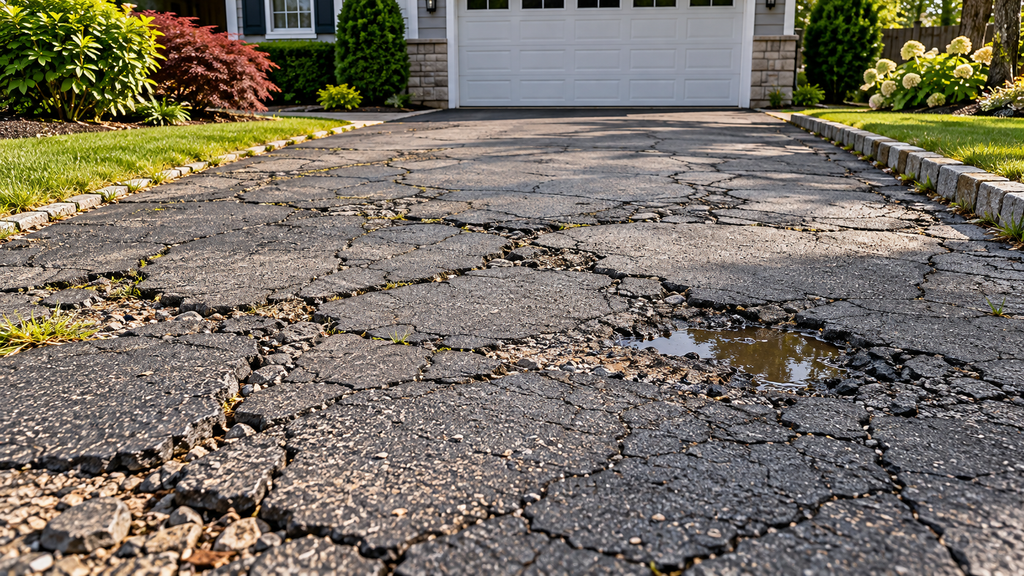
Repair makes sense when damage is limited. That means a few narrow cracks, some surface wear, no sinking, and water that runs off where it should.
Replacement starts to make sense when problems keep coming back or point to something below the surface:
- Cracking across large areas, not just a few isolated lines
- Sunken sections, ruts in the wheel paths, or edges that crumble
- Concrete slabs where one side of a crack sits higher than the other
- Standing water after rain
- Patches that keep failing
These symptoms often trace back to the base, the soil, or drainage under the surface. A new surface laid over the same problem usually inherits it. If you are unsure when an asphalt driveway should be replaced, our guide on how long asphalt lasts in New York is a good starting point. For slab problems, see how to fix cracks in a concrete driveway.
One honest note: pavers usually cost more upfront than basic asphalt or poured concrete. If the lowest initial price is your top priority, say so at the estimate. If you want design flexibility and a surface that can often be repaired one section at a time, pavers deserve a serious look.
Read Your Old Driveway Before You Call Anyone
What you see on the surface tells a contractor where to look underneath.
If You Have an Asphalt Driveway
Look for a web of connected cracks, soft spots you can feel underfoot, deep ruts, potholes, and edges that have crumbled or dropped. Widespread cracking and soft areas usually mean the base or drainage has failed, not just the top layer. If you want to replace an asphalt driveway with pavers, those spots are exactly what a contractor will want to see.
If You Have a Concrete Driveway
Walk across the concrete slabs. Do any of them shift or rock when you step on them? Do they sound hollow when tapped? Is one side of a crack higher than the other? Flaking at the surface is often cosmetic. Settlement and uneven joints usually are not. If you are considering replacing a concrete driveway with pavers, the condition of the slab also decides whether an overlay is even on the table, which we cover next.
Take photos of what you find. They will help later at the estimate.
Does the Old Driveway Have to Come Out?
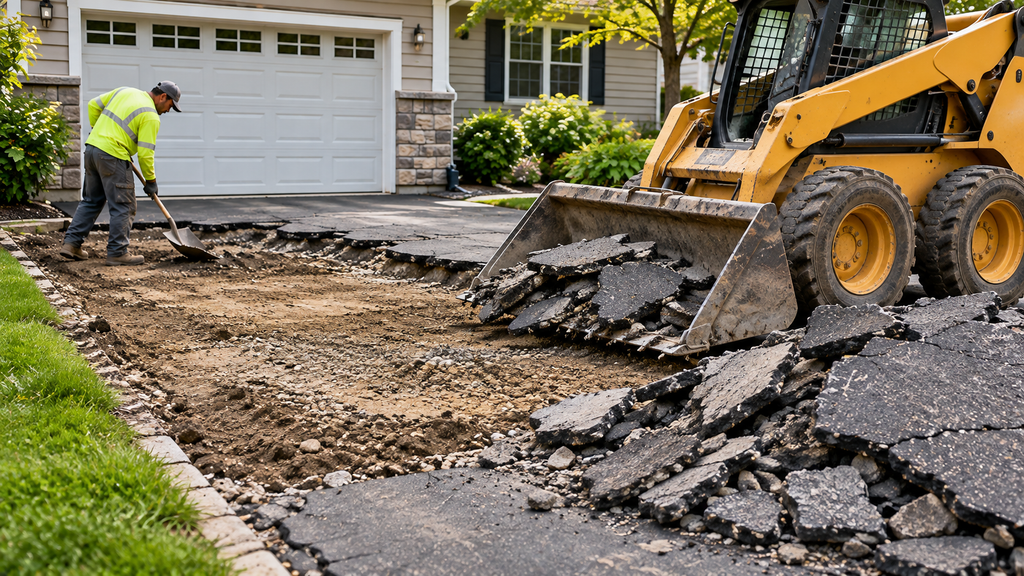
For most aging driveways, yes. A paver driveway works as a system: compacted soil, a compacted stone base, bedding sand, pavers, and edge restraints. Building that system properly usually means removing the old surface and rebuilding what is under it. Covering a failing driveway just carries its problems into the new one.
Overlay methods do exist. Industry groups publish guidance for setting pavers over existing asphalt or concrete. But they are meant for pavement that is stable, drains well, and leaves enough height for the added thickness. Because driveways support vehicle traffic, their structural requirements are more demanding than those of patios. Our article on putting pavers over concrete explains how to judge a slab.
Whatever a contractor proposes, ask them to name the method in writing. “We’ll lay pavers over it” is not a scope of work. Also ask whether they plan to rebuild the base or keep any part of it, and why.
Measure, Photograph, and Map What Surrounds the Driveway
Before the estimate visit, gather the details that affect access and layout:
- Dimensions. Length, width, and any turnaround, widening, or curve.
- Garage threshold. Note how the garage floor sits relative to the driveway. This affects how the new surface will meet it.
- Trees and roots. Roots near the driveway can complicate excavation and may be the reason the old surface heaved.
- Fixtures. Water meters, cleanouts, sprinkler heads, landscape lights, and the mailbox.
- Boundaries. Fences, hedges, neighbors’ driveways, and your property line.
- Apron, curb, and sidewalk. Their condition and where your driveway meets them.
- Vehicle use. Daily cars versus trucks, trailers, dumpsters, or landscaping equipment.
- Snow removal. Note whether you plow or shovel and where you typically pile the snow.
What Is Under the Surface Matters More Than What Goes on Top
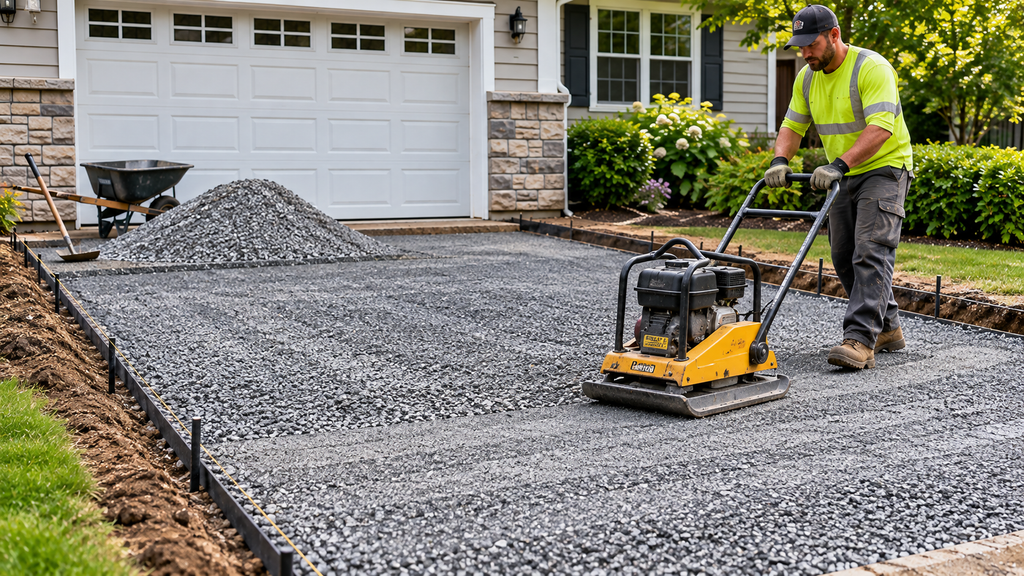
Pavers are the visible layer. The compacted base underneath carries the load. ICPI guidance provides general recommendations for driveway aggregate base thickness, often ranging from approximately 6 to 8 inches depending on site conditions. It also says the right thickness depends on soil strength, drainage, climate, and traffic. In other words, there is no single depth that fits every lot.
Water matters here too. In a freeze-thaw climate like Long Island’s, water that sits under a driveway and freezes can move it. That is why a clean, well-compacted base and a plan for runoff are not extras.
Ask what the contractor will do if the crew finds soft, wet, or poorly compacted soil after the old driveway comes out, and how the added work will be priced and approved in writing. Our installation process guide walks through excavation, base, and bedding in detail.
Drainage, Grading, and Finished Height
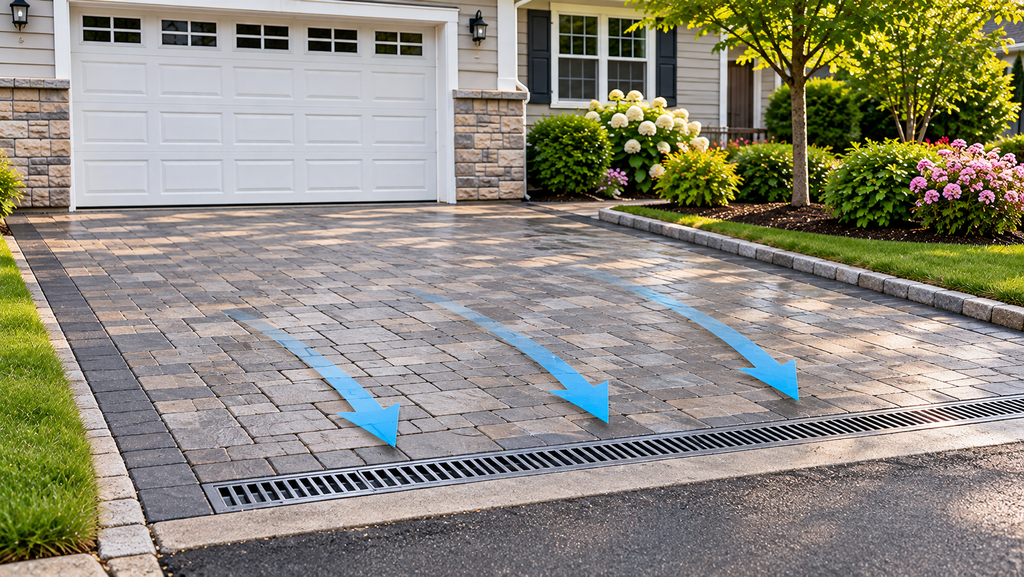
Drainage is where many replacement projects succeed or fail. Before the estimate, look at these:
- Where water goes now. Does it flow toward the garage, the street, a neighbor’s lot, or your lawn? Take photos after a rain.
- Downspouts. If roof water lands on the driveway, the plan needs to say where it goes instead.
- Low spots. Puddles on the old surface show where water collects. They are easiest to correct before new work goes in.
- Finished height. Ask how the new surface will meet the garage slab, the front walkway, and the apron. These transitions should be planned, not left to the end.
- Neighboring properties. A proper drainage plan should manage runoff without directing it onto adjacent properties.
If runoff is a major concern, ask whether a permeable paver system suits your site. It requires its own design, so it is a conversation for the estimate, not an assumption.
Choosing Pavers and Edges for Vehicle Traffic
Not every paver is meant for a driveway. ICPI guidance recommends pavers at least 2 3/8 inches (60 mm) thick for residential driveways, and notes that vehicular pavements typically use 3 1/8 inch (80 mm) units. Ask which thickness your contractor plans to use and why, especially if you park heavy vehicles or take deliveries.
Two other design points affect performance, not just looks:
- Edge restraints are structural. They hold the perimeter so the pavers do not spread under turning tires.
- Decorative borders are a design choice. They are not the same thing as edge restraints.
If you want help narrowing down materials, see our guide to the best driveway pavers for New Hyde Park homes and our driveway borders and edging service page.
Apron, Curb, Property Line, and Permits
Replacing the surface inside your property line is one thing. Work that touches the driveway apron, the curb, or the sidewalk is another.
Confirm which municipality you are in. Not every property with a New Hyde Park mailing address sits inside the Incorporated Village of New Hyde Park. Properties outside the Village may answer to the town or county instead. The simplest first step is to call the Village Building Department at (516) 354-0022, the number printed on the Village’s own permit form, and ask whether your address is within Village limits.
If you are in the Village, it publishes a Sidewalk, Curb, Apron & Driveway Permit Application. The form asks for at least 48 hours’ notice so the Building Inspector can schedule required inspections. It also lists construction notes for concrete aprons and the sidewalk sections between aprons and driveways. If your replacement reaches the apron, ask the Building Department what applies there before you choose a finished look.
Ask who is responsible. Whether a surface-only replacement needs a permit depends on your address and the scope of work, so do not rely on a general rule. Ask your contractor who decides, who files, and who schedules inspections. If you are widening the driveway or changing the curb opening, see our curb cut service and our guide to what a curb cut is.
Utilities. Contractors must call New York 811 before digging. Utility marks take a few business days, which can affect your start date.
If your driveway runs close to a fence or boundary, or is shared with a neighbor, dig out your property survey before the estimate visit.
How Removing the Old Driveway Changes Your Estimate
Removal is one of the biggest reasons two estimates for the same driveway look different. Instead of guessing at numbers, understand what drives the scope:
- Whether the old surface is asphalt or concrete, and how thick it is
- Breaking it up, loading, hauling, and disposal
- Equipment access to the driveway
- Whether the old base can be reused, rebuilt, or must be replaced
- Buried obstacles, roots, or old drainage systems discovered after the existing surface is removed
- Drainage or grading corrections the old driveway needs
- Paver thickness, edge restraints, and any decorative borders
Ask whether removal and disposal are included in the price or listed separately. Our guide to what affects a driveway paver estimate goes deeper on comparing quotes.
What the Replacement Process Usually Looks Like
Every project is different, and every contractor has their own methods. In general, a full replacement follows this order:
- Site evaluation and a written scope of work
- Permits and utility marking where required
- Removal and hauling of the old driveway
- Excavation and a check of the soil underneath
- Base placement and compaction in layers
- Edge restraints, bedding sand, and paver installation
- Joint sand, cleanup, and a final walkthrough
Weather conditions can affect both the sequence of work and the project timeline. Instead of relying on a generic duration, ask for a start date, an expected schedule, and the plan for rain or cold delays.
Questions to Ask About Replacement
Use these along with the questions in our guide to hiring a driveway paver contractor, which covers licensing, contracts, and warranties.
- Will the old driveway be fully removed? If not, what overlay method will you use, and why is mine suitable?
- Are removal, hauling, and disposal included in the price?
- How deep will you excavate, and what base material will you use?
- What happens if you find soft soil, buried debris, or old drains?
- How will the surface slope, and where will runoff and downspout water go?
- How will the new surface meet the garage, walkway, and apron?
- Which paver thickness and edge restraint will you use, and why?
- Who decides whether a permit is needed, who files it, and who schedules inspections?
- How will changes to the scope be priced and approved in writing?
- Where should we park during the work, and when can we use the driveway again?
Homeowner Planning Checklist
Work through this before you request estimates.
Document the driveway
- Photograph the full driveway from the street, each corner, the garage threshold, the apron joint, and any cracks, dips, or crumbling edges
- Measure length, width, and any turnaround or widening
- Note whether the old surface is asphalt or concrete, and whether it has been patched or resurfaced
- Mark where water collects after rain and photograph it
Check the surroundings
- Note where each downspout discharges
- Locate meters, cleanouts, sprinkler heads, lights, and the mailbox
- Note nearby trees and visible roots
- Find your property survey and note the distance to fences and neighbors
- Call the Village Building Department to confirm whether your address is inside Village limits
Decide what you need
- List the vehicles that use the driveway, including trucks, trailers, and deliveries
- Decide your must-haves versus nice-to-haves, such as pattern, color, and decorative borders
- Decide how you would handle snow removal on pavers
- Set a rough timeline and know when winter weather could affect your plans
Before you sign
- Ask each contractor to price the same scope, including removal, hauling, base, edges, and drainage
- Get the method, base depth, and paver thickness in writing
- Confirm who handles permits, utility marking, and inspections
- Ask how unexpected work will be priced and approved
Before the crew arrives
- Arrange alternate parking
- Mark sprinkler heads and lights you want protected
- Keep a copy of the permit and the contract
- Tell the crew about tight turns, soft lawn edges, and low branches
Common Planning Mistakes
- Comparing price before scope. One bid may include removal and drainage while another quietly leaves them out.
- Assuming a New Hyde Park address means Village rules. Confirm your jurisdiction first.
- Overlooking downspouts and low spots. Roof water on a driveway causes damage over time.
- Ignoring finished height. An improperly graded driveway near the garage or apron can direct water toward areas where it may cause damage.
- Skipping the weight question. Heavy vehicles may call for different paver thickness and base design.
- Treating edges as optional. Edge restraints do structural work.
- Waiting too long on permits and utility marking. Both can push back your start date.
Frequently Asked Questions
Do I have to remove my old driveway before installing pavers?
Usually, yes. A paver driveway needs its own compacted base, and most aging driveways have problems underneath that a new surface would not fix. Overlay methods exist for pavement that is stable, drains well, and has enough height, but a contractor should confirm that after inspecting your driveway.
Can I replace an asphalt driveway with pavers?
In many cases, yes. The existing asphalt generally needs to be evaluated, and the base underneath is rebuilt or adjusted depending on its condition. Ask your contractor to explain the specific replacement plan for your driveway.
Do I need a permit to replace my driveway in New Hyde Park?
It depends on your address and the scope. Work involving the apron, curb, or sidewalk may require approval, and the responsible office can differ by location. Confirm with the Building Department that covers your property, and ask your contractor who will file.
Is removal of the old driveway included in a paver estimate?
Not always. Some contractors include it in the price and others list it separately. Ask whether breaking up, hauling, and disposal are included.
Does the time of year matter?
It can. Installation guidance generally advises against laying bedding sand or pavers over frozen or saturated material, so cold or wet weather can delay a project. Ask any contractor how they handle weather and scheduling.
Ready to Plan Your New Hyde Park Driveway Replacement?
A good replacement starts with a clear look at what you have now and what the new driveway needs to do. If you are ready to talk through your project, contact Kings Pavers & Concrete to request a free on-site estimate. During the visit, the team can assess existing surface damage, driveway dimensions, drainage, grading, and site access while discussing suitable materials and the proposed scope of work. Have your photos, measurements, and survey ready, and bring the questions above.
You can also read more about our driveway paver installation service or see how we serve homeowners across New Hyde Park.