What Is Concrete Spalling? Causes, Signs & How to Fix It in New York
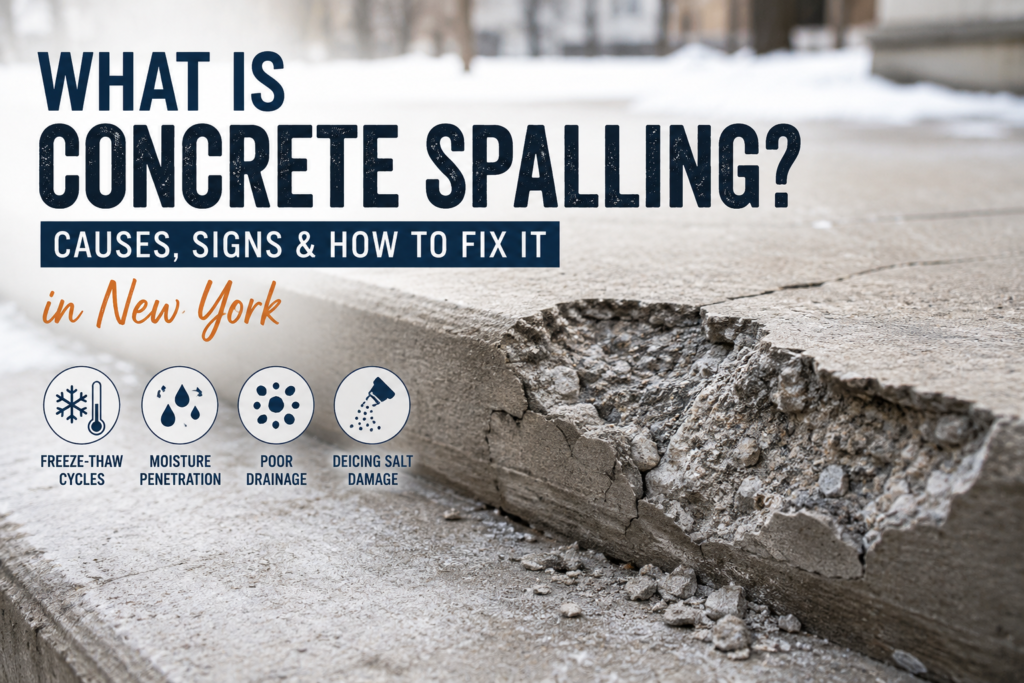
You walk out to the driveway in March, snow’s finally gone, and there it is: a patch near the garage where the top of the concrete has flaked away, leaving behind a rough, pitted surface that wasn’t there last fall. Maybe it’s the front steps. Maybe it’s a section of sidewalk where you can suddenly see the little stones that make up the concrete itself. Whatever the spot, the question is usually the same: what is this, and do I need to worry about it? In most cases, what you’re looking at is concrete spalling. It’s one of the most common things we get called out for in the spring, and it’s almost always tied back to how New York concrete gets treated over the winter. The short version: spalling is the surface of the concrete breaking away, usually in layers or chunks, because of moisture that got into the slab and then froze. The longer version, including when it’s minor and when it’s a bigger problem, is worth understanding before you decide what to do about it. What Is Concrete Spalling? Spalling is what happens when the top layer of a concrete surface flakes, peels, or chips away, exposing the material underneath. It can look like anything from light surface flaking that resembles peeling paint to larger chunks breaking loose and leaving craters behind. What’s actually happening is that moisture works its way into the concrete through hairline cracks, through the natural pores in the surface, or through poor finishing, and then something puts pressure on that moisture from the inside. Usually it’s freezing. Water expands when it turns to ice, and concrete isn’t flexible enough to handle that expansion without cracking or breaking at the surface. Over a few freeze-thaw cycles, that damage compounds. What starts as a rough patch can turn into a section of missing concrete. Some people call this spalling concrete, some call it flaking concrete, and some just say the surface is “peeling.” It’s the same issue described in a few different ways. And it’s worth being clear about something early on: a little bit of surface texture change isn’t automatically a crisis. Concrete ages. But spalling that keeps spreading, or that exposes anything underneath the surface, is a different story. What Does Spalling Concrete Look Like? This is usually the easiest way to figure out what you’re dealing with, because spalling has a pretty distinct look once you know what to check for. Light spalling often shows up as flaking or peeling thin layers of concrete lifting away, sometimes in patches only a few inches wide. Move further along the damage scale, and you start seeing pitting, small craters where pieces have popped out entirely. In more advanced cases, the surface feels rough or sandy underfoot; the aggregate, the gravel mixed into the concrete, becomes visible, and edges near joints or cracks start crumbling when you press on them. The most serious version is when you can see rebar or wire mesh poking through. That’s not cosmetic anymore, and it usually means water and possibly deicing salt have been getting to that steel for a while. What You See What It Could Indicate Recommended Next Step Light surface flaking, small patches Early-stage spalling, possibly a poor finishing layer Monitor and keep clean; note if it spreads Pitting or small craters Freeze-thaw damage progressing below the surface Have it inspected before next winter Visible aggregate (gravel showing) Loss of the top mortar layer Repair recommended to prevent further wear Rough, sandy texture over a wide area Widespread surface deterioration Professional assessment of repair vs. resurfacing Crumbling near joints or edges Water collecting and freezing at vulnerable points Check drainage and repair before it spreads Exposed rebar or wire mesh Reinforcement corrosion, more serious internal damage Get a professional evaluation soon What Causes Concrete Spalling? There’s rarely just one cause. Usually, it’s a combination of things working against the slab at the same time. Freeze-Thaw Cycles This is the big one in New York. Concrete is porous, not obviously, but at a small scale, water can get in. When temperatures drop, that trapped water freezes and expands, putting pressure on the surrounding concrete from the inside. When it thaws, the pressure releases, but the damage from the expansion is already done. Repeat that cycle over a winter with multiple thaws and refreezes, which is typical for us, and the surface starts to break down layer by layer. Deicing Salts Rock salt and other deicing products lower the freezing point of water sitting on the surface, which changes how and when that moisture freezes and refreezes. Over repeated seasons, this can accelerate surface deterioration, especially on concrete that wasn’t finished or sealed well to begin with. It’s not that using salt once will ruin a driveway; it’s the cumulative effect over years that tends to show up. Excess Moisture and Poor Drainage Any spot where water tends to pool a low point in a driveway, an area near a downspout, or a section without proper slope is going to spall before the rest of the slab. Standing water means more saturation, and more saturation means more material available to freeze and expand. Installation or Finishing Problems Some spalling traces back to how the concrete was placed years earlier. Adding too much water to the mix, finishing the surface too early or too late, or troweling in a way that seals a weak, water-rich layer at the top can all leave a surface that’s more vulnerable than it should be. This isn’t always obvious until years later, when that top layer starts to go. Corroding Reinforcement When water and salt reach the steel reinforcement inside the concrete rebar or mesh the steel starts to rust. Rust takes up more space than the original steel, and that expansion pushes outward against the concrete around it, cracking and eventually breaking it away from the inside. This is one of the more serious causes because the damage is happening
Can a General Contractor Do Concrete Work? What New York Property Owners Should Know
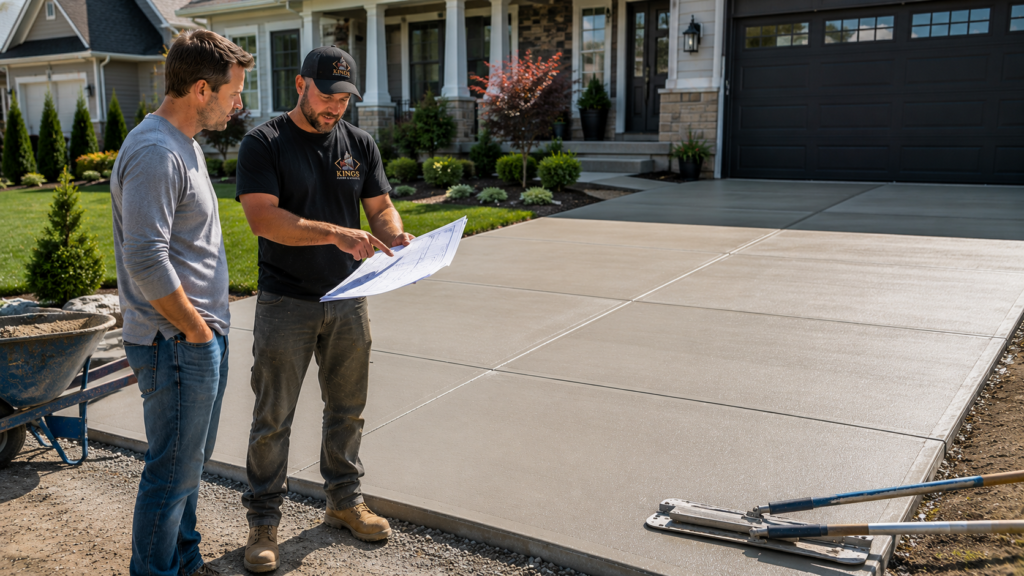
If you’ve been collecting quotes for a driveway, patio, or foundation repair, you’ve probably noticed something. Some bids come from general contractors. Others come from companies that only pour concrete. And you’re left wondering if it even matters. I’ve been pouring concrete in New York for over twenty years: driveways in Westchester, sidewalks in Queens, garage floors in the Hudson Valley, commercial slabs for warehouses on Long Island. I’ve also seen plenty of general contractor jobs, some good, some that ended up costing homeowners twice what they expected once the cracking started. So can a general contractor do concrete work? Yes, in many cases. But whether they should handle your specific project is a different question, and it depends a lot on the size, complexity, and purpose of what you’re building. A small sidewalk patch is nothing like a structural foundation or a stamped decorative patio. In this article, I’ll walk you through what general contractors are actually licensed and equipped to do, what separates them from a dedicated concrete contractor, and how to figure out which one is right for your project. No sales pitch, just what I’d tell a neighbor asking me this same question over the fence. Can a General Contractor Do Concrete Work? Here’s the direct answer: yes, a general contractor can legally perform concrete work in New York, as long as they hold the appropriate home improvement or construction license for their jurisdiction and the work falls within what that license covers. General contractors are trained to manage all kinds of construction tasks, and concrete is often part of that scope, especially for smaller jobs like a walkway repair or a small footing. But here’s what a lot of homeowners don’t realize. Licensing tells you a contractor is allowed to do the work. It doesn’t tell you whether they’ve done it enough times to do it well. Concrete is unforgiving. Get the subgrade wrong, skip proper control joints, or pour in the wrong weather conditions, and you won’t see the problem for months. By the time you do, it’s cracked, heaved, or spalling, and it’s expensive to fix. General contractors are generalists by design. They’re excellent at coordinating a full renovation: framing, electrical, plumbing, drywall, concrete, all under one roof. For a project where concrete is a small piece of a bigger job, like a new garage addition that needs a slab poured as part of the build, a general contractor is often perfectly qualified, especially if they have an experienced concrete crew or a reliable sub they use regularly. Where it gets riskier is when concrete is the whole job, or when the work is structural, decorative, or large in scale. That’s when years of concrete-specific experience start to matter more than a general license. Comparison Table: Project Type vs Contractor Type Project Type General Contractor Concrete Specialist Best Choice Small sidewalk repair Capable Capable Either Standard driveway (single pour) Sometimes capable Highly experienced Concrete Specialist Large or long driveway Limited experience Highly experienced Concrete Specialist Structural foundation Manages, may sub out Direct expertise Concrete Specialist Garage floor slab Capable if part of larger build Highly experienced Depends on scope Stamped or decorative concrete Rarely specialized Highly experienced Concrete Specialist Retaining wall Limited experience Highly experienced Concrete Specialist Commercial slab Manages, subcontracts Direct expertise Concrete Specialist Patio (basic, small) Capable Capable Either What Does a Concrete Contractor Do? A residential concrete contractor or commercial concrete contractor focuses on one trade, day in and day out. That specialization shows up in the details. Here’s what that work typically covers. Driveways. A concrete driveway contractor understands base compaction, drainage slope, and how New York’s freeze-thaw cycles affect a slab over time. Get the base wrong here, and you’ll see cracking within a couple winters. Sidewalks. A concrete sidewalk contractor knows the local municipal codes for public walkways, including slope requirements for accessibility and the permitting process, which varies by city and county. Patios. Concrete patio installation involves more design flexibility: broom finish, stamped patterns, exposed aggregate, and getting the finish right takes practiced technique, not just a mixer and a float. Foundations. A concrete foundation contractor works with structural engineers, understands rebar placement, footing depth below the frost line, and load-bearing requirements. This is not an area to learn on the job. Garage Floors. These need proper thickness, reinforcement, and often a moisture barrier, especially if the garage will be heated or finished. Retaining Walls. These carry soil pressure and drainage demands that require engineering knowledge most generalists don’t deal with regularly. Commercial Concrete. A commercial concrete contractor works with tighter timelines, heavier load requirements, and often larger pour volumes that need coordinated scheduling with ready-mix suppliers. General Contractor vs Concrete Contractor I get asked this comparison constantly, so let’s break it down honestly. Training. A general contractor’s training is broad; they know a bit about everything. A concrete contractor’s training is narrow and deep, focused entirely on mix design, curing, finishing, and structural behavior of concrete. Equipment. Concrete-specific companies typically own or regularly use screeds, power trowels, vibrating equipment, and saws for control joints. General contractors sometimes rent this equipment only when a concrete job comes up, which can affect finish quality. Crew Experience. A concrete crew that pours daily develops a feel for timing when the mix is ready to finish, how weather affects set time, and when to cut joints. That instinct doesn’t come from doing a few pours a year. Project Management. General contractors excel here when concrete is one piece of a larger renovation. They’re good at scheduling trades and keeping a big project moving. Quality Control. Specialists tend to catch problems earlier because they know exactly what a good pour looks and feels like at every stage. Long-Term Durability. This is where the difference shows up years later. Improperly compacted base, wrong concrete mix for the climate, or skipped joints often don’t fail immediately. They fail in year two or three, which is long after the contractor is off
What to Look for in a Concrete Contractor Before Hiring in New York
I’ve been pouring concrete in New York for over twenty years, and if there’s one thing I’ve learned, it’s this: the contractor you hire matters more than the concrete itself. I’ve fixed enough driveways, patios, and foundations that were done wrong the first time to know that a bad hire doesn’t just waste money; it costs you sleep. Most homeowners calling me for the first time have the same worry. They don’t know who to trust. They’ve heard stories about a neighbor’s driveway cracking within a year, or a patio that pooled water every time it rained. They want to avoid becoming the next cautionary tale. That’s really what this comes down to. Concrete work looks simple from the outside: pour it, smooth it, let it cure. But the difference between a slab that lasts thirty years and one that’s crumbling in five almost always traces back to who did the work and how. So let’s walk through exactly what to look for in a concrete contractor, based on what I’ve actually seen go right and wrong on job sites across this state. Why Choosing the Right Concrete Contractor Matters I once got called out to look at a driveway that was only two years old. Cracks running across it like a spiderweb, edges crumbling, the whole thing tilting slightly toward the garage instead of away from it. The homeowner had gone with the lowest bid. Saved maybe eight hundred dollars up front. Ended up paying nearly triple that to have it torn out and redone. That’s the real cost of hiring the wrong person. It’s rarely about the concrete mix going bad. It’s almost always about shortcuts, skipping proper base prep, pouring in the wrong weather conditions, using too much water in the mix to make it easier to work with. Small decisions that don’t show up until months later. Here’s what’s actually on the line when you hire a concrete contractor: Work quality: A rushed job shows itself in uneven surfaces, poor finishing, and joints placed in the wrong spots. Long-term durability: Concrete that’s properly reinforced and cured can handle New York winters for decades. Concrete that isn’t will flake, crack, and heave within a few seasons. Safety: Uneven walkways and driveways aren’t just an eyesore; they’re a liability, especially once ice shows up. Property value: Cracked or sinking concrete is one of the first things a buyer’s inspector will flag. Warranty protection: A contractor who stands behind their work will fix problems. One who doesn’t will disappear the moment you call. None of this is meant to scare you off the idea of getting concrete work done. It’s meant to explain why the selection process is worth taking seriously. What to Look for in a Concrete Contractor This is the part homeowners ask me about most, so I’ll go through it the way I’d walk a friend through it over coffee. Proper Licensing New York requires contractors to carry the appropriate licensing depending on the municipality you’re in. A licensed concrete contractor has met minimum standards and can be held accountable if something goes wrong. Ask for the license number and actually look it up; it takes five minutes, and it’s worth it. Insurance Coverage This one gets overlooked constantly. An insured concrete contractor protects you if a worker gets hurt on your property or if something gets damaged during the job. Without insurance, you could be the one holding the bill. Always ask to see a current certificate of insurance, not just a verbal assurance. Years of Experience There’s no substitute for having seen a lot of dirt. A contractor who’s been doing residential concrete work in New York for years has already made the mistakes new companies are still making on your project. Experience shows up in how they handle drainage, frost lines, and soil conditions specific to this region. Portfolio of Completed Work Ask to see photos of recent jobs, not just the finished product, but the prep work too. A contractor who’s proud of their process will happily show you the forms, the rebar, the base compaction. If they’re cagey about the details, that tells you something. Customer Reviews Concrete contractor reviews are one of the most honest windows into how a company actually operates. Look past the star rating and read what people say about communication, cleanup, and whether the work held up over time. References A good contractor won’t hesitate to connect you with past clients. Call two or three. Ask specifically how the project went a year or two later, not just right after it was finished. Written Estimates Concrete contractor estimates should be detailed: materials, labor, timeline, and what’s included. A vague one-line quote is a warning sign in itself. Communication Pay attention to how quickly they respond and how clearly they explain things during the estimate process. That’s usually a preview of how the whole project will go. Knowledge of New York Weather This one is specific to us. Concrete behaves differently depending on temperature and humidity, and New York’s freeze-thaw cycles are brutal on anything poured or cured incorrectly. A contractor who understands local weather will know when to pour, when to hold off, and how to protect fresh concrete from an early frost. Material Quality Ask what mix they use and why. Cheaper mixes with less cement content might save a few dollars per yard but won’t hold up the same way over twenty New York winters. Warranty Ask what’s covered, for how long, and what would void it. A contractor confident in their work will put this in writing without hesitation. Cleanup Process It sounds minor until you’re the one left with leftover concrete chunks and tire ruts in your lawn. Ask upfront what cleanup looks like when the job wraps. Quality Contractor vs. Warning Signs to Avoid Quality Contractor Warning Signs to Avoid Licensed and insured, documentation provided without hesitation Reluctant or vague about licensing and insurance Detailed written estimate with clear scope
Questions to Ask a Concrete Contractor Before Signing a Contract
Picking a concrete contractor sounds simple enough. You get a few estimates, check out some photos, and go with the one who seems most trustworthy. But I’ve been in this business for over 20 years working on driveways, patios, foundations, commercial slabs, and sidewalks all across New York and I can tell you that the hiring process is where most projects go wrong before the first bag of cement is even opened. Most homeowners don’t know what to ask. They focus on the price and the pictures, and they skip the questions that would actually tell them whether a contractor is qualified, insured, and serious about doing the job right. By the time they find out something’s wrong, the contractor has cashed the check and the concrete is already poured. This guide gives you the questions to ask any concrete contractor before you sign anything and what their answers actually mean. Why You Should Never Hire a Contractor Based on Price Alone I get it. When you’re looking at three estimates and one comes in $2,000 lower than the others, it’s hard not to be tempted. But that low bid almost always means something is getting cut and it’s usually something you won’t notice until after the job is done. Here’s what cheap concrete work often looks like in practice: • Thinner slabs that crack faster, especially in New York winters • Skipping the proper sub-base, so the concrete settles and heaves • Using a lower concrete mix than specified saves money upfront, costs you later • No expansion joints, which leads to cracking as the concrete shifts • No permits pulled, leaving you with unpermitted work that causes problems when you sell I’ve seen homeowners in Queens and Long Island spend more fixing cheap concrete than they would have spent hiring a reputable contractor the first time. A driveway replacement that should have cost $8,000 ended up costing $14,000 after the shoddy work had to be torn out and redone. The lowest bid is not the best deal. The best deal is the contractor who does the job right the first time. The Most Important Questions to Ask a Concrete Contractor Here’s a breakdown of what to ask, and what to look for in the answers: Question Why It Matters What to Listen For Are you licensed and insured? Protects you if something goes wrong on your property They should name their insurer and offer to send a certificate. Vague answers are a warning sign. How long have you been in business? Experience matters especially with New York’s freeze-thaw conditions Look for at least 5 years of active local work. A long track record is a good sign. Can I see recent projects similar to mine? Photos prove they can handle your scope of work They should have local references ready. Reluctance to share them is a red flag. Do you provide a written contract? A verbal agreement won’t protect you if anything goes wrong Any reputable contractor works from a written contract. No contract, no deal. What is included in the estimate? Avoids surprise charges once work begins The estimate should itemize labor, materials, prep work, permits, and cleanup. Who handles permits? Concrete work often requires permits in New York municipalities A good contractor pulls the permits. If they’re asking you to, walk away. What warranty do you offer? Tells you how confident they are in their own work Look for at least a 1-year workmanship warranty. Material warranties vary by product. What is your project timeline? Helps you plan around the work A specific start and end date is reasonable to request. Vague timelines cause delays. How will weather affect the project? Concrete is sensitive to temperature extremes critical in New York They should explain their cold or hot weather procedures. Generic answers aren’t enough. How do you handle unexpected issues? Problems come up. You want to know how they respond. Look for clear communication, written change order procedures, and a reasonable tone. Step-by-Step Contractor Vetting Process Don’t just call the first name that comes up in a search. Here’s how to actually vet a concrete contractor before you invite them onto your property. Step 1: Research Local Contractors Start with a search for concrete contractors in your specific area, not just “New York,” but your borough or county. Look for companies with a real local presence and actual project history in your area. A contractor who works all over the state but has no local references should raise questions. Step 2: Read Reviews Check Google, Yelp, and the Better Business Bureau. Don’t just look at the star ratingread what people actually say. Pay attention to reviews that mention communication, timelines, and how problems were handled. One or two bad reviews aren’t necessarily a dealbreaker, but a pattern is. Step 3: Verify Credentials In New York, contractors working on certain projects need to be licensed through the city or state. Ask for their license number and verify it yourself. Ask for a certificate of insurance and call the insurance company to confirm it’s active. This step alone eliminates a lot of risk. Step 4: Request Multiple Estimates Get at least three estimates. Not just for price comparison to see how different contractors approach the same job. If one estimate is dramatically lower, ask why. If one is dramatically higher, ask what justifies it. The differences reveal a lot about how each contractor plans to do the work. Step 5: Interview Contractors Use the questions in the table above. Pay attention not just to the answers but to how they answer. A contractor who gets defensive when you ask about insurance, or who brushes off questions about permits, is telling you something about how they’ll communicate once the job is underway. Step 6: Review Contracts Carefully Before you sign anything, read the entire contract. Make sure it matches what was discussed. Confirm that scope, materials, timeline, payment schedule, and warranty are all
How Long Does Concrete Take to Cure? A New York Contractor Explains
Every single customer I’ve ever worked with asks the same question the moment we finish a pour: “So when can I use it?” I get it. You’ve just invested real money into a new driveway, patio, or sidewalk, and you want to start enjoying it. But rushing the curing process is one of the most common and most damaging mistakes a homeowner can make. After more than 20 years pouring concrete across New York, I’ve seen what happens when people ignore this part. Cracked driveways. Tire ruts—completely avoidable surface damage. And I’ve also watched plenty of homeowners do it right and end up with a slab that lasts for decades. So let me walk you through exactly how long concrete takes to cure, what the milestones mean, and what you should and shouldn’t do at each stage. How Long Does Concrete Take to Cure? The short answer: concrete reaches about 70% of its full strength within 7 days and hits its full design strength at 28 days. But it doesn’t just stop there; concrete actually continues to gain strength very slowly for years after that. That said, “full strength” at 28 days is what engineers and contractors design for. That’s the number on the spec sheet, and it’s the threshold that matters for practical purposes. Here’s a breakdown of what’s happening at each stage: Time After Pour Concrete Strength What Happens Recommended Use 24 Hours ~16% Surface firms up No foot or vehicle traffic 48 Hours ~25% Slab holds a light load Light foot traffic only, carefully 7 Days ~70% Most strength reached Normal foot traffic; avoid heavy loads 14 Days ~85% Nearing full strength Light vehicles OK on residential 28 Days ~99% Full design strength All normal traffic and loads One thing I always tell customers: the 24-hour mark feels like a long time when you’re waiting, but it’s nothing compared to what happens if you drive on it too soon. I’ve seen a delivery truck park on a 4-day-old driveway and leave ruts that didn’t come out. The homeowner had to rip it up and start over. Concrete Drying vs Concrete Curing This is the part most people get wrong, and it’s worth taking a minute to explain. Drying and curing are not the same thing. Drying means the water is evaporating out of the mix. Curing is a completely different process; it’s a chemical reaction called hydration, where the water actually bonds with the cement particles to create a hard, strong material. Here’s the confusing part: you actually need moisture to cure properly. If concrete dries out too fast, it doesn’t finish curing, and you end up with a weaker slab. I always use this analogy with customers: imagine trying to bake a cake, but the oven turns off halfway through. The outside might look done, but the inside isn’t. That’s what happens when concrete dries too fast without curing. Concrete can look and feel dry on the surface within 24 to 48 hours. A lot of people see that and think it’s ready. It’s not. The chemical process happening below the surface takes weeks, and that’s what actually gives the concrete its strength. What Affects Concrete Curing Time? Not every pour cures the same way. New York weather throws all kinds of variables at us: brutal winters, humid summers, and everything in between. Here are the main factors that will affect how quickly (or slowly) your concrete cures. Factor Speeds Up Curing Slows Down Curing Temperature Warm (70–80°F ideal) Cold below 50°F or heat above 90°F Humidity Moderate humidity Very low humidity (dries too fast) Wind None High wind (pulls moisture out) Mix Design Normal water-cement ratio Too much water was added on-site Slab Thickness Thinner slabs cure faster Thick slabs take longer throughout Temperature: Ideal curing happens between 50°F and 85°F. Once you drop below 40°F, the hydration process slows dramatically. Below 32°F, it can stop entirely or, worse, the water in the mix can freeze and cause permanent damage before the concrete has a chance to gain strength. Summer heat above 90°F creates the opposite problem: the surface can dry out too fast before curing finishes. Humidity: High humidity is actually your friend during curing. Low humidity, especially combined with wind, pulls moisture out of the surface faster than the concrete can handle. Wind: Wind is a concrete contractor’s enemy during a pour and during the early curing phase. I’ve seen hot, dry, windy days in New York cause more surface cracking than anything else. We take wind speed seriously when we plan a pour. Mix Design: The water-to-cement ratio in the mix matters enormously. Sometimes workers on a job site add water to make the mix easier to work with. Every extra gallon of water reduces the final strength. I don’t allow that on my jobs. Slab Thickness: A 4-inch driveway slab cures differently than a 12-inch foundation wall. Thinner slabs lose moisture faster from both surfaces. Thicker sections retain heat from the hydration reaction longer, which affects curing throughout. When Can You Walk on New Concrete? For most sidewalks, patios, and residential slabs, you can walk on new concrete after 24 to 48 hours but carefully. No running, no dragging heavy items, and definitely no high heels. I’m serious about the heels. They concentrate incredible pressure on a small point and can leave marks in concrete that hasn’t fully set. For commercial jobs or anywhere with heavier foot traffic, I recommend waiting the full 7 days. It’s not just about whether the surface holds; it’s about whether you might be causing micro-damage that shows up months later. With patios, I also tell people to wait before setting up furniture. A patio table dragged across uncured concrete can scratch the surface finish permanently. And if you’re adding any kind of sealer or stain, wait the full 28 days. Applying a sealer too early traps moisture inside and can cause a host of problems. When Can You Drive on New Concrete? This is
Can Concrete Be Poured in Winter? What New York Property Owners Need to Know
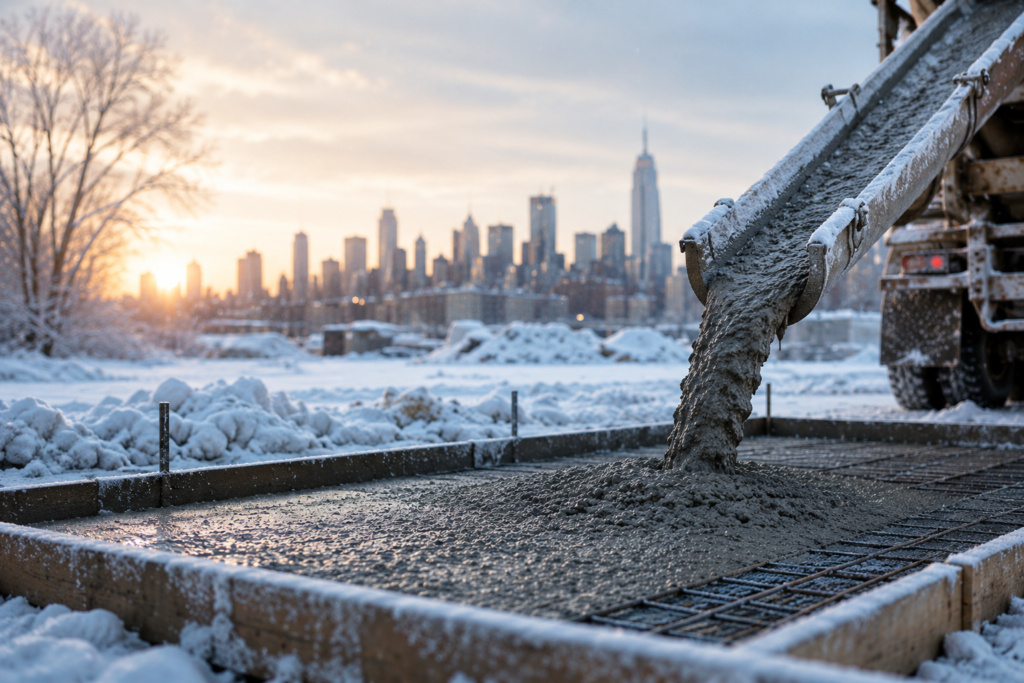
If you’ve been putting off a driveway, patio, or foundation project because winter is coming or already here, you’re not alone. I hear this from property owners all the time. “Can we even do this in the cold?” or “My last contractor told me to wait until spring.” Here’s what I tell them: winter doesn’t have to shut down your concrete project. It just means we need to be smarter about how we approach it. I’ve been pouring concrete across New York for over 20 years. I’ve done driveways in January, foundations in February, and commercial slabs when there was frost on the ground. Winter concrete work is absolutely doable, but it requires preparation, experience, and respect for what the cold can do to fresh concrete if you’re not careful. Can Concrete Really Be Poured in Winter? The short answer is yes, with conditions. The American Concrete Institute (ACI) defines “cold weather concreting” as any period when the air temperature drops below 40°F for more than three consecutive days. That covers a big chunk of the New York calendar from late November through March. The key issue isn’t the pouring itself; it’s the curing. Fresh concrete needs time and warmth to gain strength. When temperatures drop too low, that chemical process slows down dramatically. Below 27°F, water inside the mix can freeze, and if that happens before the concrete has cured, you’re looking at a compromised slab cracking, scaling, and structural weakness. That said, experienced contractors know how to manage all of this. We’ve been doing it for decades. Temperature Range Can Concrete Be Poured? Special Precautions Required 40°F – 60°F Yes Standard cold weather protocols; insulating blankets recommended 27°F – 39°F Yes, with preparation Heated materials, ground warming, and insulated curing blankets are essential Below 27°F Not recommended Extreme risk; requires enclosures, heaters, and high added cost Below 10°F Generally avoided Risk too high; most reputable contractors will reschedule Why Cold Weather Affects Concrete To understand winter concrete, you need to understand what actually happens when concrete cures. When you mix cement, water, sand, and aggregate together, you’re kicking off a chemical reaction called hydration. That reaction is what makes concrete hard and strong, and it generates its own heat in the process. The problem is, cold temperatures slow that reaction way down. Below freezing, it can stop altogether. Fresh concrete that freezes before it reaches adequate strength, typically around 500 psi, can lose up to 50% of its potential strength. That’s not a recoverable situation. You’d be looking at tearing it out and starting over. On top of that, frozen ground creates its own headaches. If you pour on ground that’s heaved or frost-hardened, the slab can shift and crack as the ground thaws in spring. I’ve seen beautiful driveways installed by well-meaning contractors get destroyed by April because nobody accounted for what was happening six inches below the surface. The risks are real, but they’re also manageable. That’s the part most people don’t hear. How Contractors Successfully Pour Concrete in Winter When I take on a winter concrete project, my approach is methodical. Here’s what the process actually looks like on a job site. Step 1: Monitor Weather Forecasts We don’t just check the morning of. I’m watching extended forecasts for at least a week before the pour and planning around the best window. Ideally, I want temperatures to stay above 40°F during the pour and for at least 48 hours after. A good pour day followed by a hard freeze the next night is a problem. Timing matters enormously. Step 2: Prepare the Ground Ground preparation in winter takes extra work. If the ground is frozen, we use heating blankets or propane heaters to thaw it out, sometimes for 24 to 48 hours before we pour. The subbase needs to be thawed and stable. Skipping this step is one of the biggest mistakes I see other contractors make. Step 3: Use Heated Materials When Necessary In colder conditions, we adjust the concrete mix. Hot water is used in the mixing process to bring the concrete temperature up, typically between 55°F and 75°F at delivery. Sometimes we’ll use accelerating admixtures that speed up the hydration process. Ready-mix plants in New York are accustomed to these requests; it’s not unusual at all. Step 4: Protect Fresh Concrete This is where most of the work happens after the pour. We cover the slab with insulating curing blankets almost immediately after finishing. In more severe cold, we set up temporary enclosures around the work area and use propane or electric heaters to maintain the temperature. The goal is to keep the concrete above 50°F for at least 48 to 72 hours longer under harsher conditions. Step 5: Monitor Curing Conditions We don’t just walk away. We check the site the next morning, monitor temperatures, and adjust coverage as needed. If temperatures drop more than expected overnight, we add more insulation. The curing phase is where winter concrete either succeeds or fails. Benefits of Winter Concrete Projects Here’s something most property owners don’t think about: winter can actually be a great time to get concrete work done. Contractor Availability. Winter is slower for most concrete crews. That means you’re not fighting for a spot on someone’s schedule. Projects that would take weeks to get started in the summer can often begin within days in January. Early Spring Readiness. If you pour a driveway or patio in January or February and cure it properly, it’s fully hardened and ready to use by the time spring arrives. No waiting through mud season while your neighbors are still scheduling their projects. Potentially Faster Project Completion. Fewer competing jobs mean your crew isn’t splitting time across multiple sites. Your project often gets more focused attention. No Heat-Related Curing Issues. Extreme summer heat has its own challenges for concrete curing. In moderate winter temperatures (say, 35°F to 45°F), with proper protection, the slower cure can actually produce a denser, stronger slab. Common Winter Concrete Mistakes
How Long Does Concrete Take to Dry? Complete Timeline for Homeowners and Contractors
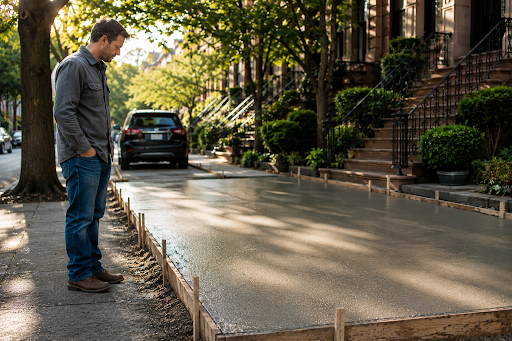
I get this question on almost every job. The slab is freshly poured, still has that smooth gray sheen, and the homeowner is already asking when they can park their car on it. It’s a fair question. You just spent good money on new concrete, and you want to use it. The short answer is: it depends. But I know that’s not what you came here for, so let me break it down properly. How Long Does Concrete Take to Dry? Here’s the quick version most people need: These are general guidelines. Weather, mix design, and slab thickness all play a role. I’ll get into all of that below. Concrete Stage Time Required What You Can Do Initial set 2–4 hours Nothing stay off completely Surface hardened 24 hours Light foot traffic only Early strength 3–7 days Furniture, foot traffic, light loads Vehicle-ready 7 days Passenger cars and SUVs Full cure 28 days Heavy vehicles, full normal use Drying vs. Curing: What’s the Difference? A lot of people use these words interchangeably. They’re not the same thing, and the difference actually matters. Drying is just the surface water evaporating. When concrete looks dry, it might feel solid enough to walk on, but that doesn’t mean much structurally. Curing is a completely different process. It’s a chemical reaction called hydration, where water bonds with cement particles to form the crystalline structure that gives concrete its strength. That process takes weeks, not hours. Think of it like baking bread. The outside of the loaf can look done and feel firm while the inside is still raw. Walk on concrete too early, and you’re essentially cutting into bread that isn’t finished. The surface dries first. The strength builds from the inside out, over the full 28-day curing period. Factors That Affect Concrete Drying Time This is where things get more nuanced. Two slabs poured on the same day can behave completely differently depending on conditions. Heat speeds up chemical reactions, but too much of it can cause problems. In direct summer sun, the surface can dry out too fast and crack before it’s had time to cure properly. Cold temperatures slow everything down. Below 40°F, the curing process essentially stalls. In freezing temperatures, fresh concrete can be destroyed. High humidity slows evaporation, which is actually fine for curing; the slab stays moist longer. Very low humidity and dry air pull moisture out too quickly, which can weaken the surface. Rain Rain on freshly poured concrete is a legitimate concern. In the first few hours after the pour, heavy rain can wash out the surface, cause pitting, and weaken the finish. Light rain after 4–6 hours is generally less damaging, but you still want to protect the surface. Wind dries out the surface faster than almost anything else. On a breezy day, we take extra precautions to keep the concrete from drying unevenly. Mix Design: Not all concrete is the same. Standard residential mixes hit about 2,000–3,000 PSI at 28 days. High-strength mixes used for commercial work or heavy-load applications can hit 5,000 PSI or more and may cure differently. Some mixes include additives that speed up or slow down the set time. Thickness of the Slab: A 4-inch residential driveway slab and a 12-inch commercial foundation don’t cure the same way. Thicker slabs take longer to reach full cure throughout their depth. New York Weather Conditions Working in New York means dealing with everything: brutal July heat, cold snaps in October, and unpredictable spring weather. We adjust our pour schedules, mix designs, and curing methods based on the forecast. A contractor who doesn’t factor in weather is asking for problems. How Long Before You Can Walk on Concrete? For most residential slabs, a driveway, a patio, or a sidewalk, you’re looking at 24 to 48 hours before it’s safe to walk on. I usually tell customers: wait until the next morning. Don’t let kids or pets on it that same day, no matter how firm it looks. At 24 hours, the surface can support a person walking carefully. That doesn’t mean it’s “done”; it’s still curing, but it won’t hold a footprint. If you walked on it for 6 hours and left footprints? That’s going to be there permanently. The surface was still soft enough to deform, and now you’ve got marks in your new concrete. For stamped or decorative concrete, I recommend waiting the full 48 hours before any foot traffic. The surface finish on decorative work is more delicate, and scuffs or scrapes are much more visible. How Long Before You Can Drive on Concrete? This one causes more problems than walking, because people underestimate how heavy vehicles are and how much stress a stationary load puts on a slab that’s still curing. Here’s how I break it down: Vehicle Type Minimum Wait Time Notes Passenger car (sedan) 7 days Standard residential mix SUV or minivan 7 days Same guideline Pickup truck (loaded) 10–14 days Heavier axle loads Delivery truck 28 days Wait for full cure Heavy commercial vehicle 28+ days May require a higher-strength mix Seven days is not a suggestion; it’s the minimum for a standard residential driveway. I’ve had customers park on a new slab for 3 or 4 days and get lucky. I’ve also seen cracking from exactly that mistake. The problem is that you don’t always see the damage right away. Cracks can appear weeks later as the slab finishes curing under stress it wasn’t ready to handle. Step-by-Step Guide to Protect Fresh Concrete Once the crew packs up and leaves, the concrete’s fate is partly in your hands. Here’s what to do. Step 1: Keep Foot Traffic Off. Put up barriers if you have to. Use orange cones, caution tape, whatever works. Keep kids and pets away for at least 24 hours, ideally 48. Even light scuffs on the first day can leave marks. Step 2: Prevent Standing Water After the initial set, standing water on the surface can weaken it. If it rains,
How Much Do Concrete Contractors Charge Per Hour in New York? Complete Cost Guide
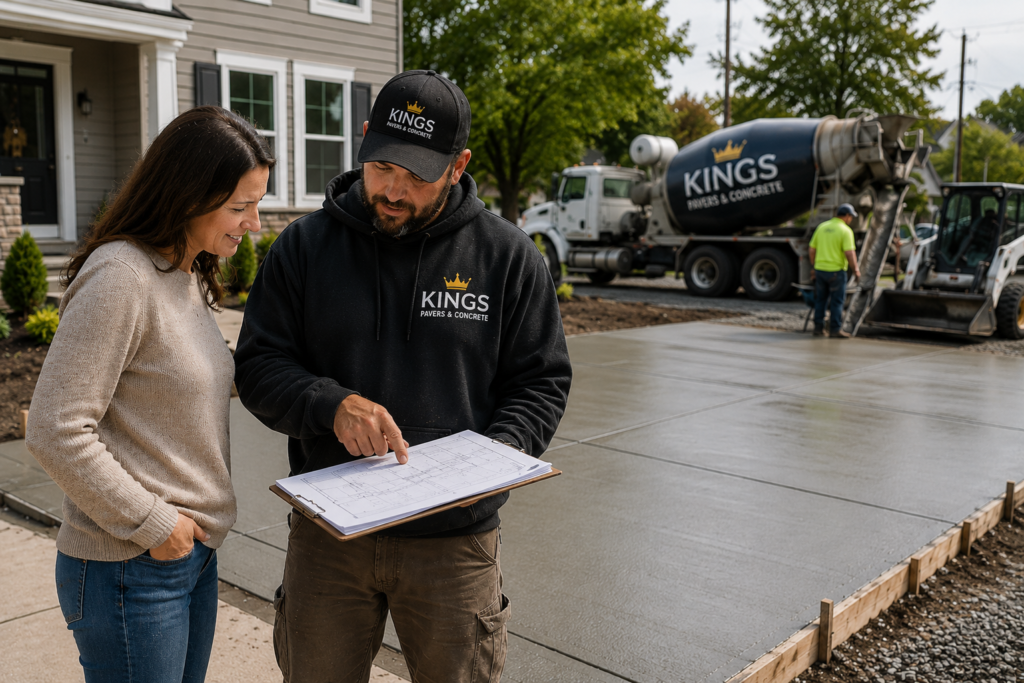
If you’ve ever called a concrete contractor for an estimate and nearly fell out of your chair when you heard the number, you’re not alone. I’ve been doing concrete work in New York for over 20 years, and the conversation about pricing is one I have almost every day. Here’s the thing: concrete work looks simple from the outside. You pour some gray stuff, it hardens, done. But the reality is a lot more complicated and a lot more expensive than most people expect. Labor, materials, site prep, permits, equipment, and New York’s cost of living all stack up fast. This guide breaks down what you’re actually paying for when you hire a concrete contractor here, what typical projects cost, and how to make sure you’re getting fair value for your money. What Does a Concrete Contractor Actually Charge Per Hour? Let’s get to the number people always ask first. In New York, most concrete contractors charge somewhere between $65 and $150 per hour for labor, depending on the type of work and the crew involved. That range is wide, and it’s wide for a reason: skilled finishing work costs more than basic labor. A laborer helping with excavation or cleanup might be on the lower end. An experienced finisher who knows how to work concrete in cold weather, match an existing surface, or pour a level foundation? That person commands a premium. For commercial projects, rates often run higher, typically $90 to $160+ per hour, because the work usually involves tighter tolerances, more inspection requirements, and larger crews. Service Type Typical Hourly Rate Project Examples General concrete labor $65–$85/hr Site prep, cleanup, basic forming Residential finishing $80–$120/hr Driveways, patios, walkways Structural / foundation work $100–$140/hr Foundations, retaining walls Commercial concrete $110–$160+/hr Commercial slabs, parking structures Decorative / specialty concrete $120–$175/hr Stamped, stained, and polished surfaces Most contractors don’t actually bill strictly by the hour on larger jobs; they give you a project price. But that project price is based on an internal estimate of the number of labor hours involved, so understanding the hourly rate helps you evaluate whether a quote makes sense. Factors That Affect Concrete Contractor Pricing When someone asks me how much a concrete contractor costs for their specific project, my honest answer is: it depends. Here are the things that genuinely move the price up or down. Project Size Larger projects generally cost less per square foot than small ones. Mobilizing a crew, renting equipment, and ordering materials all have fixed costs. If you’re pouring a 1,000 sq ft driveway instead of a 200 sq ft pad, those fixed costs get spread out. Don’t expect that logic to work in reverse. Small jobs often cost more per square foot precisely because the overhead doesn’t shrink. Location Within New York Manhattan and the other boroughs carry significantly higher costs than upstate. Parking fees, permits, tight access, and simply the cost of doing business in the city all factor in. A patio in Brooklyn will almost always cost more than the same patio in Albany, sometimes 30–50% more. Material Costs Concrete pricing fluctuates with supply chains. In recent years, we’ve seen material costs swing considerably. Ready-mix concrete in New York currently runs roughly $130 to $160 per cubic yard, not including delivery, pumping, or additives such as fiber reinforcement or accelerators for cold-weather pours. Site Preparation This one surprises people. If there’s an existing concrete slab to demo and haul away, or if the ground needs significant grading, expect that to add real money. Demolition alone can run $2–$6 per square foot depending on thickness and access. I’ve had jobs where the demo cost more than the new pour. Accessibility Can a concrete truck get close to the work area? If not, we’re pumping, and pump rentals run $500 to $1,500+ depending on the setup. Tight gates, stairs, or landscaping that has to be protected all add time and cost. Labor Complexity A broom-finished walkway and a decorative stamped patio might use the same concrete mix, but the stamped patio takes two to three times as long. Rebar installation, custom forming, or unusual shapes all add to the labor clock. Permits and Inspections In New York, certain projects, especially anything structural, require permits. Permit costs vary by municipality, but budget $200–$800 for residential permits in most areas, and potentially more in NYC. Inspections can also add to the timeline, which affects labor costs if the crew is waiting. Average Cost of Common Concrete Projects in New York Here’s what real projects actually cost in New York. These are ranges based on typical residential work; commercial projects usually run higher. Project Type Typical Cost Range Concrete driveway (standard, 2-car) $5,000–$12,000 Concrete patio (400–600 sq ft) $4,500–$10,000 Concrete sidewalk (50 linear ft) $1,500–$3,500 Foundation (small residential) $12,000–$35,000+ Garage floor (standard 2-car) $3,000–$7,000 Commercial slab (2,000 sq ft) $18,000–$40,000+ Decorative/stamped patio $8,000–$18,000 Concrete steps (exterior, 4–6 steps) $1,500–$4,000 Crack repair/resurfacing $500–$3,500 A few things worth noting: these numbers assume reasonable site conditions and standard finishes. Add decorative elements, difficult access, or major demo work, and prices climb. Why the Cheapest Quote Isn’t Always the Best Choice I’ll be straightforward here, because I’ve seen homeowners go with the low bid and end up spending more in the long run than they would have with a fair-priced contractor. The most common shortcuts I’ve seen from low-bidding contractors: Here’s a real example. A homeowner in Westchester called me after a contractor they’d hired, one they chose because his quote was about $2,000 lower than mine, poured their driveway. Within 18 months, cracks had appeared throughout, and by year three, a full section had heaved and broken apart. The repair and replacement ended up costing more than my original quote would have. I’m not saying every low bid is a red flag. Some contractors are just more efficient. But when a quote is 30–40% below everyone else, there’s usually a reason. Step-by-Step Guide to Hiring a Concrete Contractor Step 1: Define the Project